

Shell plc (SHEL) stock is heading into a closely watched earnings event, with the energy giant scheduled to report its third-quarter 2026 results on Oct. 29. Investors will be looking for evidence that stronger oil (CLZ26) prices, robust refining margins, and resilient activity translated into another quarter of solid earnings and cash generation. Shell’s Q3 outlook points to particularly strong refining economics, with its indicative refining margin rising to $42 per barrel, while Integrated Gas production is expected to benefit from the recent ARC Resources acquisition.
The update also projects Integrated Gas production of 740,000–780,000 barrels of oil equivalent per day, Upstream production of 1.735 million–1.835 million boe/d and refinery utilization of 93%–97%. LNG liquefaction volumes are expected at 7.2–7.6 million tonnes.
Don’t Miss a Day: From crude oil to coffee, sign up free for Barchart’s best-in-class commodity analysis.
With Shell coming off a strong second quarter, when it delivered $9.8 billion in adjusted earnings and announced another $3 billion share-buyback program, investors will be watching closely for the impact of commodity prices, refining margins, production and capital returns on the latest results. Meanwhile, its shares are trading close to their 52-week high and the Oct. 29 report could provide a fresh catalyst for SHEL stock.
About Shell Stock
Shell plc is a global energy and petrochemical company engaged across Integrated Gas, Upstream, Chemicals and Products, Marketing, and energy solutions, with operations spanning the energy value chain. Headquartered in London, U.K., Shell is one of the world’s largest integrated energy companies, boasting a market cap of approximately $265 billion.
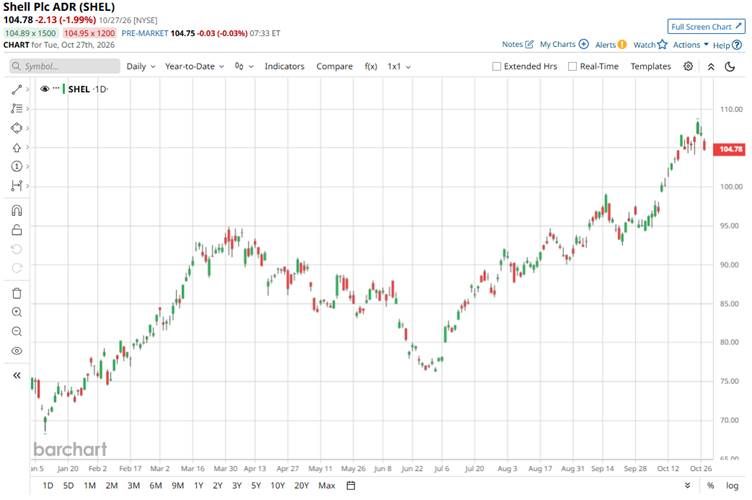
Shell stock has delivered a strong run in 2026, gaining 40.1% over the past year and 43.2% year-to-date (YTD), reflecting investor optimism around the energy major’s earnings power, cash generation, and capital returns. The shares reached a 52-week high of $108.43 on Oct. 23 and are currently trading just 3% below that level, highlighting the stock’s continued strength despite some recent profit-taking.
Shell’s rally has been supported by a favorable energy-market backdrop, while the company’s latest Q3 2026 update provides another fundamental catalyst as Shell expects its indicative refining margin to jump to $42 per barrel from $24 in Q2, while Integrated Gas production is projected at 740,000–780,000 barrels of oil equivalent per day.
 www.barchart.com
Despite the run, the stock is currently trading at 9.12 times forward earnings, which is a discount compared to industry peers.
Steady Q2 Results
Shell’s second-quarter 2026 results, released on July 30, showed a sharp improvement in profitability and cash generation compared with the same period last year. Adjusted earnings rose to $9.8 billion from $4.3 billion in Q2 2025, while adjusted EBITDA increased to $20.7 billion from $13.3 billion. Income attributable to Shell shareholders jumped to $10.8 billion from $3.6 billion, and adjusted earnings per share climbed to $1.76 from $0.72. Revenue increased to $94.7 billion from $65.4 billion, reflecting stronger realized prices and activity.
Cash generation was another major strength. Cash flow from operating activities surged 79.5% year-over-year (YOY) to $21.4 billion, helped by higher earnings and a $3.4 billion working-capital inflow, while free cash flow jumped to $17.5 billion. The company also announced a $3 billion share-buyback program, marking its 19th consecutive quarter of announcing at least $3 billion in buybacks.
Performance was broad-based across Shell’s core businesses. Integrated Gas adjusted earnings rose to $2.7 billion from $1.7 billion, while Upstream earnings jumped to $3.5 billion from $1.7 billion. Marketing earnings increased to $1.3 billion from $1.2 billion, and Chemicals & Products delivered a particularly strong turnaround, with adjusted earnings surging to $2.9 billion from just $118 million a year earlier. Renewables and Energy Solutions, however, remained relatively small, with adjusted earnings of $79 million versus a $9 million loss in Q2 2025.
Plus, the company reported ROACE of 12.4%, up from 9.4% a year earlier, while gearing eased to 18.7% from 19.1%.
The consensus EPS estimate of $11.94 for fiscal 2026 reflects an increase of 89.5%, but the EPS estimate of $10.72 for fiscal 2027 indicates a 10.2% decline YOY. On the other hand, analysts expect EPS to rise 90.3% YOY to $3.54 for Q3 (about to be reported on Oct. 29).
What Do Analysts Expect for Shell Stock?
Wells Fargo analyst Sam Margolin maintained a “Hold” rating and a $105 price target on Shell on Oct. 15, signaling a relatively cautious stance despite the energy major’s strong stock performance.
On the other hand, TD Cowen analyst Jason Gabelman reiterated a “Buy” rating on Shell on Oct. 9, with a $115 price target. TD Cowen had raised the target from $107 to $115 in late September, citing strength in commodity prices and noting that integrated oil companies, including Shell, were benefiting from the favorable commodity environment.
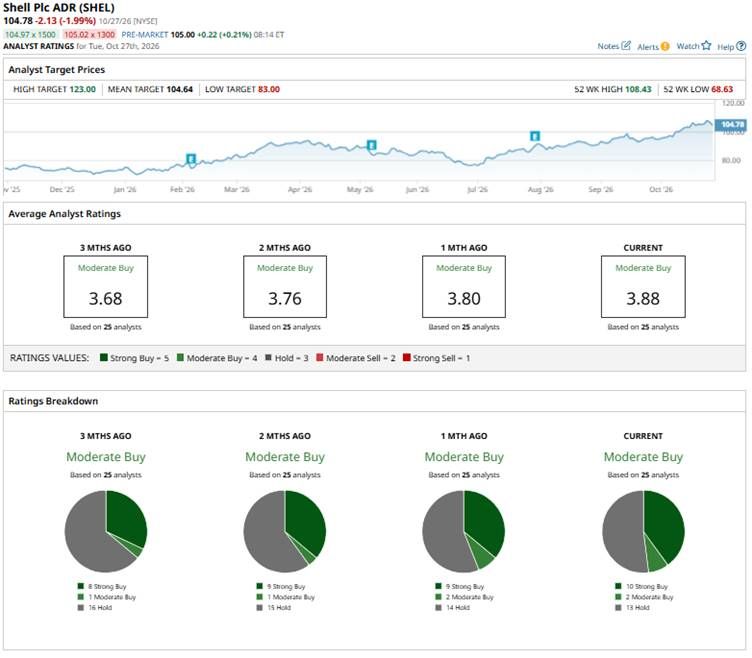
Overall, SHEL has a consensus “Moderate Buy” rating. Of the 25 analysts covering the stock, 10 advise a “Strong Buy,” two suggest a “Moderate Buy,” 13 analysts are on the sidelines, giving it a “Hold” rating.
While the stock is trading slightly above the average analyst price target of $104.64, the Street-high target price of $123 suggests that the stock could rally further by 17.4%.
 www.barchart.com
On the date of publication, Subhasree Kar did not directly have a position in any of the securities mentioned in this article. All information and data in this article is solely for informational purposes. For more information please view the Barchart Disclosure Policy here.
More news from Barchart
Dear Shell Stock Fans, Mark Your Calendars for October 29 This Financial Stock Just Raised Its Dividend by 17% Dear AMD Stock Fans, Mark Your Calendar for November 3 Pokémon Go Was Supposed to Bring People Together. Instead, It Trained AI for Military Drones.