

President Donald Trump signed two executive orders in June to speed up U.S. quantum computing development and help federal agencies adopt encryption designed to resist quantum attacks. Chip stocks also performed well earlier this week, with the iShares Semiconductor ETF (SOXX) gaining nearly 4% on Oct. 27 before retreating in ensuing sessions.
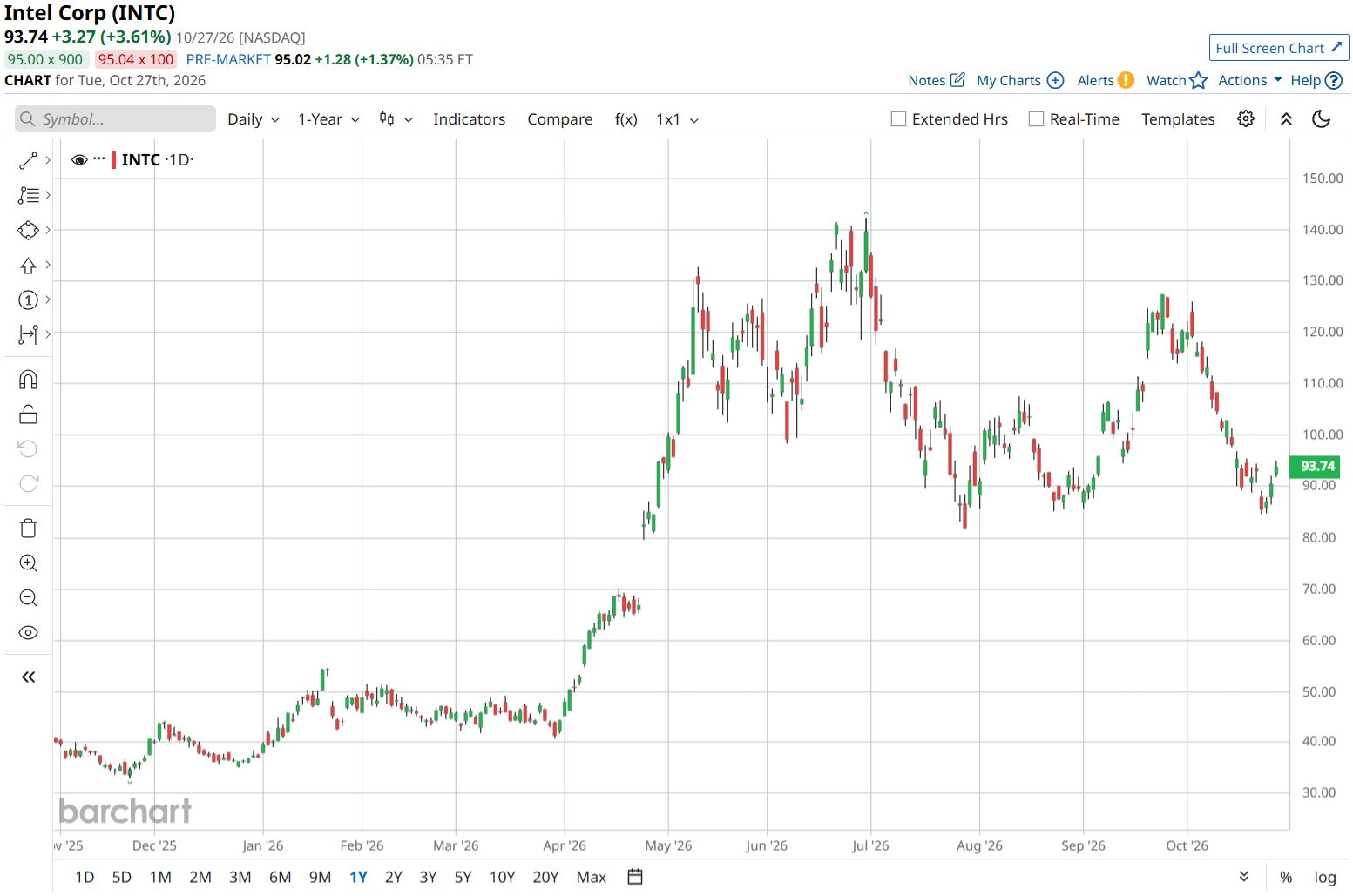
Intel (INTC) rose more than 3% to $93.74 that day after announcing an agreement to buy Classiq Technologies, an Israeli quantum software startup. The deal also came just before Intel’s Oct. 29 earnings report. Shares of INTC stock have climbed more than 70% so far this year, but Intel still trails Nvidia (NVDA), which captured much of the early artificial intelligence (AI) chip demand.
More Top Stocks Daily: Go behind Wall Street’s hottest headlines with Barchart’s Active Investor newsletter.
Buying Classiq Technologies gives Intel another way to compete in quantum computing. But does the deal make INTC stock a better investment? Let’s find out.
The Strategy Behind Intel’s Classiq Acquisition
Intel announced on Oct. 26 that it had agreed to buy Classiq Technologies, an Israeli quantum software startup. The price was not disclosed, while the deal still needs regulatory approval and is expected to close in the first half of 2027. Until then, the companies will operate separately.
Co-founded by CEO Nir Minerbi, Classiq makes software that helps businesses turn quantum algorithms into circuits that quantum computers can run. Its tools use AI and automated design to simplify work that would otherwise require specialist knowledge. Dozens of global businesses use the platform, which works with different types of quantum hardware. Classiq also helped develop the index tracked by the WisdomTree Quantum Computing Fund (WQTM).
For Intel, the appeal is software that complements its quantum hardware research, including silicon spin qubits under development since 2015. The idea is similar to how chip-design software made complex semiconductor design easier, letting developers focus on what they want to build rather than every hardware detail. Intel CEO Lip-Bu Tan believes the acquisition “transforms Intel’s Quantum Computing Group into a full-stack quantum computing business,” bringing hardware and software under one roof.
Classiq’s backers include SoftBank (SFTBY), Advanced Micro Devices (AMD), Qualcomm (QCOM), and HSBC (HSBC). Intel says that it will keep the platform’s existing connections with other quantum hardware providers after the acquisition closes.
Intel’s Core Business Still Comes First
Intel reported results for the third quarter of 2026 after the market close on Oct. 29. Revenue rose 21% year-over-year to $16.5 billion, beating consensus estimates. Data Center and AI revenue grew 78% YOY to $7.3 billion, the company's “strongest data center revenue growth in 15 years.” Meanwhile, Client Computing revenue fell 5% YOY to $8.1 billion, while Foundry revenue rose 58% YOY to $6.7 billion.
Profitability improved, too. Non-GAAP gross margin reached 44.1% from 40% a year earlier, while non-GAAP net income reached $2.8 billion, up 169% YOY.
However, shares are falling after the report due to disappointing Q4 guidance. INTC stock is down a whopping 30% in trading on Oct. 30 alone.
Still, shares remain up by more than 70% year-to-date (YTD) and more than 58% for the past 52 weeks.
 www.barchart.com
Outside the Classiq Technologies deal, Intel has expanded its multiyear partnership with Alphabet's (GOOGL) Google to support AI services and develop custom chips known as ASICs. This year, Nvidia also selected Intel’s Xeon 6 processor as the host CPU for its DGX Rubin NVL8 systems. These partnerships give Intel ways to grow its AI business while it works on the longer-term quantum opportunity.
What Analysts Expect From Intel Next
Intel guided revenue of $15 billion to $16 billion for Q4, as well as non-GAAP EPS of $0.25 and GAAP EPS of $0.10. Meanwhile, analysts expect earnings of $0.30 per share for the December quarter. For full-year fiscal 2026, analysts also expect EPS of $1.05 compared with a $0.12 loss in the year-ago period. That would represent a major return to profit, with a projected improvement of 975%.
Some analysts warmed up to INTC stock before the Oct. 30 selloff. On Oct. 19, JPMorgan analyst Harlan Sur upgraded Intel from “Underweight” to “Neutral" with an $85 price target. Still, “Neutral” is not a recommendation to buy.
Melius Research analyst Ben Reitzes is more bullish, having reiterated a “Buy” rating and a $165 target in September. Reitzes believes that Intel’s foundry and product businesses could eventually each be worth more than $80 per share. His outlook includes a possible foundry separation in or around 2030, although that is his scenario and not an announced company plan.
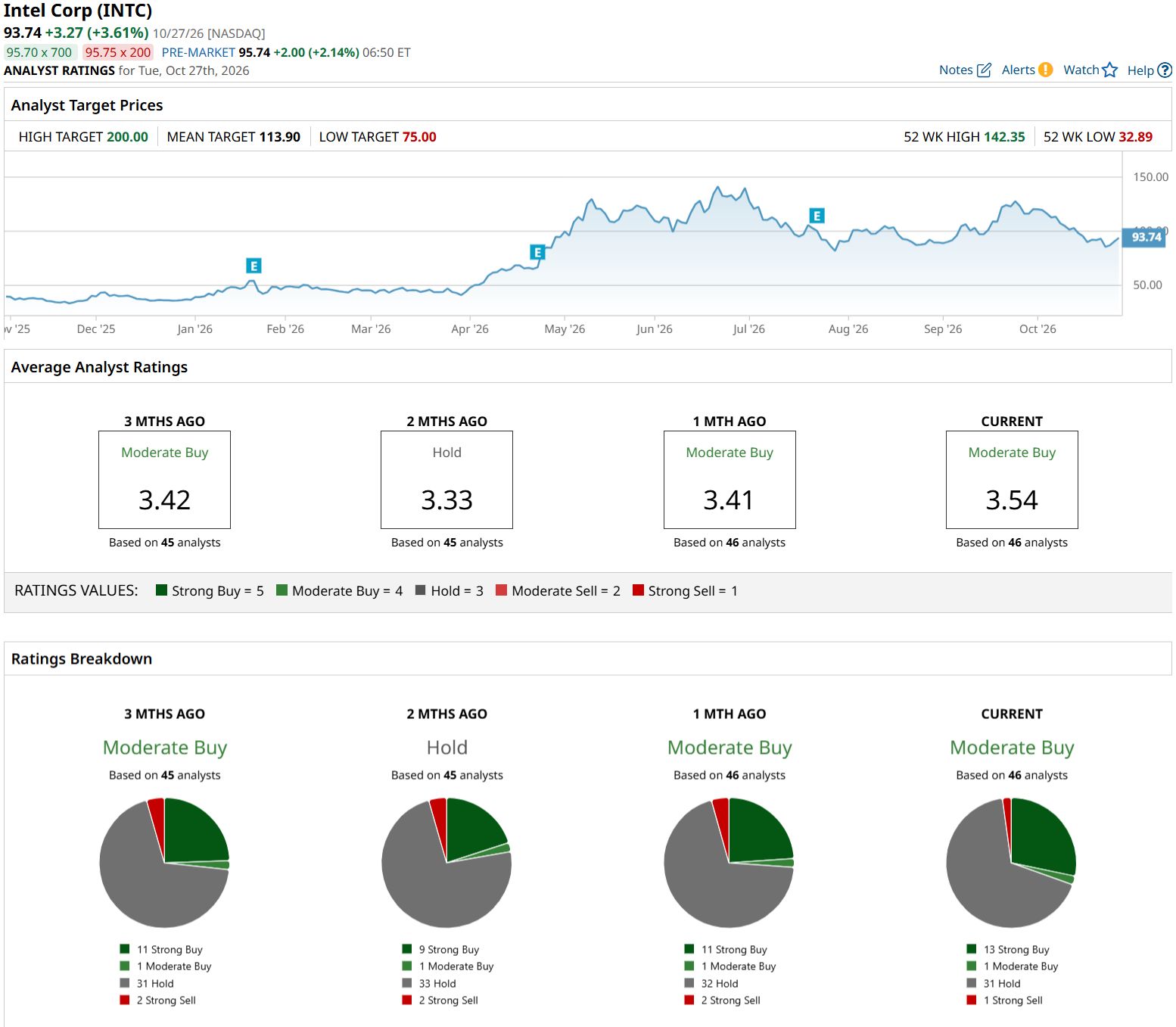
Overall, INTC stock has a consensus “Moderate Buy” rating across 46 analysts with coverage. The average price target of $114.15 suggests potential upside of approximately 79% from current levels.
 www.barchart.com
Conclusion
Investors should view Classiq as a strategic plus, not a reason to chase INTC stock. The deal could strengthen Intel’s quantum ambitions, but it does not replace the need to deliver better chips, profitable growth, and foundry progress. With financial terms undisclosed and the deal expected to close in 2027, it's too early to assign the acquisition much near-term earnings value, while disappointment after Q3 earnings has triggered a sharp 30% pullback. Buy the operating recovery if you believe in it, not the quantum headline alone.
On the date of publication, Ebube Jones did not directly have a position in any of the securities mentioned in this article. All information and data in this article is solely for informational purposes. For more information please view the Barchart Disclosure Policy here.
More news from Barchart
Intel Agreed to Buy Israeli Startup Classiq Technologies. How Investors Should View the Deal. Why Buying Bloom Energy Stock After Its Post-Earnings Selloff Could Be a Good Idea BCE Reports Earnings on November 5. Unusual Options Activity in BCE Stock Shows Institutions Are Selling Covered Calls for Income Ahead of Time. CVNA Stock Alert: Morgan Stanley Names Carvana 'Top Pick'