

The artificial intelligence (AI) boom has sparked an unprecedented spending race, with technology companies pouring enormous sums into the computing infrastructure needed to develop and run increasingly powerful AI models. SpaceX (SPCX), which has expanded further into AI following its acquisition of xAI, is no exception. But as investment requirements climb, investors are paying closer attention not only to how much companies are spending but also to how much it costs them to finance that expansion.
That question has taken on greater importance following SpaceX’s latest $40 billion GPU financing deal. Reports indicate that the capital behind the transaction is coming at a noticeably higher cost than SpaceX paid on its bonds issued in June. The situation is particularly noteworthy given the recent pressure on AI-related debt and the growing scrutiny of the industry’s massive capital requirements.
More Top Stocks Daily: Go behind Wall Street’s hottest headlines with Barchart’s Active Investor newsletter.
For SPCX investors, the announcement presents an interesting dilemma. Does the reported increase in financing costs signal a growing financial risk for SpaceX, or could the structure of the deal offer advantages that make the higher costs easier to justify? More importantly, should investors view this development as a warning sign for SPCX stock, or is there more to the story than the headlines suggest? Let’s take a closer look.
About SpaceX Stock
SpaceX designs, manufactures, and launches advanced rockets and spacecraft, while also operating Starlink, its global satellite-internet network. Following its acquisition of xAI, SpaceX has expanded beyond launch services and broadband connectivity into AI, combining space infrastructure, satellite communications, and AI development under one platform. The company’s core businesses include reusable Falcon rockets, Dragon spacecraft, the Starship program, Starlink, and xAI’s products, including Grok. This broader structure positions SpaceX as a vertically integrated technology company focused on space transportation, global connectivity, and AI-powered infrastructure. With a market cap of $1.97 trillion, SPCX is the world’s seventh-most-valuable publicly traded company.
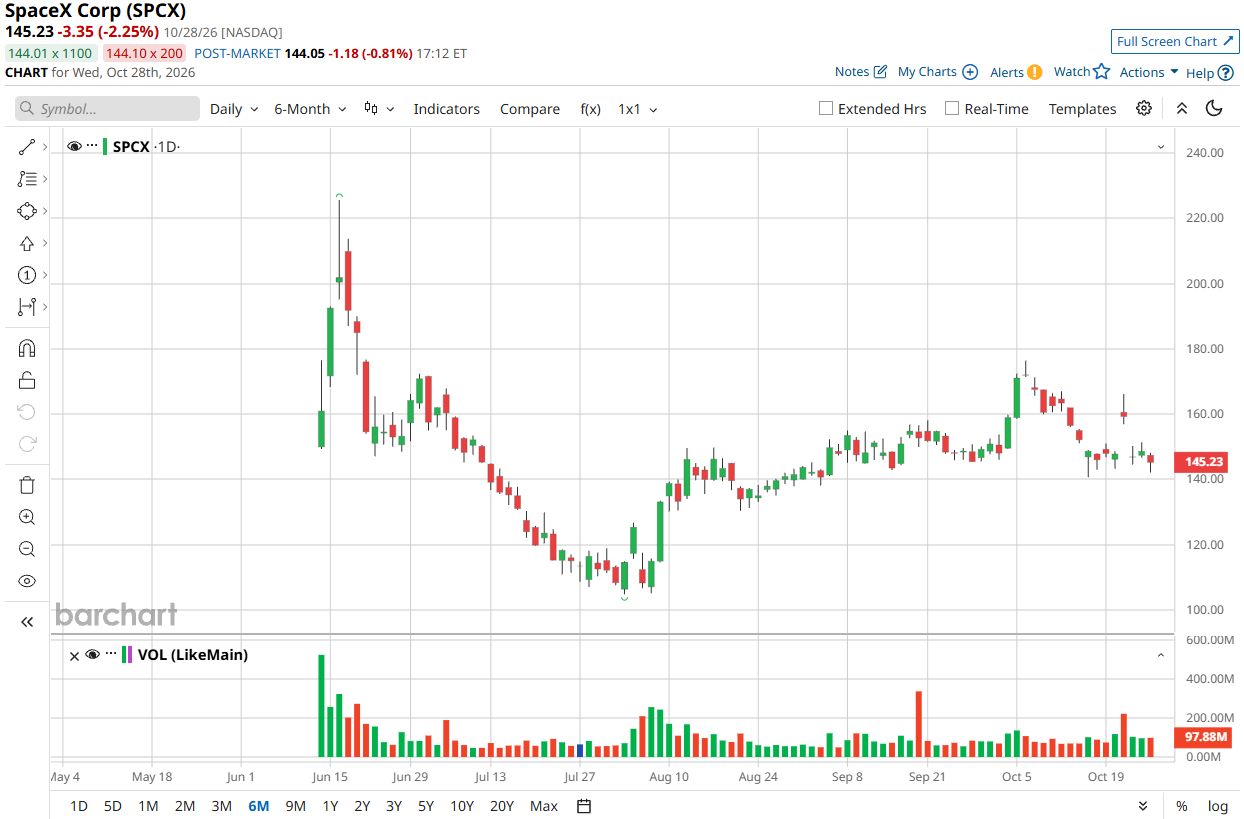
Shares of the rocket and AI company have been volatile since its June debut. SPCX stock saw sharp swings even last week, surging 7.8% on Wednesday, Oct. 21, after the company reported better-than-expected Q3 results, only to erase those gains the following day as Meta Platforms’ (META) Q3 report fueled further concerns about financing the AI buildout.
 www.barchart.com
SpaceX Secures $40 Billion in GPU Financing Through Apollo
On Monday, SpaceX announced it secured a binding commitment for roughly $40 billion in GPU financing through a master finance lease with an entity managed by Apollo Global Management. The financing will be used to acquire Nvidia (NVDA) Vera Rubin GPUs and related equipment. Under the arrangement, the Apollo-managed entity will purchase the equipment and lease it to SpaceX.
The equipment will be delivered in stages, with individual leases set to begin during the first half of 2027. Each lease will run for slightly more than five years from the date of equipment delivery. The rocket and AI company will make quarterly payments throughout the lease terms, with aggregate principal payments expected to total about $40 billion, excluding interest and other expenses.
More specifically, SpaceX said quarterly payments will generally consist of one-twentieth of the equipment’s financed cost, plus interest calculated at a fixed annual rate on the outstanding lease balance and certain additional expenses. That’s an important detail, and we’ll come back to it later. Notably, the fixed interest rate will be determined during pricing, before SpaceX formally enters into the agreement.
SpaceX expects to finalize the deal by year-end, subject to certain closing conditions.
How SpaceX’s $40 Billion GPU Financing Deal Actually Works
At this point, let’s clarify how the financing arrangement actually works. Numerous headlines reported that SpaceX raised $40 billion in debt, potentially leading some investors to assume the company conducted a traditional bond offering. Even SpaceX CEO Elon Musk wrote on X on Sunday that the company had closed $40 billion in debt.
As mentioned earlier, the arrangement is structured as a finance lease from SpaceX’s perspective. At the same time, the capital backing that lease is reportedly being raised from institutional investors through a Rule 144A bond offering. According to Bloomberg, the bonds will be issued in multiple tranches, with Pimco purchasing $4 billion of the A2 tranche, which sits between the senior and junior portions of the debt package.
With that, here’s how the arrangement works. Institutional investors provide capital to the Apollo-led financing structure, which uses the proceeds to purchase GPUs that are then leased to SpaceX. In turn, SpaceX makes quarterly lease payments that include principal, interest calculated at a fixed annual rate, and certain additional expenses. The financing vehicle then uses those payments to meet its obligations to bondholders across the various tranches.
Another important point is that the bonds’ yields do not necessarily equal the fixed annual interest rate SpaceX pays under the lease. As reported, the bond offering consists of several tranches with different risk profiles and, consequently, different yields. Meanwhile, Semafor reported on Monday that the offering’s most expensive slice, the junior tranche, will carry a rate as high as 8.75%, up from 8.3% reported last week and well above the 6.65% SpaceX paid on its most expensive bonds issued four months ago.
That tells us the capital being raised to finance the equipment lease is relatively expensive. However, the 8.75% rate on the riskiest tranche should not be confused with the fixed annual interest rate SpaceX will pay under its finance lease. Still, with the debt package reportedly expected to have yields of roughly 7.75% to 8.75%, SpaceX could ultimately face a higher borrowing cost under the lease than it did on its previous debt offering.
Why SpaceX’s Lease Makes More Sense Than Another Bond Offering
The next important question investors may have is which financing option would ultimately be more advantageous for SpaceX: the equipment finance lease or a traditional bond offering. Well, I believe the finance lease is the better option. Here’s why.
For starters, the finance lease offers an advantage in terms of risk isolation and funding-source diversification. Issuing another $40 billion in corporate bonds so soon after its $25 billion offering in June could put significantly more pressure on SpaceX’s unsecured credit profile, particularly amid the recent turmoil in debt markets for AI-related companies. Even SpaceX, which holds investment-grade ratings from the three major credit rating agencies, has seen the price of its own debt fall sharply in recent weeks. The company itself explicitly stated that the structure “diversifies our funding sources.”
Another advantage is the way the lease aligns financing obligations with cash flow. SpaceX won’t receive the full $40 billion upfront and immediately begin paying interest on the entire amount. Lease payments will begin as GPUs and related equipment are delivered, starting in the first half of 2027. This allows financing obligations to ramp up alongside the deployment of the equipment that will generate returns.
Of course, the finance lease isn’t without its drawbacks. One is the substantial amortization burden. SpaceX said each lease will run for just over five years, with quarterly payments made throughout the term. That effectively means a much faster principal repayment schedule than that of SpaceX’s corporate bonds issued in June, which mature between 2031 and 2056.
Conclusion
So, should investors be worried about SpaceX’s rising borrowing costs? To some extent, yes. The relatively high rates investors are demanding on parts of the financing package indicate they want a larger premium for funding major AI infrastructure projects. Still, those higher borrowing costs may be manageable as long as the underlying investments continue to generate strong returns.
SpaceX said it is seeing “less than one-year payback periods” on its AI investments, suggesting that the returns from its AI infrastructure could far exceed its financing costs. Ultimately, the bigger question isn’t simply whether SpaceX is paying more to borrow, but whether it can maintain those exceptionally short payback periods as it invests tens of billions of dollars in additional computing capacity.
On the date of publication, Oleksandr Pylypenko did not directly have a position in any of the securities mentioned in this article. All information and data in this article is solely for informational purposes. For more information please view the Barchart Disclosure Policy here.
More news from Barchart
SpaceX Reportedly Faces Higher Borrowing Costs on Its $40 Billion GPU Deal. What It Means for SPCX Stock. Ahead of On Semiconductor Earnings, Here's What Barchart Data Says Comes Next for ON Stock The AI Red Queen Effect: Why Big Tech Can’t Afford to Stop Spending If Taiwan Semi Raises Prices, It Could Be Bad News for Intel Stock. Here’s Why.