


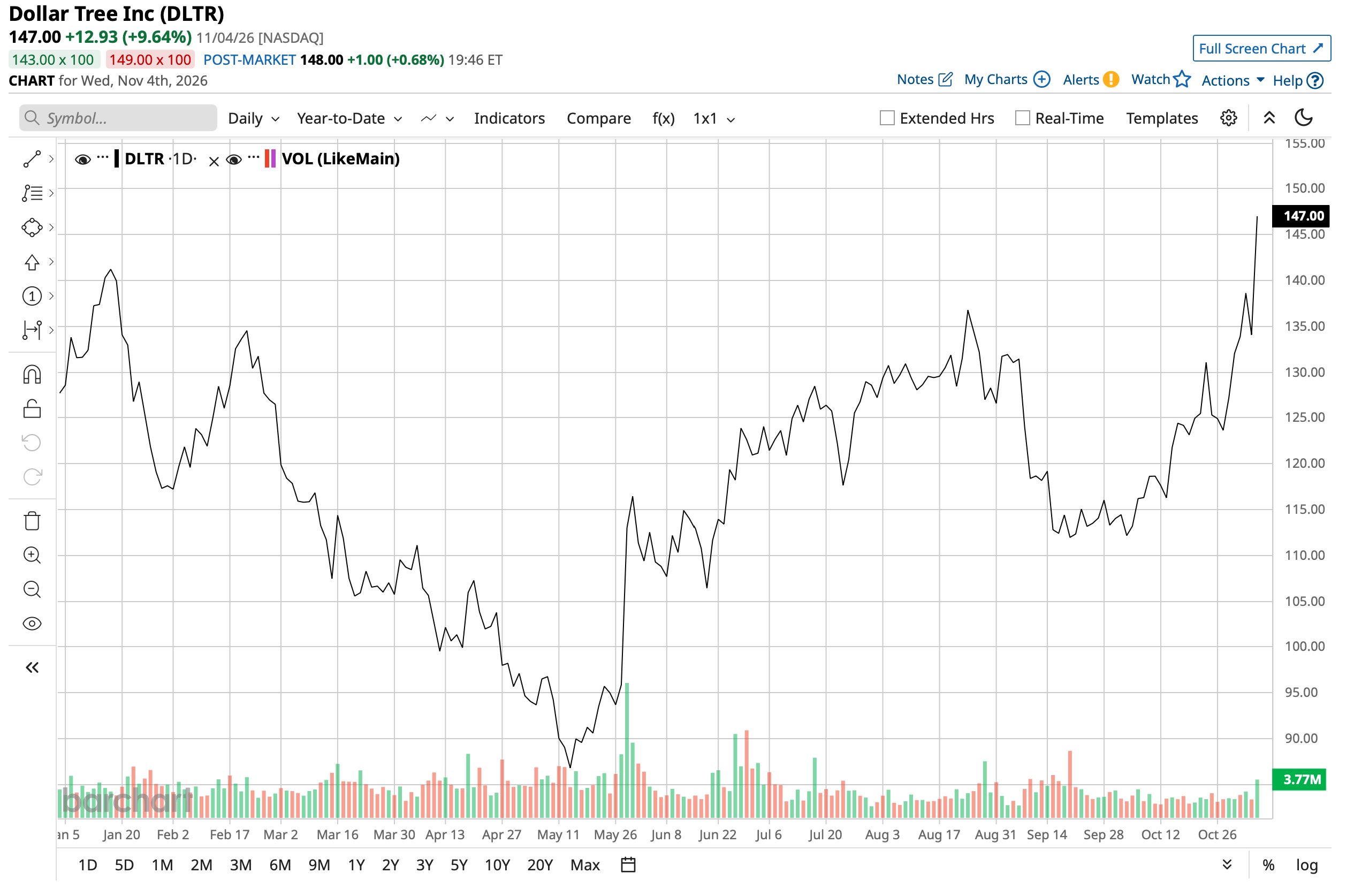
Dollar Tree (DLTR), one of the largest discount retailers in the country, saw its shares soar after a Democratic sweep of unprecedented proportions in the recently held U.S. midterm elections. Amidst a broader market rally, DLTR stock gained 9.6% on Nov. 4 and closed near its 52-week high.
Notably, Dollar Tree's rise was ahead of retail peers like Dollar General (DG) (+8.5%), Walmart (WMT) (+3.5%), Target (TGT) (+5.6%), Costco (COST) (+2.7%), and Amazon (AMZN) (+6.1%). The company's operating momentum and expectations of a restraint in policies hurting its core cohort of value-conscious consumers led to optimism around the stock.
More Top Stocks Daily: Go behind Wall Street’s hottest headlines with Barchart’s Active Investor newsletter.
About Dollar Tree
Founded in 1986, Dollar Tree operates a nationwide chain of stores selling everyday household essentials, food, snacks, health and beauty products, seasonal merchandise, party supplies, and other general merchandise at value-oriented prices. For decades, the company primarily sold products at a base price of $1. However, that changed in 2021, when it announced and completed the rollout of a $1.25 base price point across its stores.
Valued at a market capitalization of $25.8 billion, DLTR stock is up 12% on a year-to-date (YTD) basis. Should Dollar Tree stock find a place in your portfolio amid the changing political landscape? Let's take a closer look.
 www.barchart.com
Bet Your Dollar on Dollar Tree, But Nothing More
Dollar Tree's strategy is primarily rooted in its specialized merchandising and operating model rather than proprietary technology. The retailer has developed longstanding direct relationships with manufacturers, allowing it to customize product sizes, packaging, and quantities to meet specific price points, an important capability in a business built around delivering compelling value. It also combines everyday essentials with seasonal, promotional, and discretionary merchandise, creating a treasure-hunt shopping experience that encourages repeat visits and impulse purchases.
Meanwhile, the company's extensive distribution infrastructure, automatic replenishment systems, and store-specific merchandise allocation capabilities help it manage inventory and serve thousands of relatively small-format stores efficiently. Dollar Tree has also spent decades building a brand around affordable merchandise, with its historical $1 price point being central to that identity. Even after moving to the $1.25 base price and introducing higher price tiers, Dollar Tree has a recognizable value proposition that is different from a conventional discount retailer simply offering periodic price reductions.
Direct competitor Dollar General has a much wider presence with 21,148 stores. However, while comparable sales growth was almost identical for both companies in the most recent quarter — with Dollar General at 3.5% versus Dollar Tree's 3.7% — Dollar Tree came ahead in average ticket growth at 3.3% versus 1.5%. Still, Dollar General's traffic increase for the quarter was higher at 2%.
Dollar General has the scale while Dollar Tree offers momentum. Both have similar business models, and both vie for the same cohort of value-conscious buyers, but choosing one stock over the other may not be the wisest move considering their similar operations.
A Q2 Beat Aided by Tariff Refunds
Dollar Tree reported Q2 2026 results, showing a double beat and an increase in full-year earnings guidance, but with a tariff-refund caveat.
Total net sales for Q2 came in at $4.9 billion, up 7% year-over-year (YOY). Same-store net sales growth was 3.7%, with an average ticket rise of 3.3% and a 0.4% increase in traffic during the quarter. The rise in average ticket prices can be attributed to the company adding 710 multi-price stores during the quarter. However, the minimal traffic increase showed that the company's value-conscious customer base continues to remain under pressure as inflation remains high. Notably, the company also opened 75 new Dollar Tree stores during the quarter.
Diluted EPS increased 260% YOY to $2.70 in Q2. However, this included a positive tariff-refund impact of $1.31. Nevertheless, even without that thrust, earnings would have surpassed the consensus estimate.
Net cash from operating activities for the six months ended Aug. 1, 2026, stood at $1.57 billion, up from $639.2 million in the year-ago period. Overall, Dollar Tree ended the quarter with a cash balance of $1.1 billion and no short-term debt on its books, which is a positive in an environment increasingly being marked by high interest rates. In fact, net interest expense in the quarter fell to $17.8 million from $22.8 million in the same period a year ago.
For Q3, Dollar Tree expects net sales between $5 billion and $5.1 billion. For full-year fiscal 2026, revenue is expected to be between $20.5 billion and $20.7 billion. The company also raised its 2026 EPS outlook to $7.70 to $8.05 per share, “including an approximate $0.60 benefit related to the net impact of tariff refunds.”
In terms of valuation, Dollar Tree stock appears to be fairly valued. Its forward price-to-earnings (P/E) ratio of 18.5 times, price-to-sales (P/S) of 1.4 times, and price-to-cash flow (P/CF) ratio of 15.9 times are higher but relatively comparable to the respective sector medians.
What Do Analysts Think of DLTR Stock?
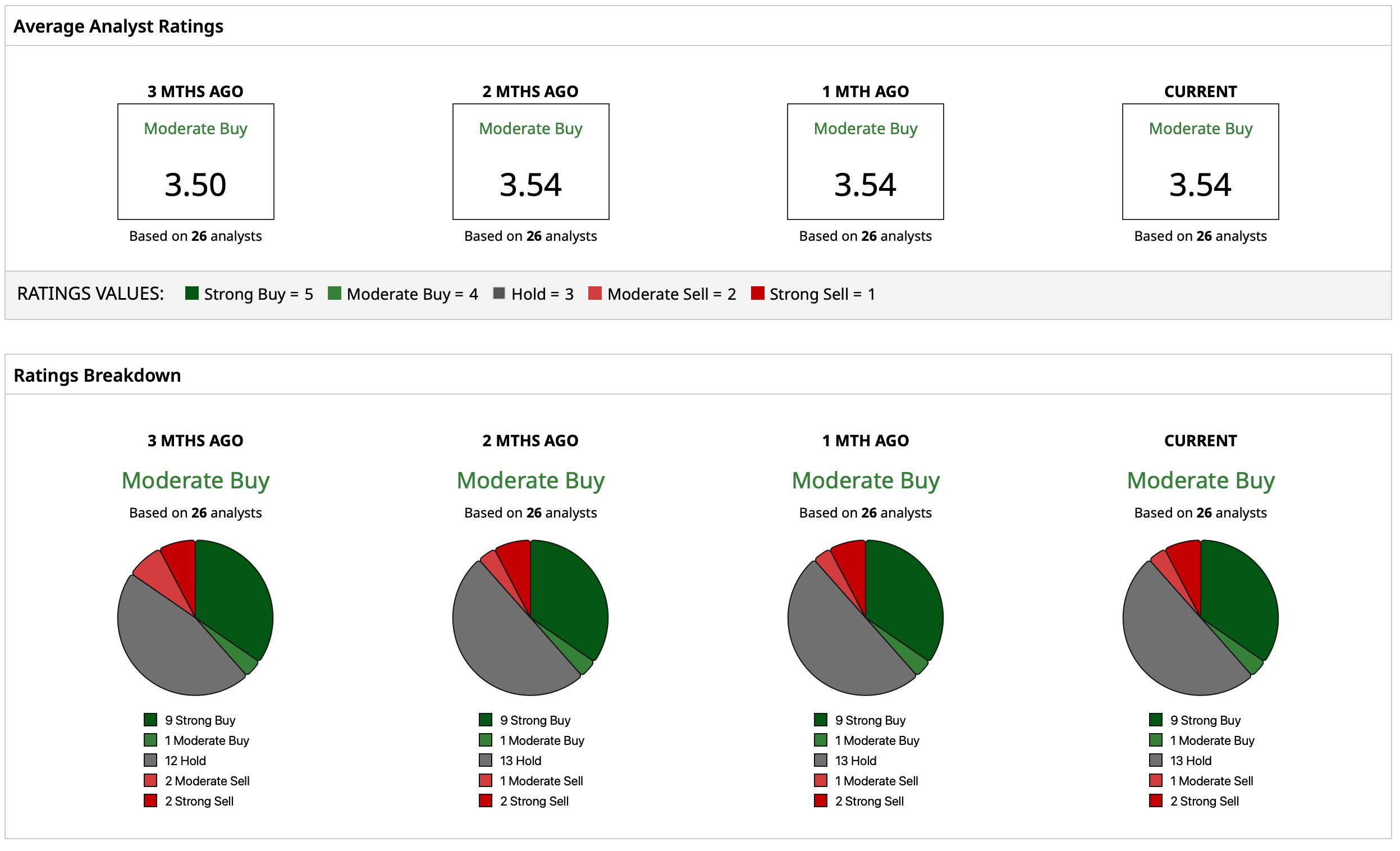
Analysts remain cautiously optimistic about DLTR stock with a consensus “Moderate Buy” rating overall. Out of 26 analysts covering the stock, eight have a “Strong Buy” rating, one has a “Moderate Buy” rating, 14 have a “Hold” rating, one has a “Moderate Sell” rating, and two analysts have a “Strong Sell” rating. The mean target price of 136.08 suggest potential upside of 4% from here, while the high target of $165 indicates potential upside of 26% from current levels.
 www.barchart.com
On the date of publication, Pathikrit Bose did not directly have a position in any of the securities mentioned in this article. All information and data in this article is solely for informational purposes. For more information please view the Barchart Disclosure Policy here.
More news from Barchart
Dollar Tree Pops 10% as Democratic Sweep Brings Cheer to the Markets. How to Play DLTR Stock Here. Bloom Energy Stock Rallies as Barclays Turns Bullish on California Power Partnership Pfizer vs. AbbVie: Higher Yield and Cheaper Valuation Give One the Clear Edge How a Slowdown in Commercial Bookings Is Rocking Palantir Stock