


Sugar may not attract the same attention as crude oil, gold, or the stock indexes. Still, experienced commodity traders know some of the most interesting opportunities develop in markets that receive relatively little publicity. With the end of the year approaching, sugar is entering a historically bearish seasonal period. What makes this year's setup particularly interesting is that several other market factors may be supporting the same outlook.
The relationship between sugar and energy prices, seasonal weakness in petroleum markets, and recent positioning by large futures traders provide reasons to examine sugar more closely. While no single indicator can predict future prices, these developments suggest that the coming weeks could be particularly interesting for traders monitoring the short side of the sugar market.
Don’t Miss a Day: From crude oil to coffee, sign up free for Barchart’s best-in-class commodity analysis.
Sugar's Historical Seasonal Selling Window
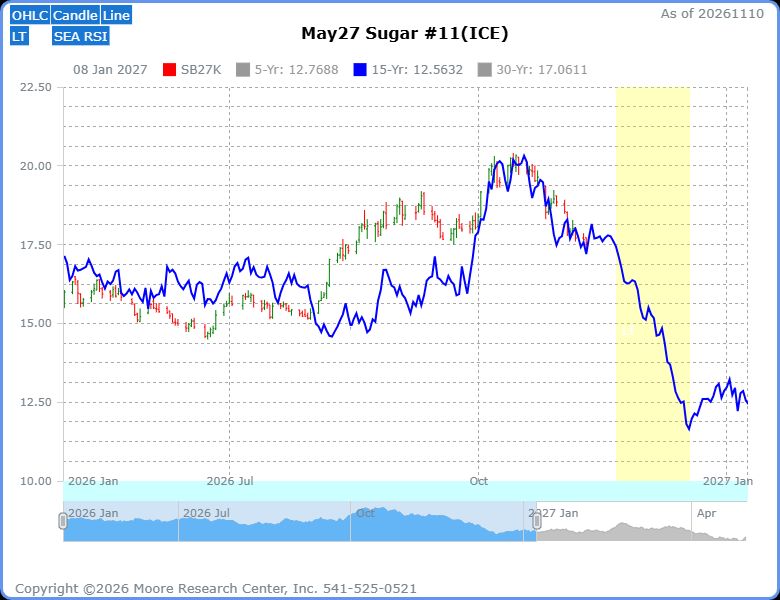
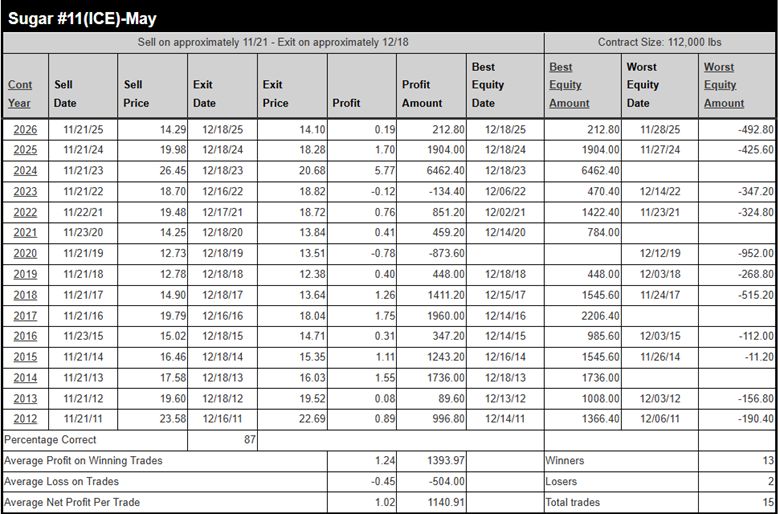
According to Moore Research Center's historical seasonal study, selling May sugar futures on November 21 and exiting on December 18 produced hypothetical profitable results in 13 of the previous 15 observations. That represents an 87% historical winning percentage, with an average net profit of approximately $1,141 per futures contract.
Source: Moore Research Center, Inc. (MRCI)
The seasonal chart illustrates how sugar prices have historically weakened during this period. Although the pattern has been relatively consistent, the results have varied considerably from year to year. The historical performance table also reveals that even profitable seasonal trades can experience adverse price movement before reaching their eventual outcome.
Source: MRCI
Seasonal studies are valuable because they identify recurring price tendencies, often associated with production cycles, supply availability, and changes in commercial demand. However, an 87% historical winning percentage does not mean there is an 87% probability that prices will decline this year. Current market fundamentals and price behavior must still support the seasonal outlook.
Why Energy Prices Matter to Sugar Traders
Brazil is the world's dominant exporter of raw sugar, and its sugarcane industry creates an important economic connection between sugar and energy markets. Brazilian mills can allocate sugarcane production between manufacturing sugar and producing ethanol, a fuel widely used in the country's transportation sector.
When ethanol becomes more profitable relative to sugar, mills have an incentive to direct more cane toward ethanol production, potentially reducing sugar supplies. Conversely, when energy prices weaken and ethanol economics become less attractive, mills may favor sugar production, increasing available supplies and potentially pressuring prices.
These production decisions are influenced by more than crude oil alone. Domestic gasoline prices, ethanol demand, government fuel policies, and the relative profitability of sugar exports all contribute to mills' decisions. Nevertheless, energy prices remain an important part of the broader fundamental picture.
Source: Barchart
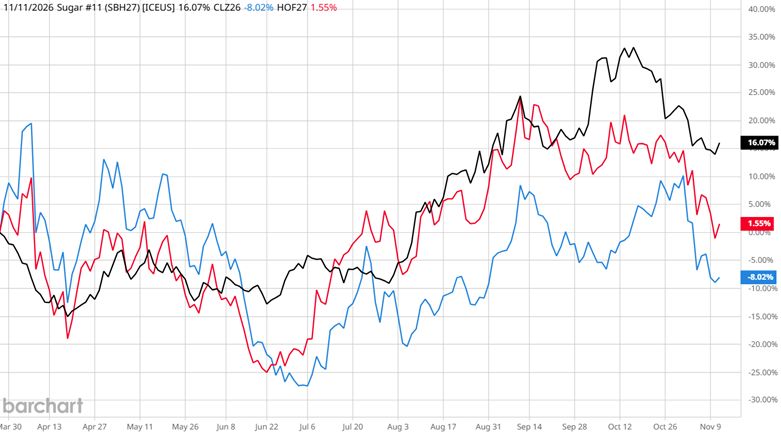
The accompanying comparison chart illustrates periods when sugar, crude oil, and heating oil have moved in similar directions, as well as periods of considerable divergence. Sugar has shown relative strength compared with crude oil during parts of 2026, suggesting other supply-and-demand factors have also influenced its price behavior.
For experienced traders, this relationship is worth monitoring because sustained weakness in energy markets could influence expectations for future Brazilian sugar production, particularly as mills evaluate the economics of the next harvest.
Petroleum Markets Also Face Seasonal Headwinds
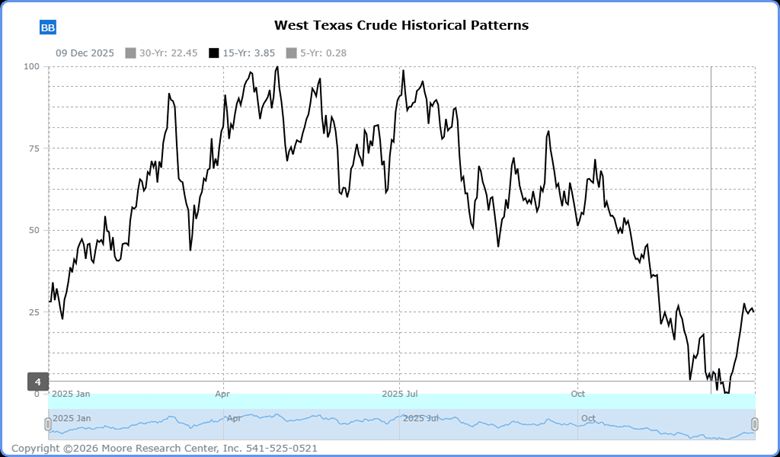
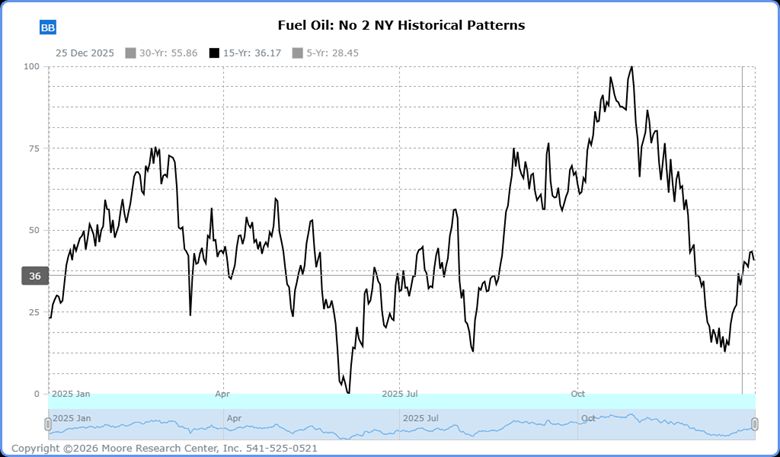
The seasonal tendencies of crude oil and heating oil provide another interesting perspective as we approach year-end. Historical cash-market studies from Moore Research Center show that both petroleum markets have frequently experienced price weakness during the fourth quarter.
Source: MRCI
The crude oil seasonal pattern generally weakens through autumn before establishing a seasonal low around early December. Heating oil shows a somewhat different pattern, with weakness often extending into mid-December. The heating oil pattern therefore overlaps more closely with sugar's November 21 through December 18 seasonal selling window.
Source: MRCI
Heating oil futures also serve as a benchmark for diesel fuel prices, making them useful for evaluating broader energy-market conditions. However, Brazilian ethanol competes more directly with gasoline, so heating oil should be viewed as a supporting energy indicator rather than a direct driver of sugar production decisions.
The fact that these markets have historically experienced weakness during overlapping periods does not guarantee they will decline together. Still, their seasonal tendencies provide additional context for evaluating sugar's approaching bearish window.
Could Managed-Money Liquidation Add Selling Pressure?
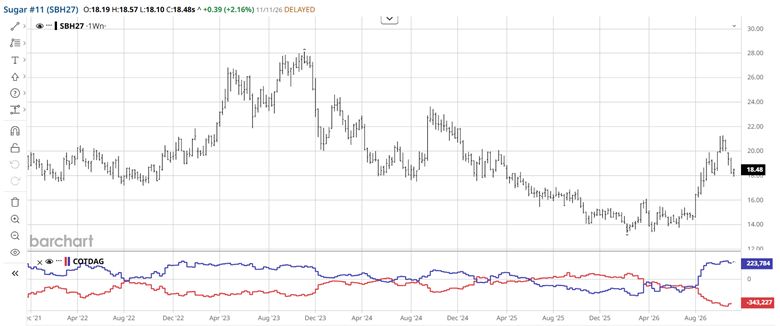
The Commitment of Traders report offers another perspective on the sugar market. As sugar approached its recent seasonal high, managed-money traders accumulated their largest net-long position in approximately five years, while commercial traders established their largest net-short exposure over the same period.
Source: Barchart
Managed-money traders frequently employ trend-following strategies, accumulating long positions as prices advance. Their buying provides liquidity for commercial producers who are naturally long the physical commodity and may progressively establish short futures hedges as prices rise. Commercial end users, by comparison, may purchase futures to protect against rising input costs.
The inverse relationship between managed-money and commercial positioning is particularly noticeable in the accompanying chart. If sugar prices continue to decline, managed-money traders reducing their substantial long exposure could add selling pressure. Commercial short covering may provide offsetting buying interest, but the potential for speculative liquidation deserves attention during an already bearish seasonal period.
What Should Sugar Traders Watch Next?
As sugar approaches its November 21 through December 18 seasonal selling window, traders should watch whether prices continue weakening and whether energy markets reinforce that direction. Equally important will be the behavior of managed-money traders, whose substantial long positions could become an additional source of selling pressure if the downtrend develops. Watching how these factors unfold may provide a clearer picture of whether this year's seasonal tendency is gaining momentum or losing influence.
However, several developments could challenge the bearish outlook. Stronger energy prices, unexpectedly reduced Brazilian sugar production, improving export demand, or renewed buying by managed-money traders could interrupt or reverse a seasonal decline. Much of Brazil's current harvest is also nearing completion, meaning changes in energy economics may influence future production expectations more than the remaining current-season output.
Assets to Trade the Sugar Market
Readers looking to participate in the sugar market have several options:
The primary vehicle is the Sugar #11 futures contract (SB), traded on ICE, representing 112,000 pounds of raw cane sugar, quoted in U.S. cents per pound. Each 0.01 cent move equals $11.20 per contract. Options on Sugar #11 futures offer another way to speculate or hedge, allowing traders to limit risk when buying options while targeting price movements. For those preferring equity accounts, the Teucrium Sugar Fund (CANE) provides exposure to sugar futures through an exchange-traded fund. Its strategy holds multiple futures maturities rather than relying exclusively on the nearby contract, although returns can still be affected by contango, backwardation, and fund expenses.In Closing...
Sugar's approaching seasonal selling window offers an interesting combination of historical price tendencies, energy-market influences, and large-trader positioning. While the 15-year seasonal record suggests that prices could experience additional weakness heading into December, stronger energy prices, unexpected supply disruptions, or renewed speculative buying could change that outlook. In my opinion, when several market factors begin aligning with a historical seasonal tendency, the opportunity deserves attention. As always, seasonality is a tool for identifying potential opportunities, not a substitute for price confirmation, sound risk management, and a disciplined trading plan.
On the date of publication, Don Dawson did not directly have a position in any of the securities mentioned in this article. All information and data in this article is solely for informational purposes. For more information please view the Barchart Disclosure Policy here.
More news from Barchart
Sugar Prices Face Seasonal Headwinds: Will Energy Markets Add More Selling Pressure? Could Last Friday's Events Have Ripple Effects for This Week's Markets? Why Did Friday's Commodity Complex Bring to Mind Candy and Nuts? 1 Million Reasons to Buy the Dip in Tesla Stock (You Can Thank Terafab)