


An under-the-radar play for a potential recovery rally in artificial intelligence, Caterpillar (CAT) presents a risky but tempting proposition. While CAT stock obviously isn’t a direct entity in the generative AI space, the technology itself can’t thrive without the buildout of data centers. With the general consensus pointing toward a long-term northbound trek, the current deflated valuation may present a contrarian opportunity.
Still, that’s also where the risk lies. As of the close of last Friday’s session, Caterpillar stock has found itself down more than 18% in the trailing month. This underperformance has “earned” CAT an 88% Strong Sell rating by the Barchart Technical Opinion indicator.
Can’t Get Enough Options?: Join the list for Barchart’s daily unusual options report, delivered free.
If that wasn’t enough, the fundamentals seem lackluster at the moment. Despite a strong third-quarter earnings report on paper, the market was unimpressed with management’s unchanged full-year outlook. Subsequently, CAT stock sold off sharply, particularly amid elevated tariff and freight headwinds.
However, it’s also important to point out that Caterpillar enjoys a massive backlog surge, driven primarily by long-term power generation demand from AI data centers. Therefore, you can imagine the overall contrarian thesis: should the AI catalyst resume its bullish trajectory (a reasonable assumption), it could potentially take Caterpillar stock along for the ride.
The other technical/quantitative argument? CAT stock has a proven history of mean reversion. When sentiment is excessively pessimistic for an extended period, the typical response is a sentiment transition from a bearish state to a bullish one.
By inductive inference, the most aggressive speculators may bank on this trend materializing again, using a vertical spread — specifically a bull call spread — to smartly maximize leverage within a time-bounded options strategy.
Making the Quantitative Case for CAT Stock
From a basic narrative perspective, mean reversion is an intriguing idea for Caterpillar stock because it’s a reliable blue chip that has likely fallen prey to a temporary setback. Sure, the current problems impacting CAT’s valuation are very much real but there are also countervailing positives (such as the demand backlog). It’s not unreasonable to believe that large-capitalization powerhouses can right the ship.
Nevertheless, from a quantitative view, we don’t want to chase a gut feeling. Rather, we want data-driven evidence to guide our decision-making processes. In this case, it’s not just about identifying a bearish state for CAT stock; it’s about recognizing the specific category of bearishness and using historical data to better understand tendencies associated with this particular signal.
In the last 10 weeks, we know as a fact that CAT stock has only managed to post three positive weekly candlesticks (where Friday’s close stood higher than Monday’s open). Whenever this ratio of seven negative candlesticks against three positive candlesticks has materialized in the charts within the trailing five years, the tendency has been for CAT to rise higher than what would be expected relative to an aggregate response over the subsequent 10-week period.
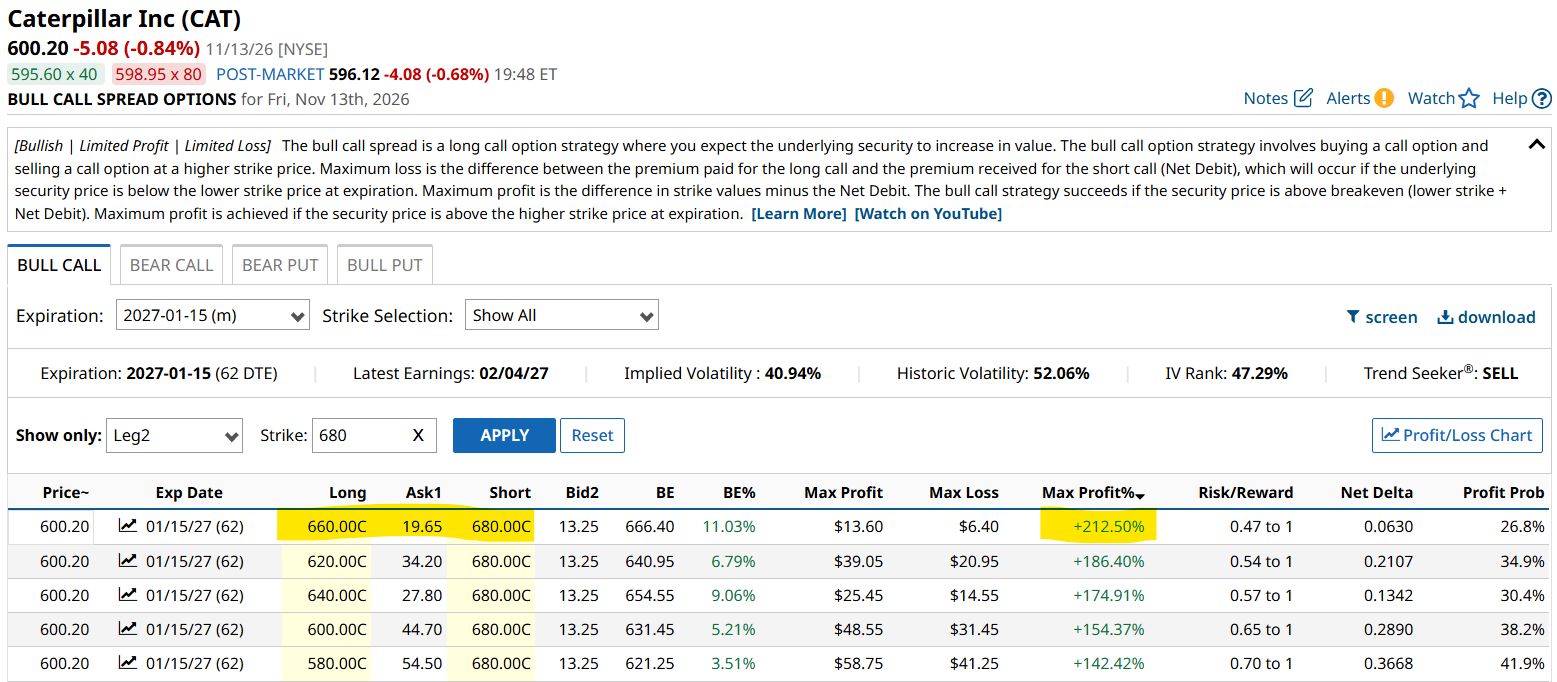
A natural tailwind that Caterpillar stock benefits from is that it historically enjoys an upward bias. That’s not surprising given the blue-chip nature of the business. But following an extremely bearish state (i.e. the current 7-to-3 ratio), CAT usually sees an extra pep to this bias.
To be upfront, an inductive inference is not a guarantee. However, if CAT responds as it typically has to the aforementioned ratio, a bullish position may be more statistically tenable. To that end, I’m looking at the 660/680 bull call spread expiring Jan. 15.
Expected Value Calculation Presents a Tempting Tale for Caterpillar Stock
Based on an inductive analysis of past analogs of the 7-to-3 ratio over the trailing five years, we may expect a probabilistic range between 38.5% and 42.3% that CAT stock will terminate above the $680 second-leg strike price on (or shortly before the Jan. 15 expiration date). This concept is also known as the exceedance ratio.
Under aggregate conditions, we would expect Caterpillar stock to feature an exceedance ratio between 27.7% and 31.1% for meeting the same criteria. That’s a serious mathematical advantage of trading CAT based on the 7-3 ratio rather than randomly buying the security.
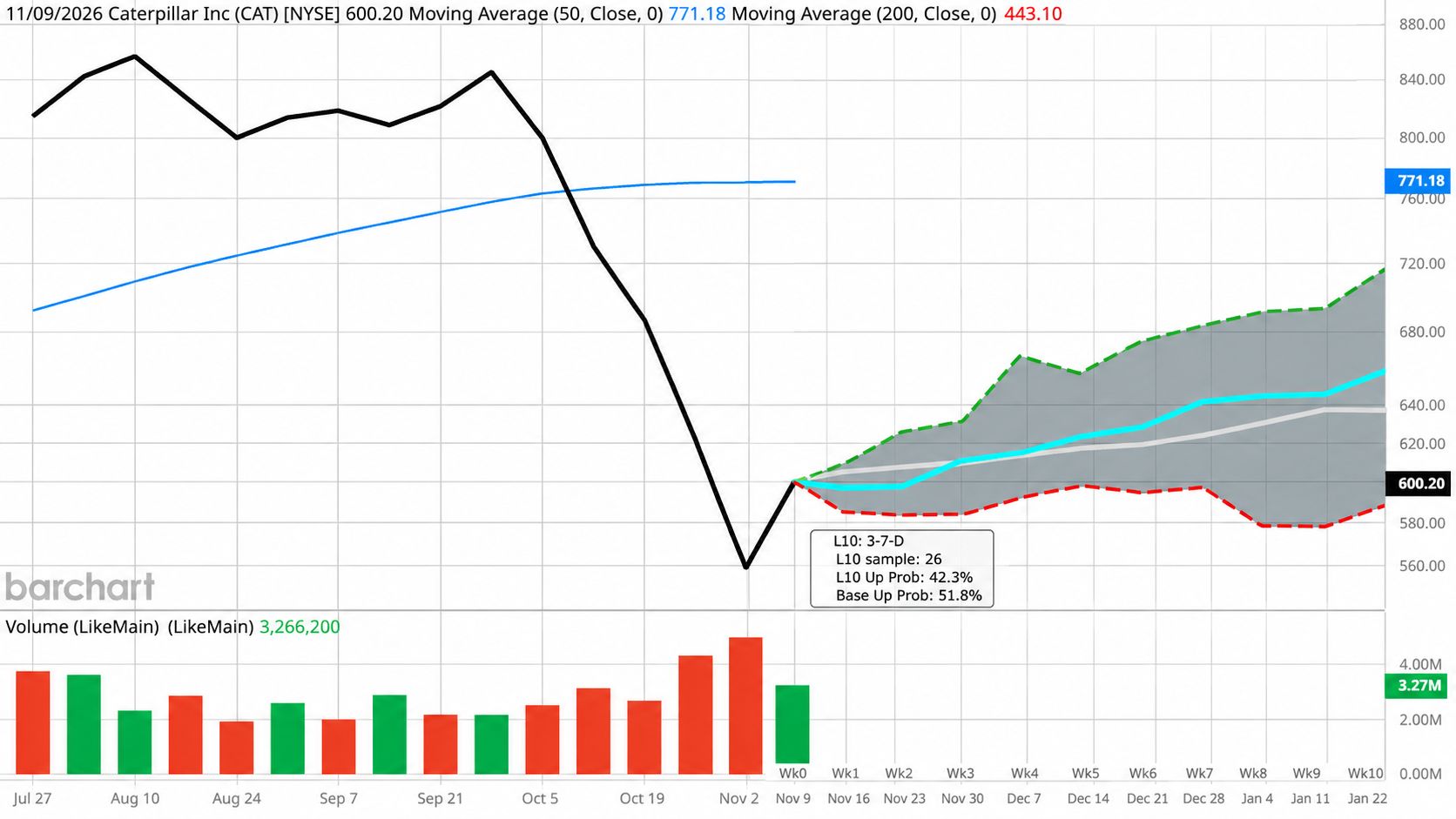
We can make the above claim due to the expected value (EV) calculation. At the best aggregate probability of 31.1%, the 660/680 bull spread would suffer from a negative EV of $18 or a return on capital (ROC) of -2.81%.
In contrast, the EV under the low-end probabilistic assumption of the 7-to-3 ratio would come out to $130 or an ROC of +20.31%. At the optimistic end, the ROC would stand at +32.19%.
Again, these calculations don’t imply that there’s a guarantee of success. CAT stock remains a speculative trade. Still, when comparing risk profiles, there’s arguably a statistical incentive to consider the $680 debit spread.
On the date of publication, Josh Enomoto did not directly have a position in any of the securities mentioned in this article. All information and data in this article is solely for informational purposes. For more information please view the Barchart Disclosure Policy here.
More news from Barchart
Caterpillar Stock Offers a Backdoor Route to a Potential AI Recovery Option Volatility and Earnings Report For Nov 16-20 Leverage AMD's 5th Straight Earnings Beat With A Trade That Pays $1,035 Nvidia is Extraordinarily Undervalued Ahead of its Earnings on Tuesday - Has NVDA Bottomed?