

Nvidia (NVDA) has spent years making headlines for its AI dominance, chip breakthroughs, and seemingly unstoppable growth. But 2026 has thrown the chipmaker a rather unexpected curveball, and this time, it has little to do with technology.
CEO Jensen Huang found himself at the center of a controversy involving an alleged affair with Alice Huang, a Chinese businesswoman suspected of having links to Chinese intelligence, and claims that the relationship helped facilitate $7.5 billion in chip shipments to Chinese firms. What started as an eyebrow-raising personal scandal soon became a serious corporate headache, with the board launching an internal investigation and the FBI also looking into the matter.
More Top Stocks Daily: Go behind Wall Street’s hottest headlines with Barchart’s Active Investor newsletter.
After two more affairs involving Nvidia employees, one an executive, came to light, the fallout culminated in CEO Jensen Huang’s resignation as CEO, president, and board member on Nov. 12, 2026. Nvidia’s shares have fallen roughly 10% over the past five trading sessions, dragging its market capitalization below $4 trillion for the first time since 2025.
But has Wall Street already priced in the worst? Renowned analyst Ming-Chi Kuo believes the worst of the immediate stock market reaction may already be behind NVDA. He views Huang’s resignation as a potential one-time clearing event, suggesting that much of the near-term uncertainty has already been reflected in the share price.
Kuo also expects the formal leadership transition and organizational changes to have little impact on Nvidia’s product development and competitiveness until 2028 at the earliest. That said, investors should keep an eye on supply-chain capacity expansion and next-generation technology development, two areas closely tied to Huang’s aggressive product strategy. Kuo also expects the leadership uncertainty to create opportunities for competing AI chip technologies.
To that end, let’s take a closer look at whether Nvidia’s underlying strengths can help it weather the leadership turmoil and put the stock back on a recovery path.
About Nvidia Stock
Nvidia was not always the Wall Street darling powering the AI revolution. Back in 1993, the California-based company started out making graphics cards primarily for video game enthusiasts. Fast-forward three decades, and those same graphics processing units (GPUs) have become the backbone of artificial intelligence (AI), cloud computing, robotics, autonomous vehicles, and high-performance computing. Not a bad career change for a company that once catered primarily to gamers.
Headquartered in Santa Clara, Nvidia has become one of the biggest beneficiaries of the global AI spending spree. As tech giants raced to build data centers and train increasingly powerful AI models, Nvidia supplied the chips powering much of that ambition. Investors rewarded the company handsomely, sending its market capitalization to extraordinary heights, nearly $6 trillion, and making it one of the world’s most valuable businesses.
But even the market’s biggest performers can have a bad day, or apparently, several bad months. Nvidia’s market capitalization has now slipped to approximately $3.9 trillion, with concerns about slowing AI spending, tougher competition, and the controversy surrounding CEO Jensen Huang adding to the pressure. The allegations involving his reported relationships and $7.5 billion in chip shipments to Chinese firms have given investors yet another reason to hit the sell button.
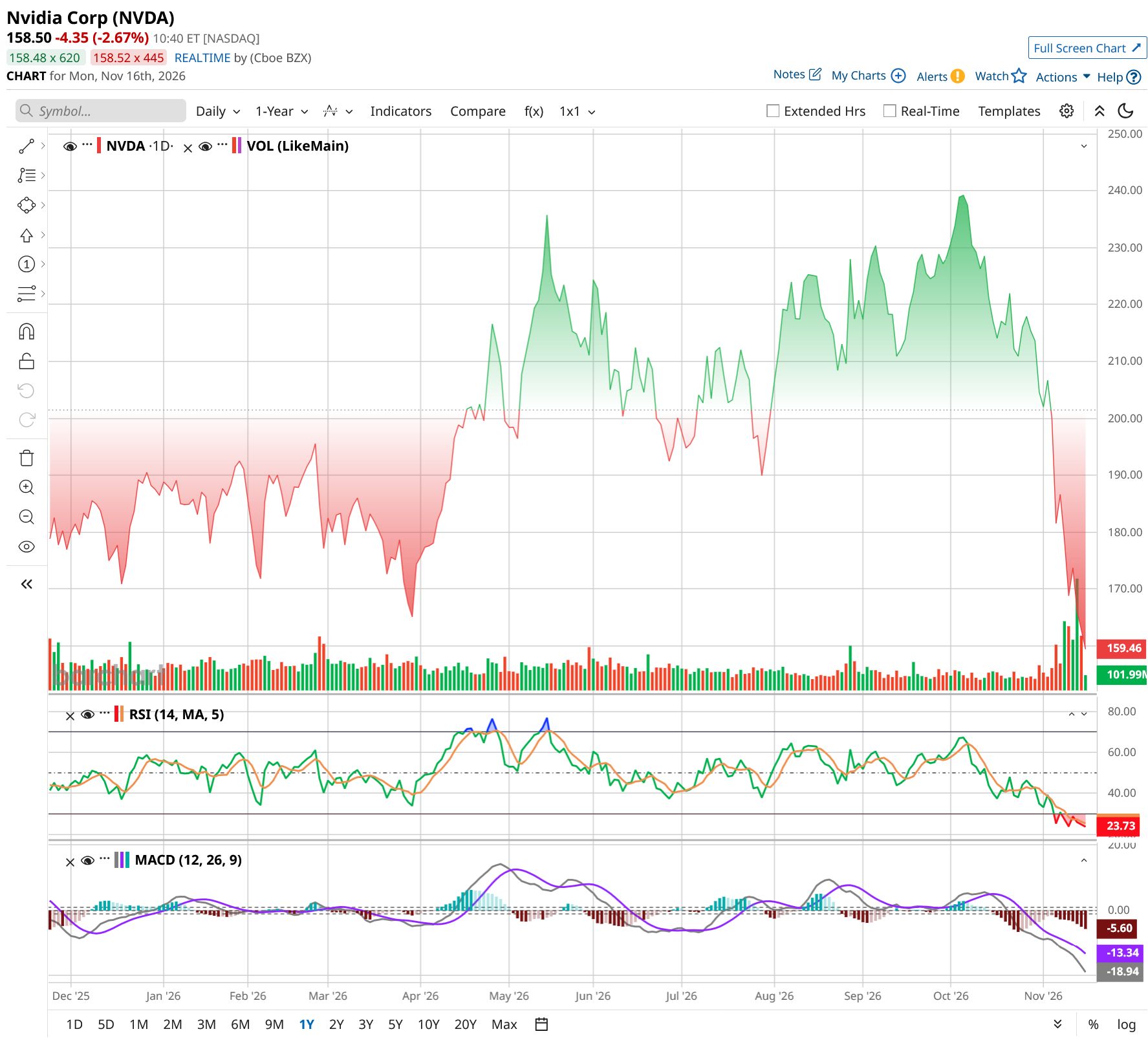
After climbing to an all-time high of $243.37 on Oct. 6, Nvidia shares have plunged to a 52-week low of $148.80 on Nov. 12. The stock has since bounced 8% from that level but is still down 34% from its peak. NVDA is down 16% over the past 52 weeks and 14% year-to-date (YTD). Over the past three months, the shares have shed 29%, declined 25% over the past month, and a 10% drop in just five trading sessions.
And the technical indicators are not rolling out the welcome mat for the bulls. The 14-day RSI stands at 24, firmly in oversold territory, suggesting the selling may have gone a little too far. Meanwhile, the MACD remains below its signal line, with red histogram bars pointing to continued bearish momentum.
 www.barchart.com
Nvidia’s recent selloff has at least given its valuation a little breathing room. The stock now trades at 16.29 times forward adjusted earnings, below both its sector average and historical multiple. Its forward price-to-sales ratio of 9.55x is still hardly a bargain-bin deal compared with peers, but it is also cheaper than its historical average.
Meanwhile, Nvidia shares the wealth with shareholders. The company pays a quarterly dividend of $0.25 per share. Granted, that’s hardly the kind of payout that will have income investors celebrating, particularly at NVIDIA’s valuation. But with a payout ratio of just around 4%, the company has plenty of earnings left to reinvest in growth, strengthen its business, and potentially reward shareholders with bigger payouts down the road.
A Snapshot of Q2's Numbers
On Aug. 26, the AI chip giant reported its fiscal 2027 second-quarter results, delivering another blockbuster quarter. Revenue jumped 106% year-over-year (YoY) to $96.2 billion, comfortably topping Wall Street estimates. Non-GAAP EPS surged 120% to $2.22, while non-GAAP gross margin improved by 2.5 percentage points to 75%.
The Data Center business continued to do the heavy lifting, bringing in $89 billion in revenue, up 117% from a year ago and contributing more than 92% of total sales. Spending by hyperscalers building AI infrastructure remained the biggest growth driver, while more companies continued adopting accelerated computing. Growth also got a boost from the initial volume rollout of Nvidia’s next-generation Vera Rubin architecture and full-scale Blackwell production for major cloud customers such as Azure, Google Cloud, and OCI.
Meanwhile, Nvidia’s Edge Computing business added another growth driver, generating $7.2 billion in revenue, up 27% annually, as AI adoption spreads closer to devices and real-world business applications.
Cash generation remained strong, too. Operating cash flow reached $24.1 billion, while free cash flow totaled $21.3 billion. Nvidia returned roughly $26 billion to shareholders through buybacks and dividends and still had $99 billion left under its share repurchase authorization. Its cash, cash equivalents, and marketable debt securities stood at $56.6 billion at quarter-end.
Nvidia is now getting ready for its next big Wall Street moment, with Q3 fiscal 2027 results due on Tuesday, Nov. 17. Management expects revenue of roughly $108 billion, give or take 2%, while both GAAP and non-GAAP gross margins are projected at 74%, plus or minus 50 basis points. And the growth story seems like it won’t cool off soon. Nvidia expects fiscal 2028 revenue to climb around 70%, although supply constraints could continue to play spoilsport through at least the end of that year.
Analysts tracking Nvidia project a fiscal Q3 2027 revenue of around $108.7 billion, while EPS is projected to climb by 100.8% YoY to $2.49 per share. Looking ahead, EPS is expected to be $9.28 in fiscal year 2027, representing an annual growth of 103.1%, and the bottom line could rise by another 69.5% YoY in fiscal year 2028 to $15.73 per share.
What Do Analysts Expect for NVDA Stock?
Wall Street is not abandoning Nvidia, but analysts are becoming a little less generous with their price targets. And the reasons go beyond one ugly week on the charts. Mizuho cut its price target to $220 from $250 but maintained an “Outperform” rating. The brokerage firm flagged potential risks from lost China revenue, market-share erosion, and pricing pressure, although it still considers Nvidia attractively valued ahead of its Nov. 17 earnings report.
CLSA took a more cautious approach, downgrading the stock from a “High-Conviction Outperform” to a “Outperform” and slashing its target to $255 from $425. The firm reduced its valuation multiple, reflecting uncertainty around Nvidia’s post-Huang future and the evolving AI market.
TD Cowen also lowered its target to $200 from $275 while retaining a “Buy” rating, citing uncertainty around 2028 estimates despite strong underlying AI demand. HSBC downgraded NVDA stock to a “Hold” from a “Buy” and set a $170 target. Its concern is an unclear succession plan and the need for incoming leadership to prove it can deliver the product roadmap.
The common thread is pretty clear. Analysts are not necessarily questioning Nvidia’s AI opportunity but are questioning how much investors should pay for it amid leadership uncertainty, competitive risks, and a potential valuation reset.
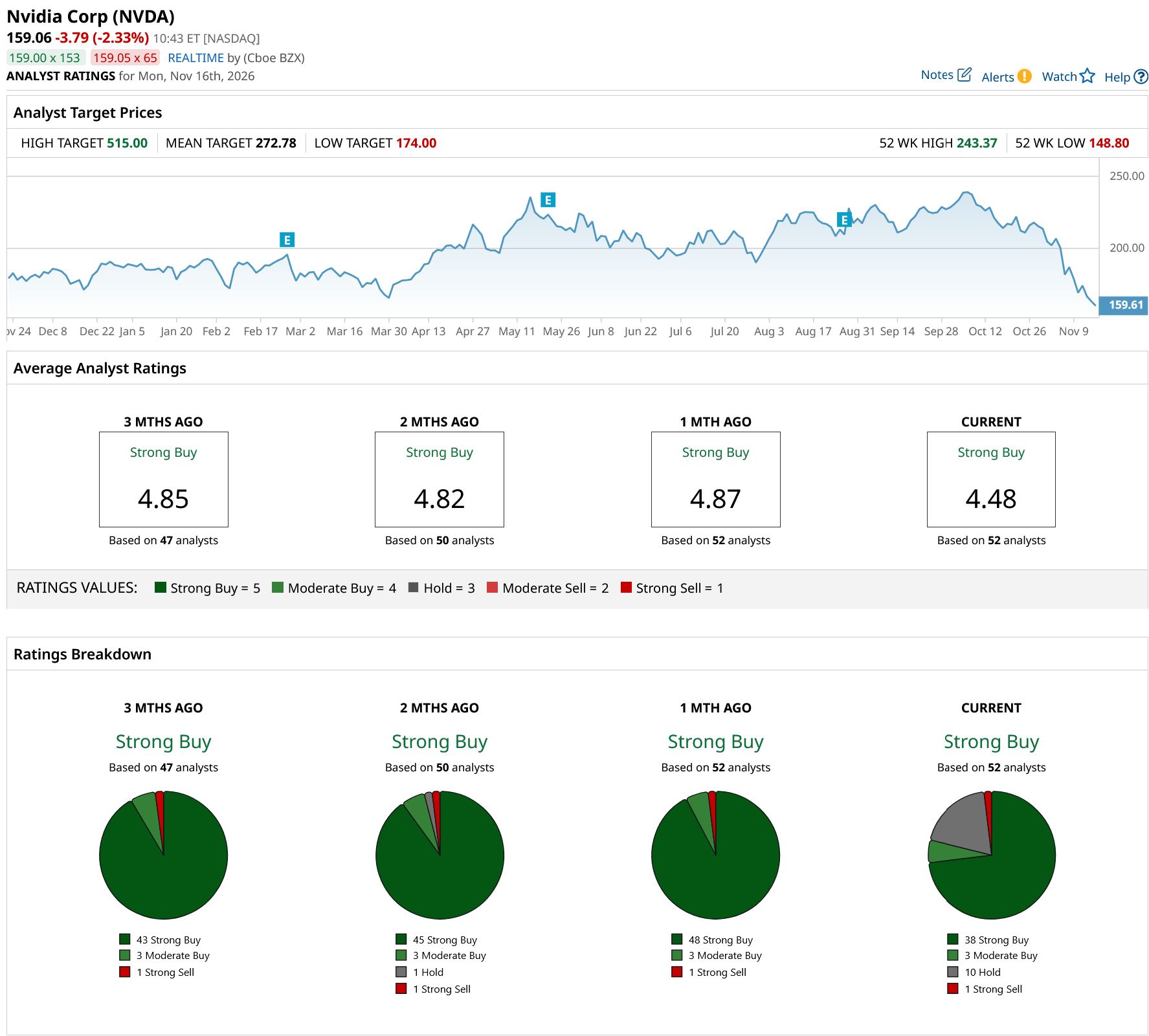
Overall, analysts are upbeat about NVDA's growth potential, giving the stock a consensus rating of “Strong Buy.” Of the 52 analysts covering the stock, 38 advise a “Strong Buy,” three recommend a “Moderate Buy,” 10 have a “Hold” rating, and only one is outright skeptical, suggesting a “Strong Sell.”
The average analyst price target for NVDA stock is $272.78, indicating potential upside of 72%. The Street-high target price of $515 suggests that the stock could rally as much as 224% from here.
 www.barchart.com
Final Thoughts on Nvidia
Ming-Chi Kuo’s assessment offers some reassurance, and there are reasons to believe Nvidia may have found a floor, or is at least getting close. Its demand pipeline remains robust, with management expecting supply constraints to persist through fiscal 2028. The company has also raised its supply and capacity commitments, reflecting the scale of infrastructure demand it is preparing to serve.
The boardroom shake-up does not mean Nvidia has suddenly forgotten how to make chips, with experienced semiconductor leadership still in place. More importantly, rising enterprise demand for AI inference could keep computing needs climbing. Still, a bottom call is easier than a sustained recovery. Wall Street will want execution, not just reassurance, before buying back in.
On the date of publication, Sristi Suman Jayaswal did not directly have a position in any of the securities mentioned in this article. All information and data in this article is solely for informational purposes. For more information please view the Barchart Disclosure Policy here.
More news from Barchart
Novo Nordisk vs. Amgen: 1 Has the Blockbuster Weight-Loss Drugs, the Other Has a Promising Rival Cathie Wood and Jim Cramer Disagree on Nvidia Stock Without Jensen Huang. Earnings Could Decide Who's Right A $1.3 Billion Reason to Buy Firefly Aerospace Stock Here Why at Least 1 Analyst Says Nvidia Stock Has Already Bottomed – Or Is Very Close