


Some companies make money when you shop. Others make money simply because the store is there.
Behind many grocery chains, convenience stores, and warehouses, there are property owners collecting rent, whether you buy something or not. Some say boring... but I prefer the term "passive". It may not get as much attention, but these businesses are proven to support a steady stream of dividends.
More Yield, Less Trap: Sign up free to get Barchart’s daily Dividend Investor newsletter straight to your inbox.
That brings us to Realty Income (O) and Agree Realty (ADC), two real estate investment trusts (REITs). Both have similar business models, but their financials, growth strategies, and dividend histories tell different stories.
Realty Income (O) Stock: A Familiar Name in Monthly Dividends
 Screenshot courtesy of www.barchart.com
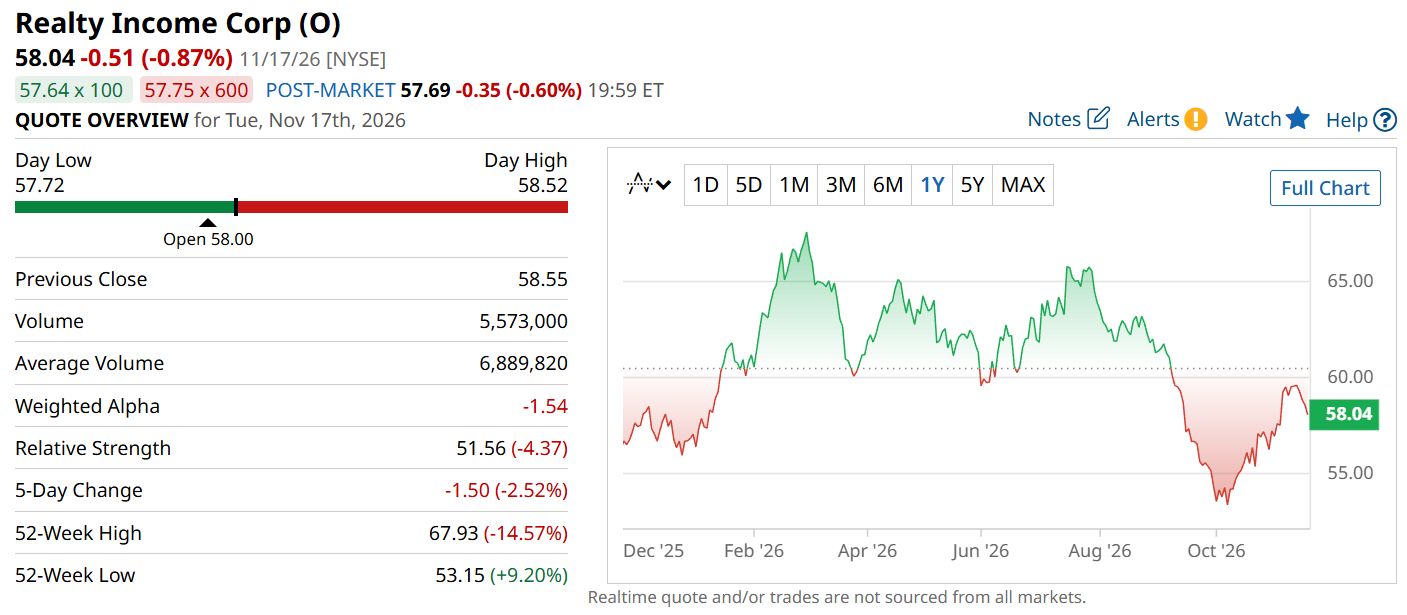
Unless you're into collecting monthly dividends, Realty Income isn't a name you'd hear about often, but you're probably more familiar with its properties than you realize. The company owns thousands of commercial properties, including convenience stores and warehouses, and thrives on rental income from those leases.
Its business model is straightforward, earning it the title “The Monthly Dividend Company.” But Realty Income is expanding with its recent venture into hyperscale data centers, allowing it to benefit from the AI boom as well.
Realty Income is arguably the best-known and one of the largest players in the REIT industry, with a market cap of $56 billion.
Agree Realty (ADC) Stock: A Growing Retail REIT That Also Pays Monthly Dividends
 Screenshot courtesy of www.barchart.com
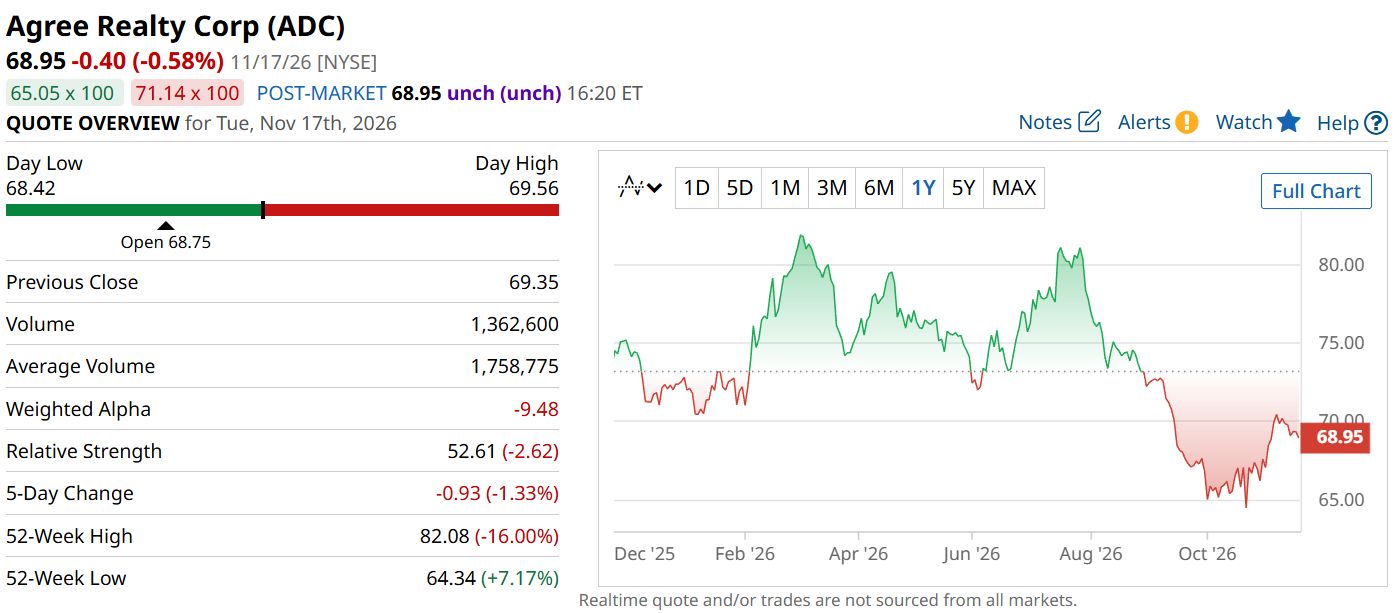
Agree Realty is in the same business, but with a stronger focus on retail properties. Some of its tenants are big grocery chains, auto parts retailers, and generally businesses that serve as the backbone of the economy.
Like Realty Income, Agree Realty is making a move of its own, expanding its portfolio with 68 retail property acquisitions, which adds more rental income opportunity and strengthens its footing in the everyday retail business.
Agree Realty is the challenger in this comparison, with a market cap of around $9 billion, roughly one-sixth the size of Realty Income.
Given the vast difference in scale, let’s see how their current business translates to numbers.
O vs. ADC: Which Dividend Stock Rewards Investors More?
| Realty Income (O) | Agree Realty (ADC) | |
| Q3 AFFO per share | $1.12 (+3.7% YoY) | $1.15 (+4.9% YoY) |
| 2026 AFFO guidance | $4.45 to $4.46 | $4.58 to $4.59 |
| Price / AFFO (guidance midpoint) | ~13.0x | ~15.0x |
| Latest monthly dividend | $0.274 | $0.271 |
| Annual dividend rate (forward) | ~$3.29 | ~$3.25 |
| Dividend yield | 5.67% | 4.72% |
| Payout Ratio (annual rate / AFFO) | ~74% | ~71% |
When it comes to REITs, one of the most useful numbers to look at is AFFO, or adjusted funds from operations, which adds back depreciation to show the cash these companies really generate. So, starting with Realty Income, it earned $1.12 per share in the third quarter, up 3.7% from a year ago, and it’s guiding to $4.45 to $4.46 for the full year. Agree Realty, on the other hand, came in higher at $1.15 per share, up 4.9%, with full-year guidance of $4.58 to $4.59, which gives it the edge on AFFO growth.
Now, to see what you’re actually paying for that cash flow, we can look at price-to-AFFO.
Using the midpoint of guidance, Realty Income trades at about 13 times, while Agree Realty sits at roughly 15 times, so Agree Realty is the pricier of the two. That premium lines up with its faster AFFO growth.
That brings us to the dividends, and here Realty Income pays more. Its latest monthly dividend of 27.4 cents works out to about $3.29 per share a year, or a yield of 5.67%. Agree Realty, by comparison, pays 27.1 cents a month, or about $3.25 a year, for a yield of 4.72%.
Both dividends look well covered, 74% of AFFO for Realty Income and 71% for Agree Realty. Agree Realty’s dividend has been growing faster, though, up about 3.4% over the past year versus about 1.7% for Realty Income. That being said, Realty Income has been steadily raising its dividend for 32 consecutive years, and as it's an S&P 500-listed company, that qualifies it as a Dividend Aristocrat.
In a nutshell, Realty Income is cheaper and pays a higher yield, while Agree Realty offers faster AFFO and dividend growth at a higher price. So it really comes down to whether you value income today or growth over time.
Realty Income vs. Agree Realty: What Analysts Expect Next
All things considered, here’s what Wall Street says:
 Screenshot courtesy of www.barchart.com
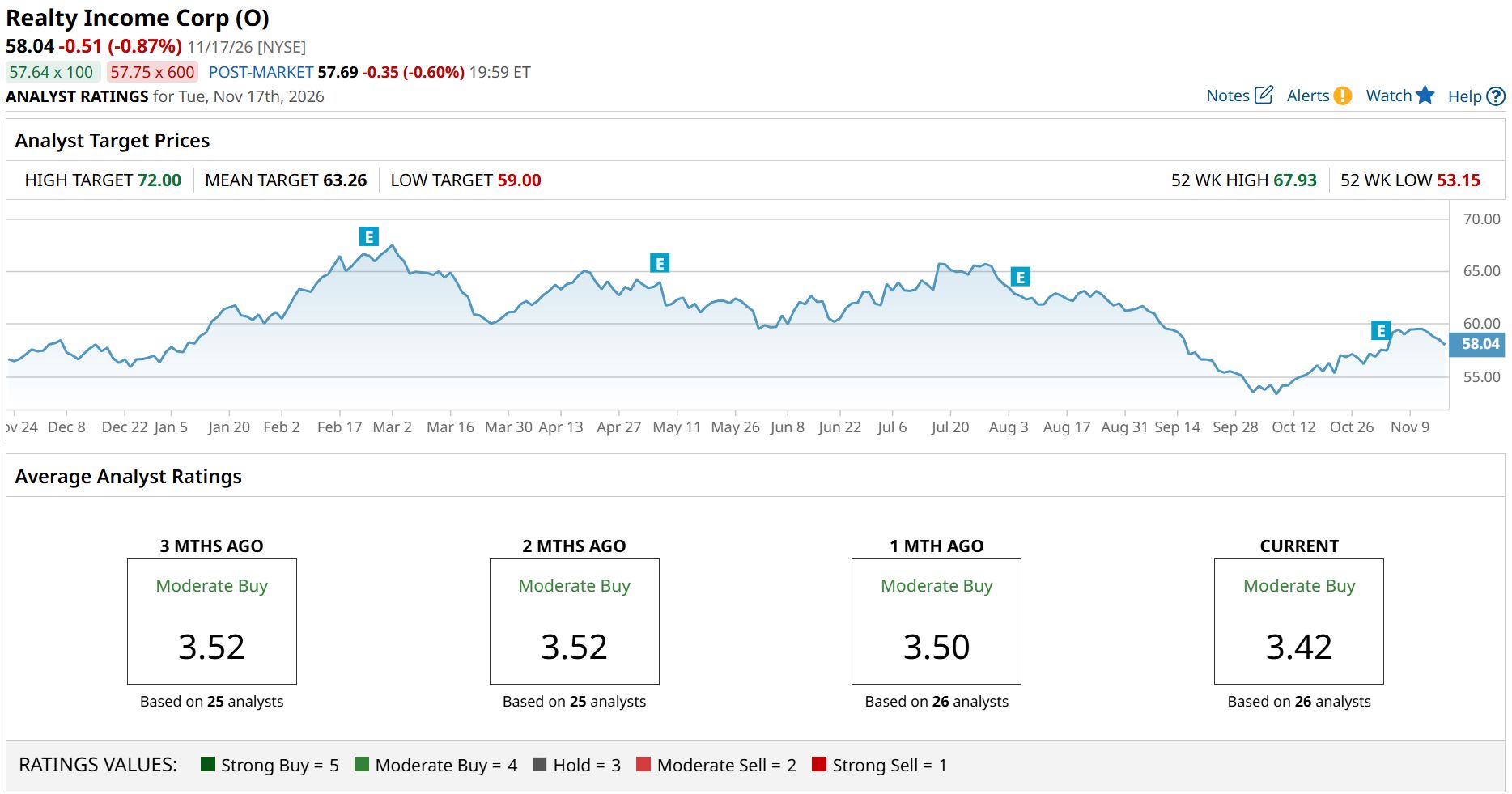
A consensus among 26 analysts rates O stock a “Moderate Buy”, with high target prices suggesting 24% upside over the next year.
 Screenshot courtesy of www.barchart.com
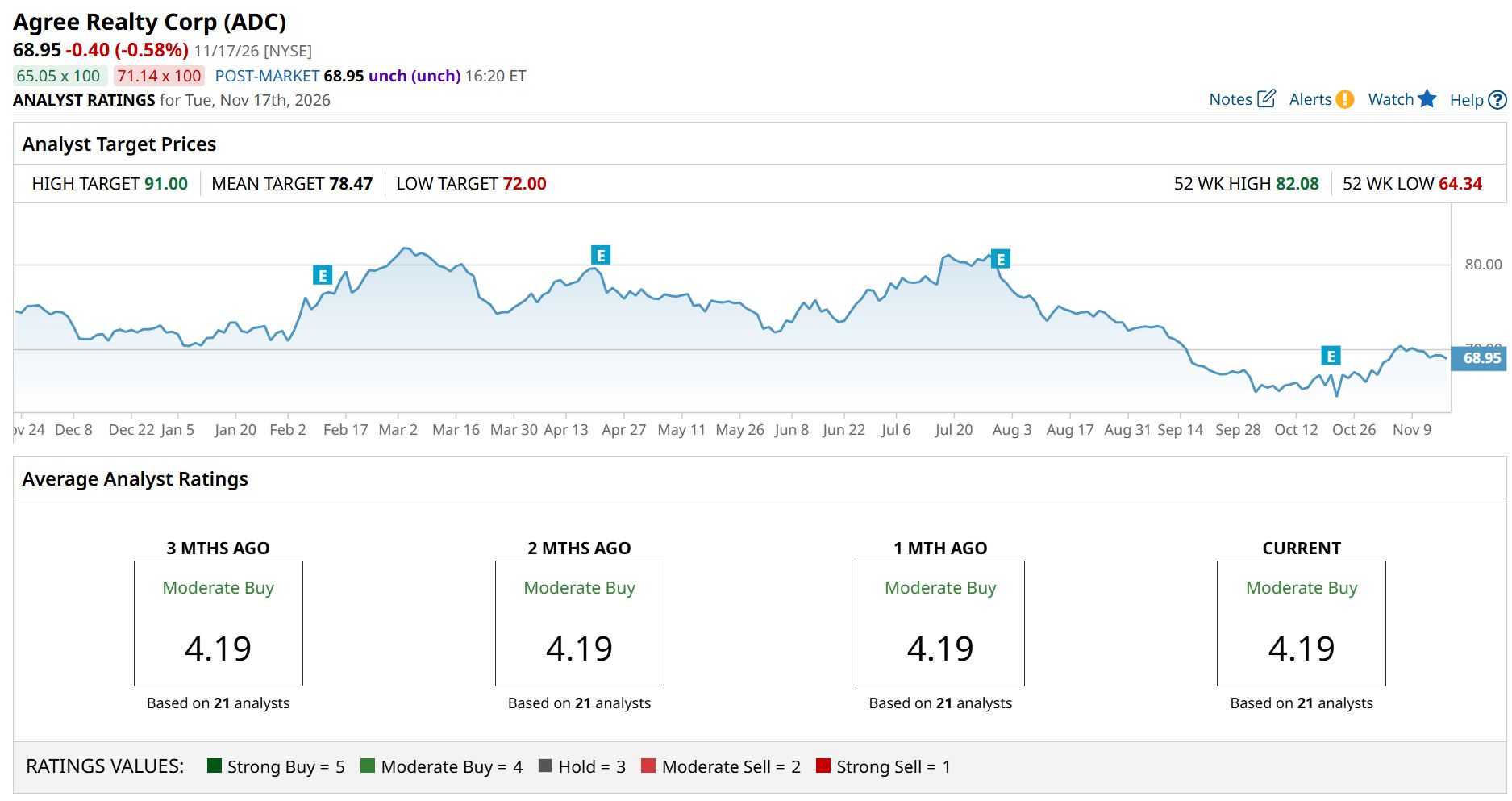
The same sentiment from a consensus of 21 analysts rates ADC stock a “Moderate Buy”. It has an upside potential of 32% if high target prices are achieved.
Realty Income vs. Agree Realty: Which Dividend REIT Is the Better Buy?
Realty Income and Agree Realty may be in the same business, but their futures are starting to look more distinct.
While these two companies look close today, I'd give Realty Income the edge. Its consistency in rewarding shareholders and its recent move into hyperscale data centers opens another source of growth, making it worth investing in.
Agree Realty also makes a compelling case. But it really all comes down to your investment goals and risk appetite. As always, do your own due diligence to see which stock fits your strategy.
On the date of publication, Rick Orford did not directly have a position in any of the securities mentioned in this article. All information and data in this article is solely for informational purposes. For more information please view the Barchart Disclosure Policy here.
More news from Barchart
Realty Income vs. Agree Realty: Which REIT Wins on Dividends and Growth? Bill Gates Has Earned $2.6 Billion in Dividends From a Landfill Stock the EPA Keeps Citing for Methane Leaks, and a Filing Shows He Just Bought 3.7M More Shares Dear Nike Stock Fans, Mark Your Calendars for November 17 This Insurance Stock Just Raised Its Dividend by Roughly 5%