

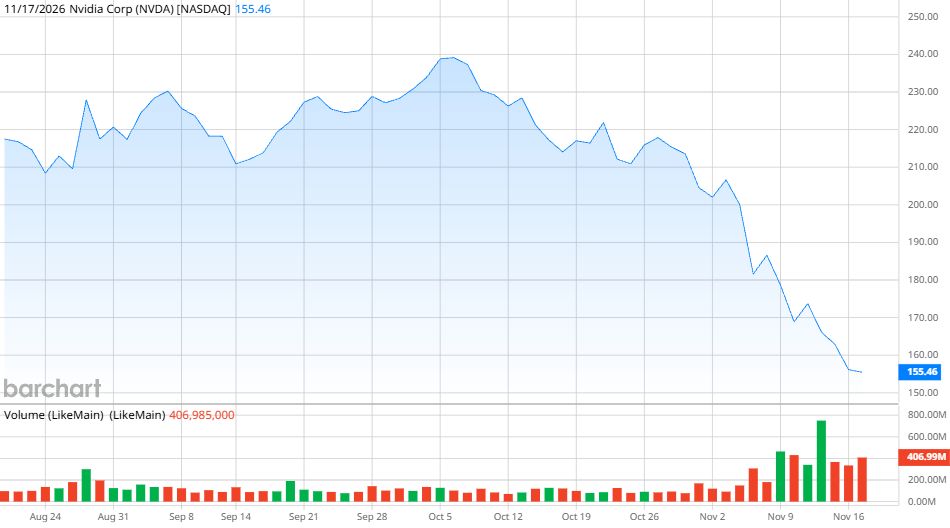
As if Nvidia (NVDA) wasn’t having a bad enough month, there is another potential blow for the world’s leading AI chipmaker — and this one could hit the artificial intelligence chipmaker directly in the pocketbook.
According to The Financial Times, Nvidia could face substantial legal expenses from shareholder lawsuits surrounding former CEO Jensen Huang’s sudden departure because its executive liability insurance doesn't provide coverage for the company itself. The report, citing people familiar with Nvidia's insurance policies, raises questions about how much the company could have to pay as investors pursue legal claims related to Huang's resignation.
More Top Stocks Daily: Go behind Wall Street’s hottest headlines with Barchart’s Active Investor newsletter.
The timing is particularly interesting. Nvidia is facing growing pressure to bring Huang back, even as its board says the company is moving forward without him.
Nvidia's Unusual Insurance Arrangement
The Financial Times reported that Nvidia carries up to $900 million in directors and officers liability insurance, commonly called D&O insurance. However, that coverage protects the personal assets of its executives and directors, and not the company’s balance sheet.
D&O insurance typically comes in three categories: Side A to shield executives and directors against certain personal liabilities, Side B to reimburse companies when they indemnify those individuals, and Side C for claims against the company itself. Nvidia reportedly purchased only Side A coverage. That leaves it potentially responsible for its own legal expenses and damages from shareholder lawsuits, including claims alleging that investors suffered losses because the company failed to disclose material information.
 www.barchart.com
That’s a huge issue right now, as the entire semiconductor industry is reeling from Huang’s Nov. 11 resignation. Huang was forced out after the board began investigating allegations that he had an extramarital affair with a Chinese businesswoman who U.S. intelligence officials believe is a Chinese spy. There are also other allegations that Huang had relationships with at least two Nvidia employees, including an executive who reported directly to him.
Shareholders filed a proposed class-action lawsuit alleging that Nvidia and Huang made false or misleading statements concerning his relationship with Megaspeed executive Alice Huang. It’s not clear what the litigation could cost Nvidia.
Pressure builds for Huang's return
Huang’s departure prompted calls for his reinstatement from some of the biggest names in technology and politics. Tesla (TSLA) and SpaceX (SPCX) CEO Elon Musk publicly supported Huang's return, while President Donald Trump also expressed support for bringing him back. Nvidia employees have joined the campaign, and Huang himself said on X that he would be willing to return if the board asked.
But Nvidia's board isn't interested. During Nvidia’s earnings call following the company’s fiscal 2027 third-quarter earnings report on Tuesday, Chairman Harvey Jones ruled out reinstating Huang as CEO and said the company would proceed with its search for a permanent replacement. Interim CEO Colette Kress, Nvidia's longtime finance chief, continues to lead the company.
So, Nvidia is in a position that I don’t think anyone could have projected just a few weeks ago. It has serious legal exposure triggered by Huang’s actions, and mounting pressure from customers, employees, and political figures who want him back.
And yet, its underlying business is delivering extraordinary results.
Nvidia's Earnings Tell a Different Story
Nvidia reported quarterly revenue of $115.84 billion on Tuesday, up 103% from a year earlier. That topped Wall Street's expectations of approximately $109.1 billion. Data center revenue was $107.6 billion, up 110%, as customers continued spending heavily on AI computing infrastructure.
Management issued fourth-quarter revenue guidance of $130 billion, exceeding the $125.1 billion consensus estimate compiled by LSEG. However, the fourth quarter includes an extra week this year, which contributes to the sequential revenue increase.
But the more revealing number may be Nvidia's outlook for fiscal 2028. Management increased its revenue guidance from a growth rate of 70% to 75%. That suggests to me that Nvidia remains confident in its relationships with customers, manufacturing partners, and suppliers despite losing the executive who spent decades building those connections.
 www.barchart.com
Wall Street Weighs In on Nvidia
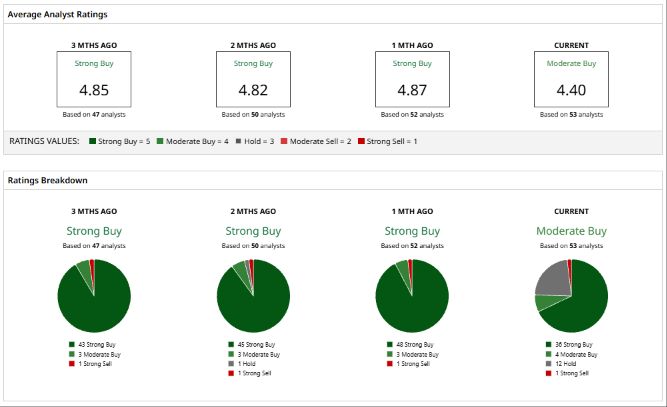
Nvidia has been a Wall Street darling for a long time. But analysts are noticeably muted following the company’s earnings report Tuesday. Most of them still have buy ratings, but many are tempering their price targets. For example:
Morgan Stanley analyst Joseph Moore: Buy rating, but cut the price target from $267 to $260 UBS analyst Timothy Arcuri: Buy rating, but cut the price target from $240 to $220 TD Cowen analyst Joshua Buchalter: Buy rating, affirmed price target of $200. Jefferies analyst Blayne Curtis: Buy rating, cut price target from $300 to $250.Those ratings aren’t a surprise. A lot is going on with Nvidia right now, and the market is smart to pause before giving the chipmaker full-throated support. And its liability issues outlined by The Financial Times should not be discounted.
For me, Nvidia is still a buy. I’m not surprised at all by the earnings beat this quarter — the quarter had already closed before Huang’s resignation — but I’m heartened by the revenue guidance increase for fiscal 2028. If Nvidia can keep its relationships intact in the post-Huang era, the company should be able to weather this storm. But it’s not going to be a smooth ride.
On the date of publication, Patrick Sanders had a position in: NVDA . All information and data in this article is solely for informational purposes. For more information please view the Barchart Disclosure Policy here.
More news from Barchart
Nvidia’s Jensen Huang Scandal Just Got More Expensive Billionaire Brad Gerstner Is Betting $5 Billion on the Anthropic IPO. The Smart Money Is Shrugging Off the AI Panic. As Tesla Plans to Roll Out the Cybercab for Individual Use, TSLA Stock Is a Tough Nut to Crack AMD Shares Climb as CEO Lisa Su Brushes Off Nvidia's Huang Turmoil, But the Real Opening Isn't Demand