

Vistra Corp. (VST), headquartered in Irving, Texas, is a Fortune 500 integrated electricity and power-generation company. It generates electricity from natural gas, nuclear, coal, solar, and battery-storage facilities and supplies retail electricity and natural gas to millions of residential, commercial, and industrial customers across the U.S. The company has a market capitalization of $40.97 billion.
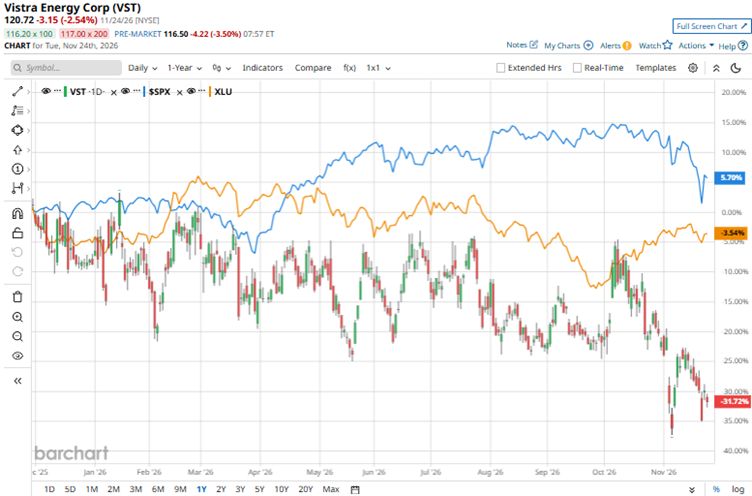
Vistra’s stock is down mainly because investors have reduced expectations for power-price and data-center-demand growth that drove its prior surge. Over the past 52 weeks, the stock has dropped 31.1%, while it has declined 22.8% over the past six months. The company’s shares reached a 52-week low of $110.89 on Nov. 5, but are up 8.9% from that level.
More Top Stocks Daily: Go behind Wall Street’s hottest headlines with Barchart’s Active Investor newsletter.
Meanwhile, the broader S&P 500 Index ($SPX) has gained 7.4% over the past 52 weeks but dropped 3.6% over the past six months, respectively, indicating the stock has underperformed the broader market over the past year. Next, we compare the stock with its own sector. The State Street Utilities Select Sector SPDR ETF (XLU) has dropped 2.6% over the past 52 weeks and 4.3% over the past six months. As a result, the stock has underperformed its sector over these periods.
 www.barchart.com
This summer, Vistra faced record weather across its markets, including new all-time peak-demand records in ERCOT and PJM in July. Throughout this period, the company's fleet maintained nearly 95% commercial availability. The company also added 5,500 MW of new natural gas-fueled generation with the Cogentrix acquisition. Its Q3 net income jumped from $652 million to $1.14 billion year-over-year (YOY). Adjusted EBITDA in the Texas segment increased from $784 million to $1.23 billion over the same period.
However, Vistra also faces some uncertainties. Investors will watch whether rising AI-driven electricity demand can offset growing political risks in Texas, where a recent Democratic election sweep sparked a sharp selloff
For the current quarter, Wall Street analysts expect Vistra’s diluted EPS to decrease 13.8% YOY to $1.88. However, EPS is expected to rise 65.4% YOY to $8.70 in fiscal 2026, followed by a 20.9% increase to $10.52 in fiscal 2027. The company surpassed consensus EPS estimates in three of the four trailing quarters.
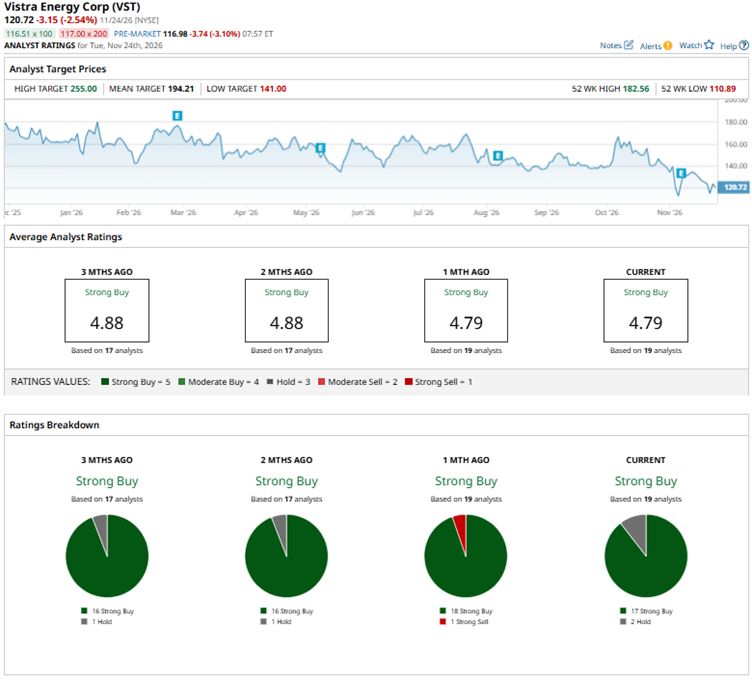
Among the 19 Wall Street analysts covering Vistra’s stock, the consensus is a “Strong Buy.” That’s based on 17 “Strong Buy” ratings and two “Holds.” The rating configuration has become less bullish compared to the prior month, with 17 “Strong Buy” ratings, down from 18.
 www.barchart.com
Recently, Bernstein analyst Sunaina Ocalan maintained an “Outperform” rating and slightly raised the price target from $181 to $182. The stock’s mean price target of $194.21 implies 60.9% upside from current market prices. Moreover, the Street-high price target of $255 implies a potential upside of 111.2%.
On the date of publication, Anushka Dutta did not directly have a position in any of the securities mentioned in this article. All information and data in this article is solely for informational purposes. For more information please view the Barchart Disclosure Policy here.
More news from Barchart
Protect Your Portfolio from a Rainy Day with This Insurance Stock – Up 40% in 2026 Nvidia Stock Trades at Attractive Valuations as Spy Scandal Headwinds Wane Nvidia Is Facing a Potential Criminal Case in California. NVDA Investors Should Brace for Another Drawdown. Nutanix Posts a Record 32.1% Margin, But a CEO Exit and Shrinking Backlog Spark a 19% Stock Plunge