


Microsoft MAI Code 2 is taking aim at a question increasingly important to the AI business: how much does it cost to get useful coding work finished, rather than simply buy access to the smartest model?
At Ignite on November 17, Microsoft introduced new coding models alongside a wider specialised-model lineup. Its headline claim is aggressive: Code 2 delivers 98% of GPT-6.1 Sol’s performance at 40% of the cost, and 96% of Claude Opus 5.5’s performance at just 5% of the cost.
The company’s detailed comparison supplies an important qualification. The results concern selected coding evaluations, and the MAI cost calculation uses a 50% promotional price. They are not a promise that every customer’s engineering bill will fall by the advertised percentage.
Microsoft MAI Code 2 targets everyday engineering
Microsoft says Code 2 is designed for common enterprise coding work, including debugging, changes across files and user interfaces. Code 2 Flash is aimed at high-volume tasks such as explanations, targeted edits and routine fixes.
The company explicitly says the models are “not yet tuned for harder problems,” including fundamental science and very long-running agent work. That narrows the claim: the pitch is useful performance in recurring workloads, rather than superiority across every demanding AI task.
Code 2 and Code 2 Flash are available in GitHub Copilot, with Flash also in limited-access preview in Microsoft Foundry. Distribution matters because a model already present in a developer’s workflow can be tested without rebuilding an entire toolchain.
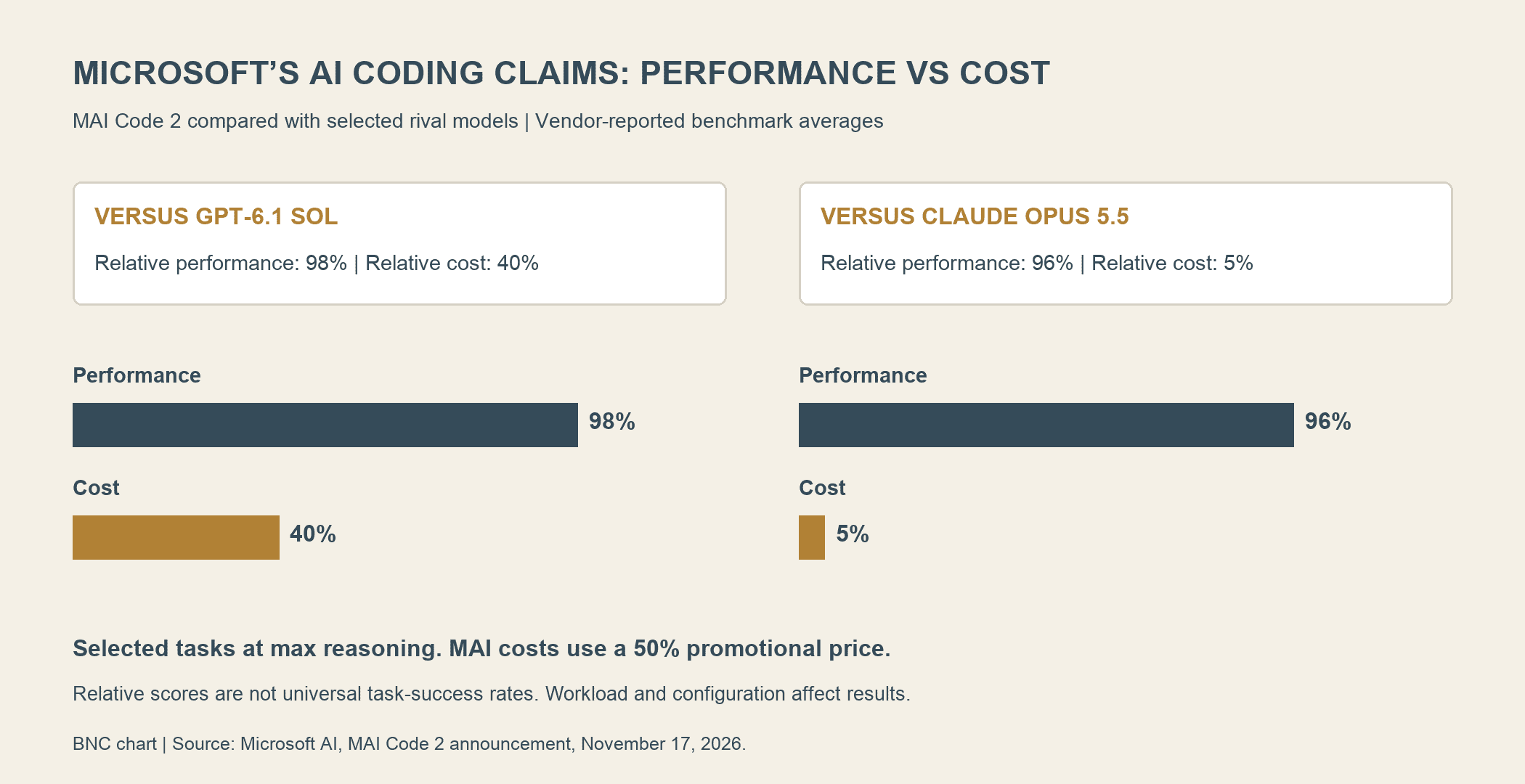 BNC chart of Microsoft’s November 17 claims, not a BNC replication. Selected benchmarks at max reasoning; MAI Code 2 costs use its 50% promotional price. Results are not universal task-success rates.
The benchmark footnotes change the buying question
The comparison averages four evaluations: DeepSWE 1.1, TerminalBench 2.1, SWE-Atlas and FrontierCode 1.1. Microsoft says models ran at maximum reasoning effort; three evaluations used its internal platform and GitHub Copilot CLI, without subagents.
That describes a particular test configuration. Different prompts, tools, effort settings and repositories can produce different costs and results. An average relative score also does not mean the model successfully completes 98% of arbitrary coding requests.
A promotional price is a second variable. The operating question is whether the economics remain attractive under the terms a customer will actually pay. A useful procurement comparison should record the promotion, its conditions and the expected price after it ends.
Nor does low token pricing alone determine the final bill. A model that needs several retries or lengthy review can cost more per accepted change than a more expensive model that completes the assignment correctly first time.
Specialised AI gives Microsoft another competitive route
The broader Ignite announcement presents coding, cybersecurity, image, real-time speech and decision models as a family built for lower-cost deployment. It frames the opportunity around agents working continuously, where repeated inference becomes an operating expense.
For example, Microsoft says MAI Cyber 2 Flash matches GPT-6 Astra’s quality at less than 2% of the cost per task on CyberGymE2E. That is another vendor-reported result on a named benchmark, not evidence of equivalent performance in every defensive environment.
The strategic logic is straightforward. A provider does not need to lead every scientific or creative test to win a substantial volume of routine work. It can compete by matching what customers repeatedly need at a price they can sustain.
For buyers, that could support using different models for different assignments. A routine code explanation and an investigation across a complex production system need not justify the same spending level or supervision.
Licensed weights do not mean an unrestricted download
Microsoft also announced MAI Licensed Weights, describing a route for trusted customers to customise models with proprietary data and run them in their own Azure environment through its Frontier Company offering.
That is a different proposition from public open weights that anyone can download and run wherever they choose. The distinction concerns access, permitted deployment and the commercial relationship, rather than the word “weights” alone.
It also makes the competition about more than a benchmark leaderboard. A company may value control over adaptations, familiar infrastructure and security arrangements alongside model quality. Others may place greater value on deployment flexibility or avoiding dependence on a single cloud.
Better demonstrations still need production evidence
The model card reports safety and capability evaluations, including tests involving harmful requests, prompt injection and unauthorised actions. These assess specific scenarios; they do not establish that a coding agent can safely receive unrestricted access to a business.
BNC’s report on agents buying computing with Bitcoin examined the same underlying commercial issue from the payment side: automated work needs metering, spending limits and a reliable way to account for consumption.
Microsoft’s launch brings that argument back to the model itself. A convincing customer trial would compare accepted changes, elapsed time, review effort and total spending on representative jobs, using the actual configuration intended for deployment.
The new models make AI price competition more concrete. The unresolved question is whether benchmark savings survive contact with everyday engineering. For Microsoft, success will be customers repeatedly choosing its models after both the launch excitement and the introductory discount have passed.