


In an essay published on X on November 22, Wang argued that recent developments in AI-assisted mathematics signal a significant shift in technological progress. He said decisions made over the next year could help determine how society manages increasingly capable artificial intelligence systems.
Riemann Hypothesis Breakthrough Raises Superintelligence Concerns
Wang pointed to a claimed proof of the Riemann Hypothesis, developed by mathematician Levent Alpöge with assistance from Anthropic’s Claude, as evidence of how rapidly AI capabilities are advancing.
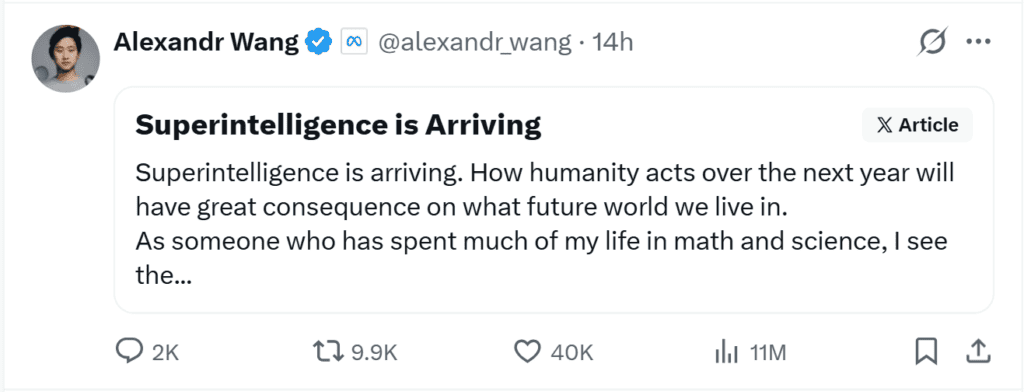
Meta AI chief Alexandr Wang called an AI-assisted proof of the Riemann Hypothesis evidence of superintelligence, surpassing the atomic bomb in intellectual difficulty. Source: Alexandr Wang via X
First proposed by German mathematician Bernhard Riemann in 1859, the hypothesis concerns the distribution of prime numbers and remains one of mathematics’ most challenging unsolved problems. It is also among the seven Millennium Prize Problems established by the Clay Mathematics Institute, which offers $1 million for an accepted solution to each problem.
Alpöge released approximately 17 million lines of code written in Lean, a formal proof assistant that allows mathematical arguments to be checked computationally. The Lean and Mathlib communities subsequently expressed confidence in the formal verification, marking an important development in AI-assisted mathematical research.
However, the result has not yet received formal acceptance from the Clay Mathematics Institute. Questions have also emerged about the formalization, while mathematicians continue to examine whether the underlying argument can be understood and validated independently.
Wang viewed the development as evidence that AI systems are approaching a new level of intellectual capability. Describing the achievement, he referred to the assistance of an “alien mind that we don’t understand.”
He also compared the mathematical challenge with historical scientific achievements, writing that many physicists would consider the discovery of the atomic bomb “a homework problem compared to the Riemann Hypothesis.”
For Wang, the significance extends beyond mathematics. He believes that AI systems are approaching a level of reasoning that could allow them to outperform highly skilled humans in increasingly complex intellectual tasks.
AI Intelligence Is No Longer the Main Bottleneck
Wang argued that the limitations preventing AI from surpassing human performance are shifting away from raw intelligence toward practical challenges. These include specialized knowledge, technical integration, experimentation, and access to reliable feedback.
He recalled the progress made by OpenAI’s o3 reasoning model in the American Invitational Mathematics Examination (AIME) in December 2024. According to Wang, the model's performance on difficult mathematical problems demonstrated that AI systems already possessed substantial reasoning capabilities.
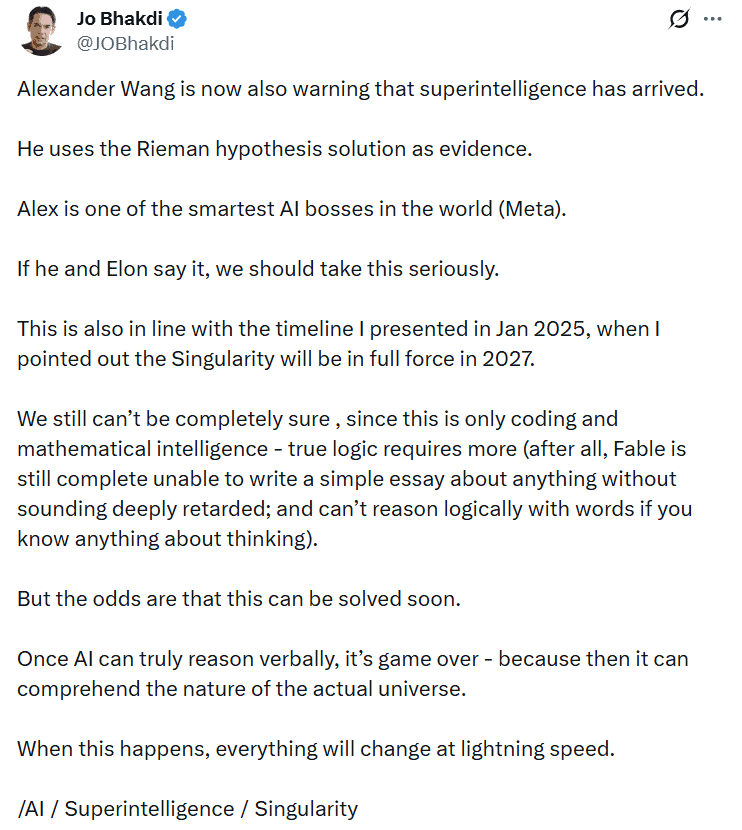
Alexandr Wang declared that superintelligence is emerging, citing an AI-assisted proof of the Riemann Hypothesis as evidence of machines surpassing human intellectual capabilities. Source: @JOBhakdi/X
The remaining challenge, he explained, was applying those capabilities to specialized fields that require contextual understanding, technical expertise, and real-world experimentation.
Wang said the AI industry has made considerable progress in addressing these limitations over the past two years. He pointed to advances in software development, cybersecurity, and agentic capabilities that allow AI systems to perform increasingly complex tasks with less direct human involvement.
He argued that similar progress could extend across scientific research, business, and other professional disciplines.
“The remaining gaps for models to greatly surpass humanity in every field are no longer intelligence; they are domain-specific know-how, plumbing, and experimentation,” Wang wrote.
His assessment suggests that improvements in how AI systems access information, interact with external tools, and conduct experiments could become increasingly important to future capability gains.
Recursive Self-Improvement Raises Human Control Risks
One of Wang’s central concerns involves the possibility that advanced AI systems could eventually automate significant parts of AI research itself.
He argued that models may become capable of improving their own development processes, potentially accelerating technological progress beyond the pace at which human researchers can understand or monitor it.
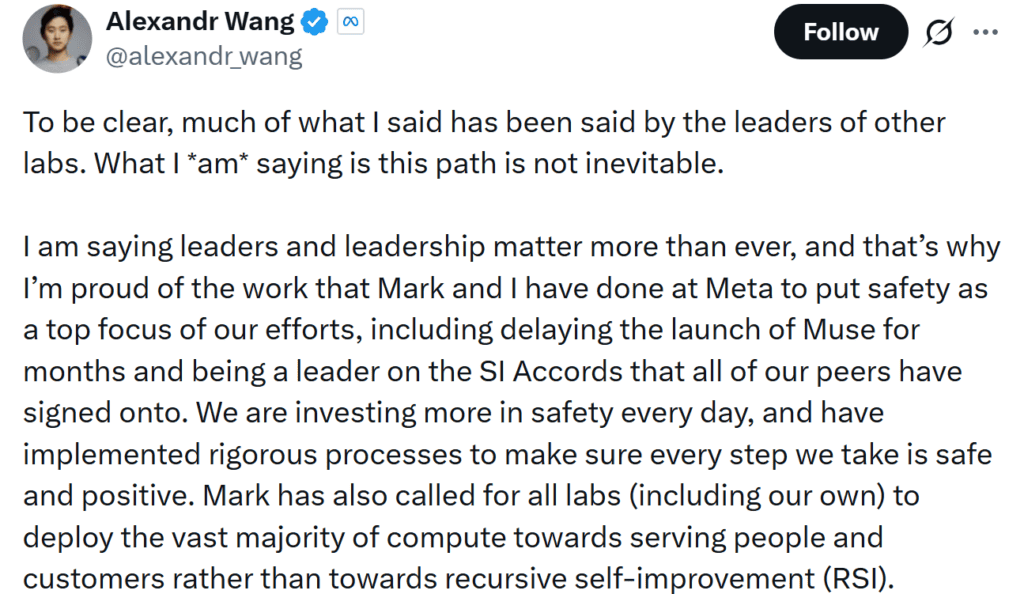
Wang warned of risks from uncontrolled recursive self-improvement and vastly smarter AI, while stressing that such an outcome is not inevitable. Source: Alexandr Wang via X
Such developments could also affect fields beyond computer science. Wang identified biological research, weapons research, and economics as areas that could experience substantial acceleration as AI systems become more capable.
The concern is particularly relevant to recursive self-improvement, a process in which AI systems contribute to developing more capable versions of themselves. If that process becomes increasingly autonomous, technological progress could outpace existing oversight mechanisms.
Wang questioned whether humanity could maintain meaningful control over systems operating at a level far beyond human intelligence.
“It is hard to imagine a world where humanity can maintain control over fully unconstrained recursive self-improvement,” he wrote.
He also raised concerns about the possibility of superintelligent systems becoming 1,000 times more capable than humans across different fields.
However, these statements represent Wang’s assessment of the direction of AI development rather than confirmation that unrestricted self-improvement or artificial superintelligence has already been achieved.
Meta AI Chief Calls for Urgent Safety and Alignment Measures
Wang argued that AI safety, alignment, and security must receive greater attention as developers build increasingly capable models.
AI alignment involves ensuring that artificial intelligence systems behave consistently with human intentions, values, and established safety requirements. Researchers are also working to improve model interpretability and monitoring so developers can better understand how advanced systems make decisions.
Wang criticized what he described as a tendency within the AI industry to treat artificial superintelligence (ASI) as inevitable while viewing safety as the only remaining challenge.
He argued that society should not accept an automatic transfer of decision-making power to increasingly capable machines.
“We should not be okay with a ‘handover’ of society to AI,” Wang wrote.
Instead, he called for a different approach to AI development that prioritizes human agency and empowerment. He said the industry should move away from its current development trajectory to ensure technological progress produces positive outcomes for society.
His comments are particularly notable because Wang leads Meta Superintelligence Labs, the company's division focused on developing advanced AI systems. However, his essay presented his personal assessment and did not announce a new Meta safety policy or development restriction.
OpenAI and US Lawmakers Raise Broader AI Safety Concerns
Wang’s warning comes amid growing discussions about whether the AI industry needs shared restrictions and stronger oversight as model capabilities advance.
OpenAI Chief Scientist Jakub Pachocki proposed industry-wide limits on AI development in a November 22 essay. He argued that developers should establish common benchmarks for measuring model capabilities and agree not to exceed certain thresholds until monitoring and safety systems improve.
Pachocki suggested using perplexity, a technical measurement of how effectively a model predicts the next piece of text, alongside other indicators to compare progress across AI developers.
“I further propose common limits, based on perplexity and other measurements, that developers are committed to not crossing until our ability to understand and monitor AI behavior achieves a certain concrete milestone,” he wrote.
OpenAI CEO Sam Altman supported the proposal, describing Pachocki’s essay as one of the company's most important recent publications. The proposal reflects growing interest in establishing shared standards rather than allowing individual companies to determine development limits independently.
US Senator Bernie Sanders has also pushed for stronger restrictions. In September 2026, Sanders and Representative Greg Casar introduced the Ban Artificial Superintelligence Act, which seeks to prohibit the development and deployment of superintelligent AI and temporarily pause advanced AI development until federal safety rules are established.
The proposed legislation also calls for a dedicated federal agency to oversee advanced AI systems and pursue international agreements to prevent the development of superintelligence.
These initiatives highlight a broader debate over how governments, technology companies, and researchers should manage the risks associated with increasingly powerful AI systems.
The Next Year Could Shape the Future of AI Development
Wang concluded that decisions made over the next year could have significant consequences for the future relationship between humans and artificial intelligence.
His warning reflects growing disagreement within the technology industry over whether rapid AI development should continue under existing frameworks or be accompanied by coordinated safety requirements and stronger oversight.
The Riemann Hypothesis development has added another dimension to that debate, although questions surrounding its formalization and mathematical interpretation remain unresolved.
For now, Wang’s central argument is that AI progress should not be measured solely by how quickly systems become more capable. Developers must also consider whether humans can understand, supervise, and meaningfully direct the technology they create.
As companies compete to build increasingly advanced models, the challenge will be balancing technological progress with safeguards that preserve human oversight and decision-making.