


Lennar Corporation LEN is navigating a housing market where affordability matters more than pricing power. Buyers remain stretched, mortgage rates have stayed in the mid-to-upper 6% range and demand remains uneven.
That backdrop is pushing Lennar toward volume discipline, cost control, land flexibility and technology investment. Those same conditions are keeping margins under pressure.
LEN Is Built for an Affordability Cycle
Lennar’s strategy fits a market that rewards attainable pricing. In the second quarter of fiscal 2026, the company delivered 20,519 homes, up 2% year over year, even as new orders declined 4% to 21,749 homes.
Pricing flexibility remains central to that approach. Average selling prices on homes delivered fell 5% year over year to $371,000, reflecting weak demand and affordability support.
Lennar Corporation Price and Consensus
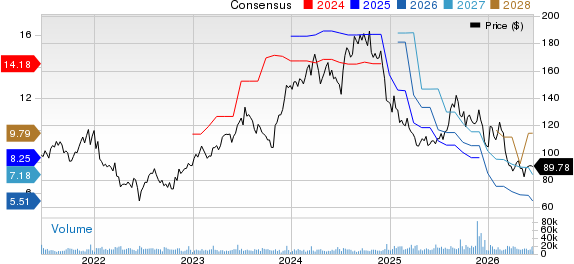
Lennar Corporation price-consensus-chart | Lennar Corporation Quote
Even-flow production also matters. By matching starts, sales and closings, Lennar aims to protect market share and improve inventory efficiency rather than wait for higher prices.
D.R. Horton DHI and PulteGroup PHM face the same affordability-sensitive homebuilding cycle. Their inclusion in Lennar’s peer set reinforces that the pressure reflects broader demand friction.
Lennar Technology Push Aims to Lift Efficiency
Lennar is trying to make the affordability cycle more manageable through technology. The company is investing in digital marketing, lead generation and customer conversion capabilities to improve responsiveness.
Its technology effort extends beyond the customer interface. Lennar is developing a technology-enabled land operating system intended to improve diligence, land acquisition and administration and reduce costs.
The goal is to operate more like a manufacturing homebuilder, with better data across land, product, construction, sales and customer experience. Payoff is longer term.
Technology spending can help execution, but adds near-term expense while revenue per home is under pressure.
LEN Costs and Cycle Times Are Improving
Lennar’s efficiency gains are the clearest counterweight to the pricing challenge. Construction cost per square foot declined to $81 in the second quarter and has fallen 13% over the past two years.
Cycle time improved to a record-low 121 days from 132 days a year earlier. Faster builds help reduce capital tied up in inventory and support more predictable delivery schedules.
Inventory turns improved to 2.5 times from 1.8 times a year ago. That matters because Lennar’s model depends on turning homesites and finished homes quickly enough to preserve activity in a weaker pricing environment.
Its land-light structure adds flexibility. At the end of the quarter, roughly 98% of homesites were controlled through third parties, while only about 2% were owned.
Lennar Margins Show the Industry Trade-Off
The margin picture shows why the stock remains pressured despite operational progress. Home sales gross margin improved sequentially to 15.6%, and incentives declined to 12.9% from 14.1% in the prior quarter.
Still, profitability remains well below last year’s level. Gross margin was 17.8% in the year-ago quarter, reflecting lower revenue per square foot and higher land costs, partly offset by lower construction costs.
Selling, general and administrative expenses remain elevated. They represented 9.2% of home sales revenues in the second quarter, up from 8.8% a year earlier, mainly because of lower revenue leverage and higher marketing and selling expenses.
This is the core industry trade-off. Builders can keep activity moving with incentives, price adjustments and faster turns, but profit per home can remain under pressure.
What LEN Ratings Say About This Trend
The bottom line is that Lennar’s operating model is improving, but the market is still focused on earnings and margin pressure. Lower construction costs, faster cycle times and a land-light model are positives, yet they have not fully offset affordability headwinds.
LEN currently carries a Zacks Rank #5 (Strong Sell). That ranking reflects weaker earnings estimate trends over the one-to-three-month horizon, which keeps the stock’s near-term setup cautious.
You can see the complete list of today’s Zacks #1 Rank (Strong Buy) stocks here.
The Style Scores also lean negative. LEN has a VGM Score of F, Value Score of D, Growth Score of F and Momentum Score of D. Since Style Scores complement the Zacks Rank, those weak grades suggest the stock lacks support across valuation, growth and momentum characteristics.
Lennar’s efficiency trends matter, but the current ratings show that those positives have not yet outweighed the pressure from lower pricing, elevated expenses and a difficult housing cycle.
Research Chief Names "Single Best Pick to Double"
From thousands of stocks, 5 Zacks experts each have chosen their favorite to skyrocket +100% or more in months to come. From those 5, Director of Research Sheraz Mian hand-picks one to have the most explosive upside of all.
This company targets millennial and Gen Z audiences, generating nearly $1 billion in revenue last quarter alone. A recent pullback makes now an ideal time to jump aboard. Of course, all our elite picks aren’t winners but this one could far surpass earlier Zacks’ Stocks Set to Double like Nano-X Imaging which shot up +129.6% in little more than 9 months.
Free: See Our Top Stock And 4 Runners UpWant the latest recommendations from Zacks Investment Research? Today, you can download 7 Best Stocks for the Next 30 Days. Click to get this free report
PulteGroup, Inc. (PHM): Free Stock Analysis Report
Lennar Corporation (LEN): Free Stock Analysis Report
D.R. Horton, Inc. (DHI): Free Stock Analysis Report
This article originally published on Zacks Investment Research (zacks.com).