

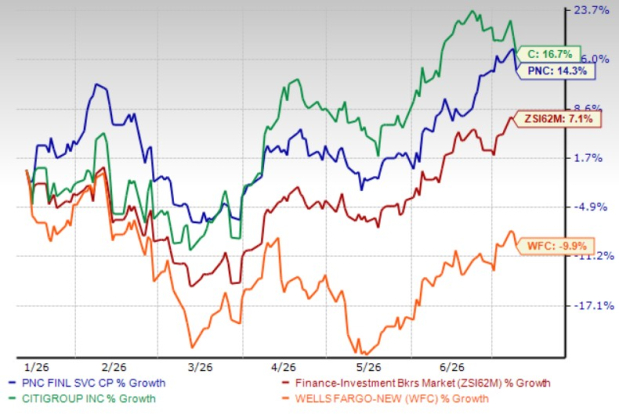
The PNC Financial Services Group, Inc. PNC shares have gained 14.3% in the past six months, outperforming the industry’s growth of 7.2%. Its close peers, Citigroup Inc. C, have gained 16.7%, whereas shares of Wells Fargo WFC have lost 9.9% during the same time period.
Price Performance
Image Source: Zacks Investment Research
Can PNC shares continue gaining after their recent strength? Let’s take a closer look.
What’s Aiding PNC’s Performance?
Business Expansion Through Strategic Acquisitions: PNC Financial has been actively expanding its business through strategic acquisitions and partnerships to strengthen its market presence and diversify its revenue base. In January 2026, the company acquired FirstBank Holding Company, substantially expanding its franchise in Colorado and Arizona. The acquisition added 95 branches and $26.8 billion in assets, with management expecting the deal to contribute nearly $1 per share to earnings by 2027. Further, the successful conversion of 780,000 FirstBank customers, more than 1,620 employees and all 95 branches in June 2026 marked the completion of a major integration milestone.
Beyond expanding its banking footprint, PNC Financial has continued to enhance its product offerings and investment banking capabilities. In August 2025, it acquired Aqueduct Capital Group to strengthen the fund placement capabilities of Harris Williams. In 2024, the company partnered with Plaid to facilitate secure customer data sharing and expanded its alliance with TCW Group to offer private credit solutions to middle-market companies. These strategic initiatives are expected to support revenue diversification and drive long-term growth.
Solid Liquidity and Capital Strength Drive Shareholder Value: The company maintains a solid liquidity and capital position. As of March 31, 2026, its total available liquidity (comprising cash and due from banks, and interest-earning deposits in banks) was $31.7 billion, while long-term debt totaled $63.9 billion, with no short-term borrowings. Further, in June 2026, PNC cleared the Federal Reserve’s 2026 stress test, with its Common Equity Tier 1 (CET1) ratio of 10.1% comfortably exceeding its stress capital buffer-based regulatory requirement of 7%. Backed by this capital strength, the company raised its quarterly common stock dividend by 18% to $2 per share in July 2026.
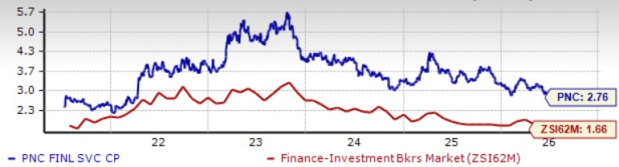
Over the past five years, PNC has increased its dividend six times, delivering a five-year annualized dividend growth rate of 6%. Further, its current dividend yield of 2.76% compares favorably with the industry's average of 1.66%.
Dividend Yield
Image Source: Zacks Investment Research
Likewise, its peers, WFC and C, also announced plans to increase dividends following the 2026 Fed’s stress test. Wells Fargo intends to raise its third-quarter 2026 common stock dividend by 11% to 50 cents per share, subject to board approval, while Citigroup plans to increase its quarterly common stock dividend by 12% to 67 cents per share beginning in the third quarter of 2026, subject to quarterly board approval.
Apart from regular dividend hikes, PNC also returns capital through share repurchases. The company has an existing authorization to repurchase up to 100 million common shares, with nearly 32 million shares remaining under the program as of March 31, 2026. Given its strong liquidity and capital position, PNC's capital deployment initiatives appear sustainable and are expected to continue enhancing shareholder value.
Steady Growth in Loans and Deposits: The company continues to benefit from steady growth in its loan and deposit balances, supported by a strong balance sheet and strategic expansion initiatives. Its total loans and deposits recorded a compound annual growth rate (CAGR) of 5.5% and 7.3%, respectively, between 2019 and 2025. The growth momentum continued in the first quarter of 2026, with both loan and deposit balances increasing year over year. The acquisition of FirstBank further strengthened the company's balance sheet, adding nearly $16 billion in loans and $23 billion in deposits during the quarter. Earlier, in 2023, PNC Financial acquired approximately $16 billion of loan commitments from Signature Bank, enhancing its lending capacity.
Looking ahead, a well-diversified deposit base, continued growth in commercial and operational deposits and a relatively favorable interest rate environment are expected to support loan demand. Reflecting these tailwinds, management expects average loan balances to grow nearly 11% year over year in 2026, up from its earlier expectation of about 8% growth.
Expansion of Branch Network: PNC Financial continues to invest in its retail banking franchise through an aggressive branch expansion strategy. In November 2025, the company increased its planned investment in branch expansion to nearly $2 billion from the $1.5 billion announced in 2024. The initiative includes opening more than 300 branches across nearly 20 U.S. markets, renovating its entire branch network by 2029 and hiring more than 2,000 employees by 2030.
The company's focus on expanding in high-growth markets has already supported customer acquisition and checking account growth. Going forward, the expanded branch network is expected to strengthen PNC Financial's retail banking presence, deepen customer relationships and support sustainable revenue growth.
Few Concerns Prevail for PNC
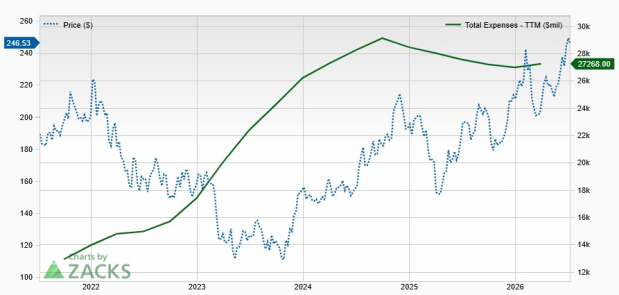
Persistent Expense Pressure: PNC Financial continues to witness an increase in operating expenses. The company's non-interest expenses recorded a CAGR of 4.6% between 2019 and 2025, with the upward trend continuing in the first quarter of 2026. While the company exceeded its 2025 Continuous Improvement Program cost-saving target, merger integration costs and continued investments in technology, branch expansion and personnel are expected to keep expenses elevated in the near term.
Total Expense Trend
Image Source: Zacks Investment Research
Loan Portfolio Concentration: The company's loan portfolio remains heavily concentrated in commercial lending. As of March 31, 2026, commercial loans accounted for 70% of total loans. Despite a diversified commercial portfolio, persistent weakness in office real estate and an uncertain macroeconomic environment remain concerns. Commercial loans accounted for 61.5% of total non-performing loans and 47.4% of net charge-offs as of March 31, 2026. Further, management expects commercial real estate charge-offs, particularly in the office segment, to remain elevated, posing risks to asset quality if economic conditions weaken.
Parting Thoughts on PNC
PNC Financial's strategic acquisitions, expanding branch network, steady loan and deposit growth and solid liquidity position are expected to support its long-term financial performance.
Over the past week, the Zacks Consensus Estimate for 2026 earnings per share has been revised upward, while the estimate for 2027 has been revised downward.
Estimate Revision Trend
Image Source: Zacks Investment Research

The expected estimates imply growth of 13.5% and 11.4% for 2026 and 2027, respectively.
However, persistent expense pressure and the company's significant exposure to commercial lending remain key near-term headwinds. Additionally, the Fed's signal of a possible rate hike later in 2026 might put additional pressure on asset quality.
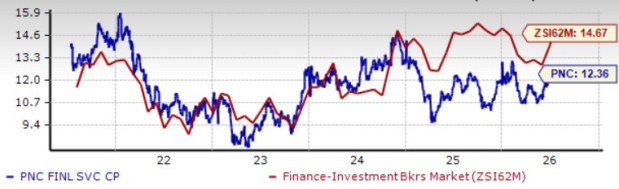
From a valuation perspective, PNC stock appears inexpensive relative to the industry. It is currently trading at a forward 12-month price-to-earnings (P/E) multiple of 12.36X, below the industry's 14.67X. Meanwhile, Wells Fargo and Citigroup trade at P/E multiples of 11.51X and 11.73X, respectively.
Price-to-Earnings F12 M
Image Source: Zacks Investment Research
Investors already holding the stock may consider retaining their positions, given PNC Financial's diversified growth initiatives, solid liquidity profile and sustainable capital deployment strategy. Those considering fresh investments may prefer to wait for a more favorable entry point until there is greater clarity on expense trends and commercial credit quality.
Currently, PNC Financial carries a Zacks Rank #3 (Hold). You can see the complete list of today's Zacks #1 Rank (Strong Buy) stocks here.
Radical New Technology Could Hand Investors Huge Gains
Quantum Computing is the next technological revolution, and it could be even more advanced than AI.
While some believed the technology was years away, it is already present and moving fast. Large hyperscalers, such as Microsoft, Google, Amazon, Oracle, and even Meta and Tesla, are scrambling to integrate quantum computing into their infrastructure.
Senior Stock Strategist Kevin Cook reveals 7 carefully selected stocks poised to dominate the quantum computing landscape in his report, Beyond AI: The Quantum Leap in Computing Power .
Kevin was among the early experts who recognized NVIDIA's enormous potential back in 2016. Now, he has keyed in on what could be "the next big thing" in quantum computing supremacy. Today, you have a rare chance to position your portfolio at the forefront of this opportunity.
See Top Quantum Stocks Now >>Want the latest recommendations from Zacks Investment Research? Today, you can download 7 Best Stocks for the Next 30 Days. Click to get this free report
The PNC Financial Services Group, Inc (PNC): Free Stock Analysis Report
Wells Fargo & Company (WFC): Free Stock Analysis Report
Citigroup Inc. (C): Free Stock Analysis Report
This article originally published on Zacks Investment Research (zacks.com).