


Morgan Stanley’s MS second-quarter 2026 call centered less on the earnings beat and more on how management sees the firm extending its advantage across wealth, institutional trading and advisory activity. The company reported EPS of $3.46, which topped the Zacks Consensus Estimate of $2.89. It generated revenues of $21.35 billion, beating the Zacks Consensus Estimate of $19.6 billion.
Morgan Stanley Price, Consensus and EPS Surprise
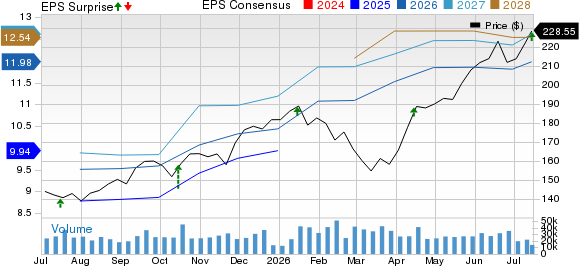
Morgan Stanley price-consensus-eps-surprise-chart | Morgan Stanley Quote
The bigger message was about durability. Executives framed the quarter as proof that the integrated model is gaining traction while client activity, IPO issuance and AI-related capital needs keep expanding.
MS Leans Harder on the Wealth Funnel
Chairman and CEO Ted Pick said Wealth and Investment Management client assets reached $10 trillion, including $8 trillion in stand-alone wealth assets, as the firm pushes to deepen relationships across adviser-led and E*TRADE channels. Chief financial officer Sharon Yeshaya said Wealth Management posted record revenues of $8.9 billion and pretax profit of $2.7 billion.
The key operating metric was net new assets. Yeshaya said Morgan Stanley gathered a record $148 billion in NNA, with stock plan IPO flows contributing just over half of that total, underscoring how workplace relationships are feeding the advisory pipeline.
In Q&A, a BofA Securities analyst pressed on whether workplace-driven flows are near a peak. Yeshaya argued the opportunity remains broad because the firm serves about 70% of the top 100 unicorns by market cap in its workplace pipeline and is still investing in referrals, product capabilities and adviser matching tools to improve retention and conversion.
Morgan Stanley Sees Broader Market Activity
Institutional Securities delivered record revenues of $11 billion and pretax profit of $4.3 billion, helped by a standout equities franchise and a firmer investment-banking backdrop. Yeshaya said investment-banking revenues rose 58% year over year to $2.4 billion, with strength across advisory, equity underwriting and fixed income underwriting.
Equities revenues reached a record $6.3 billion, while fixed income produced $2.5 billion. Management tied that performance to stronger client engagement across regions, especially in Asia, as well as multiyear investments in technology, risk management and franchise scale.
When asked by KBW about pipeline depth, Yeshaya said activity is broadening beyond the Americas, with Asia and other regions building. Pick added that improving regulatory conditions, a healthier IPO market and pent-up strategic demand are creating a more favorable backdrop for both M&A and capital raising.
MS Keeps Investing While Holding Margin Discipline
Yeshaya said the firm’s year-to-date efficiency ratio was 65%, with operating leverage offsetting higher execution-related costs and continued strategic spending. She said technology-led expense growth reflects infrastructure investment, AI-enabled efficiencies and business expansion.
Within wealth, the pretax margin was 30.5%. Asked whether that level can move structurally higher, Pick said management is not resetting targets midyear and is more focused on driving pretax profit growth than solving for a specific margin number.
That answer carried an important signal. Even after surpassing the 30% benchmark multiple times, management still appears willing to absorb near-term investment costs if they support wallet share gains and extend the runway for fee-based asset growth.
Morgan Stanley Ties AI to Advisory Demand
Pick used the call to sharpen a broader strategic theme around AI and geopolitics. He said enterprise AI adoption and a more fragmented global order are reshaping supply chains, capital allocation and client demand for advice.
In response to a Wells Fargo analyst, Pick said Morgan Stanley research now sees data-center capital spending reaching about $850 billion in 2026, $1.3 trillion in 2027 and potentially $1.5 trillion in 2028. He said that could leave the industry only 10% to 15% through a much longer AI investment cycle.
His point was not that Morgan Stanley can call the exact size of the cycle, but that the firm expects a meaningful role as adviser, underwriter and capital allocator as companies finance that build-out across private and public markets.
MS Defends Its Competitive Position in the Workplace
A Wolfe Research analyst asked about rising competition from smaller RIAs in workplace solutions. Yeshaya argued Morgan Stanley’s moat starts with corporate coverage and the integrated-firm model, then extends through financial wellness tools, adviser matching and a broader product set.
She also drew a line between Morgan Stanley’s workplace capabilities and its investment-banking franchise. The firm’s ability to win IPO-related corporate relationships, she said, gives it access to asset flows that smaller competitors cannot easily replicate.
That exchange reinforced a recurring message from the quarter: management views the workplace not as a narrow channel, but as the top of a long-duration acquisition funnel that links corporate relationships, employee assets and advice-based retention.
Morgan Stanley Enters the Back Half With Flexibility
The other major theme was balance-sheet strength. Morgan Stanley ended the quarter with a standardized CET1 ratio of 14.8%, repurchased $1.5 billion of stock and raised its quarterly dividend 15% to $1.15 per share.
Pick said excess capital gives the firm room to support clients, invest organically and consider selective bolt-on deals, though he emphasized that the bias remains toward organic deployment. The tone throughout the call was confident but disciplined, with management repeatedly stressing higher highs and higher lows through the cycle.
Zacks Signals for MS
MS carries a Zacks Rank #3 (Hold) at present, along with a Value Score of D, Growth Score of B, Momentum Score of A and VGM Score of B. That mix points to stronger growth and momentum characteristics than value support, while the VGM Score suggests a relatively balanced profile across styles.
The strongest setups typically pair a Zacks Rank #1 (Strong Buy) or 2 (Buy) with A or B Style Scores, while a Zacks Rank #3 can still be held, but is a less favorable signal. The current rank can also change as earnings estimate revisions adjust following the quarter’s results and management commentary. You can see the complete list of today’s Zacks #1 Rank stocks here.
Research Chief Names "Single Best Pick to Double"
From thousands of stocks, 5 Zacks experts each have chosen their favorite to skyrocket +100% or more in months to come. From those 5, Director of Research Sheraz Mian hand-picks one to have the most explosive upside of all.
This company targets millennial and Gen Z audiences, generating nearly $1 billion in revenue last quarter alone. A recent pullback makes now an ideal time to jump aboard. Of course, all our elite picks aren’t winners but this one could far surpass earlier Zacks’ Stocks Set to Double like Nano-X Imaging which shot up +129.6% in little more than 9 months.
Free: See Our Top Stock And 4 Runners UpWant the latest recommendations from Zacks Investment Research? Today, you can download 7 Best Stocks for the Next 30 Days. Click to get this free report
Morgan Stanley (MS): Free Stock Analysis Report
This article originally published on Zacks Investment Research (zacks.com).