

The restaurant industry continues to face an uneven operating backdrop as value-conscious consumers, intense competition and elevated labor and commodity costs pressure traffic and margins. Even so, companies with differentiated brands, expanding digital ecosystems and credible growth strategies remain better positioned to create long-term value. Chipotle Mexican Grill, Inc. CMG and The Wendy’s Company WEN are attracting attention for very different reasons. Wendy’s recently climbed to a more than seven-month high in a retail-driven, meme-like rally, while Chipotle opened its first restaurant in Mexico and is preparing for further expansion.
Chipotle is advancing its Recipe for Growth strategy through faster menu innovation, deeper rewards engagement, technology investments and continued restaurant expansion. Wendy’s, meanwhile, is pursuing its Project Fresh turnaround, but persistent U.S. traffic declines, compressed restaurant margins and elevated leverage continue to cloud the recovery. With Chipotle building on improving transaction momentum and Wendy’s facing a more demanding execution path, which restaurant stock offers the stronger investment case now? Let’s take a closer look.
Chipotle’s Recipe for Growth Strategy Gains Traction
Chipotle continues to build momentum around its Recipe for Growth strategy, which centers on stronger restaurant execution, faster menu innovation, deeper digital engagement and disciplined unit expansion. The company returned to positive transaction growth in the first quarter of 2026, while revenues increased 7.4% year over year to $3.1 billion and comparable restaurant sales rose 0.5%.
Menu innovation remains an important demand driver. The high-protein campaign, the return of Chicken Al Pastor and the launch of Cilantro Lime Sauce helped generate incremental transactions and attract new customers. Management noted that protein-based limited-time offerings typically produce several hundred basis points of transaction lift, with part of that benefit continuing even after the promotional window ends. The return of Chipotle Honey Chicken, along with additional beverage, side and protein launches planned for the remainder of the year, should help sustain customer interest and reinforce traffic momentum.
Chipotle is also strengthening customer engagement through its refreshed rewards platform. Loyalty-linked sales accounted for 32% of total sales in the first quarter, up 300 basis points year over year, while daily enrollments increased nearly 25% following the relaunch. With only about 20% of in-restaurant transactions currently connected to rewards, the company still has substantial room to expand customer identification, personalize offers and drive greater visit frequency.
Operational investments represent another meaningful growth lever. Chipotle’s high-efficiency equipment package has been installed in more than 600 restaurants and is expected to reach 2,000 locations by year-end. The company is reinvesting the resulting productivity gains into throughput and hospitality, with equipped markets generating several hundred basis points of comparable-sales improvement. Meanwhile, it plans to open approximately 350 restaurants in 2026, nearly 80% of which are expected to include Chipotlanes, supporting the company’s long-term objective of reaching 7,000 locations.
However, margin pressure remains a key concern. In the first quarter, adjusted restaurant-level margin contracted 250 basis points year over year to 23.7%. Wage inflation, weaker average restaurant sales volumes, higher marketing spending, and elevated beef and freight costs weighed on profitability. Chipotle expects the cost of sales to step up to about 30% in the second quarter of 2026 and sees full-year cost of sales inflation around 4%.
Wendy’s Turnaround Remains Fundamentally Challenged
Wendy’s continues to advance its Project Fresh strategy, which is intended to strengthen food quality, restaurant execution and franchisee economics. However, the core U.S. business has yet to establish a convincing recovery trajectory. First-quarter global systemwide sales declined 5.5% on a constant-currency basis, while U.S. same-restaurant sales fell 7.8%, primarily reflecting lower traffic. Although performance improved from February, the 6.4% decline in U.S. comparable sales during April indicates that demand remained under meaningful pressure.
Operational initiatives have produced selective evidence of progress. Company-operated restaurants, where Wendy’s operating programs have been fully implemented, outperformed the broader U.S. system by 310 basis points during the quarter. Nevertheless, the recovery profile remains heavily dependent on a second-half inflection. Management expects global systemwide sales to decline by a mid-single-digit percentage in the second quarter before returning to growth in the back half of 2026.
The earnings profile also remains constrained. The U.S. company-operated restaurant margin declined to 11.4%, pressured by traffic deleverage, approximately 8% commodity-cost inflation and roughly 4% labor-rate inflation. Adjusted EBITDA fell $13.2 million year over year to $111.3 million, reflecting weaker restaurant margins, lower franchise royalty revenues and higher general and administrative expenses. Free cash flow decreased $31.5 million to $36.5 million, primarily due to the timing of vendor-incentive payments and lower adjusted EBITDA.
For 2026, Wendy’s continues to expect a U.S. company-operated restaurant margin of 13%, plus or minus 50 basis points, incorporating approximately 4% inflation in both commodity costs and labor rates. System optimization is also projected to create a $15-$20 million headwind to adjusted revenues. Meanwhile, net leverage increased sequentially to 4.9x from 4.8x, leaving the company near the upper end of its 3.5-5.0x target range and constraining financial flexibility as it executes the Project Fresh turnaround.
How Does the Zacks Consensus Estimate Compare for CMG & WEN?
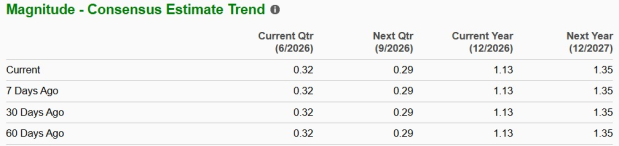
The Zacks Consensus Estimate for Chipotle’s 2026 sales suggests year-over-year increases of 8.3%, while earnings per share (EPS) are expected to decline 3.4%. In the past 60 days, earnings estimates for 2026 have remained unchanged at $1.13 per share.
CMG Earnings Estimate Trend
Image Source: Zacks Investment Research
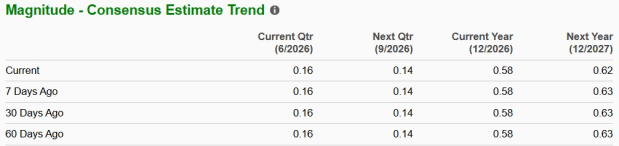
The Zacks Consensus Estimate for Wendy’s 2026 sales suggests year-over-year increases of 3%, while EPS are expected to decline 34.1%. In the past 60 days, earnings estimates for 2026 have remained unchanged at 58 cents per share.
WEN Earnings Estimate Trend
Image Source: Zacks Investment Research
Valuation and Price Performance: CMG vs. WEN
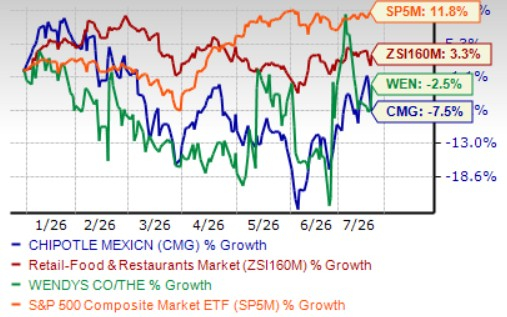
Chipotle stock has declined 7.5% so far this year, underperforming its industry and the S&P 500’s rise of 3.3% and 11.8%, respectively. Meanwhile, Wendy’s shares have lost 2.5% in the same time.
YTD Price Performance – CMG, WEN, Industry & S&P 500
Image Source: Zacks Investment Research
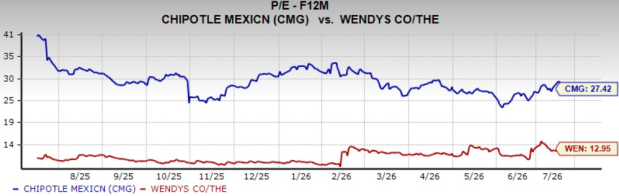
Chipotle is trading at a forward 12-month price-to-earnings (P/E) ratio of 27.42, above the industry average of 22.94 over the last year. In contrast, WEN commands an even lower forward P/E of 12.95.
Image Source: Zacks Investment Research
The Final Take
Chipotle holds the stronger investment position, supported by improving transaction trends, a faster menu-innovation cadence, rising rewards engagement and disciplined unit expansion. Its debt-free balance sheet also provides materially greater financial flexibility.
Wendy’s Project Fresh strategy has generated selective operational progress, but persistent U.S. traffic weakness, margin compression and a recovery dependent on a meaningful second-half inflection keep execution risk elevated. Although Chipotle faces ongoing cost pressure and trades at a premium valuation, its stronger operating momentum and financial foundation give it the edge at present. Chipotle currently carries a Zacks Rank #3 (Hold), while Wendy’s has a Zacks Rank #4 (Sell).
You can see the complete list of today’s Zacks #1 Rank (Strong Buy) stocks here.
7 Best Stocks for the Next 30 Days
Just released: Experts distill 7 elite stocks from the current list of 220 Zacks Rank #1 Strong Buys. They deem these tickers "Most Likely for Early Price Pops."
Since 1988, the full list has beaten the market more than 2X over with an average gain of +23.9% per year. So be sure to give these hand picked 7 your immediate attention.
See them now >>Want the latest recommendations from Zacks Investment Research? Today, you can download 7 Best Stocks for the Next 30 Days. Click to get this free report
Chipotle Mexican Grill, Inc. (CMG): Free Stock Analysis Report
The Wendy's Company (WEN): Free Stock Analysis Report
This article originally published on Zacks Investment Research (zacks.com).