


The microcomputer space is being driven by AI-enabled PCs, enterprise device refresh cycles, and the growing adoption of hybrid work. Rising demand for high-performance computing, cloud-connected workflows, and enhanced cybersecurity is accelerating hardware upgrades.
Advancements in processors, on-device AI capabilities, and energy-efficient architectures are supporting premiumization, while the approaching end of support for older operating systems is expected to further stimulate commercial PC replacement demand.
Against this backdrop, let’s assess which company offers stronger long-term growth prospects — Lenovo Group LNVGY or Dell Technologies DELL. Lenovo Group is a global technology leader with a diversified presence across PCs, enterprise infrastructure and intelligent solutions. Dell Technologies is a leading provider of servers, storage and PCs. It offers secure, integrated solutions that extend from the edge to the core to the cloud.
The Case for LNVGY
Lenovo Group remains one of the world’s largest PC manufacturers, but its evolution into a diversified technology company is strengthening its long-term growth prospects. Expansion into higher-margin areas such as AI infrastructure, hybrid cloud, enterprise services and AI-enabled devices is reducing its reliance on the cyclical PC market and creating multiple earnings drivers.
The Intelligent Devices Group remains a dependable cash generator, supported by commercial PC replacement cycles, premium-device demand and growing AI PC adoption. Meanwhile, the Infrastructure Solutions Group is becoming an important growth engine as demand rises for AI servers, data-center infrastructure and high-performance computing. An AI server pipeline exceeding $21 billion provides strong revenue visibility.
Lenovo is also expanding its enterprise AI capabilities. Its Hybrid AI Advantage solutions, developed with NVIDIA, help enterprises deploy scalable, real-time AI inferencing across cloud and on-premise environments. The acquisition of Infinidat further strengthens Lenovo’s high-end enterprise storage portfolio, creating opportunities for revenue growth and margin improvement.
The company’s broad presence across Asia, Europe and the Americas limits dependence on any single region, while established relationships with enterprises, governments and channel partners reinforce its competitive position.
As Lenovo works toward becoming a full-stack AI leader, continued investment in Personal AI and Enterprise AI should support sustainable growth. Disciplined cost control, healthy cash generation, a prudent balance sheet and consistent dividend payments also position the company to fund innovation while delivering long-term shareholder value.
The Case for DELL
Dell benefits from a diversified portfolio spanning servers, storage, networking, PCs, and IT services, providing resilience across business cycles. Dell Technologies is seeing demand for AI servers stay ahead of supply as customers accelerate deployments and lock in capacity. A key growth driver is Dell's position as a leading supplier of AI-optimized servers, supported by demand for accelerated computing and partnerships with major semiconductor providers.
Dell’s expanding ecosystem supports a fuller stack for customers that who want to run AI on infrastructure they control. Management highlighted partners including NVIDIA, Google Cloud, OpenAI, ServiceNow, Palantir, Mistral and CrowdStrike, alongside collaboration on validated designs and software integration. As enterprises continue investing in AI infrastructure, Dell is well-positioned to capture incremental market share through its end-to-end solutions and global customer relationships.
The company's large installed enterprise customer base creates recurring opportunities for hardware refreshes, storage expansion, and lifecycle services. While the PC business remains cyclical, it provides scale and distribution advantages, with potential upside from commercial PC replacement cycles and AI-enabled devices.
Management raised fiscal 2027 revenue guidance to $165-$169 billion and lifted expected AI server revenues to about $60 billion. As Dell continues to prioritize margin rate expansion, it is prudently managing expenses.
Dell generates robust free cash flow, enabling consistent debt reduction, share repurchases, and dividend growth. Its disciplined capital allocation and improved balance sheet enhance shareholder returns while maintaining financial flexibility.
Estimates for LNVGY and DELL
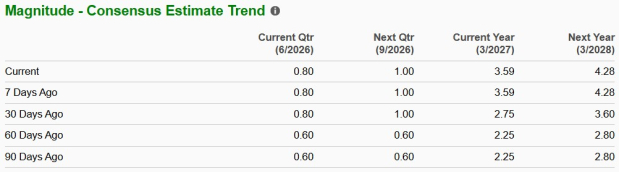
The Zacks Consensus Estimate for LNVGY’s fiscal 2027 and 2028 revenues implies a 13% and 11.3% year-over-year increase, respectively. EPS estimates for fiscal 2027 and 2028 imply a 20.5% and 19.2% year-over-year increase, respectively. EPS estimates for 2026 and 2027 have moved up 30.5% and 18.9%, respectively, in the past 30 days.
Image Source: Zacks Investment Research
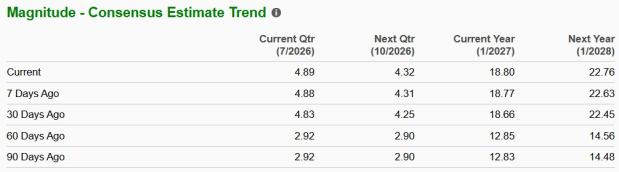
The Zacks Consensus Estimate for DELL’s fiscal 2027 and 2028 revenues implies a 57.3% and 9.3% year-over-year increase, respectively. EPS estimates for 2026 and 2027 indicate an 82.5% and a 21.1% year-over-year increase, respectively. EPS estimates for 2026 and 2027 have moved up 0.8% and 1.4%, respectively, in the past 30 days.
Image Source: Zacks Investment Research
Both carry a Growth Score of A.
Price Performance of LNVGY and DELL
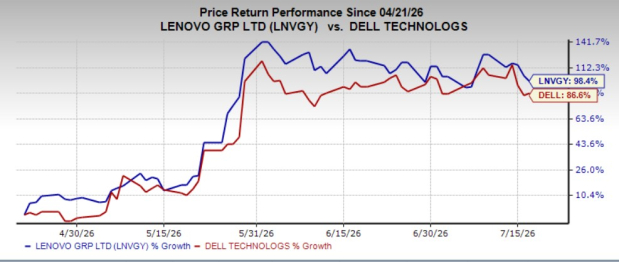
LNVGY shares have gained 98.4% in the past three months, while DELL shares have gained 86.6% in the same time.
Image Source: Zacks Investment Research
Are LNVGY and DELL Shares Expensive?
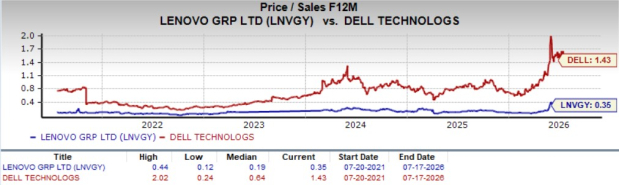
LNVGY is trading at a forward 12-month price-to-sales multiple of 0.35, higher than its median of 0.19 over the past five years. DELL’s forward 12-month price-to-earnings multiple sits at 1.43, slightly higher than its median of 0.64 over the past five years.
While Lenovo has a Value Score of A, Dell carries a Value Score of C.
Image Source: Zacks Investment Research
Conclusion
Lenovo Group presents an attractive investment opportunity, supported by its leading position in the global PC market, growing AI-related demand and improving profitability. Management targets $100 billion in revenues within two years, driven by operational efficiency and sustained innovation across Personal AI and Enterprise AI.
Dell is well-positioned to benefit from sustained AI-driven demand, a strong competitive standing, solid cash flow generation and long-term investment in digital infrastructure.
Both stocks sport a Zacks Rank #1 (Strong Buy) and have a VGM Score of A. Price appreciation, valuation, and analyst sentiment give Lenovo an edge over Dell. You can see the complete list of today’s Zacks #1 Rank stocks here.
Radical New Technology Could Hand Investors Huge Gains
Quantum Computing is the next technological revolution, and it could be even more advanced than AI.
While some believed the technology was years away, it is already present and moving fast. Large hyperscalers, such as Microsoft, Google, Amazon, Oracle, and even Meta and Tesla, are scrambling to integrate quantum computing into their infrastructure.
Senior Stock Strategist Kevin Cook reveals 7 carefully selected stocks poised to dominate the quantum computing landscape in his report, Beyond AI: The Quantum Leap in Computing Power .
Kevin was among the early experts who recognized NVIDIA's enormous potential back in 2016. Now, he has keyed in on what could be "the next big thing" in quantum computing supremacy. Today, you have a rare chance to position your portfolio at the forefront of this opportunity.
See Top Quantum Stocks Now >>Want the latest recommendations from Zacks Investment Research? Today, you can download 7 Best Stocks for the Next 30 Days. Click to get this free report
Dell Technologies Inc. (DELL): Free Stock Analysis Report
Lenovo Group Ltd. (LNVGY): Free Stock Analysis Report
This article originally published on Zacks Investment Research (zacks.com).