


EQT Corporation EQT reported second-quarter 2026 adjusted earnings of 39 cents per share, down 13.3% year over year. The figure also missed the Zacks Consensus Estimate of 41 cents by 4.9%.
Revenues declined 29.2% year over year to $1.81 billion and missed the Zacks Consensus Estimate of $1.84 billion by 1.4%.
The weaker-than-expected quarterly results can be attributed to lower realized natural gas-equivalent prices despite an 11.7% increase in sales volume.
EQT Corporation Price, Consensus and EPS Surprise
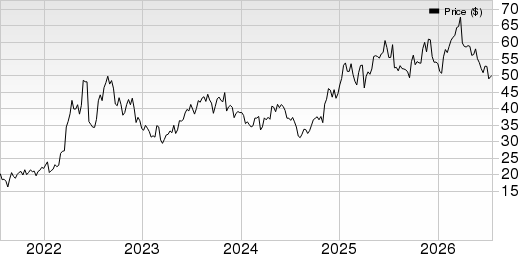
EQT Corporation price-consensus-eps-surprise-chart | EQT Corporation Quote
EQT Expands Its Integrated Platform
The company completed its $77 million acquisition of Blackline Midstream LLC on July 21, 2026, which operates two propane storage and distribution terminals in New England. The assets provide 46 million gallons of storage capacity and are expected to generate an average annual free cash flow of about $15 million over the next five years.
EQT's Production Strength Supports Results
Total sales volume increased to 634 billion cubic feet equivalent (Bcfe) in the second quarter from 568 Bcfe in the year-ago quarter. The figure came in higher than our estimate of 572 Bcfe. Production exceeded the high end of management’s guidance, driven by strong well performance, system-pressure optimization and fewer price-related curtailments than expected.
Natural gas sales volume was 597 Bcf, up from 534 Bcf in the year-ago quarter. The figure surpassed our estimate of 541 Bcf. The total liquid sales volume was 6,249 thousand barrels (MBbls), up from the year-ago level of 5,631 MBbls. The figure beat our projection of 5,172 MBbls.
The company also benefited from compression projects that reduced decline rates and improved well productivity. These operational gains prompted management to raise its 2026 production outlook by roughly 90 Bcfe.
Realized Pricing Weighs on EQT's Revenues
The average realized price declined 5.7% year over year to $2.65 per thousand cubic feet equivalent (Mcfe). The figure also missed our estimate of $2.94 per Mcfe.
The average natural gas price, including cash-settled derivatives, was $2.38 per Mcf, which declined from $2.88 a year ago. Our estimate for the same was pinned at $2.75 per Mcf.
The natural gas sales price was $3.05 per Mcf, down from $3.63 recorded a year ago.
The oil price was $70.14 per barrel compared with $51.70 in the year-ago figure. Our estimate for the same was pegged at $77.16 per barrel.
Sales of natural gas, natural gas liquids and oil decreased 5.3% year-over-year to $1.61 billion. Pipeline and other revenues rose to $155.3 million from $137.3 million a year ago.
EQT Keeps Per-Unit Costs Under Control
Total operating costs were $1.03 per Mcfe, down from $1.08 a year earlier and at the low end of the company’s guidance. Lower transmission, processing, production tax and operating-and-maintenance expenses supported the improvement.
Gathering expenses totaled 9 cents per Mcfe, up from the year-ago level of 8 cents. Transmission expenses stood at 40 cents per Mcfe, down from 45 cents recorded a year ago. Lease operating expenses amounted to 10 cents per Mcfe, up from 9 cents in the corresponding period of 2025. Selling, general and administrative expenses came in at 17 cents per Mcfe, up from the year-ago figure of 14 cents.
Cash Flow Improves for EQT
Adjusted EBITDA attributable to EQT increased to $1.07 billion from $1.03 billion in the prior-year period. Adjusted operating cash flow attributable to the company climbed to $1.01 billion from $794 million in the second quarter of 2025.
Free cash flow attributable to EQT climbed 37.6% to $329.7 million. Capital expenditures totaled $666.3 million, up from $553.6 million but 9% below the low end of guidance, reflecting operating efficiencies and lower infrastructure spending. The company paid $103 million in dividends during the second quarter of 2026.
EQT Strengthens Its Balance Sheet
EQT ended the second quarter with total debt of $5.7 billion and net debt of $5.5 billion, down from $7.8 billion and $7.69 billion, respectively, at the end of 2025.
The company had approximately $3.6 billion of liquidity and $52 million outstanding under its $3.5 billion revolving credit facility. Subsequent to quarter-end, EQT repaid $115 million of debentures due in 2026.
Production Outlook Rises for EQT
Management updated its full-year 2026 sales volume guidance to 2,375-2,450 Bcfe. Third-quarter production is projected to be between 570 Bcfe and 620 Bcfe, with 34-50 net wells scheduled to be turned in line.
Full-year maintenance capital spending is forecast at $2.04-$2.19 billion. The updated range incorporates a $25 million reduction in capital-spending guidance. Third-quarter maintenance expenditures are expected to be between $510 million and $580 million, while growth capital spending is projected at $200-$240 million.
EQT’s Zacks Rank & Key Picks
EQT currently has a Zacks Rank #4 (Sell).
Some better-ranked stocks from the energy sector are Par Pacific Holdings PARR, Valero Energy VLO, and FuelCell Energy FCEL. While Par Pacific sports a Zacks Rank #1 (Strong Buy), Valero Energy and FuelCell Energy carry a Zacks Rank #2 (Buy) each at present. You can see the complete list of today’s Zacks Rank #1 stocks here.
Par Pacific Holdings operates an integrated downstream energy business across the United States, with fuel retail operations in Hawaii, Washington and Idaho; refining operations in Hawaii, Wyoming, Washington and Montana; and a supporting logistics network. Its refineries have a combined crude oil throughput capacity of 219,000 barrels per day and produce gasoline, diesel, jet fuel, marine fuels, asphalt and other petroleum products.
Valero Energy is a leading refining player with a robust network of 14 refineries and a combined high-complexity throughput capacity of 3 million barrels per day, which distinguishes it from other independent refiners. VLO’s refineries have a combined Nelson Complexity Index of 11.5, which implies that they can process a wide variety of feedstocks, convert them into higher-value products and shift product yields according to market conditions.
FuelCell Energy is a clean energy company that offers scalable, reliable, low-carbon power solutions. It produces power using flexible fuel sources such as biogas, natural gas and hydrogen. The company’s proprietary molten carbonate fuel cell systems generate electricity through an electrochemical process instead of burning fuel, reducing carbon emissions and minimizing the environmental impact of power generation. FCEL is anticipated to play a crucial role in the energy transition by enabling industries and communities to shift from traditional fossil fuels to low-carbon alternatives.
Beyond Nvidia: AI's Second Wave Is Here
The AI revolution has already minted millionaires. But the stocks everyone knows about aren't likely to keep delivering the biggest profits. AI’s second wave is moving from infrastructure to implementation and these companies are at the forefront of this transition, positioned to become what Amazon and Google were to the internet era.
See Stocks Now >>Want the latest recommendations from Zacks Investment Research? Today, you can download 7 Best Stocks for the Next 30 Days. Click to get this free report
EQT Corporation (EQT): Free Stock Analysis Report
Valero Energy Corporation (VLO): Free Stock Analysis Report
FuelCell Energy, Inc. (FCEL): Free Stock Analysis Report
Par Pacific Holdings, Inc. (PARR): Free Stock Analysis Report
This article originally published on Zacks Investment Research (zacks.com).