


Baker Hughes Company BKR reported second-quarter 2026 adjusted earnings of 64 cents per share, up 2% year over year. The figure beat the Zacks Consensus Estimate of 51 cents by 25.5%.
Revenues of $6.74 billion surpassed the consensus mark of $6.49 billion by 3.9%. However, the figure declined 2% from the year-ago quarter.
Better-than-expected quarterly results reflected strong OFSE execution, firm IET profitability and record order momentum.
EQT Corporation Price, Consensus and EPS Surprise
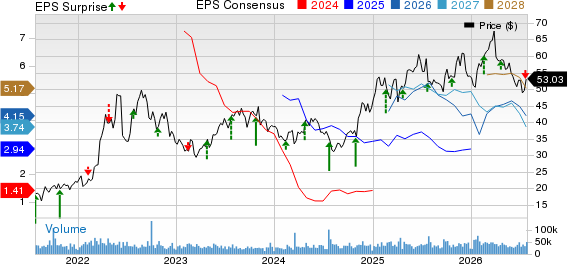
EQT Corporation price-consensus-eps-surprise-chart | EQT Corporation Quote
BKR's Orders & Backlog Surge
Remaining performance obligations, a measure of contracted future work, reached $40.06 billion, up 18% year over year. The increase reflected a record Industrial & Energy Technology (“IET”) backlog, which rose to $37.09 billion and an increased Oilfield Services & Equipment (“OFSE”) backlog, up 10% year over year.
Orders across all business segments totaled $10.5 billion, up 49% from $7.03 billion recorded a year ago, driven by record order intake from the IET business segment. Notably, IET orders nearly doubled from the prior-year period, supported by continued momentum in Gas Technology Equipment and Gas Technology Services.
The company posted a total book-to-bill ratio of 1.6, indicating that orders exceeded current-quarter revenues.
Baker Hughes' IET Momentum Strengthens
Industrial & Energy Technology revenues were $3.29 billion, flat year over year. Lower Gas Technology Equipment and Industrial Solutions revenues, including the effect of the PSI disposition, affected segment results in the quarter, offset by growth across the other product lines.
Segment EBITDA increased 16% from the year-ago quarter to $678 million. The EBITDA margin expanded 280 basis points to 20.6%, driven by pricing, productivity, cost-out initiatives and favorable foreign exchange movements. The positives were partly offset by lower volume and inflation.
BKR's OFSE Execution Tops Guidance
Oilfield Services & Equipment revenues fell 5% year over year to $3.45 billion, mainly due to the SPC divestment and Middle East disruptions. North America revenues increased 1%, while International revenues declined 6% year over year.
OFSE EBITDA declined 11% to $605 million, while the margin contracted 120 basis points to 17.5%. Sequentially, however, revenues and EBITDA each rose 7%, driven by higher volume, pricing, cost actions and foreign exchange.
Baker Hughes Expands Margins and Cash Flow
Adjusted EBITDA increased 2% year over year to $1.23 billion. The adjusted EBITDA margin improved 70 basis points to 18.3%, with company-wide results exceeding the midpoint of management's guidance.
Operating cash flow was $1.35 billion compared with $510 million in the corresponding period of 2025. Free cash flow in the second quarter totaled $1.11 billion compared with $239 million a year earlier. Net capital expenditures were $236 million, including $135 million for OFSE and $85 million for IET.
BKR's Balance Sheet Reflects Chart Funding
BKR ended June with cash and cash equivalents of $15.73 billion. Long-term debt stood at $15.48 billion at the end of the second quarter, reflecting the financing associated with the all-cash Chart Industries acquisition.
The company paid $228 million in dividends during the second quarter and made no share repurchases. Management remains focused on deleveraging after the Chart closing and targets net debt to adjusted EBITDA of 1x-1.5x within 24 months.
Baker Hughes Broadens Its Industrial Portfolio
The company completed the Chart acquisition, adding thermal management, air and gas handling, compression and lifecycle-service capabilities. Baker Hughes expects Chart to become a third reporting segment beginning in the third quarter of 2026.
Management expects run-rate cost synergies of $95 million in year one, $230 million in year two and $325 million in year three. The integration plan also targets commercial benefits from a larger installed base, expanded aftermarket reach and broader digital penetration.
BKR Raises Its 2026 Expectations
For the third quarter of 2026, Baker Hughes expects revenues of $6.57-$7.17 billion and adjusted EBITDA of $1.12-$1.30 billion. OFSE revenues are projected at $3.40-$3.70 billion, while IET revenues are forecast at $3.17-$3.47 billion.
For 2026, the company now expects revenues of $26.65-$28.05 billion and adjusted EBITDA of $4.6-$5.1 billion. IET order guidance was raised to $17.5-$19.5 billion, and the Horizon 2 IET order target increased to more than $45 billion for 2026-2028.
The outlook excludes guidance for the Chart segment. It assumes that Middle East activity remains broadly consistent through year-end and that logistics inflation and supply-chain challenges remain in line with recent trends.
BKR’s Zacks Rank & Key Picks
BKR currently carries a Zacks Rank #3 (Hold).
Some better-ranked stocks from the energy sector are Par Pacific Holdings PARR, Valero Energy VLO and FuelCell Energy FCEL. While Par Pacific sports a Zacks Rank #1 (Strong Buy), Valero Energy and FuelCell Energy carry a Zacks Rank #2 (Buy) each at present. You can see the complete list of today’s Zacks Rank #1 stocks here.
Par Pacific Holdings operates an integrated downstream energy business across the United States, with fuel retail operations in Hawaii, Washington and Idaho, refining operations in Hawaii, Wyoming, Washington and Montana, and a supporting logistics network. Its refineries have a combined crude oil throughput capacity of 219,000 barrels per day and produce gasoline, diesel, jet fuel, marine fuels, asphalt and other petroleum products.
Valero Energy is a leading refining player with a robust network of 14 refineries and a combined high-complexity throughput capacity of 3 million barrels per day, which distinguishes it from other independent refiners. Valero’s refineries have a combined Nelson Complexity Index of 11.5, which implies that they can process a wide variety of feedstocks, convert them into higher-value products and shift product yields according to market conditions.
FuelCell Energy is a clean energy company that offers scalable, reliable, low-carbon power solutions. It produces power using flexible fuel sources such as biogas, natural gas and hydrogen. The company’s proprietary molten carbonate fuel cell systems generate electricity through an electrochemical process instead of burning fuel, reducing carbon emissions and minimizing the environmental impact of power generation. FCEL is anticipated to play a crucial role in the energy transition by enabling industries and communities to shift from traditional fossil fuels to low-carbon alternatives.
Zacks' Research Chief Names "Stock Most Likely to Double"
Our team of experts has just released the 5 stocks with the greatest probability of gaining +100% or more in the coming months. Of those 5, Director of Research Sheraz Mian highlights the one stock set to climb highest.
This top pick is a little-known satellite-based communications firm. Space is projected to become a trillion dollar industry, and this company's customer base is growing fast. Analysts have forecasted a major revenue breakout in 2025. Of course, all our elite picks aren't winners but this one could far surpass earlier Zacks' Stocks Set to Double like Hims & Hers Health, which shot up +209%.
Free: See Our Top Stock And 4 Runners UpWant the latest recommendations from Zacks Investment Research? Today, you can download 7 Best Stocks for the Next 30 Days. Click to get this free report
Baker Hughes Company (BKR): Free Stock Analysis Report
Valero Energy Corporation (VLO): Free Stock Analysis Report
FuelCell Energy, Inc. (FCEL): Free Stock Analysis Report
Par Pacific Holdings, Inc. (PARR): Free Stock Analysis Report
This article originally published on Zacks Investment Research (zacks.com).