

Microsoft MSFT reported fourth-quarter fiscal 2026 earnings of $4.74 per share on a non-GAAP basis (excluding OpenAI investment impacts), which increased 23% on a year-over-year basis (up 23% in constant currency). The figure beat the Zacks Consensus Estimate by 12.59%. On a GAAP basis, earnings per share were $4.81, up 32% year over year.
Revenues of $90 billion increased 18% year over year and beat the Zacks Consensus Estimate by 2.93%. At cc, revenues grew 17% year over year, reflecting continued strength in cloud and AI demand.
Results for the quarter included several discrete items relative to the guidance Microsoft provided on April 29, 2026, which together added 27 cents to earnings per share. These included a $3.2 billion gain tied to Microsoft's investment in Anthropic and lower-than-expected costs associated with the company's first-ever Voluntary Retirement Program, partially offset by severance expense and impairment charges in the Xbox business.
Microsoft Cloud revenues totaled $59.3 billion, up 27% year over year. Commercial remaining performance obligation reached $678 billion, up 84% year over year, with sequential growth driven largely by commitments from customers other than AI model developers.
Following the earnings announcement, Microsoft shares rose in extended trading as the company topped consensus expectations across revenues, operating income and earnings per share, even as capital spending continued to climb.
Microsoft Corporation Price, Consensus and EPS Surprise
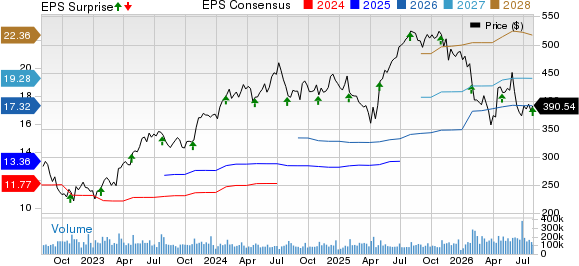
Microsoft Corporation price-consensus-eps-surprise-chart | Microsoft Corporation Quote
MSFT's Q4 Segment Performance
Productivity & Business Processes
The Productivity & Business Processes segment generated $37.8 billion in revenues, which grew 14% year over year (14% in cc).
Microsoft 365 Commercial cloud revenues increased 14% on a reported basis, or 16% when adjusted for a prior-year comparable that had benefited from two points of in-period revenue recognition.
Microsoft 365 Consumer cloud revenues rose 24% (22% in cc). LinkedIn revenues increased 12% (10% in cc). Dynamics 365 revenues grew 13% (12% in cc).
Operating income for the segment rose to $21.9 billion from $19 billion a year earlier, representing an increase of about 15%.
Intelligent Cloud
The Intelligent Cloud segment contributed $39.3 billion in revenues, up 32% year over year (31% in cc).
Azure and other cloud services revenues surged 43% year over year, with growth accelerating from the prior quarter on continued demand across workloads.
Operating income for the segment increased to $16 billion from $12.1 billion a year earlier, up roughly 31%.
More Personal Computing
The More Personal Computing segment generated $12.9 billion in revenues, down 4% year over year (down 5% in cc), pressured by weaker hardware and gaming content revenues, partly offset by growth in search advertising.
Windows OEM and Devices revenues declined 7%. Xbox content and services revenues fell 10%, while Search advertising revenues, excluding traffic acquisition costs, rose 10% (9% in cc).
Operating income for the segment declined to $2.7 billion from $3.2 billion a year earlier, down about 14%, reflecting severance and impairment charges tied to the Xbox business.
MSFT's Notable Developments in Q4
Microsoft continued expanding its AI and cloud infrastructure during the quarter, adding new data center capacity across multiple continents to support growing demand.
The company disclosed plans to extend the estimated useful life of its data center and office buildings to 25 years from 15 years starting in fiscal 2027, a change that will affect future depreciation and lease accounting. More future data center capacity is also expected to be structured as operating leases rather than finance leases going forward.
Microsoft 365 Copilot paid seats surpassed 30 million, with net seat additions more than doubling on a sequential basis during the quarter.
On the leadership side, Microsoft named a LinkedIn executive to lead the professional networking business going forward. The company also introduced a new, more cost-efficient AI coding model during the quarter and lowered Xbox Game Pass subscription prices.
Management indicated it is resetting decisions across Xbox content, platform and operations, with an expectation for the gaming business to return to growth in fiscal 2027.
Microsoft also highlighted continued investment in AI-driven cybersecurity capabilities, describing a multi-model, agentic approach to threat detection and response that combines smaller, efficient models for the bulk of routine tasks with larger frontier models for more complex cases.
MSFT's Financial Performance in Q4
Gross margin reached $60.5 billion, up about 15% year over year.
Total operating expenses increased to $19.9 billion from $18.1 billion, up roughly 10%, driven by continued investment in research and development, AI talent and data. Research and development expenses were $10 billion, sales and marketing were $7.6 billion, and general and administrative expenses were $2.3 billion.
Operating income increased 18% year over year (18% in cc) to $40.6 billion. Net income reached $35.8 billion, up 31% on a GAAP basis; on a non-GAAP basis excluding OpenAI-related impacts, net income was $35.3 billion, up 22% (22% in cc).
Other income and expense, net, was a positive $3.4 billion in the quarter, compared with a negative $1.7 billion a year earlier, aided by net gains on investments and derivatives.
MSFT's Q4 Capital Expenditure and Infrastructure
Cash paid for additions to property and equipment was $35.8 billion in the quarter. Including finance leases, total capital expenditures and finance lease additions rose sharply year over year as the company continued to build out AI and cloud capacity.
Cash flow from operations totaled $55.4 billion, up about 30% year over year, driven by strong cloud billings and collections.
As of June 30, 2026, Microsoft maintained total cash, cash equivalents and short-term investments of $76.8 billion compared with $94.6 billion a year earlier. Long-term debt (including current portion) was $31.1 billion.
Microsoft returned $10.2 billion to shareholders through dividends and share repurchases during the fiscal fourth quarter.
MSFT's OpenAI Partnership Update
The fiscal fourth quarter reflected net gains from investments in OpenAI of $480 million, adding 7 cents to earnings per share. This compares with the fourth quarter of fiscal 2025, when net losses from OpenAI investments decreased net income and earnings per share by $1.575 billion and 21 cents, respectively.
These OpenAI-related impacts have historically created volatility in reported GAAP results, leading the company to provide non-GAAP measures excluding these effects to help investors better understand operational performance.
MSFT's Q1 2027 Outlook
For the first quarter of fiscal 2027, Microsoft expects total company revenues between $89.85 billion and $90.95 billion, suggesting growth of roughly 16% to 17%.
The Intelligent Cloud segment is expected to generate revenues between $40.95 billion and $41.25 billion. The Productivity and Business Processes segment is expected to generate revenues between $36.7 billion and $37.0 billion.
Foreign currency is expected to reduce total revenue growth by less than 1 point in the first quarter. Excluding any impact from OpenAI investments, other income and expense is expected to be roughly negative $100 million, as interest income is more than offset by interest expense, including payments tied to data center finance leases. The effective tax rate for the quarter is expected to be approximately 20%.
Capital expenditures are expected to exceed $50 billion in the first quarter of fiscal 2027, reflecting both continued infrastructure investment and the impact of the lease reclassification tied to the useful-life change for data centers and office buildings. For fiscal 2027, Microsoft expects capital expenditures of roughly $175 billion under the updated accounting treatment, while underlying investment levels for calendar 2026 remain unchanged from prior guidance.
Zacks Rank & Stocks to Consider
Microsoft currently carries a Zacks Rank #3 (Hold).
Some better-ranked stocks in the broader Zacks Computer and Technology sector are Analog Devices ADI, Applied Materials AMAT and Cisco Systems CSCO, each carrying a Zacks Rank #2 (Buy) at present. You can see the complete list of today’s Zacks #1 Rank (Strong Buy) stocks here.
Shares of Analog Devices have rallied 37.1% year to date. The Zacks Consensus Estimate for ADI’s fiscal 2026 earnings is pegged at $12.42 per share, up by 10 cents over the past 30 days, indicating an increase of 59.4% year over year.
Shares of Applied Materials have skyrocketed 101.1% year to date. The Zacks Consensus Estimate for AMAT’s fiscal 2026 earnings is pegged at $12.14 per share, up by 4 cents over the past 30 days, indicating a rise of 28.9% year over year.
Cisco Systems shares have surged 48.7% year to date. The Zacks Consensus Estimate for CSCO’s fiscal 2026 earnings is pegged at $4.28 per share, unchanged over the past 30 days, indicating an increase of 12.3% year over year.
Beyond Nvidia: AI's Second Wave Is Here
The AI revolution has already minted millionaires. But the stocks everyone knows about aren't likely to keep delivering the biggest profits. AI’s second wave is moving from infrastructure to implementation and these companies are at the forefront of this transition, positioned to become what Amazon and Google were to the internet era.
See Stocks Now >>Want the latest recommendations from Zacks Investment Research? Today, you can download 7 Best Stocks for the Next 30 Days. Click to get this free report
Microsoft Corporation (MSFT): Free Stock Analysis Report
Analog Devices, Inc. (ADI): Free Stock Analysis Report
Cisco Systems, Inc. (CSCO): Free Stock Analysis Report
Applied Materials, Inc. (AMAT): Free Stock Analysis Report
This article originally published on Zacks Investment Research (zacks.com).