


Realty Income O and Simon Property Group SPG both offer investors large portfolios, strong balance sheets and long records of paying dividends. Yet, they solve different problems. Realty Income owns mostly single-tenant properties under long net leases, which makes its cash flow relatively steady. Simon owns leading malls, outlets and mixed-use destinations, giving it more direct exposure to retailer sales, leasing demand and redevelopment gains.
That difference matters when choosing between them. Realty Income offers broader tenant, industry and geographic diversification, while Simon provides stronger internal growth when its high-quality centers gain traffic, rents and occupancy.
Both entered 2026 with solid operating momentum and improved guidance, but their risk profiles remain distinct. The better choice depends on whether an investor prefers predictable income and repeatable acquisition-led growth or a more active retail-property model with higher operating upside and greater economic sensitivity.
The Case for O
Realty Income’s core advantage is the reliability of its model. Its portfolio spans 15,571 properties, 1,786 clients and 92 industries, with 98.9% occupancy as of March 31, 2026. Most leases place taxes, insurance and maintenance on tenants, limiting property-level cost swings. Compared with Simon’s traffic-driven centers, Realty Income’s rent stream is less tied to discretionary shopping patterns.
Scale also supports a wider growth runway. Realty Income can invest across the United States, Europe, industrial properties, retail, gaming, data centers and credit structures. First-quarter investment volume reached $2.8 billion at a 7.1% initial cash yield, while management raised full-year volume guidance to $9.5 billion. Its sourcing network and ability to fund larger transactions should help it remain selective.
The private-capital strategy adds another layer. Partnerships with Apollo and GIC, the U.S. Core Plus fund and the new data-center venture can expand investment capacity without relying only on common-stock issuance. Fee income and third-party equity may improve per-share growth while keeping Realty Income in control of sourcing and asset management. The expanded $5.5 billion revolving facilities further strengthen flexibility.
Finally, the dividend remains central. Realty Income has declared 673 consecutive monthly dividends and announced an increase in the monthly rate again in June. AFFO per share rose 6.6% in the first quarter, and management lifted annual guidance to $4.41-$4.44. Same-store growth is modest, but high occupancy, broad diversification and multiple funding channels create a clearer path to steady compounding than Simon’s more cyclical operating model. That combination supports a constructive outlook for income-focused investors seeking durable growth.
The Case for SPG
Simon Property Group offers a different kind of strength, which is ownership of high-quality malls, Premium Outlets and mixed-use destinations that are difficult to replace. Strong locations attract retailers, shoppers, restaurants and entertainment uses, supporting a network effect that smaller centers cannot easily copy. Simon’s first-quarter occupancy was 96.0% for malls and outlets, while base minimum rent increased 5.2%.
Retail demand also appears healthy. Simon signed more than 1,100 leases covering 4.7 million square feet during the quarter, and management said its leasing pipeline was larger than a year earlier. Retailer sales reached $819 per square foot, up 11.8%, giving tenants more capacity to absorb rent increases. This operating leverage can produce faster growth than Realty Income’s contract-based rent escalators.
Redevelopment is another useful lever. Simon had projects underway at 29 centers, with its share of costs at about $1.06 billion and an expected blended yield of 9%. Mixed-use additions, anchor replacements, hotels and apartments can raise traffic and improve land productivity. The company can fund these projects from internal cash flow, reducing dependence on new equity.
Still, Simon’s results are more connected to consumer spending, tourism, retailer health and execution on large projects. Its international interests and platform investments add complexity, while malls require ongoing capital to stay relevant. The balance sheet is sound, with $8.7 billion of liquidity and net debt to EBITDA of 5.0 times, and guidance improved. Even so, strong recent trends do not remove retail-cycle risk for long-term shareholders.
How Do Estimates Compare for Realty Income & Simon Property?
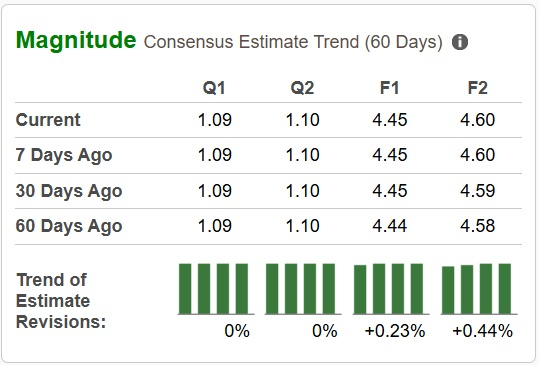
The Zacks Consensus Estimate for Realty Income’s 2026 and 2027 sales implies year-over-year growth of 9.03% and 8.13%, respectively. The consensus mark for 2026 and 2027 funds from operations (FFO) per share suggests a year-over-year increase of 3.97% and 3.34%, respectively. Over the past 60 days, estimates for O’s 2026 and 2027 FFO per share have been tweaked northward.
For Realty Income:
Image Source: Zacks Investment Research
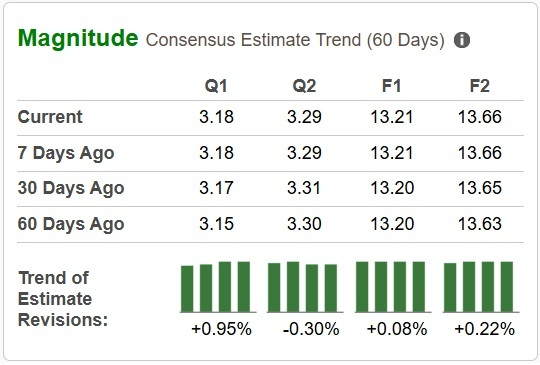
The Zacks Consensus Estimate for Simon Property’s 2026 and 2027 sales calls for year-over-year growth of 12.34% and 3.59%, respectively. The consensus estimates for both 2026 and 2027 FFO per share have been revised marginally upward over the past 30 days. The figures suggest a year-over-year increase of 3.77% and 3.45%, respectively.
For Simon Property Group:
Image Source: Zacks Investment Research
Price Performance and Valuation of O & SPG
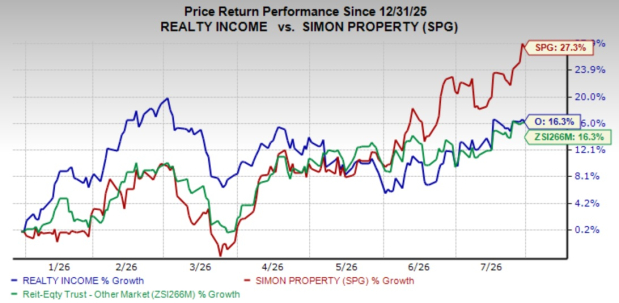
So far in the year, Realty Income shares have risen 16.3%, while Simon Property stock has rallied 27.3%. In comparison, the Zacks REIT and Equity Trust - Retail has advanced 16.3% in the same time frame.
Image Source: Zacks Investment Research
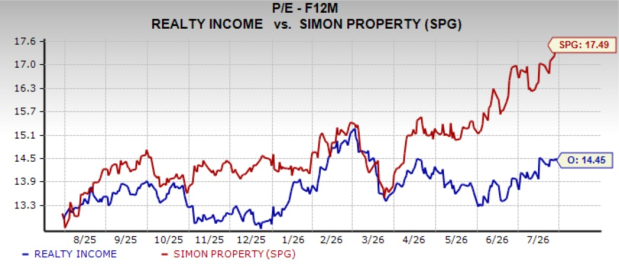
O is trading at a forward 12-month price-to-FFO, which is a commonly used multiple for valuing REITs, of 14.45X, which is above its three-year median of 13.24X.
Meanwhile, SPG is presently trading at a forward 12-month price-to-FFO of 17.49X, which is also above its three-year median of 13.16X. Both O and SPG carry a Value Score of D.
Image Source: Zacks Investment Research
Conclusion: O Has the Edge
Both REITs have strengths. Simon owns scarce, productive retail destinations and has ways to lift cash flow through leasing, redevelopment and mixed-use projects. Its operating momentum supports keeping an existing position, but the higher forward multiple and closer link to consumer conditions limit the appeal of adding aggressively now.
Realty Income offers the better overall setup. Its diversified net-lease portfolio, monthly dividend record, growing private-capital platform and lower forward earnings multiple provide a stronger balance of income, resilience and growth. For investors choosing one name now, Realty Income is the more attractive stock to accumulate, while Simon is best retained.
While O has a Zacks Rank #2 (Buy), SPG carries a Zacks Rank #3 (Hold). You can see the complete list of today’s Zacks #1 Rank (Strong Buy) stocks here.
Note: Anything related to earnings presented in this write-up represent funds from operations (FFO) — a widely used metric to gauge the performance of REITs.
Beyond Nvidia: AI's Second Wave Is Here
The AI revolution has already minted millionaires. But the stocks everyone knows about aren't likely to keep delivering the biggest profits. AI’s second wave is moving from infrastructure to implementation and these companies are at the forefront of this transition, positioned to become what Amazon and Google were to the internet era.
See Stocks Now >>Want the latest recommendations from Zacks Investment Research? Today, you can download 7 Best Stocks for the Next 30 Days. Click to get this free report
Simon Property Group, Inc. (SPG): Free Stock Analysis Report
Realty Income Corporation (O): Free Stock Analysis Report
This article originally published on Zacks Investment Research (zacks.com).