

Arm Holdings plc ARM has entered fiscal 2027 with impressive momentum, supported by accelerating adoption of its architecture across cloud infrastructure, edge computing and emerging artificial intelligence applications. The company delivered strong fiscal first-quarter revenue as both licensing activity and royalty collections expanded at a healthy pace.
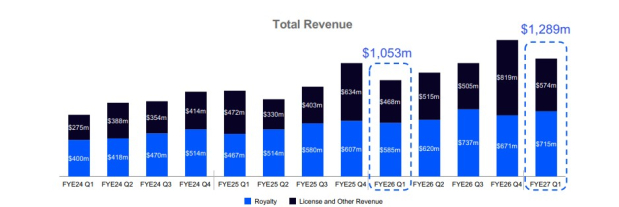
Revenues came in at $1.3 billion, beating the Zacks Consensus Estimate by 1.8% and increasing 22.4% year over year. Royalty revenues and licensing and other revenues increased 22% and 23% year over year.
Earnings of 45 cents per share beat the Zacks consensus estimate by 12.5% and increased 28.6% year over year.
The biggest structural shift is no longer limited to smartphones. Arm's technology is increasingly becoming the preferred computing foundation for hyperscale cloud providers, AI-enabled personal computers, autonomous vehicles, robotics and industrial automation. This diversification reduces dependence on any single end market and creates multiple long-term growth engines.
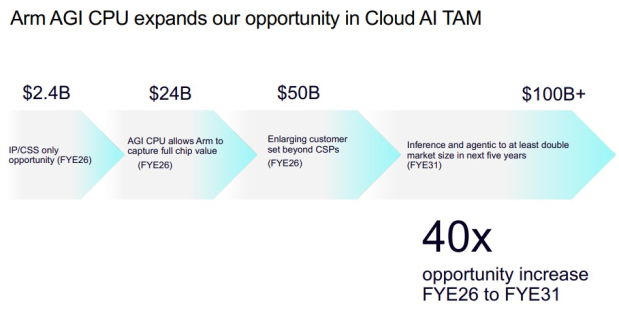
Management also highlighted growing interest in its newly launched Arm AGI CPU platform. Customer demand has expanded rapidly, manufacturing capacity has been secured for the initial rollout, and discussions with additional customers continue to strengthen the commercial pipeline. While this business remains in its early stages, it represents an additional monetization avenue beyond Arm's traditional licensing model.
Cloud AI is Becoming the Largest Growth Driver
The strongest contributor to ARM's recent performance remains cloud infrastructure.
Demand for Arm-based processors continues to rise as hyperscale cloud companies increasingly deploy custom chips designed around the company's Neoverse architecture. The trend reflects growing demand for energy-efficient processors capable of handling AI workloads without sacrificing performance.
The adoption cycle also extends beyond central processing units. Networking processors, smart network interface cards and data-processing units increasingly rely on Arm technology, creating another source of royalty growth.
Outside the cloud, the company continues to benefit from the gradual migration toward higher-value processor designs across smartphones and consumer electronics. Even when handset demand remains uneven, newer premium chip designs generate higher royalty rates, helping offset industry softness.
Another encouraging trend is the expansion of AI beyond traditional computing devices. Intelligent vehicles, robotics platforms and autonomous industrial systems increasingly require efficient processing at the edge, an area where Arm already possesses a well-established ecosystem.
Licensing Strength Reflects Deep Customer Commitment
Licensing remains equally encouraging. The company continues signing long-duration agreements with several strategic customers spanning cloud computing, automotive technology, consumer electronics and robotics. Rather than purchasing isolated processor designs, customers increasingly seek long-term access to future architecture roadmaps.
This strengthens revenue visibility while reinforcing Arm's position as a foundational technology provider instead of a cyclical semiconductor supplier.
Management also continues investing aggressively in engineering resources to support future architectures, software tools and AI-focused products. Although these investments elevate operating expenses today, they are intended to expand the company's competitive moat over the coming years.
Importantly, Arm continues generating substantial free cash flow, providing financial flexibility to support both innovation and future product expansion.
Peer Comparison: NVIDIA, Qualcomm
Among U.S.-listed companies, NVIDIA NVDA remains one of the most relevant peers because both companies benefit directly from expanding AI infrastructure spending.
Unlike NVIDIA, which primarily generates revenue through graphics processors and complete AI computing platforms, Arm focuses on licensing processor architectures that become embedded across countless semiconductor products.
The relationship is complementary rather than purely competitive. NVIDIA continues incorporating Arm-based CPUs into several next-generation AI platforms, reinforcing confidence in Arm's growing relevance throughout modern AI infrastructure.
Another important comparison is Qualcomm QCOM. Historically, Qualcomm has relied heavily on Arm architecture across its smartphone processors, but the relationship is expanding into AI-enabled PCs and future data-center opportunities. The company's continued investments in Arm-based computing illustrate the industry's growing confidence in the architecture.
While Qualcomm competes in chip design rather than processor licensing, both companies benefit from increasing adoption of AI-enabled devices that require efficient computing capabilities, making their long-term growth drivers closely aligned.
Risks Still Deserve Attention
Despite the favorable outlook, investors should remain mindful of several risks. The semiconductor industry remains cyclical, and enterprise spending can fluctuate alongside broader economic conditions. Royalty growth also depends on customer product launches and shipment volumes, introducing periodic volatility.
Another consideration is execution risk surrounding Arm's newer AI CPU initiative. Although customer interest appears strong, scaling manufacturing capacity, fulfilling orders and maintaining attractive commercial terms will be critical to realizing its full potential.
Meanwhile, increased investment in research and development will continue weighing on operating expenses. While these expenditures support future innovation, they may limit margin expansion if revenue growth slows.
Should Investors Hold ARM Stock?
Arm appears well positioned to benefit from several enduring technology transitions rather than relying on a single product cycle. Its expanding presence across cloud infrastructure, intelligent edge devices, advanced automotive systems and AI software ecosystems provides multiple avenues for sustained growth. At the same time, much of this optimism is already reflected in investor expectations, leaving limited room for operational missteps. The company's long-term fundamentals remain attractive, but execution around new products, customer adoption and industry demand will remain essential. Given the balance between exceptional growth opportunities and elevated expectations, ARM currently looks best suited as a Hold for existing investors while awaiting further execution and valuation support.
ARM currently carries a Zacks Rank #3 (Hold). You can see the complete list of today’s Zacks #1 Rank (Strong Buy) stocks here.
Beyond Nvidia: AI's Second Wave Is Here
The AI revolution has already minted millionaires. But the stocks everyone knows about aren't likely to keep delivering the biggest profits. AI’s second wave is moving from infrastructure to implementation and these companies are at the forefront of this transition, positioned to become what Amazon and Google were to the internet era.
See Stocks Now >>Want the latest recommendations from Zacks Investment Research? Today, you can download 7 Best Stocks for the Next 30 Days. Click to get this free report
ARM Holdings PLC Sponsored ADR (ARM): Free Stock Analysis Report
QUALCOMM Incorporated (QCOM): Free Stock Analysis Report
NVIDIA Corporation (NVDA): Free Stock Analysis Report
This article originally published on Zacks Investment Research (zacks.com).