

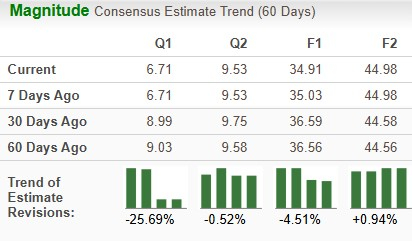
Eli Lilly and Company LLY will report its second-quarter 2026 earnings on Aug. 5, before market open. The Zacks Consensus Estimate for sales and earnings is pegged at $20.26 billion and $6.71 per share, respectively. Earnings estimates for 2026 have declined from $36.59 per share to $34.91 per share over the past 30 days.
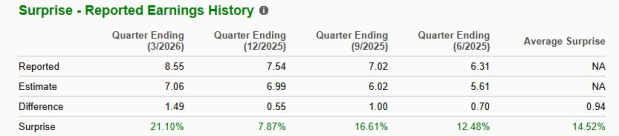
The healthcare bellwether’s performance has been solid, with the company exceeding earnings expectations in each of the trailing four quarters. It delivered a four-quarter earnings surprise of 14.52%, on average. In the last reported quarter, the company delivered a positive earnings surprise of 21.10%, as seen in the chart below.
LLY’s Earnings Surprise History
What Does Our Model Say for Lilly?
Lilly has an Earnings ESP of -10.38% and a Zacks Rank #3 (Hold). You can see the complete list of today’s Zacks #1 Rank (Strong Buy) stocks here.
Per our proven model, companies with the combination of a positive Earnings ESP and a Zacks Rank #1, #2 (Buy) or #3 have a good chance of delivering an earnings beat. You can uncover the best stocks to buy or sell before they’re reported with our Earnings ESP Filter.
Factors Shaping LLY’s Upcoming Results
In the second quarter, like the past few quarters, the key drivers of Lilly’s top-line growth are likely to have been its popular GLP-1 drugs, diabetes drug Mounjaro and obesity drug Zepbound, driven by high demand trends, partially offset by lower pricing.
The Zacks Consensus Estimate for Mounjaro and Zepbound is pegged at $8.94 billion and $4.72 billion, respectively.
Investors will also look for the first sales numbers of Lilly’s newly-launched once-daily oral GLP-1 pill, Foundayo (orforglipron), which was launched in April. On the first-quarter conference call, Lilly had said that early launch data for Foundayo were encouraging, and insurance coverage for the pill is expanding rapidly through major PBMs.
Rival Novo Nordisk NVO had gained approval for an oral version of its obesity drug, Wegovy, in December 2025 and launched the pill in January 2026. Investors will be keen to know how NVO’s obesity pill affected Foundayo’s market share in the second quarter as the former enjoyed a first-to-market advantage.
Beyond Mounjaro and Zepbound, higher demand and volume growth for Lilly’s key growth drugs like Olumiant and Emgality are likely to have provided top-line support in the second quarter, driven by increased demand trends. However, sales of Trulicity are likely to have declined due to competitive dynamics, including patient switches to Mounjaro and lower realized prices.
While volumes are expected to have increased for most drugs, lower realized prices (including U.S. Part D changes) are likely to have continued to hurt sales of most drugs, including Mounjaro and Zepbound.
In the first quarter, Taltz’s sales had declined. It remains to be seen if its sales improved in the second quarter. Jardiance’s sales rose, gaining from a one-time benefit of $250 million in international sales, which was absent in the second quarter.
The Zacks Consensus Estimate for Trulicity, Taltz, Verzenio, Jardiance, Olumiant and Emgality is $852 million, $846.0 million, $1.56 billion, $699.0 million, $255.0 million and $205.0 million, respectively.
Relatively newer products like Ebglyss, Jaypirca, Kisunla and Omvoh are likely to have contributed significantly to sales growth. Sales of most of these drugs have been improving sequentially for the past few quarters. Sales of the new breast cancer drug, Inluriyo, are likely to have improved sequentially in the second quarter.
Sales of most established drugs like Forteo, Humalog and Humulin are likely to have declined in the quarter.
Higher marketing, selling and administrative expenses to support the launch of new products and indications are likely to have hurt operating profits in the quarter. R&D expenses are also expected to have increased due to higher costs for early- and late-stage pipeline portfolios.
Costs related to Lilly’s several M&A deals that closed in the quarter, like Centessa Pharmaceuticals, are likely to have raised operating costs and lowered earnings growth in the quarter.
Nonetheless, a single quarter’s results are not so important for long-term investors. Let us delve deeper to understand whether to buy, sell or hold Lilly’s stock.
LLY’s Price Performance and Valuation
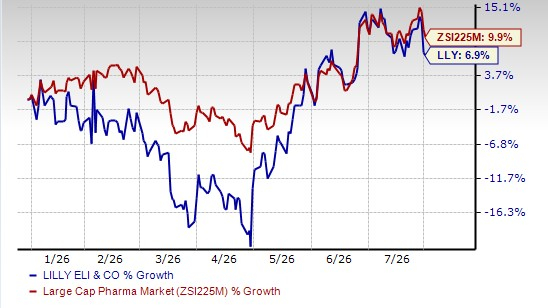
So far this year, LLY’s stock has risen 6.9% while the industry has risen 9.9%.
LLY Stock Performance
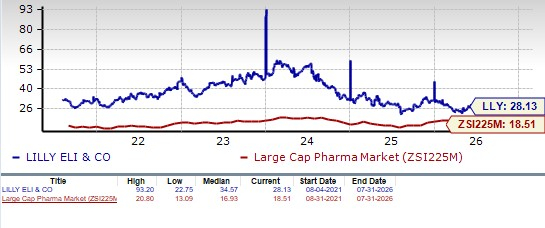
The stock is trading at a premium to the industry, as seen in the chart below.
LLY Stock Valuation
Our Investment Thesis on LLY Stock
Lilly's biggest strength is its dominance in the rapidly expanding obesity and diabetes markets. Its blockbuster drugs, Mounjaro and Zepbound, have become some of the fastest-growing medicines in pharmaceutical history, gaining from enormous global demand for GLP-1 therapies. These therapies account for more than 60% of the company’s total revenues, with sales expected to remain strong throughout 2026.
In addition to Mounjaro and Zepbound, Lilly has secured approvals for several other new therapies over the past few years, like Omvoh, Jaypirca, Ebglyss and Kisunla. These newly approved drugs are also contributing to Lilly’s revenue growth.
Foundayo can prove to be a commercial game-changer for Lilly. The company expects to launch Foundayo in most international markets during 2027.
Lilly is evaluating Foundayo in six phase III studies for other diabetes and obesity-related diseases. For the type II diabetes indication, Lilly has filed regulatory applications in several countries.
To maintain leadership in the GLP-1 market, Lilly is developing several next-generation, more powerful and more convenient GLP-1–based treatments, including oral options and multi-acting candidates.
In its GLP pipeline, retatrutide is one of Lilly’s most important late-stage candidates, as it targets three biological pathways — GLP-1, GIP and glucagon — potentially offering greater weight-loss and metabolic benefits than existing medicines, which mostly act on one or two biological pathways. The candidate has demonstrated approximately 28% weight loss in late-stage studies. Lilly plans to submit a biologics license application for retatrutide to the FDA in the first quarter of 2027. If approved, retatrutide could become another multibillion-dollar product.
Lilly has also embarked on an aggressive M&A spree in 2026, acquiring and partnering with biotech companies across oncology, neuroscience, cardiovascular disease, gene editing and vaccines to diversify its long-term growth drivers beyond GLP-1 therapies. The company has announced more than $20 billion in biotech deals this year. In its most recent deal, Lilly announced a definitive agreement to acquire New York-based clinical-stage biotech AtaiBeckley ATAI for $2.8B upfront to strengthen its neuroscience pipeline.
Lilly has its share of problems. Prices of most of Lilly’s products are declining in the United States. Price is expected to continue to be a drag on top-line growth in the low to mid-teens percentage in 2026. Rising competition in the GLP-1 diabetes/obesity market is a key headwind. Also, sales of late-life cycle products like Trulicity, Taltz and Verzenio are expected to be flat to down in 2026.
Stay Invested in LLY’s Stock
Lilly remains one of the most compelling growth stories in the pharmaceutical industry, supported by its significant price appreciation, dominant position in the rapidly expanding obesity and diabetes markets, a diversified late-stage pipeline and strong financial performance. One should stay invested in this stock, no matter how the second-quarter results play out.
Beyond Nvidia: AI's Second Wave Is Here
The AI revolution has already minted millionaires. But the stocks everyone knows about aren't likely to keep delivering the biggest profits. AI’s second wave is moving from infrastructure to implementation and these companies are at the forefront of this transition, positioned to become what Amazon and Google were to the internet era.
See Stocks Now >>Want the latest recommendations from Zacks Investment Research? Today, you can download 7 Best Stocks for the Next 30 Days. Click to get this free report
Eli Lilly and Company (LLY): Free Stock Analysis Report
Novo Nordisk A/S (NVO): Free Stock Analysis Report
AtaiBeckley Inc (ATAI): Free Stock Analysis Report
This article originally published on Zacks Investment Research (zacks.com).