


As the third quarter of 2026 nears its end, the selloff in pure-play quantum computing stocks is increasingly looking like a valuation and commercialization reset. Since reporting second-quarter results, IonQ IONQ shares have declined 7.3%. The company’s direct peers Rigetti Computing RGTI and D-Wave Quantum QBTS have lost 10.6% and 16.2%, respectively.
The weakness is notable because the period has brought a steady stream of positive developments, including IonQ’s SkyWater integration, its new Superion 256 platform and expanded commercial agreements.
Stock Comparison Since IONQ's Q2 Earnings Release
Image Source: Zacks Investment Research
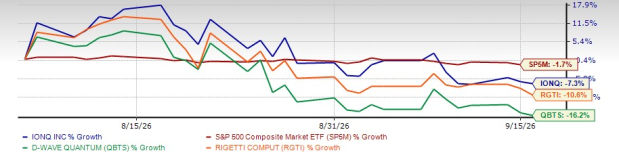
The problem is that strategic progress is arriving faster than financial monetization. IonQ's second-quarter revenues were up 287% year over year, but it still posted a $120.3 million adjusted EBITDA loss. Government support also validates quantum's strategic importance, but much of the funding is directed toward long-cycle R&D and infrastructure rather than immediately translating into recurring commercial revenues. The June White House quantum order itself emphasizes accelerating research, deployment and commercialization, indicating that the industry remains in a development phase.
Meanwhile, the macro backdrop has become less supportive of speculative, long-duration technology assets like quantum. On Sept. 16, the Federal Reserve raised rates to 3.75%-4.00% and indicated another hike could come in 2026, keeping discount rates and funding costs elevated. Against this backdrop, investors are increasingly focused on revenue growth, improving profitability and commercial adoption, rather than technological milestones or government funding alone. For pure-play quantum stocks like IONQ, the gap between strong technological progress and limited near-term financial returns continues to weigh on valuations.
IonQ's Growth Story Needs Stronger Commercial Execution
As the third quarter of 2026 (July -September) enters its final weeks, IonQ’s strong operating growth is yet to translate into a sustained stock-price recovery. The company’s Remaining Performance Obligations (RPO) reached $485 million in the second quarter, up from $122 million a year earlier. On Sept. 8, IonQ raised its 2026 revenue outlook to $450-$460 million, including the SkyWater buyout, which was completed on July 31. The company also expects customer deliveries of its new Superion 256 platform in 2027.
Management noted that it is advancing multiple generations of semiconductor-based systems, including its path to 10,000 qubits in 2027. These milestones support the longer-term growth case, but they do not immediately change IonQ’s financial profile. The second-quarter adjusted EBITDA loss was $120.3 million, indicating the substantial investment still required to scale the platform.
A sustained stock-price reversal therefore may require evidence of commercial execution rather than additional technology announcements alone. IonQ has continued to build that evidence through the SkyWater acquisition, a $28 million DARPA contract extension and new government and enterprise relationships.
However, several developments remain longer-dated. Superion customer deliveries are slated for 2027, while some recently-declared partnerships are not included in RPO or 2026 revenue guidance because they remain at an early stage.
With the Fed rate now at 3.75%-4.00% and with the possibility of another 2026 hike, the macro backdrop also remains challenging for high-duration, loss-making technology stocks. For investors, the key is to focus on IonQ’s revenue conversion, RPO growth, loss trajectory and 2027 system deployments. A quick reversal is not yet clearly supported by these near-term financial indicators.
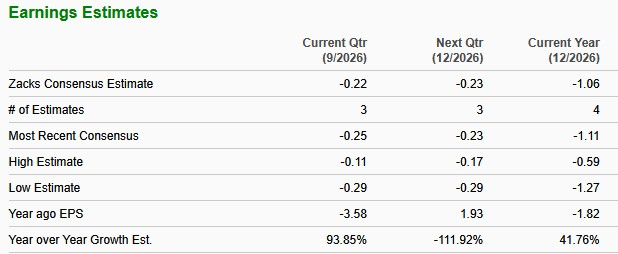
What's Next for IonQ: Q3 and Full-Year 2026 Estimates
The Zacks Consensus Estimate for IONQ’s third-quarter and 2026 EPS is pegged at a loss of 22 cents and a loss of $1.06 per share, respectively, implying 93.9% and 41.8% improvements over year-ago reported figures.
Image Source: Zacks Investment Research
IonQ's 50-Day and 200-Day Moving Averages
Image Source: Zacks Investment Research
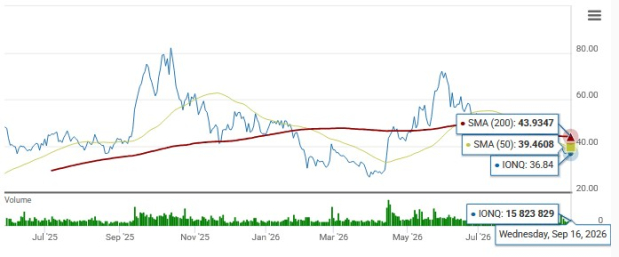
Technically, the chart shows IONQ is currently below its 50-day SMA and its 200-day SMA, indicating that the stock remains in a weak technical setup, with both short- and longer-term price trends tilted downward and shares yet to establish a sustained bullish reversal.
Conclusion: Hold or Sell the Stock Now?
IonQ’s strong revenue growth, expanding RPO and technology roadmap show its long-term quantum opportunity, but the near-term setup remains clouded by heavy losses, commercialization risks and technical weakness. The stock’s position below both its 50-day and 200-day SMAs also suggests that a durable recovery is yet to take shape.
IONQ currently carries a Zacks Rank #4 (Sell), reflecting unfavorable earnings-estimate trends and near-term expectations. Given the combination, investors may consider selling IONQ now and reassessing the shares once commercial execution and financial results provide clearer evidence of a sustained recovery.
You can see the complete list of today’s Zacks #1 Rank (Strong Buy) stocks here.
Beyond Nvidia: AI's Second Wave Is Here
The AI revolution has already minted millionaires. But the stocks everyone knows about aren't likely to keep delivering the biggest profits. AI’s second wave is moving from infrastructure to implementation and these companies are at the forefront of this transition, positioned to become what Amazon and Google were to the internet era.
See Stocks Now >>Want the latest recommendations from Zacks Investment Research? Today, you can download 7 Best Stocks for the Next 30 Days. Click to get this free report
IonQ, Inc. (IONQ): Free Stock Analysis Report
Rigetti Computing, Inc. (RGTI): Free Stock Analysis Report
D-Wave Quantum Inc. (QBTS): Free Stock Analysis Report
This article originally published on Zacks Investment Research (zacks.com).