


Oshkosh Corporation OSK continues to face operational challenges, with weakening refuse demand, production disruptions and declining profitability in key segments weighing on performance. Despite strong Access sales growth, unfavorable product mix and higher costs have limited margin expansion. Meanwhile, fire truck production delays have disrupted deliveries and forced management to lower its full-year earnings guidance. Declining Transport profitability and a sizable debt maturity in 2027 add to the concerns.
Let's examine the factors weighing on OSK's investment outlook.
Weak Refuse Demand and Transport Profits Weigh on OSK
Weakness in Oshkosh's refuse and recycling business remains a concern amid subdued fleet spending. In the third quarter of 2026, Refuse and Recycling vehicle sales declined 12.3% year over year to $162.5 million. Unit backlog also remained 10.3% below the prior-year level as of Sept. 30, 2026, highlighting prolonged demand weakness. Although management reported some improvement in orders from key fleet customers, these early signs have yet to translate into a sustained sales recovery, limiting revenue visibility.
Oshkosh's Transport segment is facing additional profitability challenges. Third-quarter revenues declined 4.4% year over year to $562 million, while operating income plunged 77.6% to $8.2 million. Operating margin contracted to 1.5% from 6.2%, reflecting unfavorable product mix and higher manufacturing costs. The absence of a $25 million intellectual property licensing benefit recorded last year further contributed to the decline. Backlog decreased 12.8% to $5.6 billion, raising concerns about future revenue visibility.
OSK's Access Margins and Fire Truck Delays Pressure Earnings
Despite strong sales growth, Oshkosh's Access segment continues to struggle with margin expansion. Third-quarter sales increased 20.7% year over year to $1.34 billion, but adjusted operating margin improved only marginally to 11.2% from 11%. Adverse product and customer mix and higher incentive compensation costs offset much of the benefits from increased volumes and improved pricing. Continued volatility in raw material and freight expenses could further constrain profitability.
Production challenges in Oshkosh's Vocational segment are adding to earnings pressure. The transition to high-flow fire truck assembly caused deeper disruptions than anticipated, with third-quarter production and shipments roughly 20% below the prior-year level due to complex parts routing delays. Consequently, segment revenues declined 7% year over year to $899.9 million. Adjusted operating income fell to $102.4 million from $151.1 million, while margin contracted to 11.4% from 15.6%.
Although management is improving parts tracking and scheduling, the production ramp is expected to take longer. Oshkosh lowered its full-year 2026 adjusted EPS guidance to $8.50-$9.50 from approximately $11, reflecting manufacturing disruptions and weaker operating performance.
Oshkosh's Debt Maturity Adds to Financial Concerns
Oshkosh's $500 million unsecured term loan matures in March 2027, creating a refinancing or repayment requirement. Cash and cash equivalents increased to $558 million as of Sept. 30, 2026, from $403.6 million at June 30, while available revolving credit capacity was $1.58 billion. The company also remained compliant with its debt covenants.
Still, the upcoming maturity could compete with other capital allocation priorities as Oshkosh navigates operational challenges and reduced earnings guidance. Refinancing requirements and potential financing costs could add pressure if business performance remains weak.
With weak demand, production setbacks and margin pressures continuing to challenge Oshkosh, a meaningful earnings recovery remains difficult, while the upcoming debt maturity adds to the risks. Until operating performance improves across its key segments, the concerns support a bearish stance on OSK.
Oshkosh Corporation Price and Consensus
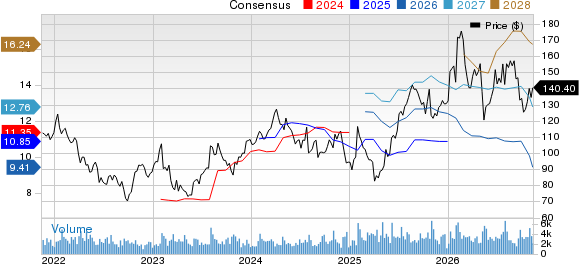
Oshkosh Corporation price-consensus-chart | Oshkosh Corporation Quote
OSK's Zacks Rank & Key picks
OSK currently carries a Zacks Rank #5 (Strong Sell).
Some better-ranked stocks in the Auto space are Honda Motor HMC, Standard Motor Products, Inc. SMP and Atmus Filtration Technologies Inc. ATMU. HMC, SMP and ATMU carry a Zacks Rank #2 (Buy). You can see the complete list of today's Zacks #1 Rank (Strong Buy) stocks here.
The Zacks Consensus Estimate for HMC's current-year earnings is pegged at $2.32 per share, indicating a 210% year-over-year increase. The estimate for earnings has moved northward over the past 60 days.
The Zacks Consensus Estimate for SMP's current-year earnings is pegged at $4.3 per share, indicating a 7% year-over-year increase. Its earnings beat the Zacks Consensus Estimate in three of the trailing four quarters and missed once, with the average earnings surprise being 11.5%.
The Zacks Consensus Estimate for ATMU's current fiscal-year earnings is pegged at $2.99 per share, indicating a 9.5% year-over-year increase. The estimate for earnings has been rising over the past 60 days.
Zacks' Research Chief Names "Stock Most Likely to Double"
Our team of experts has just released the 5 stocks with the greatest probability of gaining +100% or more in the coming months. Of those 5, Director of Research Sheraz Mian highlights the one stock set to climb highest.
This innovative software-as-a-service firm upped its user base +22% year over year. That rate is increasing and margins are expanding as AI efficiencies take effect. Of course, all our elite picks aren't winners, but this one could far surpass earlier Zacks' Stocks Set to Double like D-Wave Quantum, which shot up +680.1%.
Free: See Our Top Stock And 4 Runners UpWant the latest recommendations from Zacks Investment Research? Today, you can download 7 Best Stocks for the Next 30 Days. Click to get this free report
Oshkosh Corporation (OSK): Free Stock Analysis Report
Honda Motor Co., Ltd. (HMC): Free Stock Analysis Report
Standard Motor Products, Inc. (SMP): Free Stock Analysis Report
Atmus Filtration Technologies Inc. (ATMU): Free Stock Analysis Report
This article originally published on Zacks Investment Research (zacks.com).