


Our picks are Sprout Social (SPT) and HealthStream (HSTM), two high-quality businesses with innovative technology and opportunities to sustain growth despite macroeconomic headwinds. Sprout Social is shifting its focus toward larger customers, which could stabilize revenues, deepen customer relationships and support cross-selling. HealthStream, meanwhile, is leveraging technology and industry expertise to strengthen its competitive moat. Both operate in attractive markets and are incorporating AI into their offerings.
AI is becoming an increasingly important growth driver for the industry. Gartner forecasts worldwide AI spending to reach $2.7 trillion in 2026, up 49.5% year over year, highlighting the scale of investment and adoption underway. Companies are using AI and machine learning to enhance existing products, introduce new features, improve operational efficiency and differentiate their offerings. Growing AI computing demand is also driving investment in cloud infrastructure, data centers and processing capacity, benefiting digital infrastructure and cloud-service providers. However, the extent of these opportunities varies across the industry's diverse business models.
A stronger economy generally supports industry demand, while macroeconomic uncertainty, inflation, tariffs, weakening consumer confidence and higher interest rates pose headwinds for the industry, especially considering its capital-intensive nature. Meanwhile, increasingly accessible AI tools are lowering barriers to entry, allowing smaller players to develop competing offerings with fewer resources but intensifying competitive pressures across the industry.
Valuations across the industry have declined significantly over the past six months. This, alongside rising earnings estimates, suggests that opportunities may exist among companies with sound business models, attractive growth prospects and the financial flexibility to navigate a challenging operating environment.
About the Industry
Internet - Services companies primarily rely on digital platforms, software and supporting technology infrastructure to deliver products, services and infrastructure to individual or corporate consumers. Given the increased digitalization of the world and the industry's role as a digital enabler, the range of offerings is very broad and may include ecommerce, search, social networking, cloud-based software, collaboration and business productivity solutions.
Companies generally monetize their offerings through advertising, subscriptions, licenses, usage-based charges, commissions and transaction fees. Alphabet, Baidu and Akamai are some of the larger players, while Crexendo, Inuvo, Marchex, Sify and Trivago are some of the smaller or more specialized players. Very large players (mainly Alphabet) tend to skew averages.
Factors Determining Industry Performance
AI Adoption Creates New Growth and Monetization Opportunities: Rapid adoption of artificial intelligence (AI) is creating significant growth opportunities across the Internet - Services industry while reshaping competition and business models. Companies are integrating generative AI into search engines, digital advertising, ecommerce platforms, cloud-based software and business productivity applications to improve personalization, customer engagement, search relevance and operational efficiency. Alphabet and Baidu are incorporating AI into search and advertising, while companies such as Sprout Social and Shopify are using it to enhance software and ecommerce offerings. AI is also creating new monetization opportunities through premium subscriptions, enterprise AI solutions, usage-based services and enhanced advertising capabilities.Digital Consumption, Advertising and Online Transactions Drive Growth: Secular growth in digitization continues to support the Internet - Services industry, as work, entertainment, shopping and other activities increasingly move online. Rising Internet penetration, smartphone usage, social media engagement and online video consumption are expanding digital audiences and creating opportunities for advertising and monetization. Younger generations, particularly Gen Z, are accustomed to conducting more of their daily activities online, reinforcing the shift toward digital platforms. Growing digital advertising expenditure, supported by AI-powered targeting, personalization and campaign optimization, is enhancing the effectiveness of online campaigns and attracting greater marketing budgets to digital channels. Meanwhile, the expansion of ecommerce, social commerce, cross-border trade, digital payments and on-demand services is supporting transaction growth across online marketplaces, mobility and food delivery businesses. Companies such as Alphabet, The Trade Desk, Shopify, DoorDash and Uber are positioned to benefit from these trends through advertising, ecommerce and transaction-based business models. However, growing reliance on digital platforms also raises privacy and cybersecurity concerns.
Enterprise Digitalization and Cloud Adoption Support Growth: Continued digital transformation across businesses is supporting demand for cloud platforms and collaboration tools, as well as cybersecurity, data management and productivity applications. Companies’ modernization efforts increasingly involve the migration of workloads to cloud environments to improve scalability, flexibility and cost efficiency. Growing AI adoption is further driving demand for cloud computing, data storage and processing capacity, benefiting providers of cloud services and digital infrastructure. The shift toward subscription-based and usage-based pricing models also provides opportunities for recurring revenues, customer expansion and scalable growth.
Macroeconomic and Competitive Challenges Weigh on Growth: increasing macroeconomic uncertainty is leading to tighter enterprise budgets, longer sales cycles and increased scrutiny of technology spending, which are at times delaying purchasing decisions. Higher interest rates increase borrowing costs and raise the cost of funding investments across the Internet Services industry. However, smaller companies, particularly those focused on AI and infrastructure, are more exposed to these pressures because of their limited financial resources, greater dependence on external capital and lower financial flexibility, potentially widening the resource gap between them and larger players. They also have to compete for consumer attention, advertising budgets and online transactions, with the resultant pricing pressure and increase in customer acquisition costs limiting their ability to monetize their offerings and generate attractive returns. At the same time, increasingly accessible AI tools are lowering barriers to entry, allowing smaller players and new entrants to develop competing products and services with fewer resources. This creates opportunities for a broader range of companies to participate in the industry, while intensifying competitive pressures for established players.
Zacks Industry Rank Indicates Near-Term Pressure
The Zacks Internet - Services industry is housed within the broader Zacks Computer and Technology sector. It carries a Zacks Industry Rank #160, which places it among the bottom 35% of more than 245 Zacks-classified industries.
The group’s Zacks Industry Rank, which is basically the average rank of all the member stocks, indicates that constituent companies may be undergoing some difficulties.
Looking at the aggregate earnings estimate revisions over the past year, there have been significant improvements in both the 2026 and 2027 estimates. The 2026 estimates were growing gradually until June this year, but shot up after that. Even with the slight moderation from the September peak, they still aggregated a 77.2% increase from November 2025. The 2027 estimate jumped in April, peaked in June but has moderated only slightly since then, netting a 15.7% increase from November 2025 actuals.
Historically, the top 50% of Zacks-ranked industries outperforms the bottom 50% by a factor of more than 2 to 1. So the industry being in the bottom 50% indicates that investor sentiments remain muted.
Before we present a few stocks that you may want to consider for your portfolio, let’s take a look at the industry’s recent stock-market performance and valuation picture.
Stock Market Performance Weakened Recently
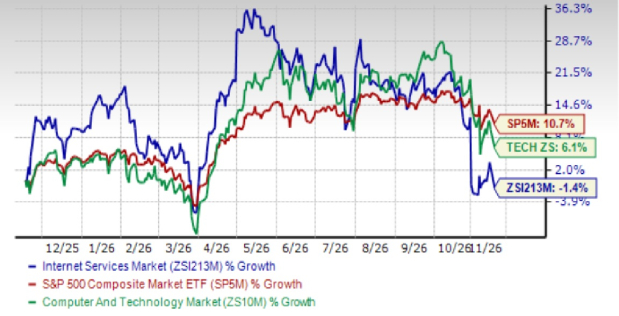
The industry has returned more than both the broader Technology sector and the S&P 500 through most of the past year, starting a downward trajectory in August. The industry’s net loss of 1.4% over the past year is considerably weaker performance than the broader sector’s 6.1% gain and the S&P 500’s 10.7% gain.
One-Year Price Performance
Image Source: Zacks Investment Research
Industry Valuation: Reasonable
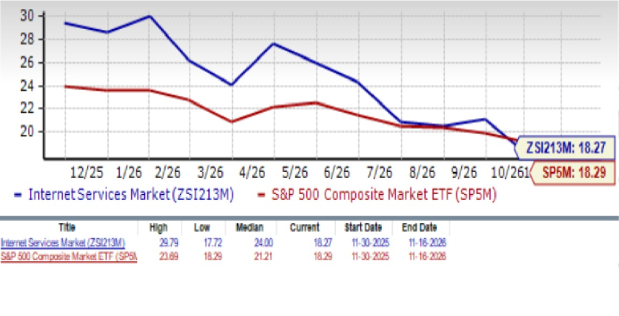
On the basis of forward 12-month price-to-earnings (P/E) ratio, we see that the industry is currently trading at an 18.27X multiple, which is a discount to its median value of 24X over the past year. This is close to the S&P 500’s 18.29X although a significant premium to the broader technology sector’s 16.61X. Overall, the industry has traded between a low of 17.72X and a high of 29.79X over the past year, both points being a premium to the sector. The S&P 500 has traded within a tighter range over the past year. At these levels the industry appears fairly valued.
Forward 12 Month Price-to-Earnings (P/E) Ratio
Image Source: Zacks Investment Research
2 Solid Bets
Sprout Social, Inc (SPT): Sprout Social, Inc. is a cloud-based software company headquartered in Chicago, IL. It provides businesses with tools to manage, analyze and optimize their social-media presence across platforms such as Instagram, LinkedIn, TikTok, Facebook and X. Its subscription-based platform integrates content publishing, message management, customer service, social listening, influencer marketing and performance analytics into a unified dashboard.
Businesses use Sprout to schedule posts, respond to customers through a centralized inbox, monitor brand sentiment and generate data-driven marketing insights. The company is increasingly incorporating AI to automate workflows, analyze social data and help organizations turn online conversations into actionable business intelligence and more effective customer engagement strategies.
As social media evolves from a marketing channel into a broader business platform supporting customer care, brand monitoring, crisis management, sales discovery and reputation analytics, demand for integrated SaaS solutions that can manage these functions is increasing. Sprout Social is increasing its focus on large enterprises, where broader adoption across departments, higher subscription values and opportunities to expand product usage can support revenue growth.
This strategy is gaining traction, with the number of customers contributing at least $30,000 in annual recurring revenue reaching 3,925 at the end of the third quarter of 2026, up 6% year over year, while customers contributing at least $50,000 grew 11% to 2,155. Average contract value increased 12% to $18,009. Larger enterprise relationships also offer opportunities to deepen customer engagement through additional users, social profiles and product modules, supporting cross-selling opportunity, recurring revenues and customer lifetime value. As subscription revenues expand, the scalability of the SaaS model offers scope for operating leverage and margin improvement.
AI presents both competitive challenges and opportunities for Sprout. While generative AI lowers barriers to entry and enables competitors, including social media platforms, to develop their own analytics and engagement tools, Sprout's established platform, accumulated social data, data normalization capabilities and analytical infrastructure provide potential differentiation. Processing and interpreting large volumes of unstructured social data across platforms, while maintaining historical context and delivering actionable insights, requires specialized capabilities and ongoing investment.
Sprout is also embedding AI into sentiment analysis, social listening and customer engagement workflows through its Trellis agentic AI capabilities, which can automate tasks and make its platform more valuable to customers. Its ability to combine extensive social data, analytical tools and integrated workflows could help it maintain a competitive position as AI reshapes the industry. The estimated trailing 12-month subscription revenue contribution from customers with at least $30,000 in ARR grew 18% year over year to $301.5 million in the third quarter of 2026, indicating increasing revenue contribution from larger customers.
Reallocation of resources to larger, more sophisticated customers could weaken revenue and retention of smaller customers. Although the number of customers contributing at least $30,000 in ARR increased in the last quarter, it declined slightly sequentially, indicating some moderation in new customer additions within this segment.
The transition is occurring against a backdrop of macroeconomic uncertainty, tighter customer budgets, greater scrutiny of spending and more demanding purchasing approvals, which are lengthening sales cycles and weighing on both new business and customer expansion. If larger-account acquisition and expansion do not accelerate sufficiently to compensate for the slower growth in smaller customer segments, revenue growth could be muted for a prolonged period of time as the company reshapes its customer base.
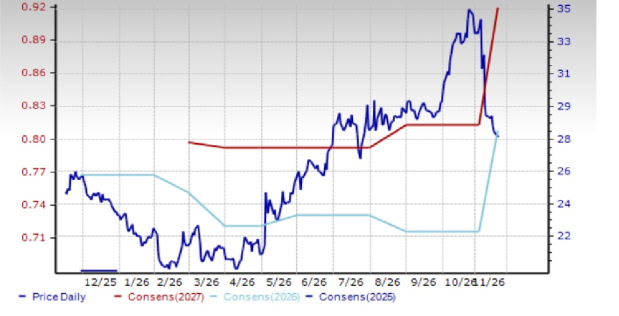
Sprout topped estimates in the last quarter, with EPS beating by 50%. The 2026 estimate has increased 22 cents (20.2%) in the last 30 days while the 2027 estimate increased 28 cents (18.4%). Revenue and EPS increased 7.8% and 59.8% in 2026 and 3.9% and 38% in 2027.
The shares of this Zacks Rank #1 (Strong Buy) stock have gained 8.2% over the past year.
Price and Consensus: SPT
Image Source: Zacks Investment Research

HealthStream, Inc. (HSTM): The Nashville, TN-headquartered healthcare technology company primarily provides cloud-based Software-as-a-Service (SaaS) applications to US-based healthcare providers including hospitals and other care institutions, both government and private, as well as pharmaceutical and medical device companies, nursing schools and nursing students. Its technology facilitates workforce development, training and learning, clinical education, competency assessment, nurse and staff scheduling, credentialing, privileging and provider enrollment. Its product portfolio also includes performance assessment and simulation-based education solutions, supported by its proprietary hStream technology platform, which facilitates interoperability across applications.
HealthStream is positioned to benefit from secular demand for trained healthcare professionals and the need for hospitals and healthcare systems to effectively deploy and manage their workforces. Its addressable market expanded 9% in 2025 to 13.7 million healthcare professionals, in addition to approximately 1,000 nursing schools and 1 million nursing students. Population growth, evolving healthcare needs, new treatment methodologies, increasing workforce complexity and regulatory training requirements support demand for its solutions.
The company is seeing broad-based strength across Learning, Credentialing and Scheduling, its three main application suites. Its Learning platform offers more than 20,000 courses from over 90 industry partners.
CredentialStream revenues grew 15% year over year in the third quarter of 2026, while ShiftWizard, its flagship scheduling application, increased 20%. The Resuscitation Suite and Competency product family grew 14% and 10%, respectively. Additionally, myClinicalExchange, which connects nursing and allied health students with clinical rotations, recorded 26.5% revenue growth.
These gains reflect demand across multiple areas of healthcare workforce management and strengthen opportunities to cross-sell complementary applications. Its investments in enterprise applications, platform capabilities and AI-enabled assessment tools strengthen its product offerings and further support cross-selling. Recent acquisitions, including Virsys12 and MissionCare Collective, are also contributing to revenue growth and broadening its capabilities.
HealthStream's SaaS business model provides a highly predictable revenue stream, with subscription services accounting for 96% of revenues in the first nine months of 2026. The company reported 10.6% revenue growth, 25.7% operating income growth, 13.6% net income growth and 13.4% adjusted EBITDA growth during this period.
As a result, management projected a slight increase in its full-year 2026 revenue guidance. Its strong balance sheet, with $115.2 million in cash, cash equivalents and marketable securities and no outstanding debt as of September 30, provides ample financial flexibility to support product development, acquisitions and other growth initiatives.
That said, higher labor costs, third-party software expenses, royalties, hosting costs and acquisition-related amortization are weighing on margins and profitability. Legacy products, which continue to account for approximately 10% of revenues, are also a drag on overall growth. Revenues from recently acquired businesses are tracking below management's expectations, raising questions about the pace of integration and returns on these investments.
Cybersecurity threats remain an ongoing concern given the sensitive healthcare information handled by the company. A recent data breach involving its credentialing product resulted in $250,000 in expenses after insurance recoveries, while privacy-related class-action lawsuits are ongoing. Although the financial impact is not expected to be material at present, the incident introduces uncertainty regarding potential litigation, remediation costs and reputational risks.
HealthStream topped EPS estimates ny 20% in the last quarter. The 2026 estimate increased 9 cents (12.5%) in the last 30 days while the 2027 estimate increased 10 cents (12.2%). Revenue and EPS increased a respective 9.2% 15.7% in 2026 and 4.5% and 13.6% 2027.
The shares of this Zacks Rank #2 (Buy) stock have gained 13.3% over the past year.
Price and Consensus: HSTM
Image Source: Zacks Investment Research
Beyond Nvidia: AI's Second Wave Is Here
The AI revolution has already minted millionaires. But the stocks everyone knows about aren't likely to keep delivering the biggest profits. AI’s second wave is moving from infrastructure to implementation and these companies are at the forefront of this transition, positioned to become what Amazon and Google were to the internet era.
See Stocks Now >>Want the latest recommendations from Zacks Investment Research? Today, you can download 7 Best Stocks for the Next 30 Days. Click to get this free report
HealthStream, Inc. (HSTM): Free Stock Analysis Report
Sprout Social, Inc. (SPT): Free Stock Analysis Report
This article originally published on Zacks Investment Research (zacks.com).