


During periods of uncertainty, investors often pay closer attention to businesses that look built to withstand the noise.
When volatility picks up, the focus tends to shift toward companies with more resilient demand, stronger cash flow, and products that remain relevant regardless of the economic backdrop. That is what makes Pfizer and Merck worth putting side by side. Both are major healthcare companies that play important roles in global medicine while remaining relevant to investors seeking a mix of income, stability, and business strength.
More Yield, Less Trap: Sign up free to get Barchart’s daily Dividend Investor newsletter straight to your inbox.
The question is: Which one looks more compelling today?
Pfizer (PFE)
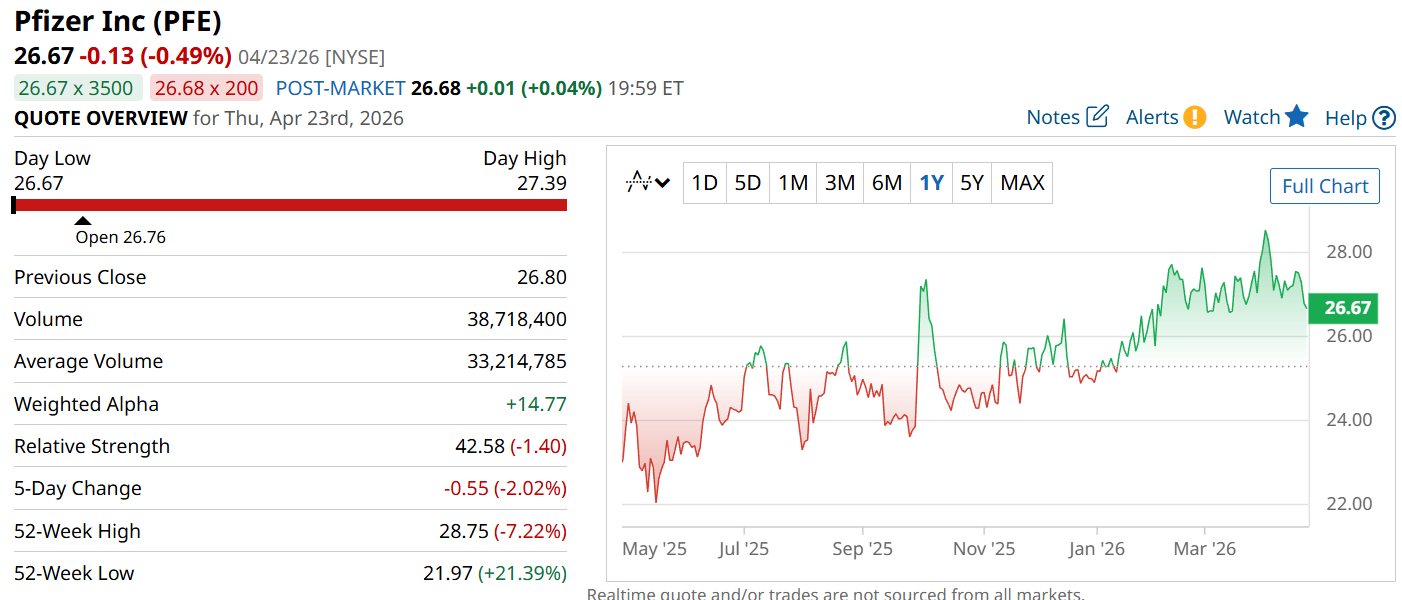
Let’s start with Pfizer. It is one of the largest drugmakers in the world, with a business built around medicines and vaccines that is used across several major areas of healthcare. Put simply, Pfizer develops and sells treatments that reach patients globally.
Pfizer stock trades at around $26 a share, up 21% from its 52-week low and about 7% year-to-date.
Merck & Company (MRK)
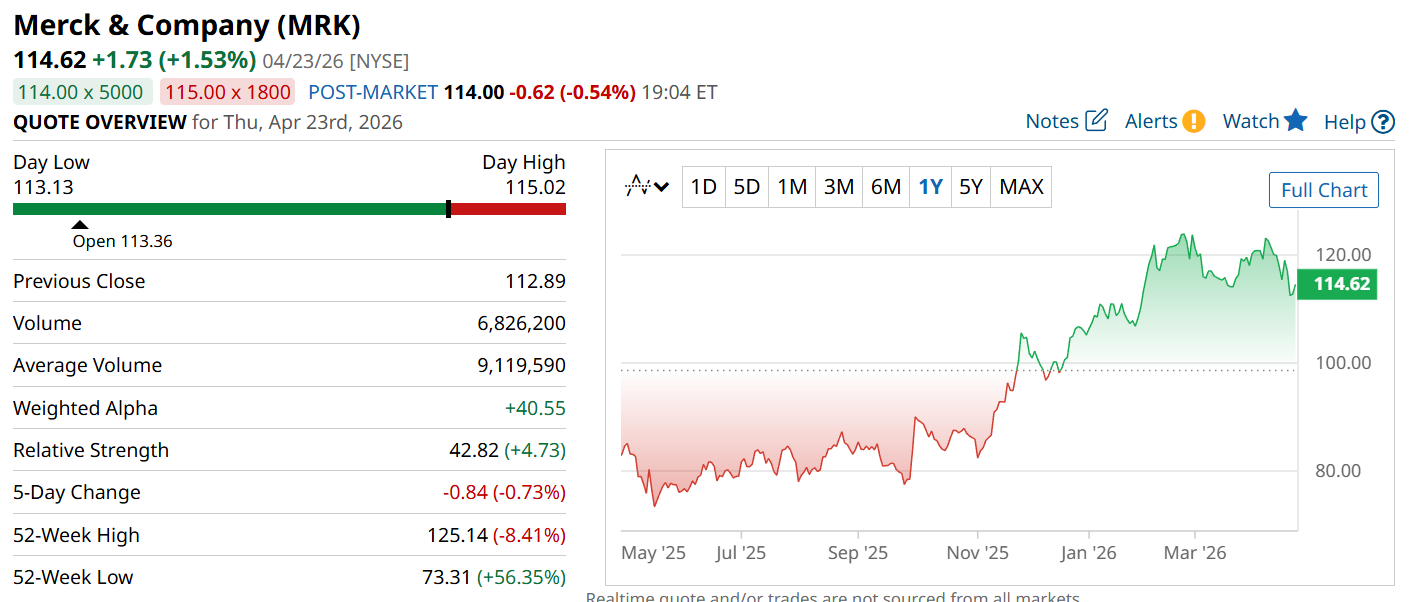
Then there's Merck & Co., another pharmaceutical giant with a strong presence in prescription drugs, vaccines, and animal health. In simple terms, Merck makes money by selling healthcare products for both people and animals, giving it a slightly broader business mix.
Trading at around $114, it’s up 56% from its 52-week low and around 9% year-to-date.
At this juncture, it’s hard to establish the winner yet. So, let’s get to know the both of them better.
How they make money: Pfizer vs. Merck
Pfizer and Merck both operate in the pharmaceutical space, but they are not built the same way.
Pfizer focuses on human medicines and vaccines. Its business spans a range of products, including Eliquis, Prevnar, Vyndaqel, Comirnaty, and Ibrance, giving it a diverse lineup.
At the same time, Merck also sells prescription medicines and vaccines, but it has an added business line in animal health. Further, Merck is far more dependent on a single product than Pfizer is, with that drug accounting for 49% of its sales in 2025. But more on that later.
So, while both companies make money by developing and selling major healthcare products, Pfizer looks more diversified across its human health portfolio, while Merck leans more heavily on a blockbuster drug, supported by vaccines and animal health.
Financial health
To better understand them, let’s look at the latest quarterly numbers.
| Metric | Pfizer | Merck & Company |
| Sales | $17.56 billion | $16.40 billion |
| Net Income | -$1.65 billion | $2.96 billion |
| Operating Cash Flow | $11.70 billion | $16.47 billion |
| Forward P/E | 9.16x | 22.85x |
Pfizer came in with slightly higher sales for the quarter, reporting $17.56 billion in sales, compared with $16.40 billion for Merck.
Profitability, however, tells a very different story. Pfizer reported a net loss of $1.65 billion, while Merck generated $2.96 billion in net income. That gap gives Merck a clear edge in net income comparison.
The same is true for cash flow: Merck posted $16.47 billion in operating cash flow, compared with $11.70 billion for Pfizer. It matters because operating cash flow provides a clearer sense of how much cash the business is generating from operations, which is crucial in an industry where research and development, product development, and payouts require significant capital.
Valuation, though, is where Pfizer rebounds. Its forward P/E ratio sits at around 9x, while Merck trades at nearly 23x. For context, the medical sector average is just above 25x.
Why does it matter? Because P/E compares a stock’s price with its expected earnings, it tells us how much investors are paying for each dollar of profit. On that basis, both stocks are still trading below the sector average, but Pfizer looks much cheaper by a wide margin.
So while Pfizer had a slight edge in revenue and clearly looks cheaper on valuation, Merck looks stronger in profitability and cash generation. Put another way, Pfizer looks like the cheaper stock, while Merck looks like the financially stronger business.
How do their dividend metrics compare?
For income-focused investors, this may be what you’re waiting for.
Pfizer has raised its dividend for 16 consecutive years and currently pays a forward annual dividend of $1.72 per share, yielding around 6.3%. Its payout ratio is at 53%, meaning it allocates over half of its earnings to dividends, which explains the stronger yield.
Meanwhile, Merck & Co. pays $3.40 per year, or about 3.02%. It also has a more conservative payout ratio of 36%
So while Pfizer stands out more for income (because of its much higher yield), it also comes with a higher payout ratio. Merck, on the other hand, offers a lower yield but appears to retain more of its earnings within the business. One could also say that a lower payout ratio could suggest that it's easier for a company to increase its dividend.
Wall Street’s take
There's a clear winner between these two companies, at least according to a consensus on Wall Street.
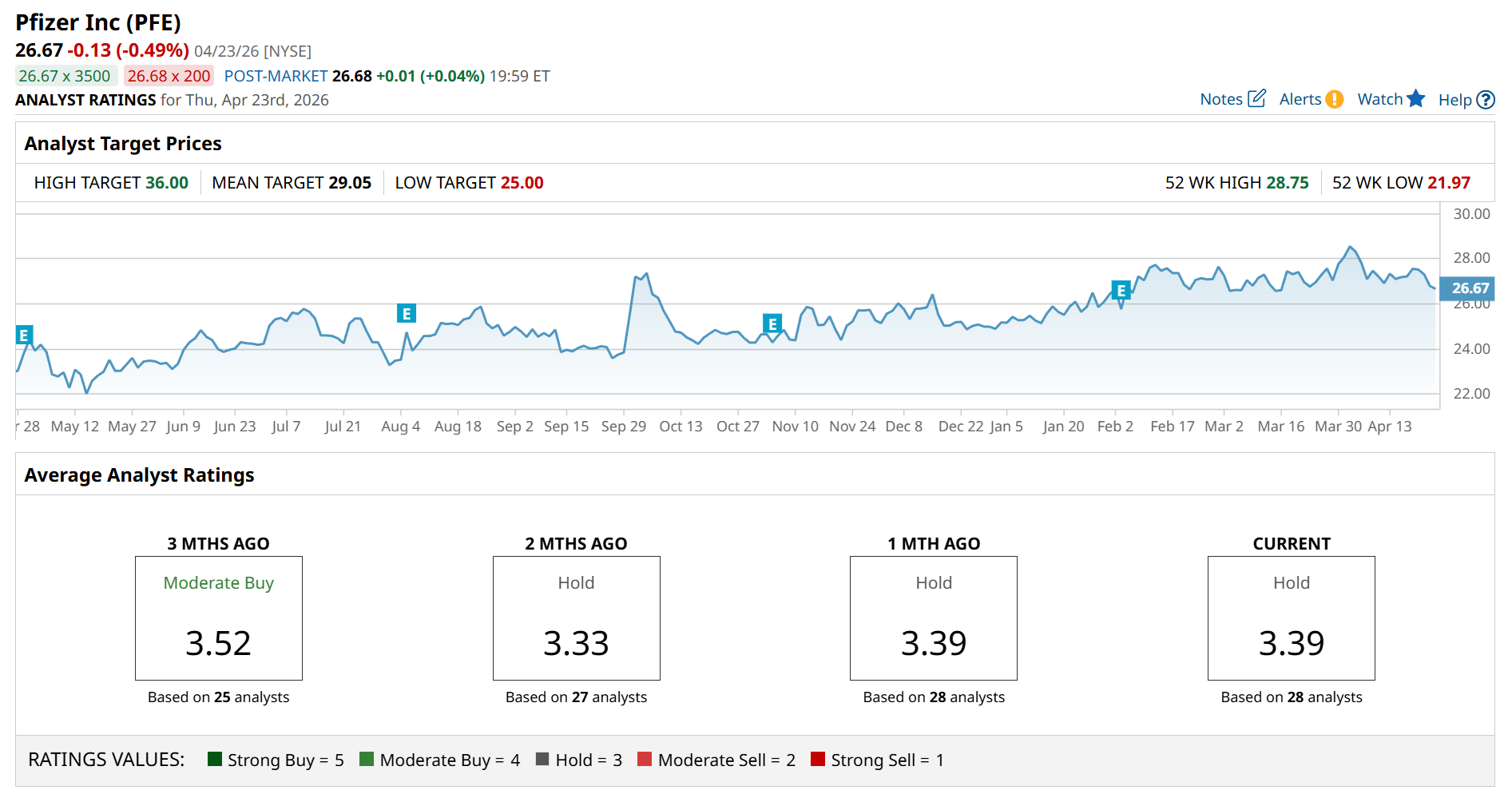
A consensus among 28 analysts rates Pfizer a “Hold”, suggesting that further developments may be needed before sentiment turns more clearly bullish or bearish. Its mean target price suggests about 9% potential upside.
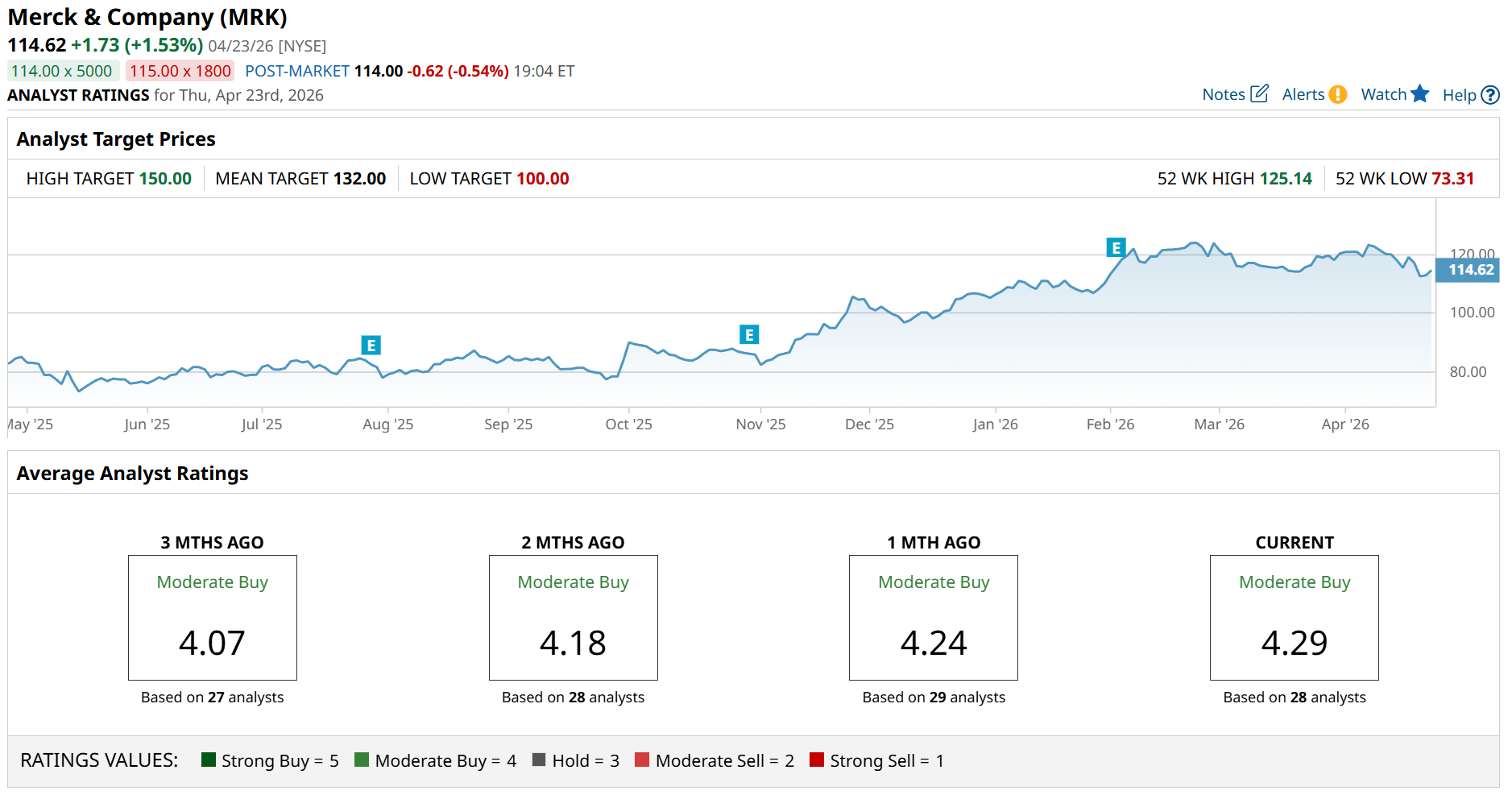
Meanwhile, Wall Street is more bullish on Merck & Co., as a consensus among 28 analysts rates the stock a “Moderate Buy,” with a score of 4.29 out of 5. The mean and high target prices suggest a potential upside of between 15% and 31%.
So Pfizer carries a more cautious hold rating, while Merck has the stronger support from Wall Street right now.
Verdict
Both Pfizer and Merck have their strengths, which is why this is not a one-sided comparison.
Pfizer stands out more on valuation and dividend yield, making it the more appealing option for income-focused and value-oriented investors.
Merck, meanwhile, looks stronger on profitability, cash flow, and overall Wall Street sentiment, giving it the edge for investors seeking capital growth and income.
In the end, Merck appears to come out slightly ahead in this matchup, though Pfizer still has a case, depending on what an investor prioritizes. As always, investors should conduct their own due diligence and decide which stock best fits their goals.
On the date of publication, Rick Orford did not have (either directly or indirectly) positions in any of the securities mentioned in this article. All information and data in this article is solely for informational purposes. For more information please view the Barchart Disclosure Policy here.
More news from Barchart
Wall Street Says Buy Merck Over Pfizer. The Numbers Tell a More Complicated Story. This Boring Dividend King Might Be the Safest Pick to Add to Your Portfolio Honeywell Just Announced That Its Quantinuum Unit Filed for an IPO. How Should You Play HON Stock Here? Broadcom Stock Is Trading at New All-Time Highs. Should You Buy Shares Here?