

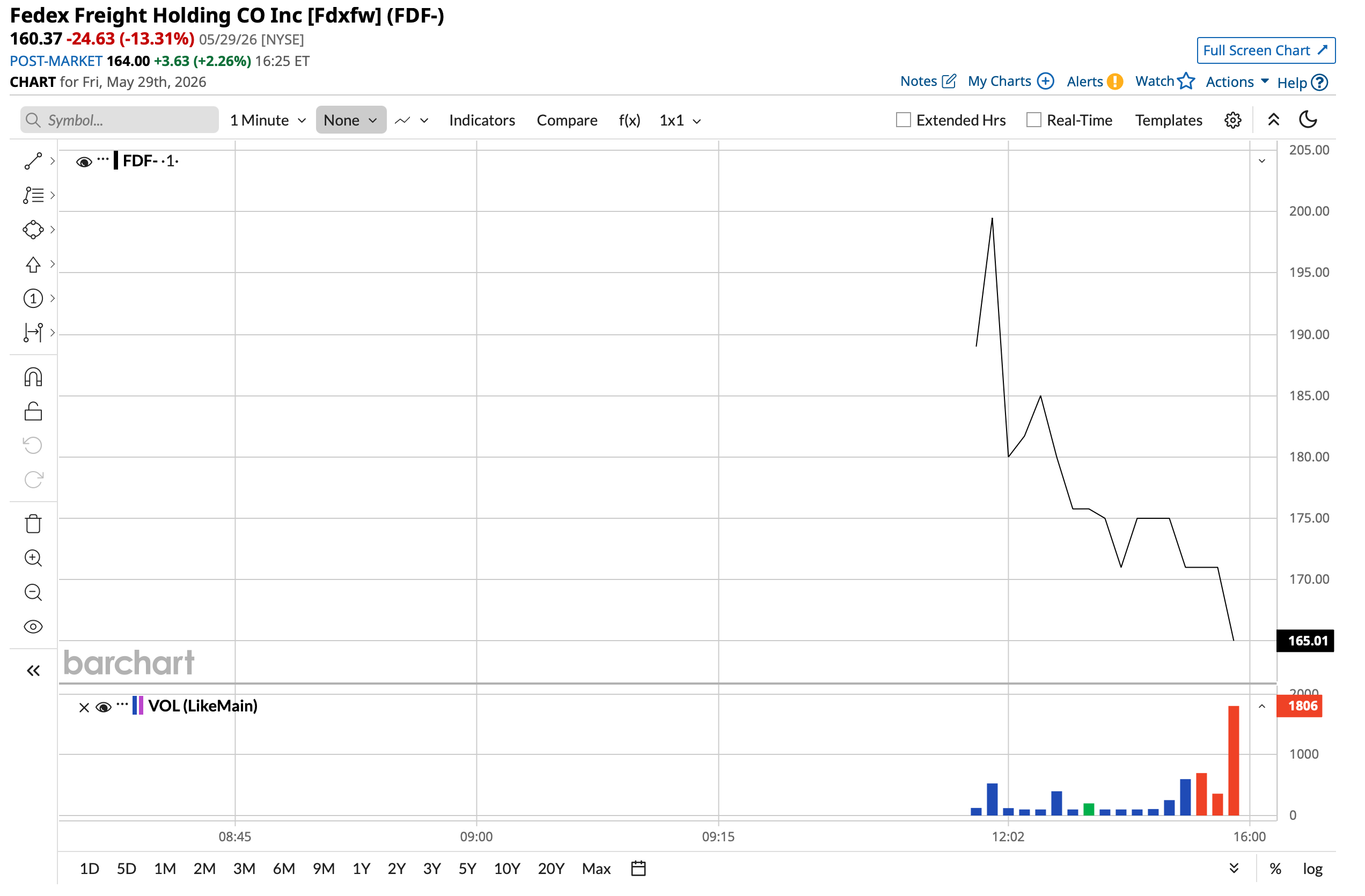
FedEx Freight (FDXF), the new company spun off from FedEx, made its debut on the stock exchanges yesterday. Investors would like to forget the first day, as the stock ended almost 7% lower. Yet, FedEx Freight operates the largest North American less-than-truckload fleet currently, and that should count for something.
 www.barchart.com
 Notably, in my most recent analysis of FedEx, I had highlighted that this was a prudent move on the part of the company to make its operations more efficient. But, as a standalone investment, does FedEx Freight have what it takes to be one for the long haul?
More Top Stocks Daily: Go behind Wall Street’s hottest headlines with Barchart’s Active Investor newsletter.
Sizable Presence
At its FedEx Freight Investor Day, the medium-term outlook for a 4%-6% CAGR revenue growth may not sound much. However, this is actually comparable to the LTL industry's long-term growth rate of about 5% for the decade. Moreover, projections of a free cash flow generation of more than a billion dollars, along with a conversion rate of 90% builds a solid base on which the company can build upon to expand its fleet or invest in technology.
However, FDXF stands out primarily through the exceptional reach of its operational network. The firm runs close to 400 service centers featuring more than 26,000 terminal doors nationwide. In addition, its coverage extends to about 99% of all United States zip codes. This vast infrastructure supports more compact and efficient local routes that improve driver productivity, lower fuel usage for each shipment, and enable a greater volume of pickups and deliveries within every shift than rivals with less extensive systems can achieve.
Such a broad scale equips FDXF with the flexibility to manage two complementary service models under one integrated operation. These include rapid options for time-critical shipments and standard offerings for regular transit. This structure helps the company address a diverse set of customer requirements across the freight sector. It delivers higher-priced quick service to clients who value speed while relying on everyday freight to maintain full truckloads and cut down on trips with no cargo.
From a technology perspective, FDXF will break away from the older information systems of its previous parent entity. Instead, the company is creating a fresh technology platform built exclusively for less-than-truckload transportation needs. A key element involves AI tools for flexible pricing strategies. These solutions review live network availability, directional traffic patterns, and cargo specifications to update immediate price offers without delay. The system reduces rates on routes with excess capacity to draw additional business and increases charges where space is limited to improve returns. This approach maximizes income per transport unit and simplifies reservation and billing activities.
The firm's Chief Technology Officer, Michael Rodgers, has emphasized the rollout of intelligent artificial intelligence agents developed through a collaboration with Salesforce (CRM). Unlike basic automated chat tools, these advanced systems apply machine learning to tackle complicated logistics matters independently. They can adjust routes for shipments facing delays, address detailed questions on invoicing, or notify customers about potential service interruptions in advance. FDXF projects that these enhancements will lower the volume of routine manual processes by up to 60% in the years ahead.
In the terminal areas, where labor expenses tend to run highest, the company is introducing advanced radio frequency identification and visual recognition capabilities. This technology captures details on every pallet's measurements, weight, and destination as equipment moves items around the facility. The resulting data flows directly into the central AI system to optimize trailer arrangements for proper balance and efficient unloading sequences. These improvements decrease manual handling time and help protect against cargo damage, an important expense factor in this business segment.
Final Take
FedEx Freight appears to be the dominant force in the LTL market, and it is doing all it can to hold on to its apex position. However, the company should be mindful of a competitor such as Amazon (AMZN), which has launched its own LTL operations. Although it is not the core focus of Amazon, the distribution it has is comparable to that of FedEx Freight, along with much deeper coffers.
Yet, FedEx Freight should not have much cause to worry, as its decades of expertise and core focus should allow it to thwart any competition for the time being.
On the date of publication, Pathikrit Bose did not have (either directly or indirectly) positions in any of the securities mentioned in this article. All information and data in this article is solely for informational purposes. For more information please view the Barchart Disclosure Policy here.
More news from Barchart
Even If Eli Lilly Stock Continues to Shine, Stay Away from This Pharmaceutical ETF Micron Stock Could Still Have Nearly 70% Upside Potential Left in Its Tank Nvidia Launches AI Chip for Laptops. Count NVDA Stock Out at Your Own Peril. Greg Abel's Big Bet: Berkshire to Buy Taylor Morrison Homes in $6.8 Billion Deal