


Quantum computing just got its “Uncle Sam” moment.
The U.S. government is investing more than $2 billion into quantum initiatives, and that changes the conversation. This is no longer just a futuristic science project buried inside research labs. It’s becoming a national technology race, a manufacturing race, and eventually, a commercialization race.
More Yield, Less Trap: Sign up free to get Barchart’s daily Dividend Investor newsletter straight to your inbox.
And that’s why it feels like we’ve reached a tipping point as investors ask: Is now the right time to buy quantum stocks? And if it is, then which one should you buy?
Today, I’ll attempt to answer those questions.
What is quantum computing?
We’re all aware of how artificial intelligence (AI) is running the market right now.
But this isn’t new. We’ve all seen this for other emerging tech that had the potential to change the landscape. There was personal computing in the 80s, the internet in the late 90s, and the smartphone and mobile internet boom back in the 2000s.
This scenario even played out when the first printing press was introduced. We’ll see it when the next exciting innovation comes around.
But a big part of being an investor is looking forward – and not to the next month or week or so, but to the next few decades. And that leads to the obvious question: what comes next after AI?
The easy answer is quantum computing.
Quantum computing, a branch of quantum technology, leverages the principles of quantum mechanics to perform certain computational tasks that are considered impossible or impractical by today’s standards.
The easiest way to explain the concept is this: every computer you use today processes information using binary digits, or bits. A bit can be either a one (1) or a zero (0). Every device you use, every program you run, ultimately depends on patterns of trillions of these ones and zeros being stored, moved, and processed as fast as electrical signals can travel.
In fact, our entire technology infrastructure is built upon these ones and zeros.
But it has a big limitation.
A bit can only be either a one or a zero at any given instant. Bits can switch faster than any of us can think, but they can still only go so fast. So even if the time it takes to change a bit from a one to a zero is better measured in picoseconds, which is one trillionth of a second, it still consumes time.
That’s why modern computers, as fast as they are, still face a physical limit on how much they can calculate.
Why should you buy quantum stocks now?
And this is where quantum computing comes into play. The technology uses qubits instead of regular bits. A qubit exists in a quantum state – which means it can be a one, a zero, or both before anyone observes and measures it. This is called quantum superposition.
That means quantum computers can potentially calculate and evaluate many possible outcomes simultaneously, rather than processing them one at a time like traditional computers.
Now, it doesn't mean a quantum computer will replace your laptop tomorrow, or suddenly solve every problem on earth the day after. In fact, for most everyday tasks, classical computers are still the better tool for the job. (You wouldn’t use a jackhammer to hang your family pictures, after all.)
But here’s the thing. Quantum’s applications can positively impact computationally intensive workloads such as molecular studies for drug discovery, materials science, financial modeling, and, of course, artificial intelligence.
This is why many investors consider quantum computing as the next logical step in tech. What AI was for the internet, quantum computing is now for AI: the next big thing.
To be clear, it’s not the replacement. It’s an improvement – and a potential solution to some of AI’s biggest challenges.
Increasing calculation capacity means more efficient use of power, something that AI data centers are notoriously bad at.
Data set sizes can increase exponentially, leading to better, more complex decisions and outcomes. That means better LLMs and smarter autonomous systems.
Training can take a fraction of the time AND cost.
We’re already seeing some of these benefits in both directions today. Microsoft (MSFT) recently used AI to improve the qubit stability of its Majorana 2 quantum chips. Perhaps soon, quantum computers will be the ones helping to advance AI.
And that is why many investors are looking into buying quantum stocks now. Sure, the companies working on the technology today are mostly small and speculative. Many dismiss them as lottery-ticket picks with their negative earnings, dwindling cash flows, and irregular revenue.
But this could be the golden entry opportunity into the next logical step in computing technology. Just like buying the struggling GPU maker Nvidia (NVDA) back in 2019.
And, of course, the marriage between AI and quantum can lead to the development of new, unimagined software and hardware. For many, that’s such a big source of excitement. Because how do you put a price tag on technology that hasn’t even been invented yet?
Back in the 90s, the internet wasn’t valued based on the juggernaut it’s become today. They tried, but at no point did any company even get close to a trillion-dollar valuation.
Now, we have 11 companies valued at over a trillion, with almost all of them involved in AI:
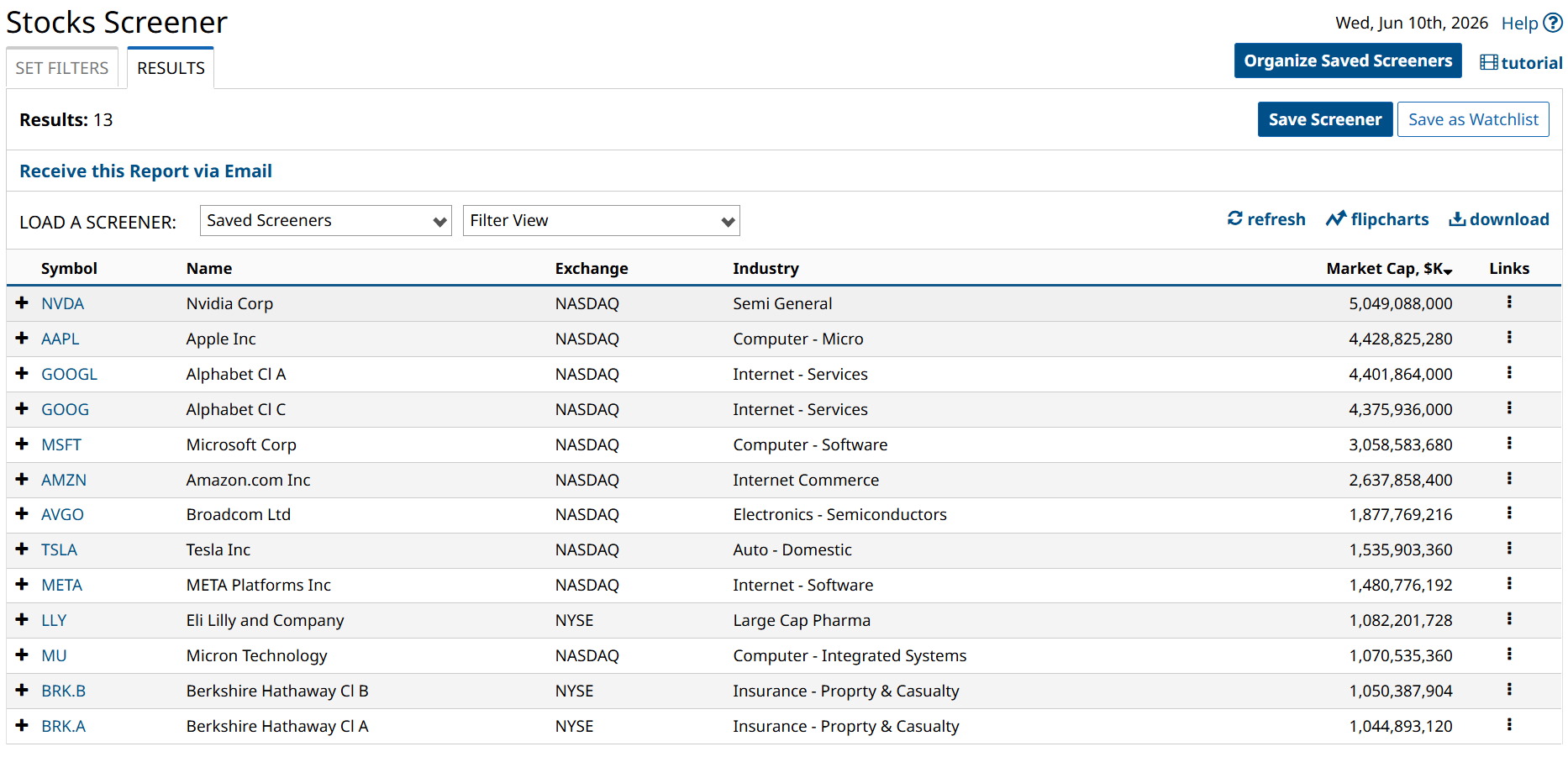
That’s the same crux with quantum computing. If it can reach its potential, the biggest winners might overshadow today's top companies.
Why shouldn’t you buy quantum stocks now?
Quantum technology is still a highly speculative corner of the market.
For the most part, the technology itself is still not commercially viable. Certain companies have been able to monetize it with commendable consistency (one of which we’ll talk about later), but the technology’s biggest challenges remain unsolved.
The first and most significant hurdle is error correction. Qubits are highly sensitive to almost any interaction with them. That includes noise, heat, electromagnetic interference, and even the very act of measurement itself. Once a qubit is disrupted, it loses quantum information (decoherence), which leads to computational errors.
Any company aiming for large-scale commercialization needs to address decoherence. After that, they need to find a way to build systems with thousands or millions of these more stable qubits, find a way to reduce production costs, implement a cooling solution that doesn’t consume enormous amounts of energy, and then ultimately convince commercial buyers that the benefits of quantum computing justify its price tag.
But those are technological roadblocks. For investors, it’s more black-and-white: when can you expect a return on your investment? The honest answer is that nobody really knows.
Unlike with AI, where some companies are already proving that their previous investments are yielding revenue, quantum computing is still mostly a bet. Sure, some stocks have seen quadruple-digit returns in the last few years; but when you take a peek under the hood, their valuation ratios run almost as high.
For some investors, that level of uncertainty is a dealbreaker, and I don’t blame them for staying away.
But for others, that’s precisely why quantum computing is so attractive. It represents an opportunity to get in on the ground floor of something that could change the course of technology forever.
Speculative pure-play quantum companies
On that note, let’s discuss some of the top pure-play quantum companies today. These are the ones that are pushing the boundaries of tech, each taking a different approach to solving the same problems. Getting an idea of what they do can help investors in deciding which ones they want to back.
Pure-Play #1. IonQ (IONQ)
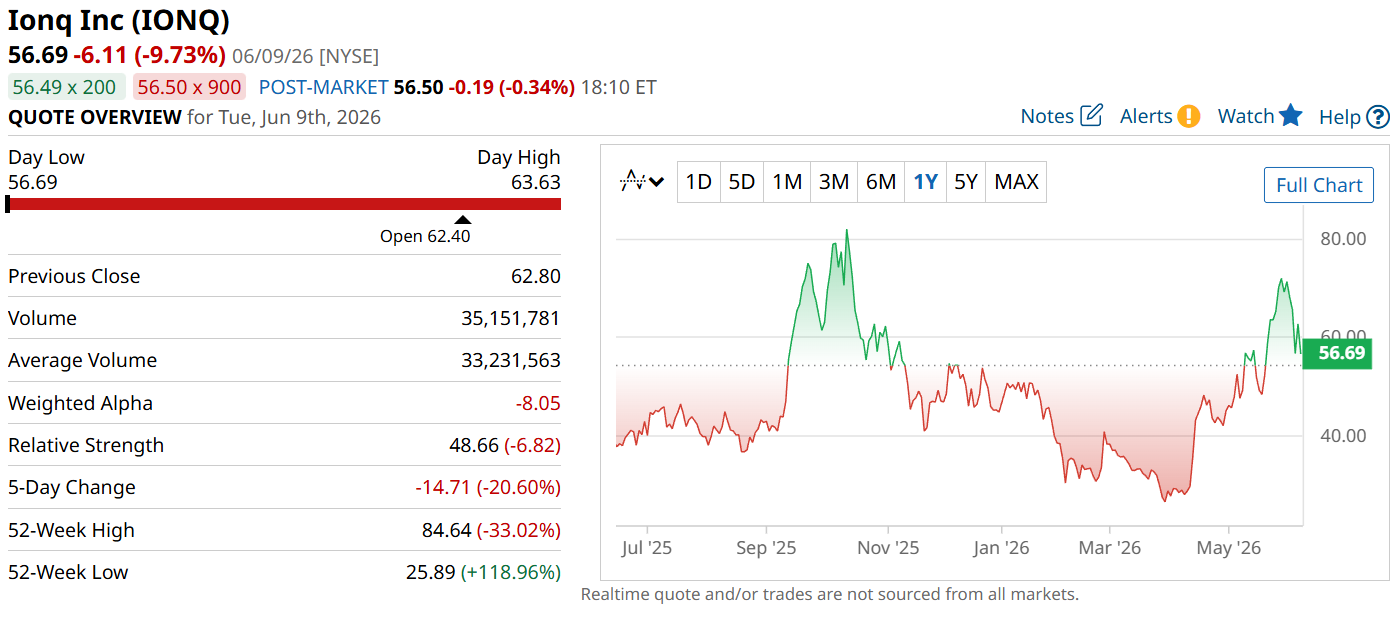
Let’s start with IonQ, because this is still the quantum stock many retail investors think of first.
The investment case for IonQ is built around trapped-ion technology, and one of the big points viewers keep bringing up is that IonQ’s systems don’t require the same near-absolute-zero cooling setup that superconducting quantum platforms need.
That matters because if quantum computing is ever going to scale commercially, companies will need to dial down how practical it is to build, operate, and eventually sell. And that’s what makes IonQ so exciting. In fact, compared to many quantum names, IonQ already has a stronger revenue growth story and a large cash position, which we’ll dive more into later.
Pure-Play #2. D-Wave (QBTS)
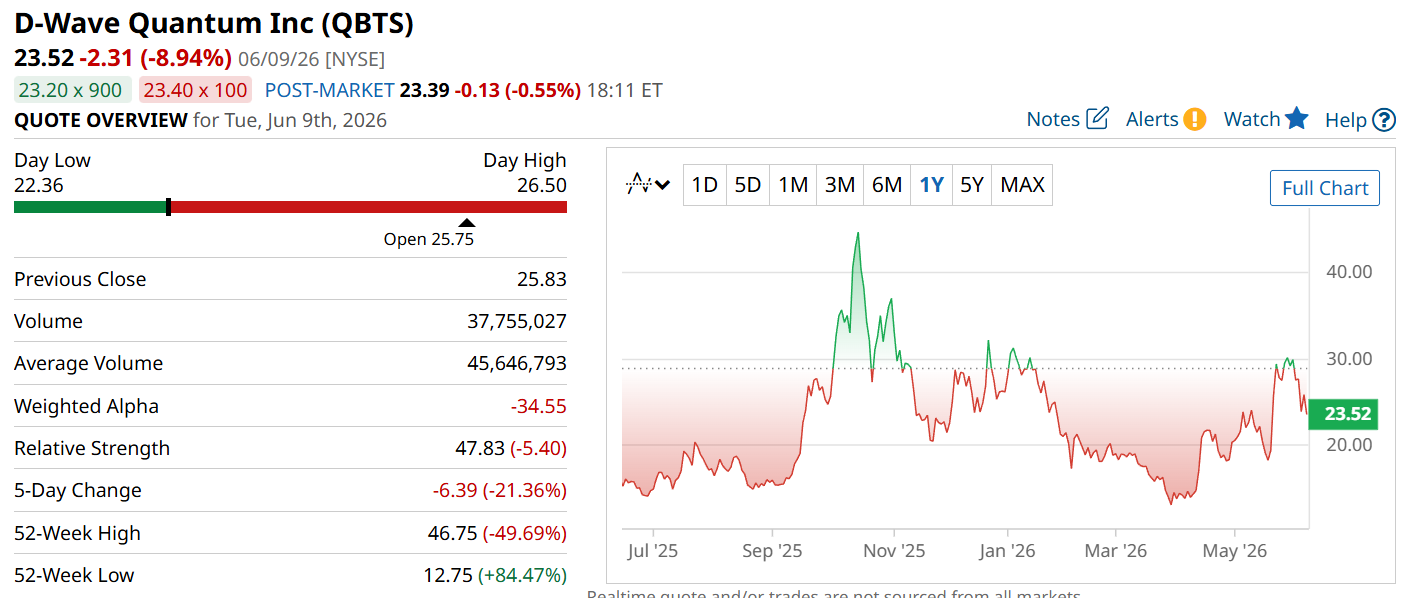
Now let’s talk about D-Wave, because this is where the quantum story gets a little more complicated.
D-Wave isn’t telling the exact same story as IonQ. Its focus has been more on quantum annealing, optimization problems, and real-world use cases that may be useful earlier than full fault-tolerant quantum computing.
So the pitch here is different. D-Wave argues that quantum tools can already begin solving certain types of problems using existing technology.
That’s why the government funding angle matters. D-Wave was included in the recent U.S. quantum investment push, and it also sits squarely in the middle of the broader debate over which quantum platforms governments and enterprises are willing to support.
But there’s an important counterpoint investors should consider.
D-Wave’s systems still raise the same question that follows many superconducting quantum platforms: if the hardware depends on cryogenic cooling, can it really scale for mass commercial use?
Pure-Play #3. Rigetti (RGTI)
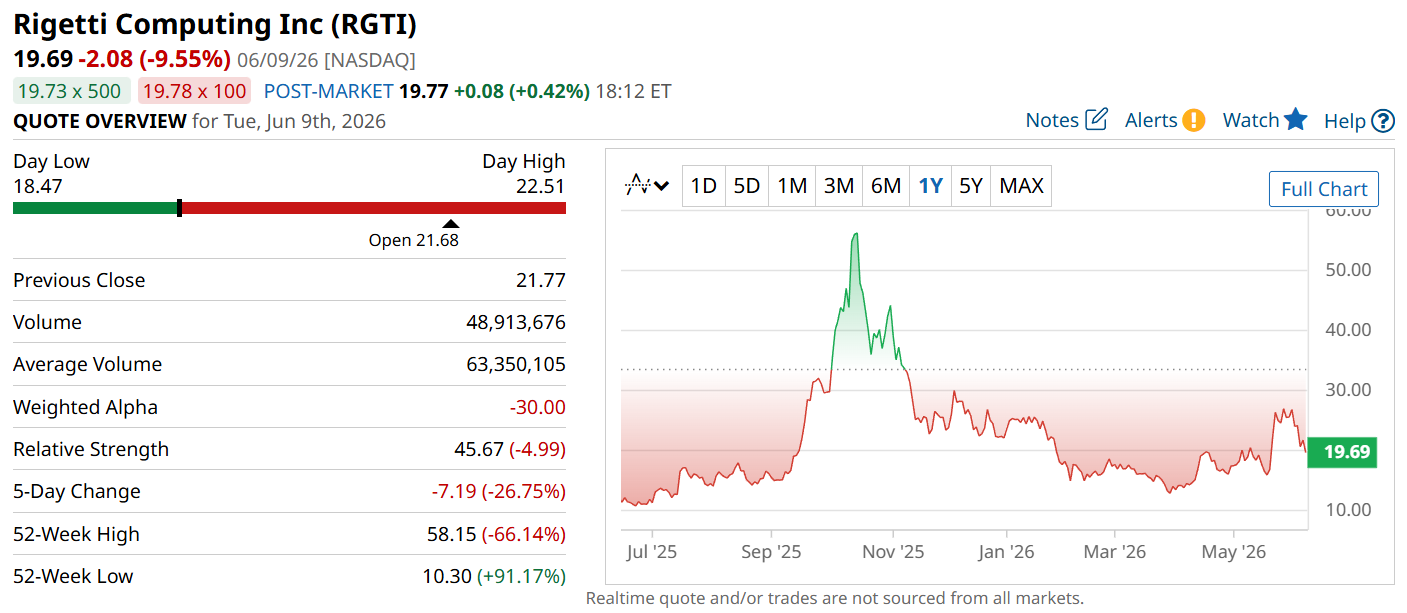
Rigetti is another name that deserves attention here, especially because it’s closely tied to the government-backed quantum narrative.
Like D-Wave, Rigetti is part of the superconducting quantum camp. But Rigetti’s story is more focused on building a full-stack quantum computing platform and proving that its architecture can scale over time.
The company has also been getting attention because of its planned U.K. expansion and the broader government investment cycle that seems to be favoring certain quantum players.
That’s the tension with Rigetti. It has government momentum, a clear technical roadmap, and a high-upside story. But investors need to decide whether this is a real long-term platform or another early-stage quantum company that still has a lot to prove before the business catches up with the stock.
Pure-Play #4. Quantinuum (QNT)
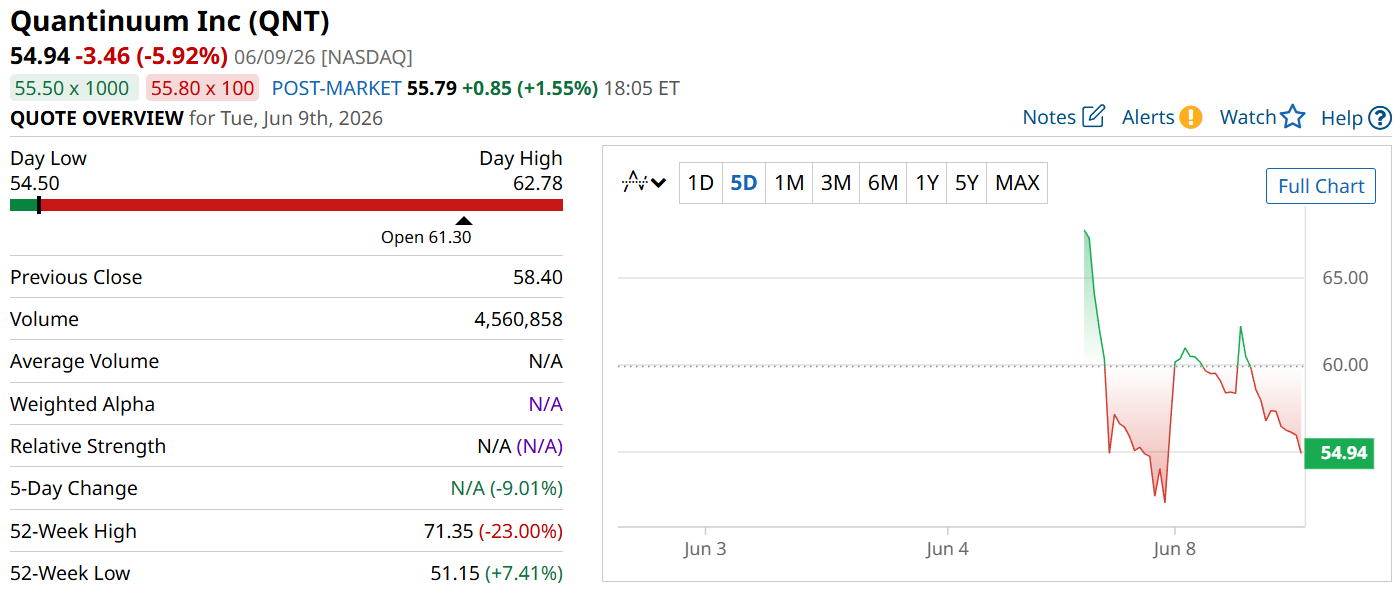
Now we’re getting to the newest hype name in quantum: Quantinuum.
The market is already buzzing after its IPO, and it’s easy to see why. Quantinuum IPOed with a lot of attention, a serious technical background, and a full-stack quantum story that instantly puts it in the same conversation as IonQ, D-Wave, Rigetti, and even IBM (IBM).
The company’s H-Series hardware is the big focus here, and this is where the comparison with IonQ becomes especially interesting.
Both companies are associated with trapped-ion technology, but investors need to look beyond the hype and ask which platform is actually showing stronger performance, better benchmarks, and a more credible path to commercial use.
And right now, IonQ has all the cards. That doesn’t mean Quantinuum can’t catch up, but all we have right now is the promise of its technology. That makes it the obvious lottery-ticket pick out of the group.
Valuation comparison among the pure-play quantum group
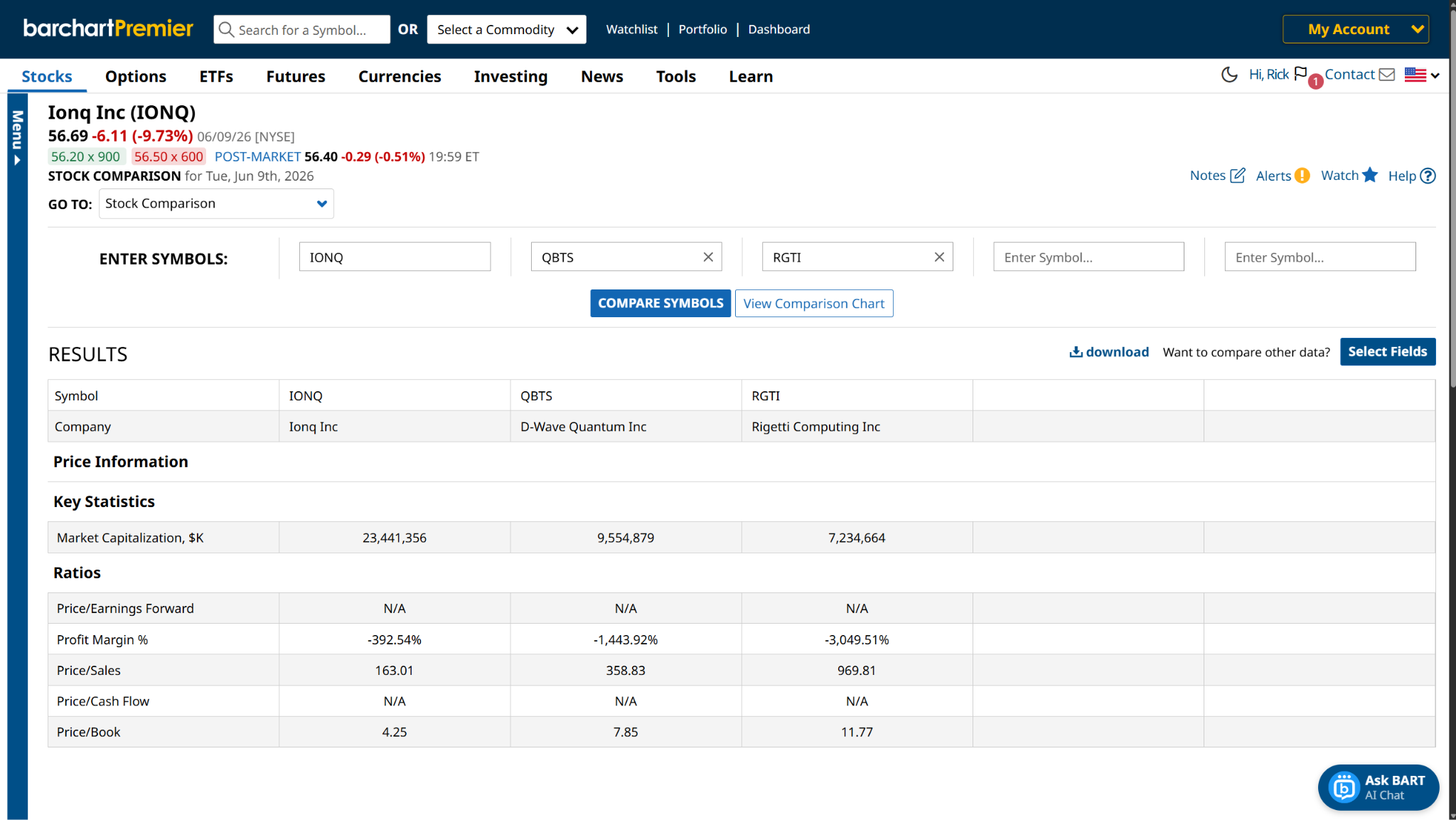 Pure-play quantum stocks compared.
 Right off the bat, I’m removing Quantinuum from the running because we don’t yet have enough data on it.
So, focusing on the other three, I can say that IonQ has the best valuation score. It has the lowest price-to-book ratio, which measures how much investors pay relative to the company’s net assets per share.
It also has the second-lowest price-to-sales ratio, which measures revenue per share.
In fact, IonQ is breaking revenue records and raising guidance for Q2 and full-year 2026.
Additionally, its remaining performance obligations have reached $470 million, with 50% due within the next 12 months.
All this suggests that IonQ is barrelling towards revenue stability. Yes, the company is still reporting large adjusted losses and operates in an emerging industry, but its growing backlog, repeat customers, and improving revenue visibility set it apart.
Because the cold, hard fact is that Rigetti and D-Wave still don’t have that kind of revenue and visibility.
The quantum heavy hitters (megacaps)
Of course, some of the biggest tech companies in the world wouldn’t pass up such an opportunity to spearhead the development of quantum technology. In this list, I’m focusing on the more established names that are running their own quantum tech departments. These companies have the money to spend on any quantum initiative they choose.
But the question is: how are they developing quantum technology, and how do their initiatives compare with the competition?
Megacap #1. International Business Machines (IBM)
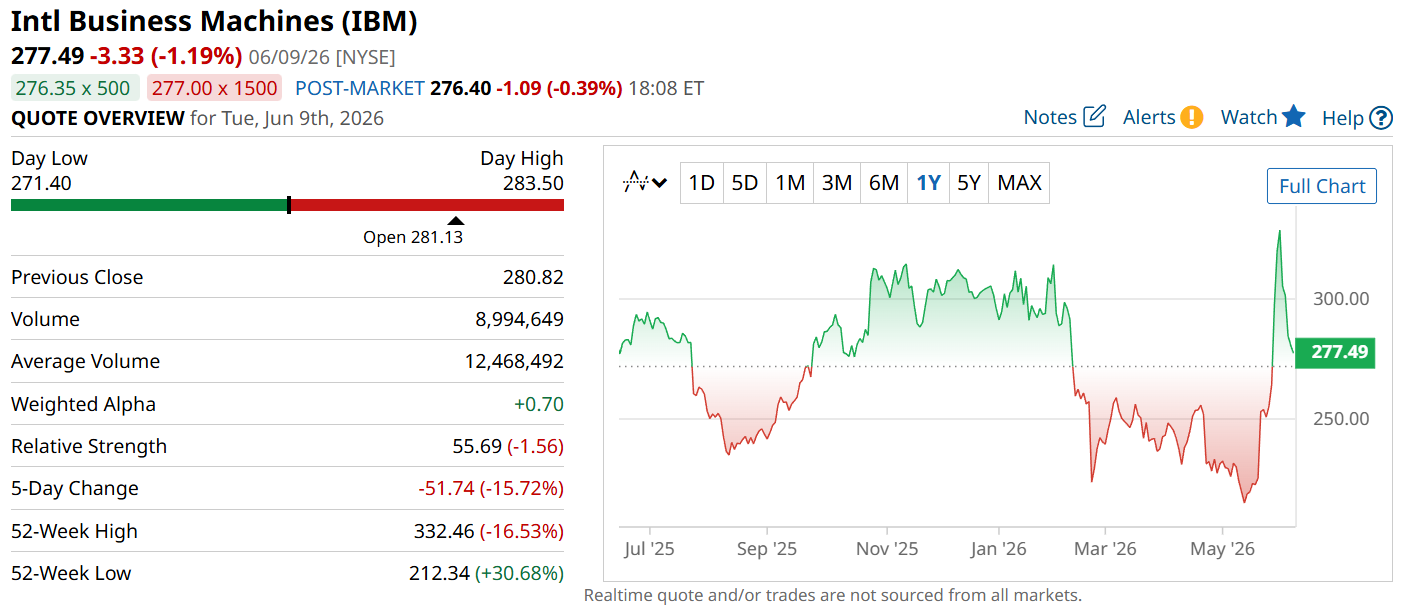
IBM is probably the most credible Big Tech quantum name right now.
The company has been building quantum computers for decades, and it already has real hardware, cloud access, software tools, and enterprise partners.
Today, its quantum work is built around superconducting qubits, which are tiny circuits cooled to extremely low temperatures so they can behave according to quantum mechanics. IBM makes these systems available through the cloud, so researchers, developers, enterprises, and universities can experiment with real quantum hardware rather than just simulations.
The important part of IBM’s initiative is that it’s trying to build a full quantum ecosystem: hardware, software, developer tools, cloud access, quantum algorithms – all the bells and whistles.
But even more exciting, IBM has also introduced newer quantum chips such as Nighthawk and Loon. Nighthawk is designed to run larger, more complex quantum circuits, while Loon focuses on testing the hardware building blocks needed for error-corrected quantum computing.
While quantum is only a small part of IBM's business, the company remains one of the industry's most established players.
Megacap #2. Microsoft (MSFT)
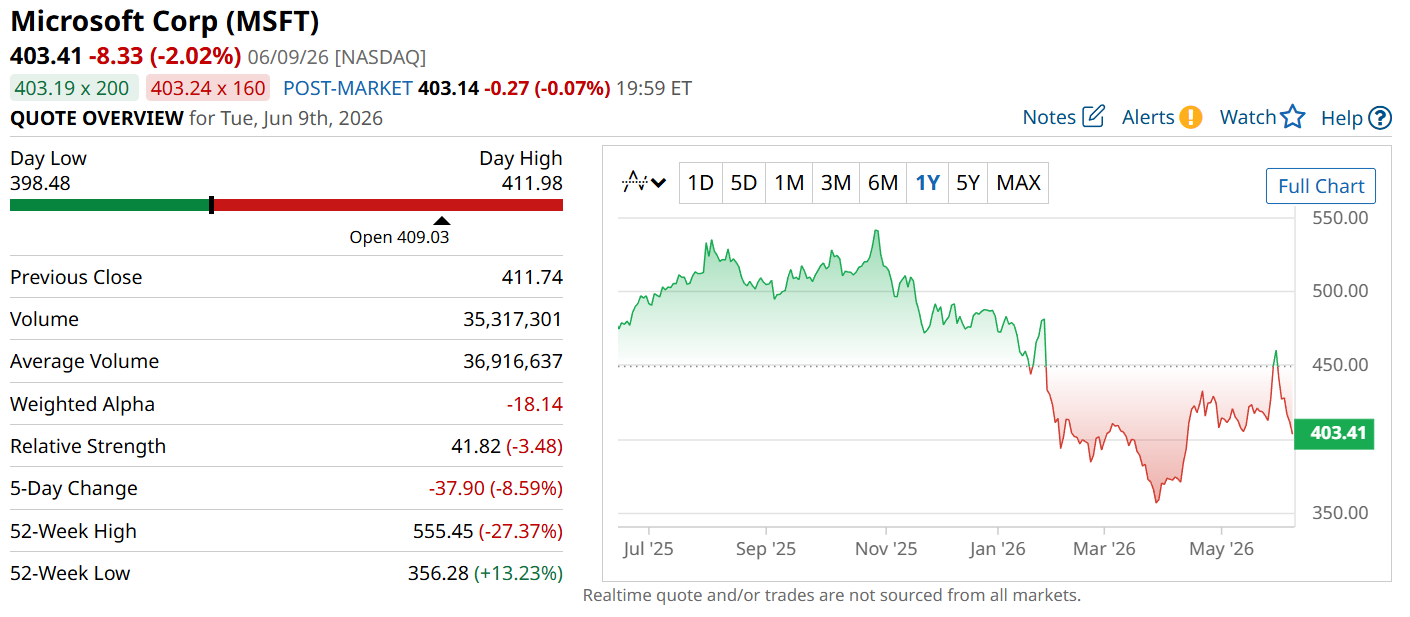
Microsoft is taking a different approach from IBM. The company has been working on topological quantum computing, which is one of the more ambitious approaches.
The basic idea is that topological qubits could be more stable and less error-prone than other types of qubits. Microsoft’s bet is that if it can build more stable qubits right from the get-go, it may eventually need fewer resources to scale a useful quantum computer.
Microsoft’s latest hardware push is tied to its Majorana 2 quantum chips. The company says its Majorana-based quantum processing units are designed to accelerate progress toward scalable quantum computing.
But this is also one of the more controversial quantum efforts. Microsoft’s claims about Majorana-based topological qubits have faced skepticism from at least some researchers, especially because this approach is extremely difficult, and Microsoft has faced earlier controversy over related research.
So, an interesting take on the problem, but execution and – more importantly – proof is still in question.
Megacap #3. NVIDIA (NVDA)
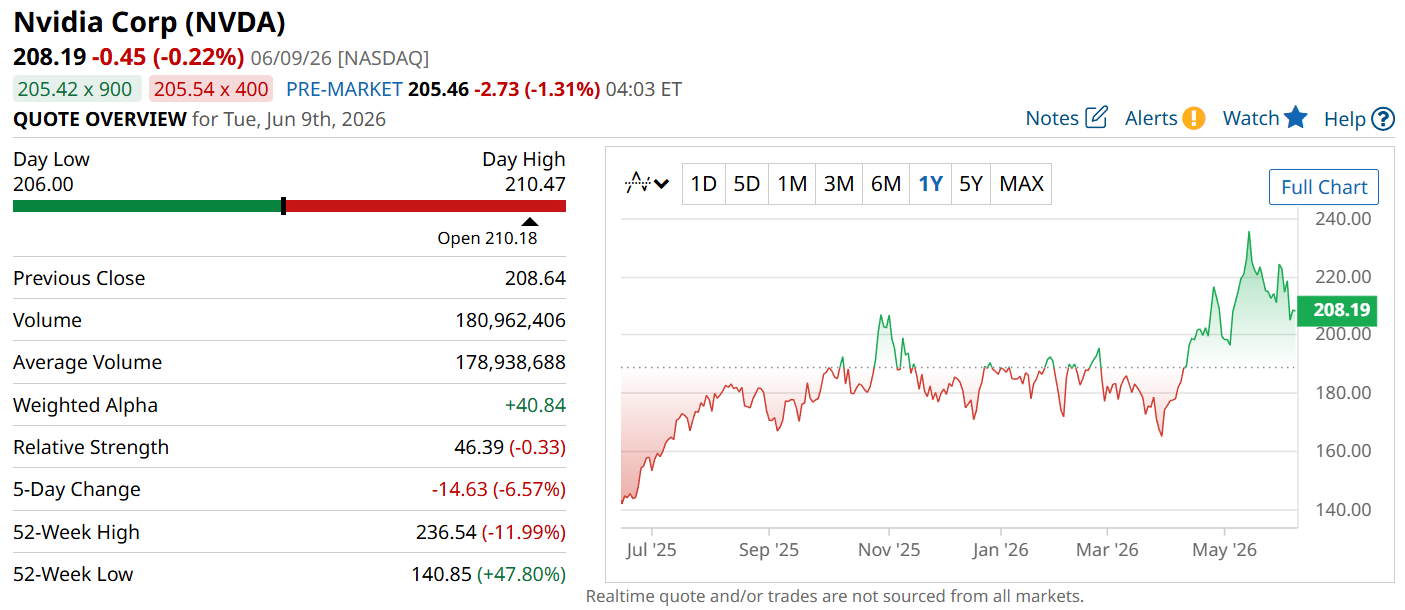
NVIDIA is also taking a novel approach to quantum tech. Instead of building and developing individual computers, it’s laying the groundwork for quantum infrastructure.
Practical quantum computing probably won’t work as a standalone system. It will likely be a hybrid model, with quantum processors working alongside classical computers, GPUs, CPUs, and AI systems – and NVIDIA intends to occupy that niche. That is solid forethought right there.
NVIDIA’s main quantum platform is CUDA-Q, an open-source quantum development platform for hybrid quantum-classical computing. It is designed to let developers build applications that can run across GPUs, CPUs, and quantum processing units from a single program.
Nvidia is also pushing the link between AI, high-performance computing, and quantum computing. At GTC 2026, the company’s annual conference, it described quantum work as increasingly tied to AI supercomputing, especially as the industry shifts from simple qubit demonstrations toward large-scale quantum-classical systems.
Megacap #4. Alphabet (GOOGL)
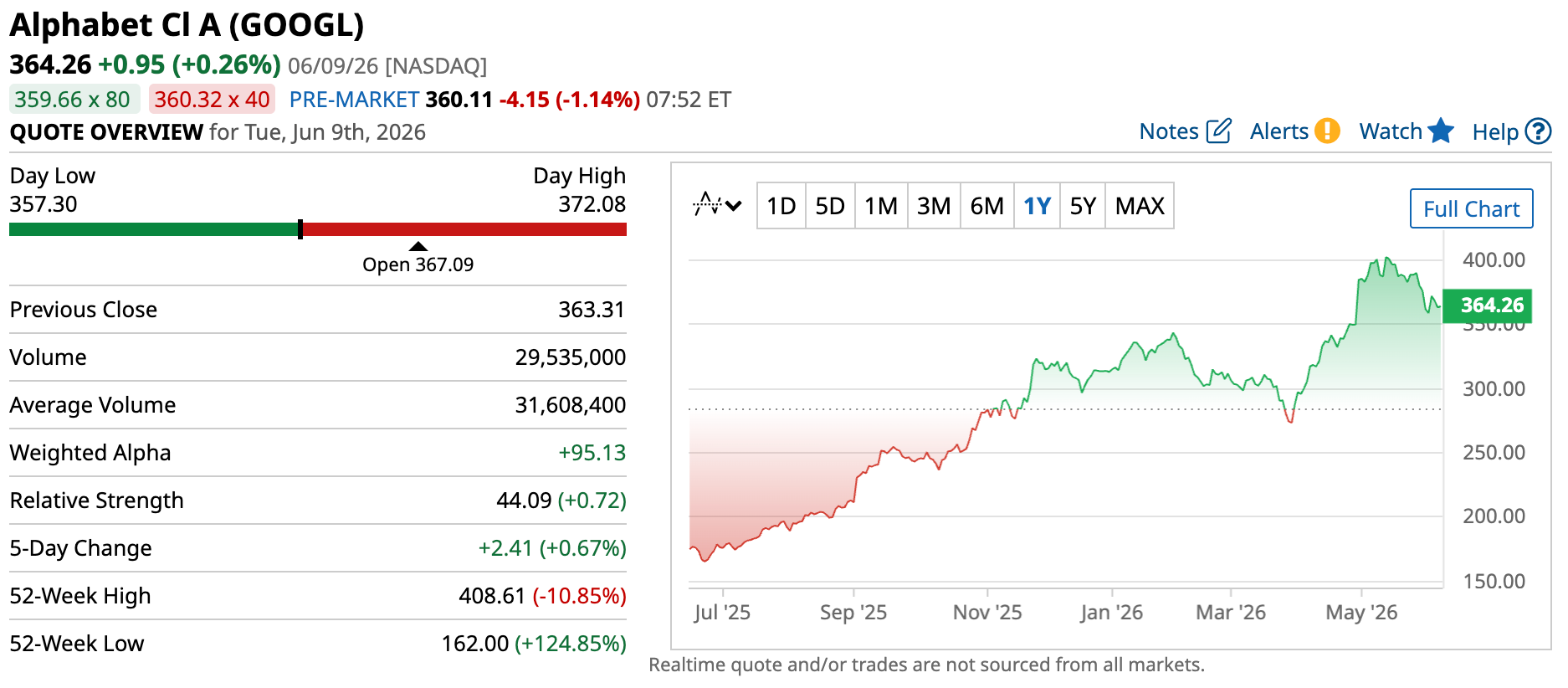
Alphabet is another major quantum player. With Google Quantum AI, the company focuses on building better quantum processors, improving error correction, and eventually making quantum computers useful for real-world problems.
Google Quantum AI first became widely known years ago for its “quantum supremacy” claim, but the more important recent project is its Willow quantum chip. According to the company, Willow showed that errors can be reduced as the system scales up, which it described as a key step toward useful, large-scale quantum computing.
Google’s broader initiative is to build a useful, large-scale quantum computer that can advance scientific discovery, including areas such as chemistry, materials science, and complex physical simulations. Its quantum work also intersects naturally with AI because Alphabet has deep expertise in AI models, cloud infrastructure, and advanced research.
So Google’s quantum initiative is research-heavy, hardware-heavy, and long-term – qualities that many potential investors will likely love.
Which company edges out the competition?
Of all the megacap choices, the one with the most promising quantum pipeline is… a more complicated question that calls for nuance.
If we’re talking about pure technological strength, the top choice is going to be either Alphabet or IBM. Google’s promise of error reduction at scale is such an intriguing and important concept for commercialization. Meanwhile, IBM’s existing and, critically, usable quantum hardware gives it more credibility, and its commitment to future development doesn’t hurt either.
But, if we’re talking about potential industry impact, then we can’t forget NVIDIA. There is some truth in its hybrid model prediction, and this approach can be extremely valuable as another “picks-and-shovels” play to rival its AI GPU initiative.
Which quantum company wins?
If we’re talking about a pure-play quantum pick, then my vote goes to IonQ. It has one of the strongest commercial stories in the sector, with improved revenue visibility and a growing backlog.
Now, don’t get me wrong: all of these pure-play picks carry substantial risk. But IonQ’s business appears to be way ahead of the competition.
If you’re looking at the megacaps for safer exposure, then IBM or Alphabet are the top choices.
But there's one more contender that deserves a bright spot on this list. That's where the sixth contender enters the conversation: the Defiance Quantum ETF.
The safest way to invest in Quantum right now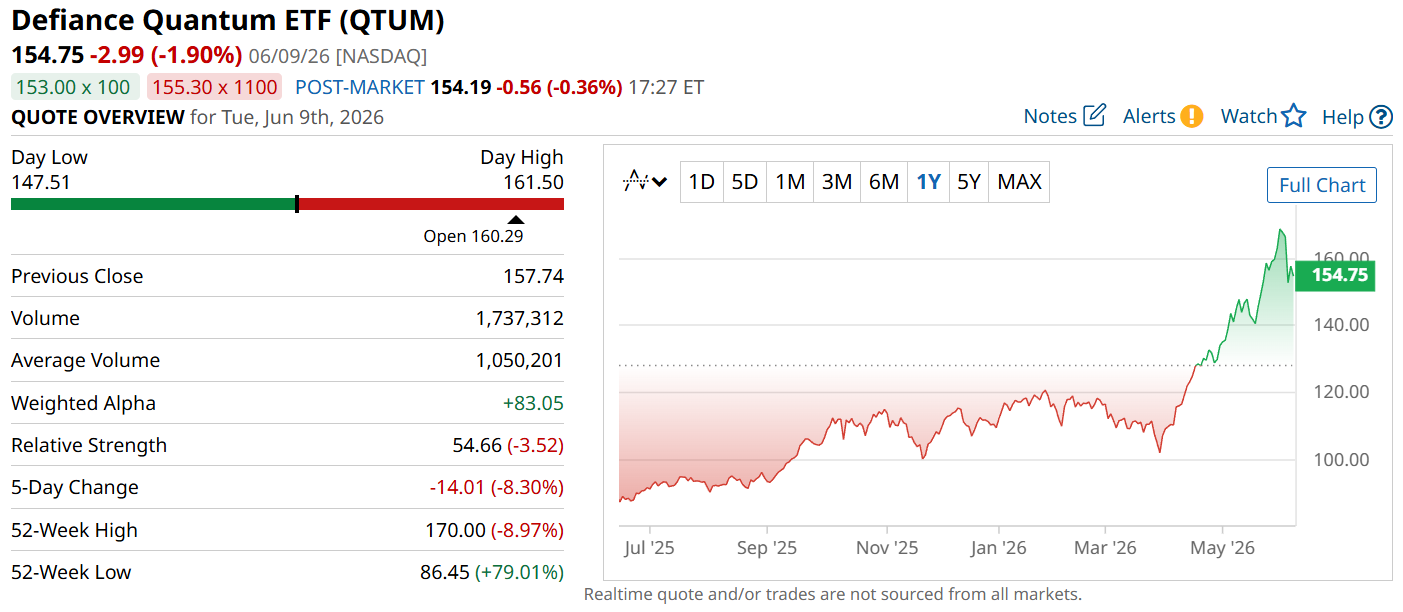
The Defiance Quantum ETF (QTUM) provides investors with exposure to a wide range of companies engaged in quantum computing, AI, machine learning, semiconductors, cloud computing, and advanced computing infrastructure.
Now, I do want to underline that breadth of exposure: Defiance Quantum, despite the name, is not a 100% quantum play, so if you’re expecting that, you’ll be disappointed. The fund also includes larger firms involved in AI, semiconductors, and supporting technologies – companies that can and are potentially tied into the future of quantum computing.
This broader approach also reduces the risk of owning only speculative quantum stocks with no revenue and definitely no income.
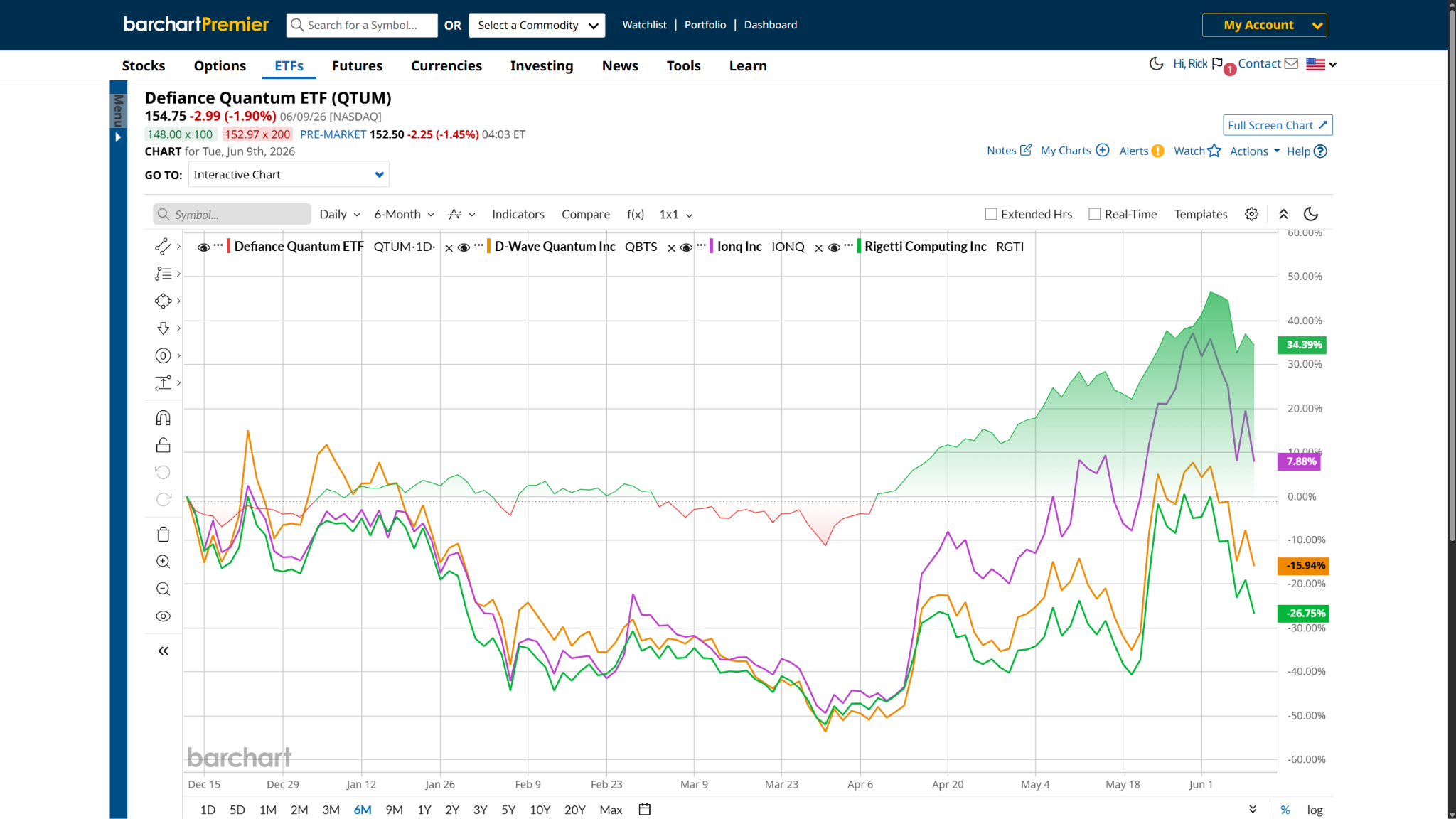
So, how does Defiance Quantum stack up against the other contenders earlier?
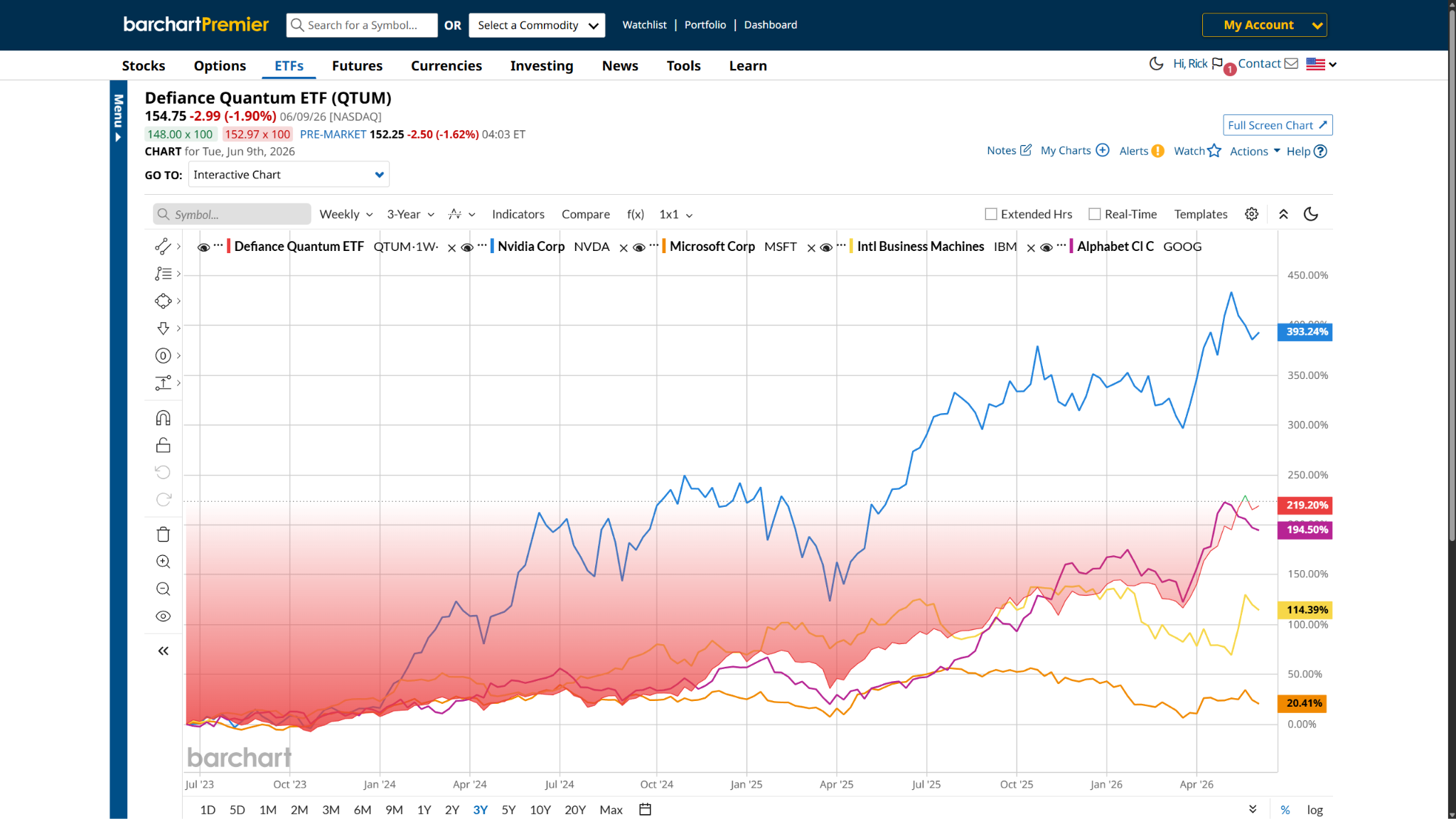
As you can see, there’s been some massive movement over the last three years as interest in pure-play quantum stocks accelerated. Rigetti and D-Wave are leading the pack at 1,673% and 1,151%, respectively.
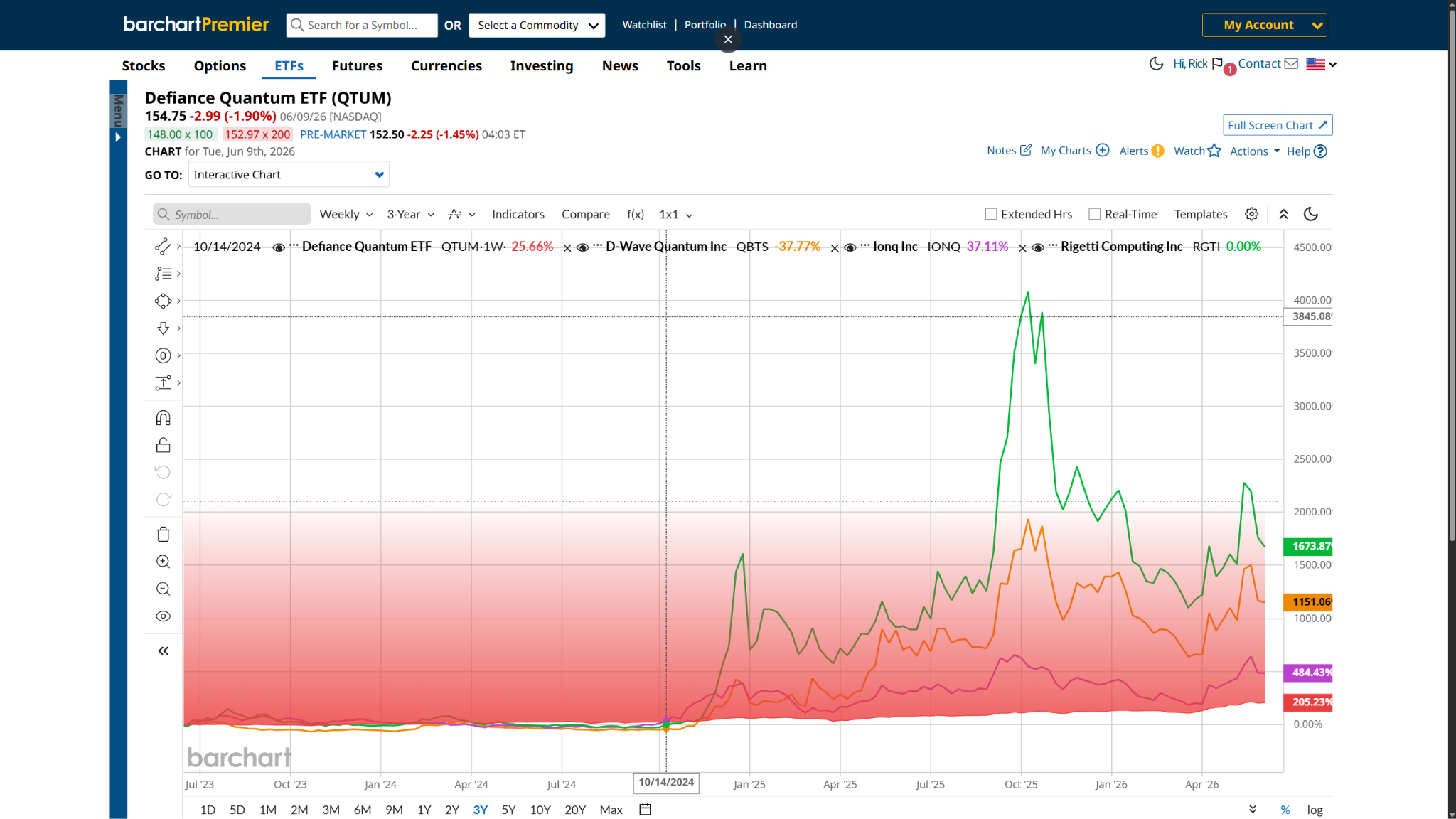
But if we zoom in to the six-month view, only Defiance Quantum and IonQ are in the green, with the ETF outpacing IonQ by over 27 points. The rest are in the red.
It’s largely a similar story when we stack QTUM against the megacaps, at least over the last six months.
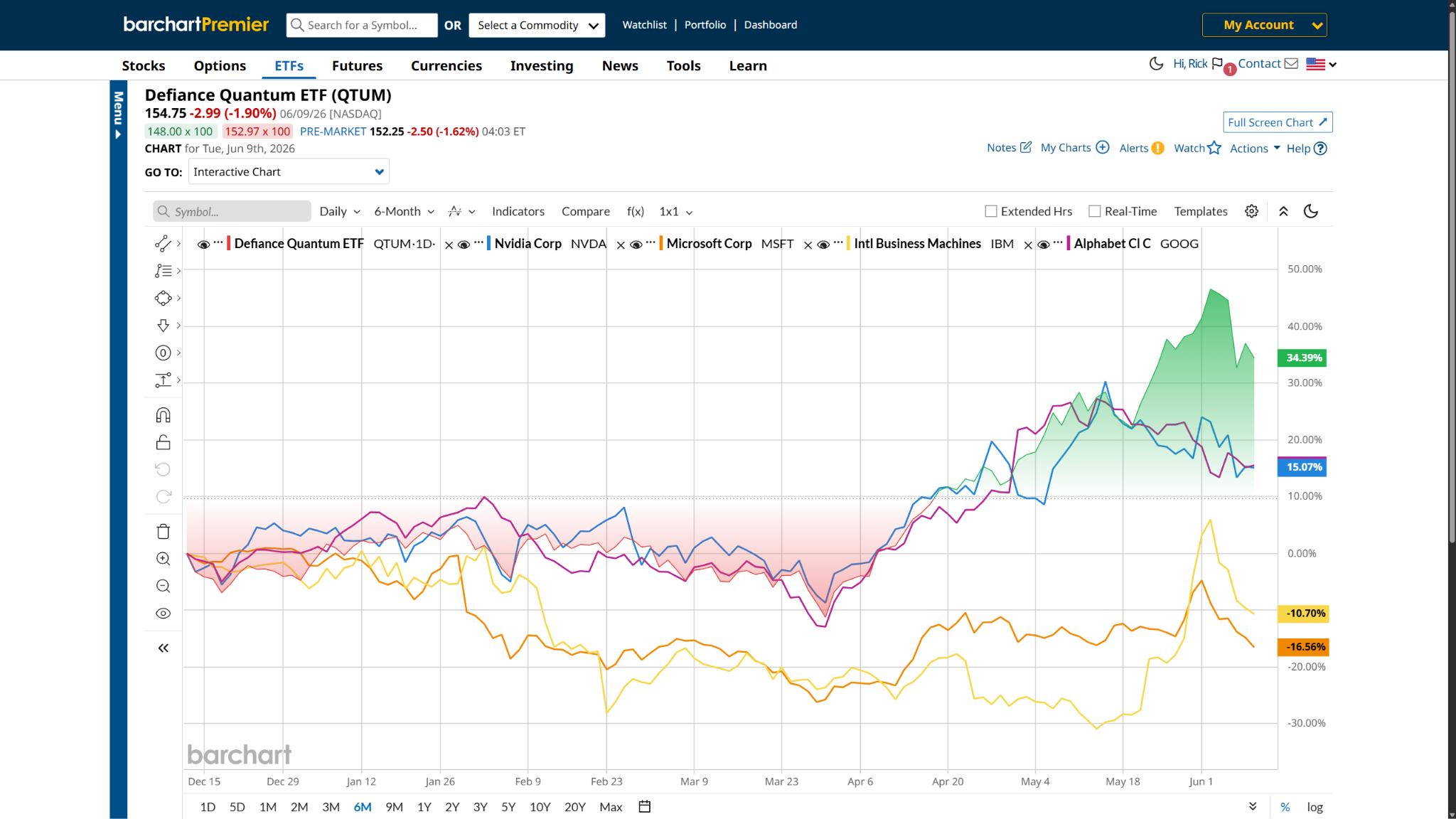
This suggests that the broader, more diversified ETF is performing better than any single company in the short term, though that’s not necessarily the case in the longer term compared to megacap stocks.
Bottom line: If you want pure-play speculative exposure, then IonQ’s developing business offers the better prospect.
If you want a company with strong quantum initiatives but a broader business base, IBM or Alphabet would be a great choice.
But if you want all of that, plus built-in diversification and lateral exposure to AI, then Defiance Quantum is the best choice for you.
Then again, I don’t have a crystal ball, so if you’re keen on getting into the quantum bandwagon before it starts rolling, make sure you do your due diligence.
On the date of publication, Rick Orford did not have (either directly or indirectly) positions in any of the securities mentioned in this article. All information and data in this article is solely for informational purposes. For more information please view the Barchart Disclosure Policy here.
More news from Barchart
Quantum Computing Looks Like Nvidia in 2019. This Could Be the Generational Buy of the Decade. This Newly Listed Closed-End Fund Just Revealed SpaceX as Its Top Holding at $117 Million. Iran War Apathy Has Left Rare Earth Stocks in Critical Condition. Stay Far Away from the REMX ETF’s Dangerous Trap. When Investors Finally Get Sick of AI Stocks, This Medical Devices ETF Could Be a Long-Term Winner