

The gap between digital assets and traditional public company stocks has been narrowing, and recently, that trend has been accelerating.
On Monday, Coinbase (COIN) officially launched pre-IPO perpetual futures contracts tied to artificial intelligence heavyweights OpenAI and Anthropic, following its earlier rollout of a similar vehicle for the recently public SpaceX (SPCX). This move allows eligible non-U.S. retail traders to gain synthetic price exposure to high-profile, venture-backed private firms before they ever reach a public stock exchange. A decade ago, this might have been considered akin to virtual reality. Now, it’s very much real.
Join 200K+ Subscribers: Find out why the midday Barchart Brief newsletter is a must-read for thousands daily.
For Coinbase, this isn’t just a product launch. It represents an expansion into a lucrative, high-margin derivatives business which can diversify its revenue away from basic, spot-market crypto trading volume.
However, before analyzing the charts and COIN’s corporate setup, traders must grasp the unique risks of this new derivative instrument.
What Is a Pre-IPO Perpetual Future?
In traditional finance, standard futures contracts carry a rigid expiration date. When that date arrives, the contract must be settled, requiring traders to either close out their position or roll it over into the next calendar cycle.
A perpetual future (or “perp,” not to be confused with a slang term for a suspected criminal) removes this constraint entirely. It is a derivative contract that trades continuously with no expiration date, allowing participants to hold a leveraged directional view indefinitely.
To ensure the contract’s price stays anchored to the underlying asset’s true value, the exchange utilizes a dynamic mechanism called a funding rate. That’s a periodic payment exchanged between long and short positions based on the contract’s premium or discount to the fair market value.
When this is applied to trending pre-IPO companies like OpenAI and Anthropic, the mechanism becomes complex. Private entities do not have a transparent, real-time public share count. So, pricing these contracts on a per-share basis is highly unreliable.
Coinbase bypasses this hurdle by building contracts pegged directly to a valuation-based index. For instance, a contract mark price of 1,800 implies a $1.8 trillion aggregate corporate valuation. Sort of like a market capitalization before there is a public market to set that figure. Profits and losses are completely settled in a stablecoin proxy like USDC.
These contracts do not represent direct ownership of private equity shares. Instead, they function as a synthetic price discovery mechanism. The moment a company files its final public IPO prospectus and begins trading on a legacy exchange, Coinbase automatically rebases the valuation perp into a standard, per-share stock perp via a profit-and-loss neutral adjustment, allowing open positions to carry directly through the transition.
If the recent SPCX IPO is any indication, my suspicion is this has a better chance of being good news for COIN than for many retail traders, who may be drawn in by the pre-IPO action, rather than solid investment hygiene. But we shall see.
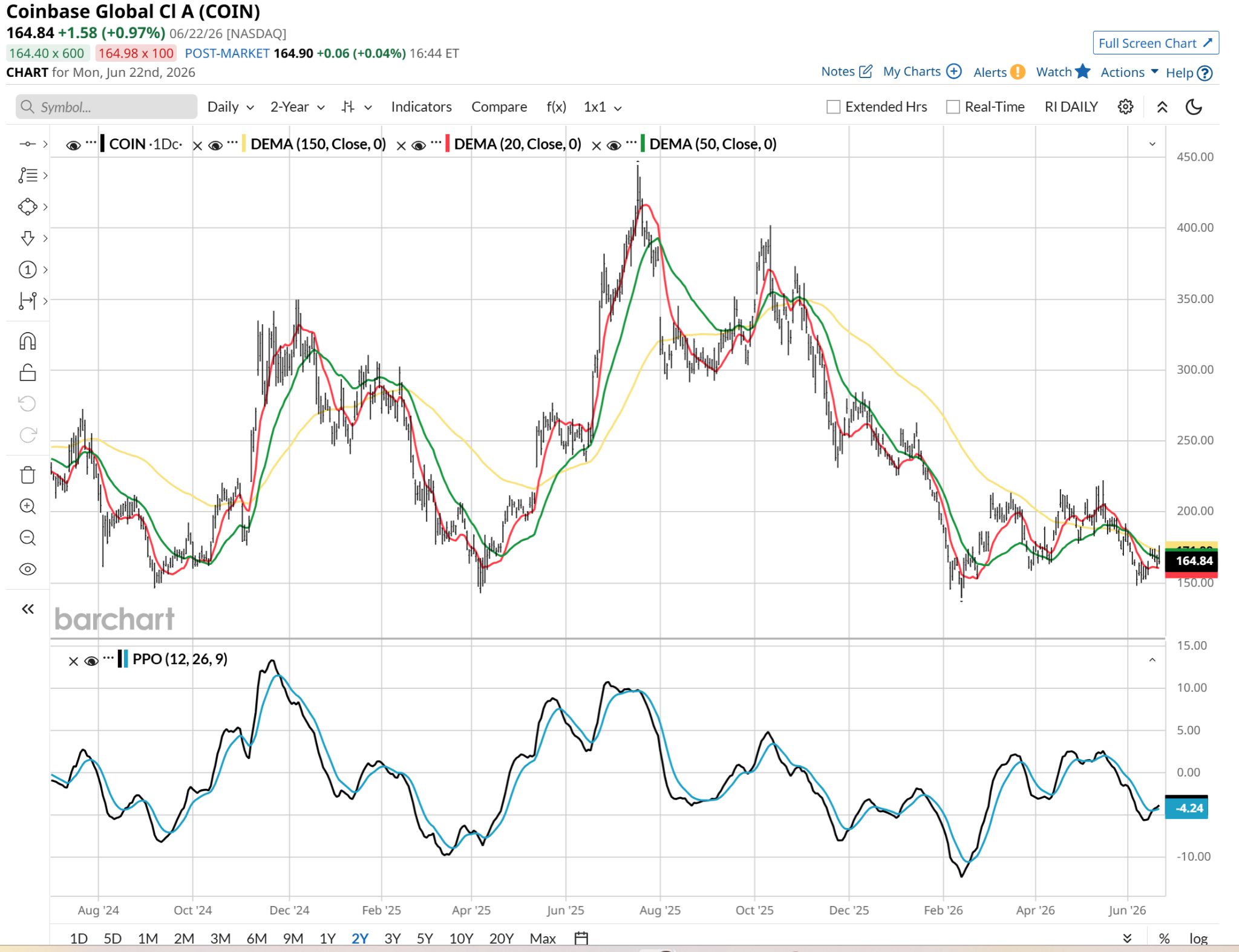
COIN stock has been stuck at the bottom of a trading range. That’s what we see here.
 www.barchart.com
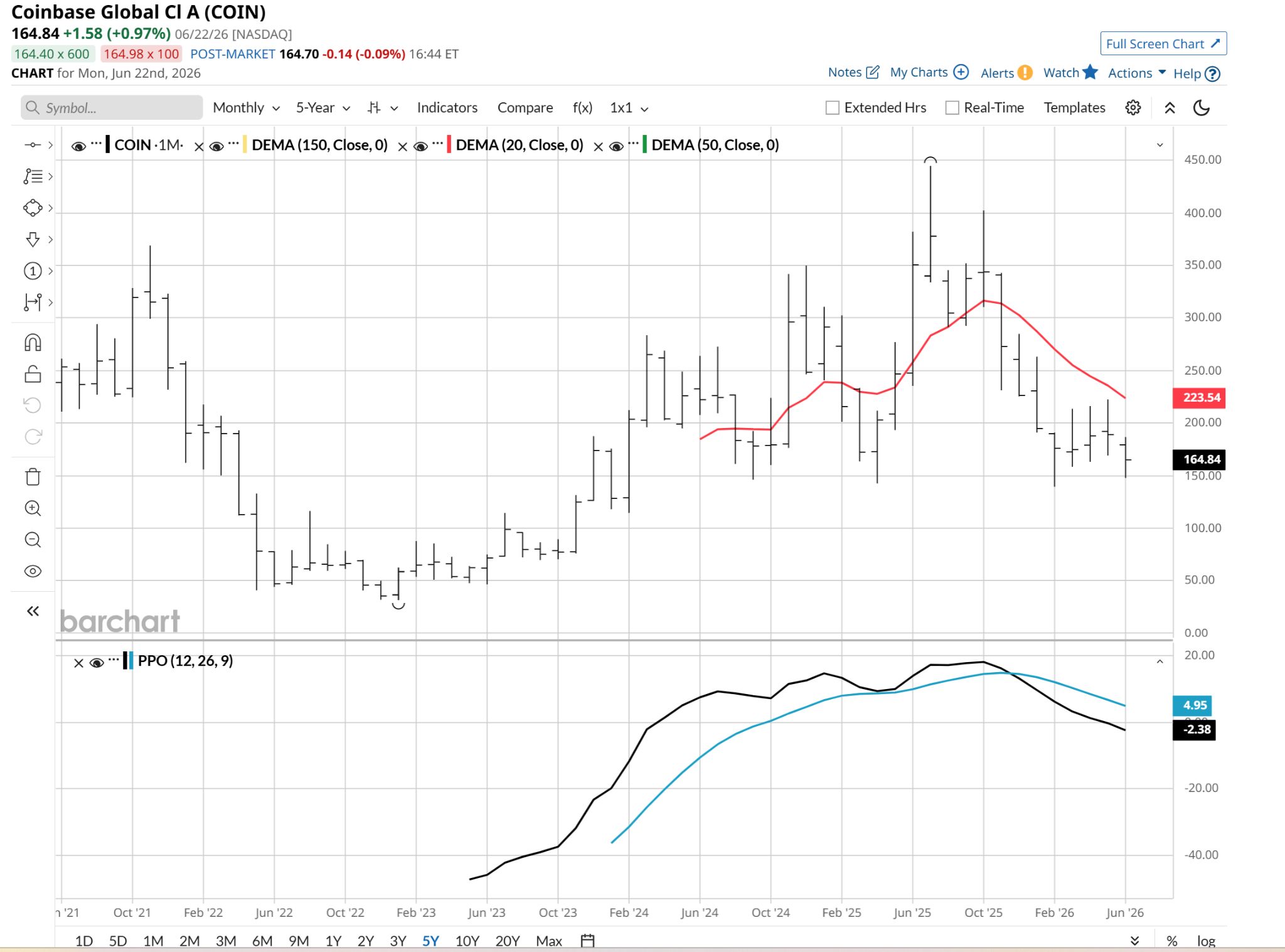
 And the more we peel back this stock’s performance history, the worse it looks. COIN went public on April 14, 2021, just over five years ago. The night before, the stock was priced by the Nasdaq Exchange at $250 a share, and it opened at $381 at 1:30 p.m. Eastern on April 14, for a more than 50% premium.
It actually peaked at nearly $430 on its debut day before closing near $328. It closed yesterday, June 22, 2026, at exactly half that price. And no, there was not a 2:1 stock split! Put it all together and you get a longer-term chart that looks like this:
 www.barchart.com
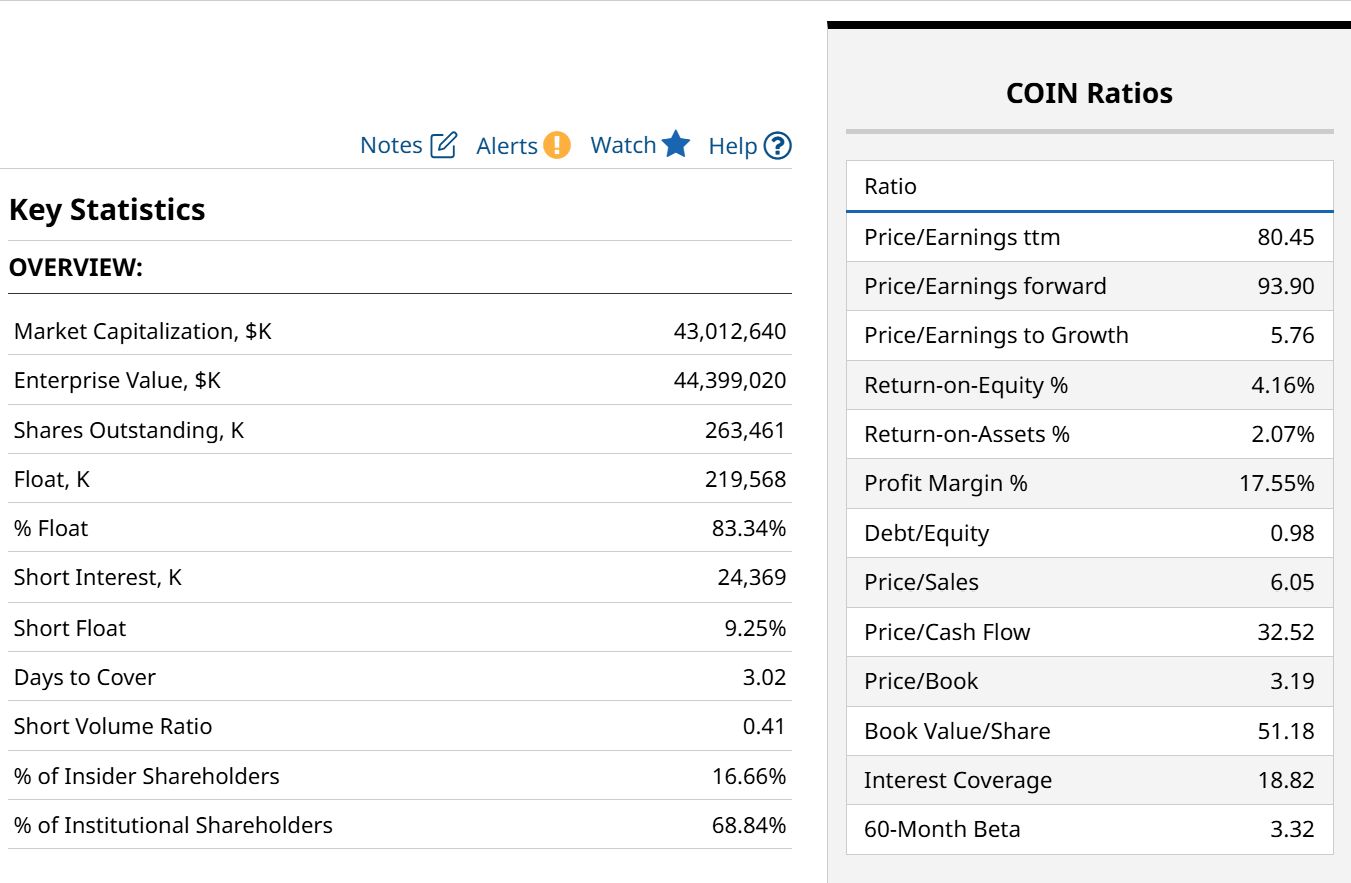
 You also get a stock selling at 80x trailing earnings, more than five times its growth rate and six times sales. That has prompted the stock to trade wildly over time, resulting in a 60-month beta of more than three times that of the S&P 500 Index ($SPX).
 www.barchart.com
 From a corporate monetization perspective, this derivatives expansion positions Coinbase to capture a massive competitive moat, much in the way it did as the first prominent crypto exchange. It is filling a void which has existed for some time, whereby access to late-stage venture capital valuations has historically been gated strictly to institutional desks or restricted secondary employee sales.
Perpetual futures fall into the category of something I won’t be chasing with my money, but I can’t tell you what to do with yours. It is high risk, but with high return potential. As long as someone understands the former as well as the latter, they can at least consider these with eyes wide open.
Rob Isbitts created the ROAR Score, based on his 40+ years of technical analysis experience. ROAR helps DIY investors manage risk and create their own portfolios. For Rob’s written research, check out ETFYourself.com.
On the date of publication, Rob Isbitts did not have (either directly or indirectly) positions in any of the securities mentioned in this article. All information and data in this article is solely for informational purposes. For more information please view the Barchart Disclosure Policy here.
More news from Barchart
Coinbase Is Offering Pre-IPO Perpetual Futures on OpenAI and Anthropic. That’s Better News for COIN Stock Than It Is for You. Dear MicroStrategy Stock Fans, Mark Your Calendars for July 4 Strategy Sells Shares to Buy Bitcoin. What This Means for MSTR Stock. COIN Stock Alert: What to Know as Coinbase Launches AI Trading Tool