

Intel (INTC) is running short on chips, not customers. The semiconductor giant has spent the last year rebuilding its reputation with buyers of central processing units, the chips that act as the brain of a personal computer or a data center server.
Now the comeback story has run into a new problem: it cannot produce enough chips to keep up with orders, and the shortage is starting to show up in prices. Media reports indicate that Intel raised list prices on its Xeon server chips and Core Ultra laptop chips heading into the third quarter, and Wall Street thinks the company can keep raising prices without scaring away buyers.
More Top Stocks Daily: Go behind Wall Street’s hottest headlines with Barchart’s Active Investor newsletter.
 www.barchart.com
 Wedbush Expects Intel to Benefit From Higher Prices
Wedbush Securities analyst Matt Bryson told clients that ongoing shortages of server CPUs give Intel room to raise prices without hurting demand.
He noted the real question is not whether Intel can raise prices, but where those increases are landing, whether official list prices are moving in step with what computer makers pay, or whether Intel is mainly adjusting smaller retail and distribution prices, according to Seeking Alpha.
The price hike in server chips should drive higher earnings growth for Intel, given that server chips account for a much larger share of its business. If the increases are showing up broadly, it suggests Intel has pricing power for the first time in years, a sign that supply is tight.
At the Bank of America Global Technology Conference on June 2, Chief Financial Officer David Zinsner said the company's server CPU revenue grew in the 20% to 25% range last quarter, driven primarily by average selling price increases rather than unit growth.
He explained that as core counts per chip increase, prices naturally rise too. Notably, Intel is also seeing like-for-like price gains on a per-core basis, something that had been sliding for years. Zinsner also said Intel is locking in longer-term agreements with customers that fix both price and volume, giving the company better visibility into how much capacity to build.
He added that current demand looks strong enough to support growth this year, next year, and the year after, and that the constraint right now is supply, not customer appetite. In his words, if a company simply stamped out a chip and called it a CPU today, it would probably sell.
The demand itself is being reshaped by artificial intelligence. Intel CEO Lip-Bu Tan told investors at the J.P. Morgan technology conference on May 19 that the ratio of central processing units to graphics processing units in AI systems has shifted dramatically.
Training-era workloads leaned heavily on GPUs, often with one CPU per eight GPUs.
With agentic AI, where software agents plan, use tools, and complete multi-step tasks on their own, customers are telling Intel the ratio is closer to 1:1, and in some cases, four CPUs for every GPU.
At Intel's Computex keynote on June 2, Corporate Vice President Kevork Kechichian showed a live demo comparing traditional AI inference against an agentic AI workflow.
The traditional setup was GPU-heavy, running close to 7-to-1 in favor of graphics chips. The agentic version flipped that balance toward CPU-heavy work, since agents spend more time on tasks like fetching data, running code, and checking rules, jobs that CPUs handle best.
What Is the INTC Stock Price Target?
For Intel shareholders, price increases paired with supply constraints are a healthier combination than price cuts chasing demand, which has hurt margins for years.
Zinsner said Intel is pulling forward its manufacturing yield targets for its advanced 18A chip-making process by at least a quarter, which should help the company produce chips faster and ease some of the current bottleneck.
Intel has also set a longer-term financial goal, internally referred to as the Rule of 45, that combines revenue growth and operating margin into a single target above 45%. Zinsner called it a multiyear goal rather than something achievable immediately but said improving costs, steadier pricing, and rising demand all point in the right direction.
None of this guarantees that Intel will keep its pricing power once new capacity comes online. But for now, a company that struggled for years to sell its story to Wall Street has a much simpler pitch: demand is outrunning supply, and customers are paying up rather than walking away.
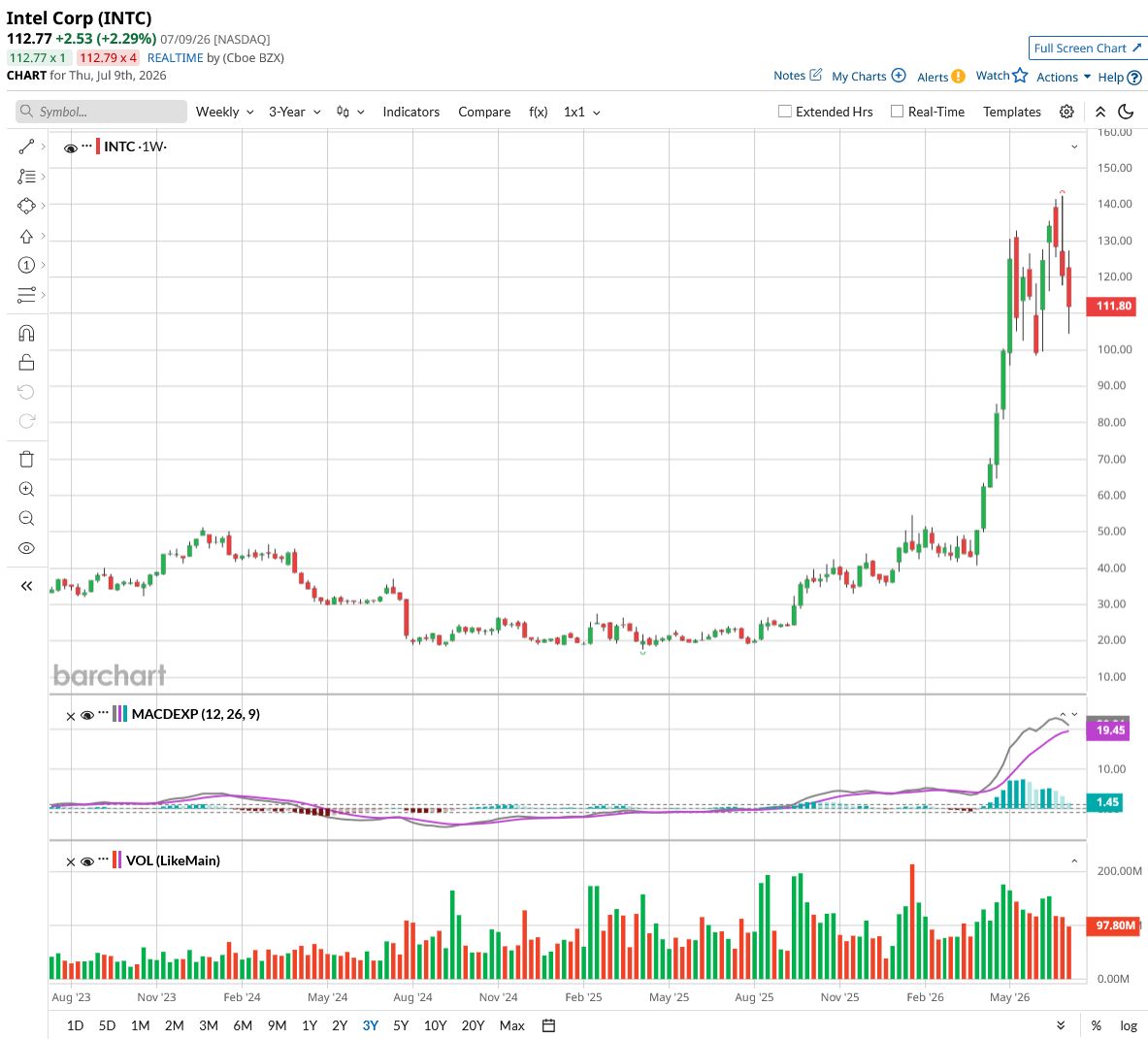
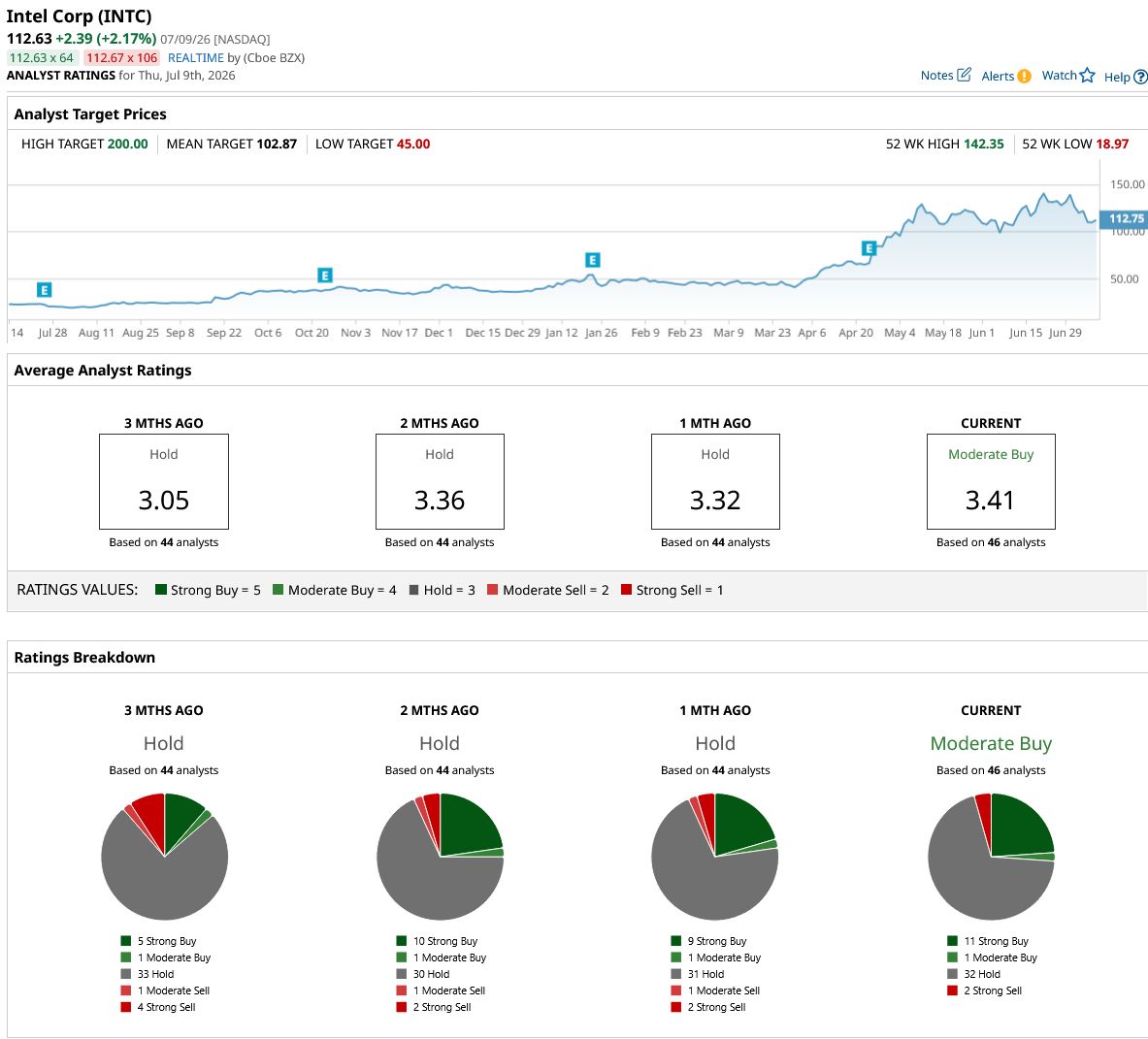
Out of the 46 analysts covering INTC stock, 11 recommend “Strong Buy,” one recommends “Strong Buy,” 32 recommend “Hold,” and two recommend “Strong Sell.” The average price target is $102.87, below the current price of $112.
 www.barchart.com
 On the date of publication, Aditya Raghunath did not have (either directly or indirectly) positions in any of the securities mentioned in this article. All information and data in this article is solely for informational purposes. For more information please view the Barchart Disclosure Policy here.
More news from Barchart
Intel Future Price Hikes Send Huge Demand Signal to Wall Street Broadcom Lands $30 Billion Chip Deal With Apple. Why It’s a Win-Win for AAPL and AVGO. Amazon Is Spending So Much on AI That Even Its Cash Isn’t Enough. Why Investors Shouldn’t Be Worried. A $225 Million Reason to Sell FuelCell Energy Stock Now