


It’s worth saying straight out of the gates that Bloom Energy (BE) should be considered a speculative, high-risk trade. Sure, Bloom has enjoyed strong demand thanks to the stratospheric rise of artificial intelligence and the buildout of data centers. But it’s also fair to point out that BE stock has suffered a heavy corrective cycle, losing 20% in the past five sessions and 43% in the trailing month.
Nevertheless, investors aren’t giving up on Bloom stock, in part because the broader performance is impressive. Right now, BE enjoys a 24% Weak Buy rating from the Barchart Technical Opinion indicator, a byproduct of the ticker gaining almost 127% on a year-to-date basis. Of course, the bulk of that performance is tied to Bloom’s core value proposition: providing rapid, off-grid solid-oxide power generation for electricity-hungry AI data centers.
Can’t Get Enough Options?: Join the list for Barchart’s daily unusual options report, delivered free.
This theme represents one of the strongest thematic trends in clean tech and isn’t likely to fade anytime soon. Much of the optimism focuses on backlog validation, with major hyper-scaler partnerships confirming that data center operators are willing to pay a premium to bypass three-to-five-year utility grid interconnection queues. As well, management has dramatically lifted guidance, suggesting that the demand pipeline is expanding robustly.
So, why did BE stock tumble so badly in recent sessions if the fundamentals are so strong? More than likely, the volatility comes from structural concerns. For example, Bloom Energy was promoted from the small-capitalization Russell 2000 index to the mega-cap Russell 200 benchmark.
It’s also likely that BE stock came undone from a relative-value pair trade. Basically, traders took profits from what was perceived to be an overextended BE share price to buy deeply discounted alternative fuel-cell and power-equipment peers.
In other words, we witnessed a classic value rotation. But now that Bloom stock has suffered steeply, the same mechanics could help lift this currently maligned security.
Extreme Order Flow Imbalance Could Right Itself for BE Stock
Quantitatively, there’s no denying that the bulk of traders have been slamming the “Sell” button on Bloom stock. Moreover, smart money traders are prioritizing downside protection for longer-expiry options. For example, the volatility skew for the Sep. 18 expiration date shows a typical “smirk” setup.
Here, more traders are buying insurance against a sharp downturn than they are positioning themselves for upside convexity. Subsequently, the implied volatility (IV) for out-the-money (OTM) puts on the left side of the chart rises far above the IV for OTM calls on the right side.
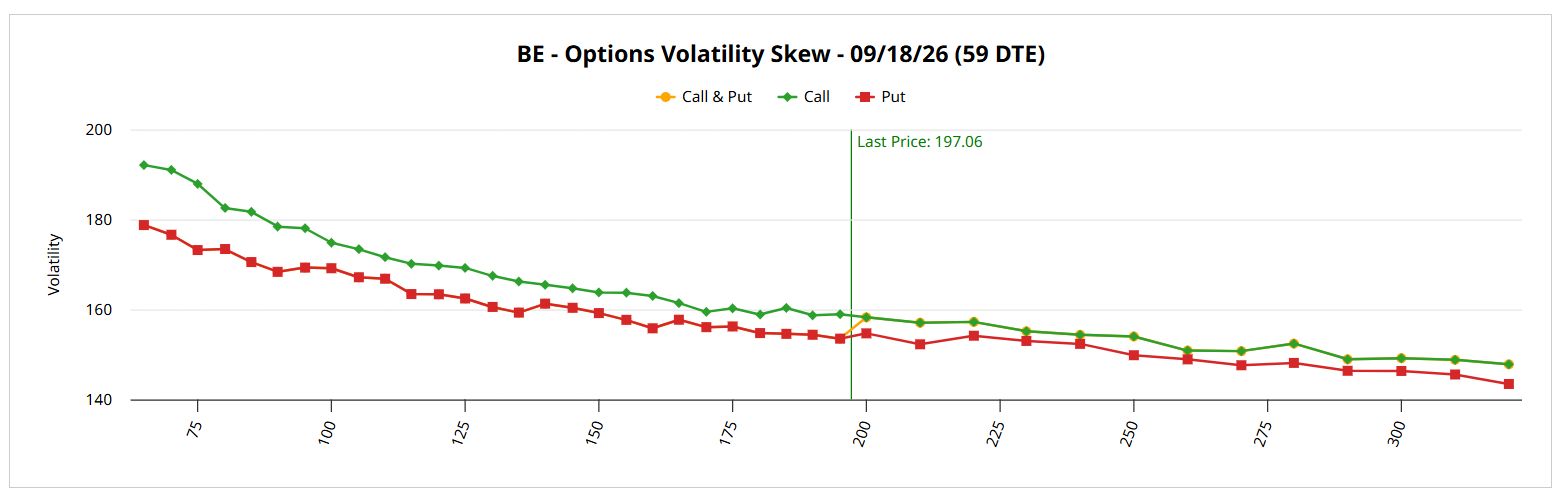
We should be careful when assigning predictive qualities to the volatility skew: just because you buy more auto insurance coverage doesn’t necessarily mean you’re more likely to get into a car accident. However, the volatility smirk demonstrates that, for now, the smart money is concerned that BE stock could fall further before circumstances improve.
Indeed, the data justifies their anxiety. In the last 10 weeks, Bloom stock printed only two up weeks, thereby leading to a downward slope. However, this 2-8-D quantitative sequence — which has materialized 16 times on a rolling basis since January 2019 — historically has signaled an eventual recovery.
I say eventual because by week 3 of the signal flashing, the median outcome for BE stock is around $177. If so, Bloom could potentially suffer a loss of more than 10% before conditions improve. So, why not talk about BE in a couple weeks’ time? Because with the next earnings disclosure scheduled for July 28, the ticker could move in a variety of places. Thus, I’m rather low confidence regarding the near-term signal.
That said, BE stock has historically gained — in weeks 8 through week 10 — about 26.8% as a median expectation following the flashing of the 2-8-D signal. Nominally, this target is the equivalent of approximately the $250 price level, which was last seen earlier this month.
Obviously, it’s an aggressive target but here’s why I’m mathematically intrigued.
Identifying a Possible Mispricing
Since I would classify Bloom stock as a speculative, lower-confidence trade, I don’t want to spend too much cash up front. Therefore, I would be looking at the thinly constructed 240/250 bull call spread expiring Sep. 18, which charges a net debit of $480. BE would need to rise through the $250 strike at expiration to trigger the maximum payout of 108.33%.
What’s enticing here is the breakeven price of $244.80. Right now, Wall Street assigns a probability of profit that BE stock will hit this threshold at expiration at only 36.6%. That’s awfully low and under classic risk management calculations, this spread would carry a negative expectancy value. Essentially, if you keep betting on this trade, you’ll end up losing over the long run.
However, I have a personal disagreement with how this theoretical probability is calculated. Generally speaking, the 36.6% figure is the implied probability assuming that Bloom’s IV run through the Black-Scholes model is the best representation of reality. Since Black-Scholes assumes risk-neutrality and lognormality, I’m not sure that it’s the most accurate model to use in this case, especially because of Bloom’s extreme order flow imbalance (i.e. way more down weeks than up weeks).
Instead, what I have discovered is that, of the 16 times that BE stock flashed the 2-8-D signal, the ticker rose above the $244.80 breakeven price a total of nine times on week 9 (Sep. 18). Observationally and empirically, then, it’s possible that the probability of profit is 56.2%. If so, this would mean that the 240/250 bull spread is underpriced relative to historical volatility under 2-8-D conditions.
Interestingly, as a random baseline, the odds than any given nine-week long hold on BE stock would lead to a share price of $244.80 at the endpoint is 32% (120 out of 375 instances). As such, the Black-Scholes’ probability of profit of 36.6% would be a realistic figure if we assumed random price discovery.
My point is that because Bloom stock has been so deflated, the expected outcome of future distributions has historically yielded above-average bullish performances, likely due to the mechanics of mean reversion. If you want to try your luck, BE is a name to have on your radar.
On the date of publication, Josh Enomoto did not have (either directly or indirectly) positions in any of the securities mentioned in this article. All information and data in this article is solely for informational purposes. For more information please view the Barchart Disclosure Policy here.
More news from Barchart
Bloom Energy Stock Is Very Risky, But This Speculative Trade on BE Is Tantalizing Here Domino's Pizza Delivers Strong FCF and FCF Margins - Is DPZ Stock Too Cheap? CRWD Short Strangle Could Net $1,045 in a Few Weeks Huge, Unusual Intel Options Volume Today Ahead of Earnings This Week