

No one can deny that Nvidia (NVDA) is the de facto leader in the artificial intelligence (AI) semiconductor race. Every platform it has released since the start of the AI boom has generated strong interest from hyperscalers and enterprises alike, with demand often exceeding supply for years at a time. The main reason is CUDA, Nvidia’s proprietary software ecosystem that allows graphics processing units (GPUs) to be programmed for general-purpose computing tasks, including AI training and inference. CUDA was also the biggest reason Nvidia’s GPUs sold out like hotcakes during the crypto boom of the pandemic.
Today, though, that dominance is now being challenged – but perhaps not in the way you think.
More Top Stocks Daily: Go behind Wall Street’s hottest headlines with Barchart’s Active Investor newsletter.
Instead of creating competing general-purpose chips, some companies are targeting its largest customers by offering AI chips custom-made for customer-specific workloads, called application-specific integrated circuits (ASICs). These chips are designed to excel at a narrow set of AI tasks, improving power efficiency and allowing hyperscalers to obtain the chips they need at prices below those of Nvidia’s market-leading products.
So that raises an obvious question: If custom AI chips are becoming a larger piece of the AI infrastructure puzzle, is there suddenly a war against Nvidia’s leadership? And if so, which companies are best positioned to benefit from this movement?
And perhaps more importantly, if there is a new chip war, which custom chip companies should investors actually be watching?
But here’s what most investors miss: no matter who wins the chip war, every chip in it passes through the same few companies further down the stack – and one of them sits so low that without it, none of this exists.
Why Hyperscalers Want Custom Chips
The first and most important reason hyperscalers are turning to custom chip manufacturers, or producing those chips themselves, is cost.
Training a frontier AI model requires tens of thousands of GPUs running around the clock. Even after the model is trained, serving it to millions of users through inference can cost billions of dollars – a never-ending capex cycle.
Now, imagine this: if a hyperscaler has the opportunity to shave 20% to 30% of those costs annually and still get chips that perform the tasks they need, why wouldn’t they grab it? Especially when those 20%-30% savings could easily translate to hundreds of millions, if not billions, of dollars.
The second reason is power efficiency.
Let’s face it. These days, power is becoming AI’s biggest bottleneck, and GPUs installed within data centers require massive amounts of power. In fact, according to the International Energy Agency (IEA), a conventional data center may draw around 10 to 25 megawatts (MW), while a hyperscale, AI-focused facility can require 100 MW or more.
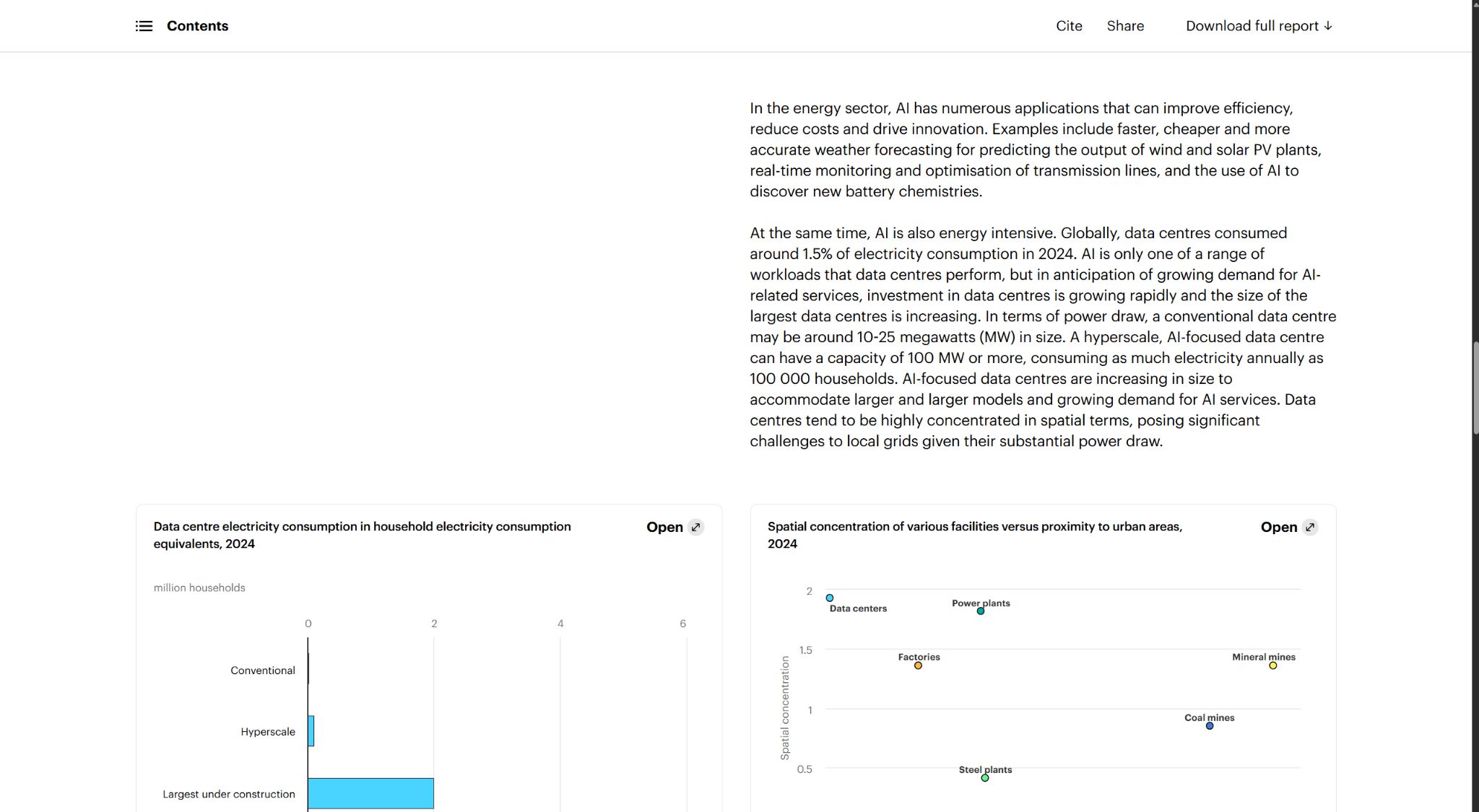 Image courtesy of the International Energy Agency (IEA)
 Now, I admit, those numbers might look meaningless without a frame of reference. So to put them into perspective, that’s roughly enough electricity to power ~8,000 average U.S. homes for an entire year, or up to a mid-sized city in the U.S. Any savings in that department could translate into material benefits for the company, the immediate area around the data center, and the overall environment.
Going back to chips, a GPU uses more electricity than a CPU because it’s built to be more flexible. Custom chips, however, have more specialized, intentional designs. Take for example, a hyperscaler operating a large-language model without graphics capabilities. It can use silicon optimized for matrix multiplication, memory bandwidth, and token throughput. Big words, I know, but the point is, it wouldn’t need the general-purpose graphical capabilities that come with every Nvidia GPU. That means it doesn’t need as much power as a general-purpose chip to do its job.
Finally, there’s the issue of optimization.
Nvidia’s GPUs are incredibly versatile because they’re built to handle thousands of different workloads. That’s a major advantage for cloud providers serving millions of customers with varying needs.
But hyperscalers also run their own internal AI models every day. Google operates Gemini. Meta trains and serves Llama. Amazon powers services like Bedrock and Alexa. And Microsoft supports Copilot and numerous other enterprise AI products.
When you know exactly which models you’ll be running, you don’t necessarily need a chip capable of doing everything. Instead, you can use a custom silicon ASIC that’s optimized for YOUR workload, again, reducing unnecessary hardware costs while improving performance per watt.
The 2 Routes to Custom AI Silicon
Now that the benefits are clearer, let’s talk about how exactly companies are getting their hands on custom silicon.
In-House Development
The first and most straightforward way for companies to acquire custom AI silicon is to build it themselves. For hyperscalers, the biggest advantage of designing custom silicon is complete control. They can optimize every aspect of the chip around their own AI models, reducing power consumption, lowering inference costs, and avoiding dependence on a single supplier.
There’s also the strategic benefit of not depending on a third party and getting in line to buy the next chips because there aren’t enough of them.
But of course, going down this rabbit hole isn’t cheap. Developing a cutting-edge AI accelerator requires billions of dollars in R&D, years of engineering effort, and access to the world’s most advanced semiconductor manufacturing. It’s an investment that only the largest technology companies can realistically afford.
The payoff, if successful, however, can be enormous. Over time, those savings can add up to billions of dollars, especially when AI workloads are running across hundreds of thousands of servers.
This is exactly the line of thinking that Alphabet (GOOGL), Amazon (AMZN), Microsoft (MSFT), and Meta Platforms (META) have embraced. These companies are each developing their own in-house chips to meet their own specific workload demands.
Let’s start with Alphabet, arguably the first hyperscaler to recognize the need for specialized hardware for AI. The company first announced its Tensor Processing Unit (TPU) back in 2016. Instead of a general-purpose design, Google engineers leaned more toward building TPUs for machine learning, optimizing the chip for better tensor calculations.
For those unfamiliar, tensor calculations are the large-scale mathematical operations AI models use to process data, apply learned weights, and generate outputs. Every time you ask an AI chatbot a question, it performs billions of these calculations to produce a response. That broader process of using an already-trained model to generate a new answer is known as inference.
And so, that specialization can make a major difference. Google says its Trillium TPU, its sixth-generation chip, delivers 4.7 times higher peak computing performance per chip and up to three times higher inference throughput than the previous generation. It also improves energy efficiency by 67%.
Now, you might be wondering how Trillium stacks up against Nvidia’s Vera Rubin or Blackwell platforms. Unfortunately, you’d be hard-pressed to find an accurate comparative assessment for the chips because, well, they’re not designed to solve the same problems. So it’ll be like comparing apples to oranges, or, more specifically, TPUs to GPUs.
I also have to mention the way Alphabet monetizes TPUs, because they don’t mass-produce and sell them as Nvidia does. Instead, the company uses the chips in its own data centers, then rents them out as part of its cloud infrastructure.
Amazon is doing the same thing with its Trainium and Inferentia chips. But these two chips have different purposes. Trainium is optimized for training large AI models, where developers teach a model by feeding it massive datasets over weeks or even months. On the other hand, Inferentia is designed for inference.
So the company has developed these two chips to improve both ends of the AI lifecycle. One’s for training, which happens at the start when you build an AI model. The other is for improving performance during active operations and scaling.
And like Alphabet, Amazon is monetizing these chips by renting their compute out as part of the AWS cloud platform.
Microsoft has taken a similar approach with its Maia family of custom AI accelerators, which it deploys within Azure’s infrastructure.
Meta, meanwhile, is keeping its MTIA chips almost entirely for itself. After all, the company doesn’t have a cloud platform to monetize, so it’s using its custom silicon to improve Facebook and Instagram’s recommendation systems, ad targeting, and generative AI features.
Third-Party Custom Silicon
Of course, not every company has the engineering talent, capital, or scale to spend billions developing its own AI accelerator. In fact, not every hyperscaler I mentioned earlier handles 100% of its custom chip production.
That’s why we have third-party custom silicon designers.
These companies work directly with hyperscalers to design ASICs tailored to each customer’s workloads. In many cases, the hyperscaler owns the architecture and software requirements, while the chip designer provides the semiconductor expertise needed to turn those ideas into production-ready silicon.
For example, Meta asked Broadcom (AVGO) to co-develop multiple generations of its MTIA chips. The partnership includes a 2-nanometer accelerator and a multiyear, multigigawatt MTIA deployment.
To be clear, Meta still owns MTIA – no one is questioning that. But, Broadcom contributes by providing the chip design expertise needed to translate Meta’s AI requirements into production-ready silicon. It works alongside Meta on areas such as chip architecture, high-speed interconnects, packaging, and integration.
In short, Meta decides what the chip should do, while Broadcom helps determine how to build it.
Broadcom is also partnered with Google. In its April 2026 8-K filing, Broadcom stated that it and Google “have entered into a Long-Term Agreement for Broadcom to develop and supply custom Tensor Processing Units.”
Notice the pattern here?
Broadcom can certainly create its own silicon and sell it to other companies who need this type of tech. But the company chooses to work with larger hyperscale customers to manufacture chips based on their own designs instead.
Doing so gives Broadcom a more attractive business model that’s ripe for growth. And we’ve already seen the effects. It took less than two years for Broadcom to double its market cap, from $1 trillion back in 2024, to $2 trillion in 2025.
But, of course, Broadcom isn’t the only one in the custom silicon space. Marvell Technology (MRVL) works with smaller companies, namely the cloud providers, to manufacture chips tailored specifically for their customers’ workloads. Marvell also offers a tertiary lineup including high-speed networking and optical connectivity products.
Sound familiar? That’s because it is.
Broadcom offers practically the same set of products as Marvell. The main difference, however, is customer concentration and scale. Broadcom has publicly disclosed relationships with “Magnificent Seven” companies such as Meta and Alphabet - and is widely regarded as the biggest player in custom AI silicon.
Marvell, on the other hand, is still in the process of building out a growing pipeline of hyperscale customers. It also places greater emphasis on its networking and optical infrastructure business.
Now, when investors compare a smaller company to a larger one, they tend to gravitate towards the smaller company because it has more room for growth, so investors getting in now would gain more over the years.
In fact, Nvidia CEO Jensen Huang went on record to say that Marvell is the "next trillion-dollar company."
 A screenshot of an article published on www.barchart.com
 Foundries: The Bottom of the Custom Silicon Tech Stack?
But you know what’s funny?
Both Broadcom and Marvell are fabless chip producers. That means they design the chips, but they don’t actually manufacture them. Once they design the chip, they send it to specialized semiconductor foundries for production.
And that’s where perhaps the most important companies in the entire AI supply chain come in: the foundries.
Taiwan Semiconductor Manufacturing Company (TSM) is the dominant player in this space, serving as the top choice for many AI hyperscalers to manufacture their chip designs. Yes, even Nvidia depends on TSM for silicon fabrication.
But it doesn’t have complete dominance over the entire foundry industry.
Samsung Electronics is a close competitor to TSM through its Foundry division. Like TSM, it produces advanced chips for outside customers and is currently investing heavily in smaller process nodes. Its clearest win here is Tesla (TSLA), which signed a $16.5 billion deal for Samsung to produce its next-generation AI5 and AI6 chips on Samsung’s 2nm process. Samsung is also expanding its relationship with Apple, though that work centers on next-generation image sensors rather than Apple’s main processors. Apple’s flagship 2nm chip volume, however, still runs through TSM. Even so, the Tesla win alone marks a real foothold for Samsung in the AI chip race.
In addition to custom silicon, Samsung’s Memory Business also produces high-bandwidth memory (HBM), giving the company exposure to two of the most critical components of AI tech.
And if that’s not all, Intel (INTC) is also trying to establish Intel Foundry as another major alternative. While the company has historically fabricated its own CPUs, now it’s offering manufacturing capacity and technology to outside clients.
That said, Intel has struggled to get its Foundry business off the ground, as the last couple of years have shown. The company still has significant ground to make up in both process technology and customer adoption. It is making strides to establish Foundry as a viable business, but its eventual profitability is still likely years down the line.
In other words, AI companies may design their own chips, but they still depend on foundries to turn those designs into physical silicon. Whether the chip comes from Nvidia, Broadcom, Marvell, or an internal team, a foundry still has to manufacture it at enormous scale.
ASML: The Actual Bottom of the Silicon Tech Stack
But you know what’s even funnier?
Even though foundries are near the bottom of the AI supply chain, there’s another company even lower on the list. And without it, none of the tech would ever exist.
Take ASML Holding N.V. (ASML), the world’s leading supplier of advanced semiconductor lithography systems, the machines that chip foundries need to manufacture their processors.
So if we frame AI as a modern-day gold rush, the foundries are selling the picks and shovels, while ASML is the one actually supplying the equipment that turns bare iron and uncut wood into said digging implements.
Its flagship product is the Extreme Ultraviolet (EUV) lithography system, arguably the most complex machine ever built.
These systems project incredibly fine-scale circuit patterns onto silicon wafers, enabling foundries like TSM, Samsung, and Intel to manufacture cutting-edge 3-nanometer and 2-nanometer chips that power today’s AI revolution.
Now, from that description alone, you just know these things don’t come cheap. Earlier-generation EUV lithography systems typically sell for well over $150 million each, while ASML’s latest High-NA EUV machines can each cost upwards of a cool $400 million.
 www.barchart.com
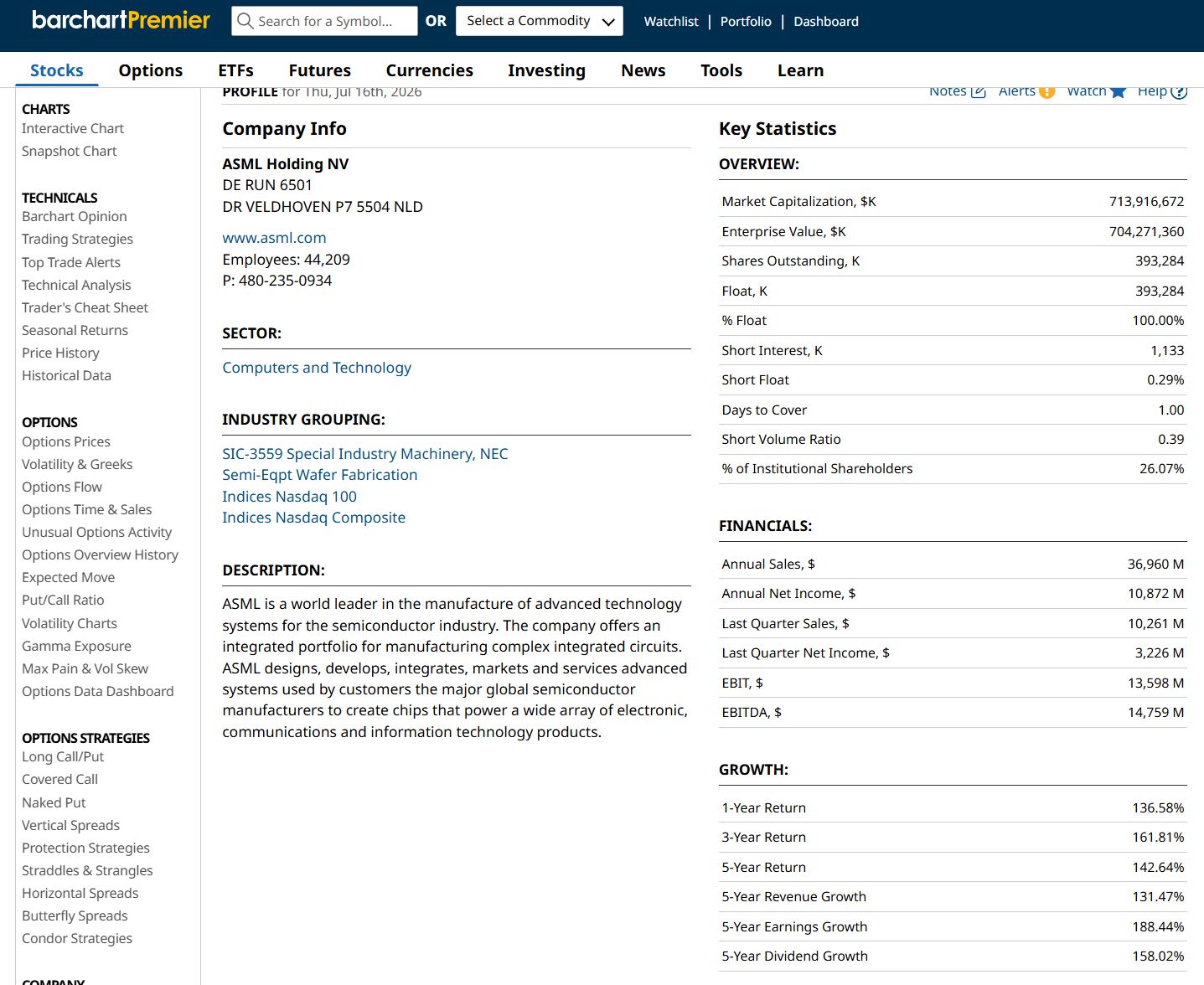
 And with estimates ranging from 10 to over 30 of those EUV systems required for a modern fabrication facility, ASML is making bank on the AI boom. The company’s revenue has increased by over 131% in the last five years, while net income is up 188%.
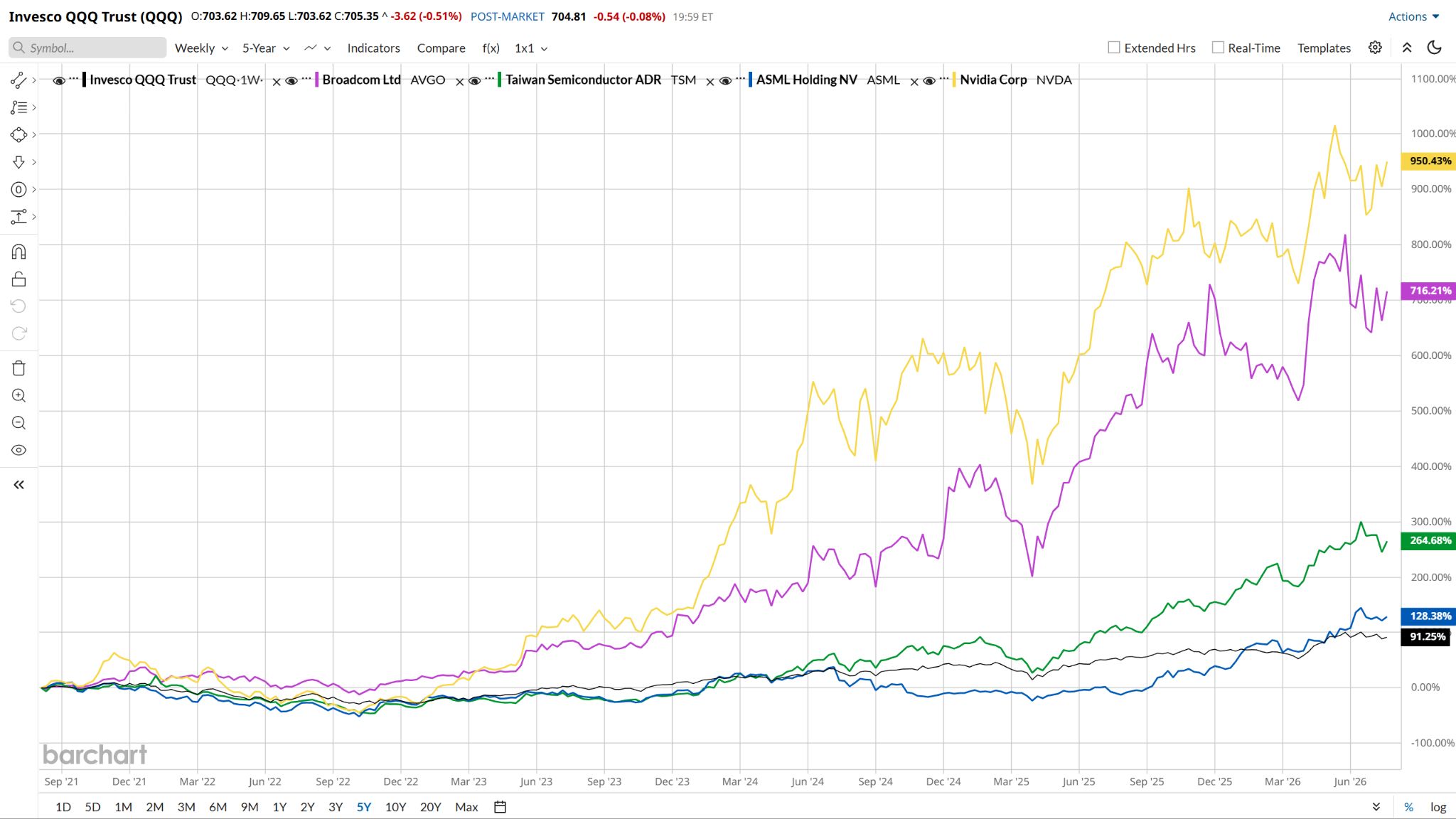
Now, you might be wondering: if ASML is that important in AI, why didn’t it grow as much as its peers? I mean, it really only beat the index by a measly 40% or so, while the rest are multi-baggers.
 www.barchart.com
 Well, Nvidia sells the AI chips itself, and demand for those chips exploded almost overnight as companies raced to build and deploy generative AI. The same could be said for Broadcom and TSM, to a lesser degree.
ASML, by contrast, sells the equipment used to manufacture those chips. Its customers don't buy a new lithography machine every time they need more GPUs. Instead, they make multibillion-dollar capital investments years in advance, expanding fabrication capacity only when demand justifies it.
In other words, Nvidia and the others benefited immediately from surging AI demand, while ASML benefits more gradually as foundries build the long-term manufacturing capacity needed to support that demand. That's a slower business, but it's also one that's supported by extraordinarily high switching costs and years-long customer relationships.
The Cold, Hard Truth
After everything covered, one might say it’s easy to conclude that custom AI chips are about to dethrone Nvidia.
I don’t think that’s what’s happening here.
Nvidia still builds the most versatile AI accelerators around, and CUDA remains one of the strongest competitive moats in the technology industry. Not only that, custom silicon and Nvidia GPUs solve different problems. Again, apples to oranges, or TPUs to GPUs. Yes, hyperscalers can save billions on optimized, tailor-made silicon for specific tasks. But the fact is, custom AI chips cannot match a general-purpose chip on every workload, and hyperscalers simply cannot make a new custom chip for every type of AI application they run.
The economics of custom chips only make sense when the same workload is repeated at an enormous scale. For everything else, Nvidia’s flexible GPU platform remains the better solution. That’s why Google still buys Nvidia GPUs. Amazon still offers Nvidia instances on AWS. Microsoft continues expanding Azure with Nvidia hardware. Meta still relies heavily on Nvidia while investing in MTIA.
No, the better takeaway for investors here is that the AI chip “war” isn’t a zero-sum game.
Every custom AI chip still needs to be designed, manufactured, packaged, and tested. That creates opportunities not just for Nvidia, but also for Broadcom, Marvell, TSM, ASML, and the rest of the semiconductor ecosystem.
The bottom line here is that custom silicon is just another direction AI is expanding towards. The industry’s getting bigger, and more players are entering the game.
For investors, that means looking beyond the obvious names. The next decade of AI will be built on an entire tech ecosystem, not on a single company. And the better you understand that ecosystem, the better your chances of finding tomorrow’s winners.
On the date of publication, Rick Orford had a position in: GOOGL , AMZN , MSFT , META . All information and data in this article is solely for informational purposes. For more information please view the Barchart Disclosure Policy here.
More news from Barchart
A $1.6 Billion Reason Salesforce (CRM) Stock Is Up Today Nvidia’s Rivals Are Coming for Its Crown, But the Smartest AI Bet Sits Further Down the Tech Stack Alphabet Just Dropped a $94 Billion Surprise for SpaceX Stock. How to Play SPCX from Here. Truist Just Upgraded PayPal Stock. Here's Why.