

I last wrote about lumber on Barchart on April 14, 2026, when I concluded with the following:
Lumber’s path of least resistance depends on where interest rates are heading over the coming weeks and months. If crude oil prices increase inflation, lumber is likely to decline, along with lumber-related and other stocks, as higher rates tend to weigh on the stock market. However, if hostilities end, interest rates could fall along with crude oil prices, fostering higher demand for lumber and higher lumber prices. In April 2026, the current environment is highly uncertain as lumber is now in the peak construction and demand season with no explosive price action on the horizon.
Don’t Miss a Day: From crude oil to coffee, sign up free for Barchart’s best-in-class commodity analysis.
Nearby physical lumber futures were trading $573.50 per 1,000 board feet on April 13. The long bond futures have moved lower from 113-23, pushing interest rates higher since April 13. Meanwhile, shares of WY, WOOD, and CUT have not moved much, reflecting interest rates rather than lumber futures, which could be an opportunity.
Lumber futures rally
Nearby CME physical lumber futures closed 2025 at $576 per 1,000 board feet.
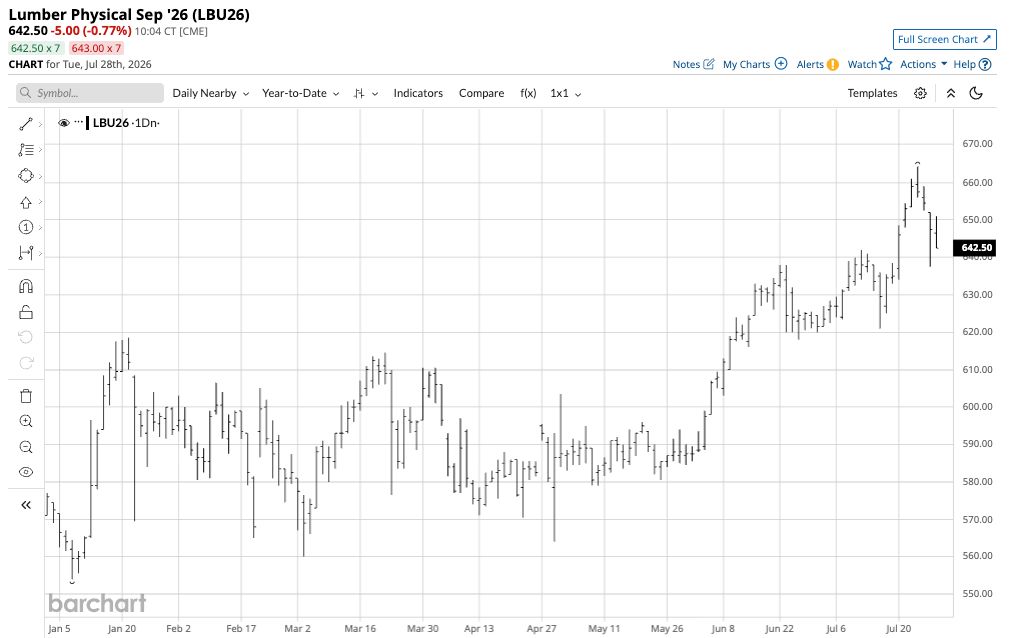
The nearby continuous year-to-date lumber futures chart shows that after trading in a consolidation range from $554 to $618.50 from January 7 through June 8, 2026, lumber futures moved above the top end of the range, reaching a high of $642 per 1,000 board feet on July 10. Technical support is at $618, the June 25 low.
At $642.50 per 1,000 board feet on July 28, lumber futures were 11.5% higher than the 2025 closing price.
Seasonality is a reason for caution
While lumber prices have rallied in 2026, they are not running away on the upside. The old random-length lumber futures contract rose to highs of $1,711.20 in May 2021 and $1,477.40 in March 2022. The most recent high before 2026 was $698.50 per 1,000 board feet in August 2025. The CME replaced the random-length lumber futures with a smaller contract with more flexible delivery characteristics to encourage more hedging and speculative interest. However, at 8,077 contracts of open interest on July 27, the physical lumber futures remain illiquid. An illiquid futures market can experience high price volatility when trends develop, as bids to purchase disappear when the price falls and offers to sell evaporate during rallies.
Lumber can be a seasonal commodity as the construction season begins in spring and ends in fall. Therefore, lumber demand tends to decline to seasonal lows during late fall and winter. In late July 2026, the active-month lumber futures contract is for September delivery, which favors lower prices over the coming months as winter approaches and construction projects decline. Meanwhile, an exogenous event, the Canadian wildfires over the past weeks, has ignited supply fears, pushing lumber prices higher.
WY has underperformed lumber
As of July 27, physical lumber futures were 11.5% higher in 2026. Weyerhaeuser Company (WY) is unique as it owns and leases timberlands in the U.S. and Canada. Therefore, WY operates as a REIT (Real Estate Investment Trust) that is sensitive to and correlated with interest rates and lumber prices.
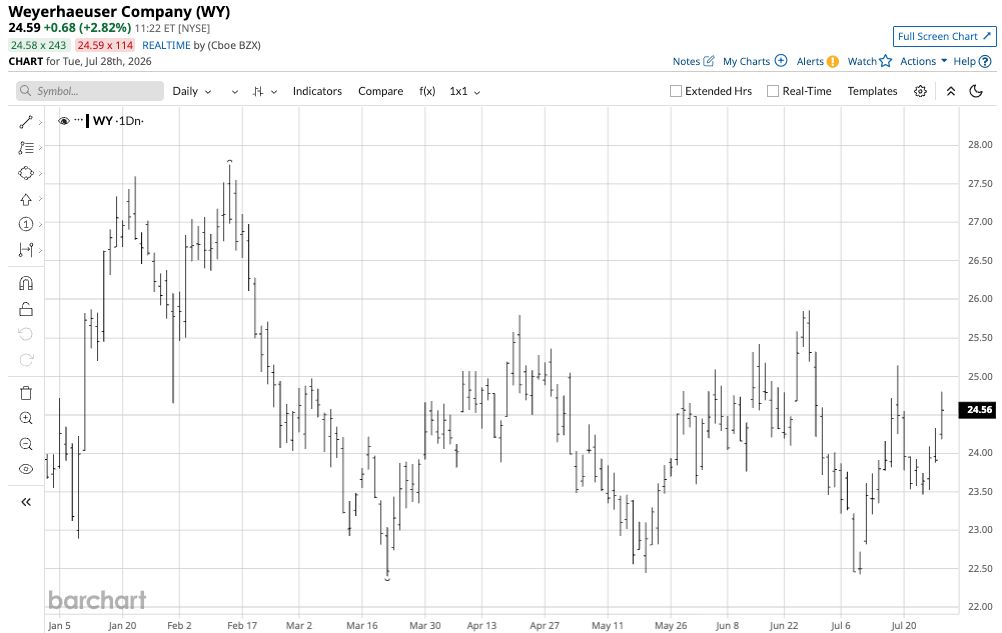
The chart shows that WY shares have moved 3.80% higher from $23.69 on December 31, 2025, to $24.59 per share on July 27, 2026. Meanwhile, WY pays shareholders an annual dividend of $0.84, yielding 3.42%, enhancing the performance in 2026.
WOOD and CUT have declined
The iShares Global Timber & Forestry ETF (WOOD) and the Invesco MSCI Global Timber ETF (CUT) own portfolios of lumber-related companies.
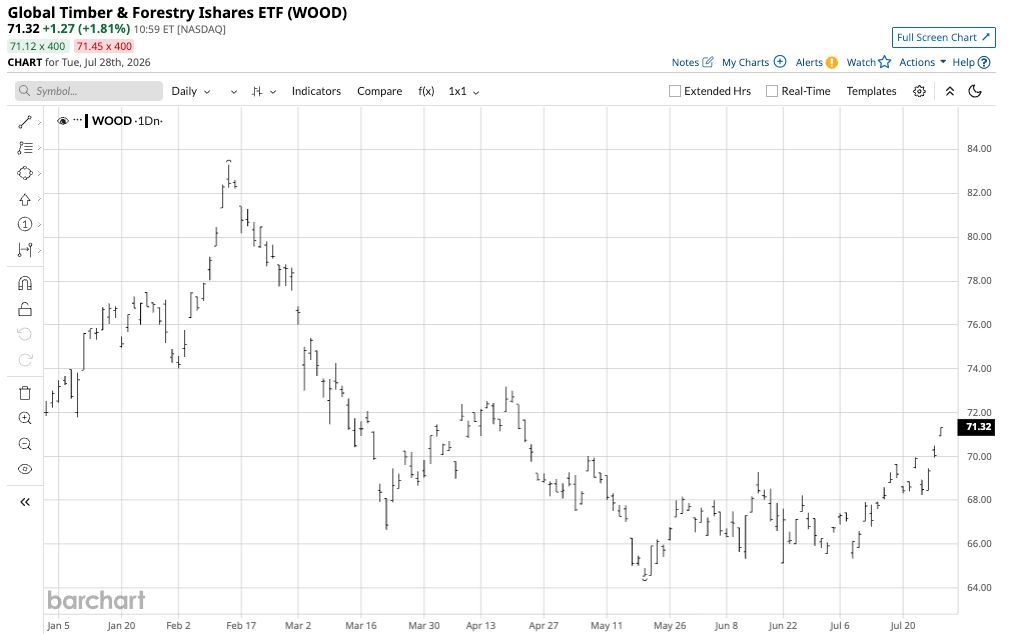
The chart shows that WOOD shares have edged 0.96% lower from $72.01 on December 31, 2025, to $71.32 per share on July 27, 2026. Meanwhile, WOOD pays shareholders a $1.68 annual dividend, yielding 2.36%, which enhances performance in 2026 and is barely enough to flip it to a positive return.
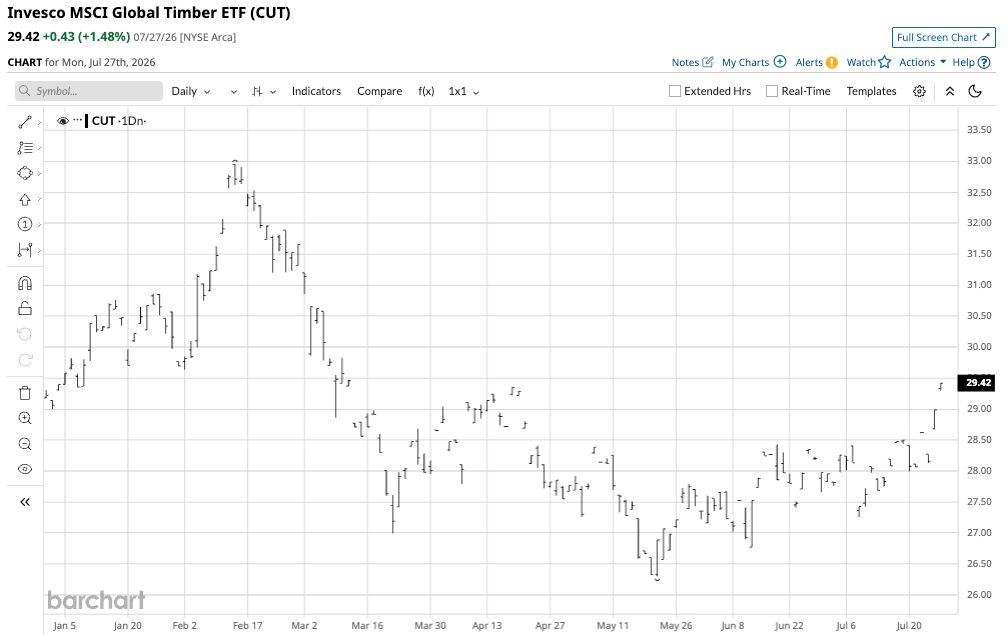
The chart shows that CUT shares have moved 1.24% lower from $29.06 on December 31, 2025, to $29.42 per share on July 16, 2026. Meanwhile, CUT pays shareholders a $0.72 annual dividend, yielding 2.45%, which, combined with 2026 performance, is enough to flip it to a marginally positive return.
The bottom line is that lumber futures have outperformed WY, WOOD, and CUT in 2026. Both WOOD and CUT own WY shares in their portfolios.
Avoid the futures; WY, WOOD, and CUT could have upside potential
When considering any trade or investment, liquidity is critical, as it reflects the ability to execute risk positions at tight bid/offer spreads on entry or exit. Lumber futures can gap higher or lower during volatile periods, creating execution roadblocks due to low daily volume and open interest.
WY trades an average of over 4.646 million shares per day, WOOD’s daily average volume is over 8,700 shares, and CUT’s is around 1,300 shares. WY is clearly the most liquid lumber-related asset.
Lumber’s price is highly correlated to interest rates because demand increases when new home mortgage rates and financing rates on other construction projects decline. Interest rates remain elevated in July 2026, as inflationary pressures are stubbornly high. Therefore, we should expect weak lumber prices until interest rates begin to decline. REITs are also sensitive to interest rates and tend to rise when rates decline. Therefore, WY is likely to remain stable until rates decline and lumber rallies. However, buying WY on a scale-down basis, leaving plenty of room to add on further declines, could be optimal for the future. WY’s over 3.4% yield at the current share price is another factor that creates cash flow while waiting for capital appreciation.
In July 2026, seasonality and elevated interest rates could weigh on lumber prices and WY, WOOD, and CUT shares over the coming weeks and months. However, lumber’s price consolidation around the $600 per 1,000 board feet level could be healthy for the 2027 construction season if rates begin to decline and construction demand increases. The wildfires in Canada are another factor that could create future supply concerns and price volatility, given the destruction and the U.S. administration’s threat of tariffs and sanctions on Canada’s government.
On the date of publication, Andrew Hecht did not have (either directly or indirectly) positions in any of the securities mentioned in this article. All information and data in this article is solely for informational purposes. For more information please view the Barchart Disclosure Policy here.
More news from Barchart
What are the Prospects for Lumber Prices? West Fraser Timber Stock Charges Ahead as Lumber’s Technical Breakout Gains Steam Cerebras Just Got Fast-Tracked Into the S&P 500. Here’s What It Means for Investors Can Lumber Prices Explode?