

Apple (AAPL) delivered another quarter of headline-beating results, with revenue and earnings topping Wall Street’s expectations. Yet instead of celebrating, investors rushed for the exits, sending the stock sharply lower after the company’s closely watched Services business fell short of expectations.
The miss has raised fresh concerns about the health of Apple’s most profitable growth engine at a time when the iPhone maker is already navigating intensifying competition, regulatory pressure on the App Store, and slowing momentum in its high-margin digital ecosystem.
More Top Stocks Daily: Go behind Wall Street’s hottest headlines with Barchart’s Active Investor newsletter.
As Services has become an increasingly important driver of Apple’s valuation, even a modest disappointment was enough to shake investor confidence. Plus, the company’s guidance also failed to cheer investors. Let’s discuss what it could mean for the stock going forward.
About Apple Stock
California-based Apple stands as a forward-looking company and a worldwide leader in hardware, software, and services. Its portfolio spans iconic devices like the iPhone, iPad, Mac, and Apple Watch, alongside widely used platforms such as the App Store, iCloud, Apple Music, and Apple TV+. The company currently boasts a market cap of $4.54 trillion and a Magnificent Seven status.
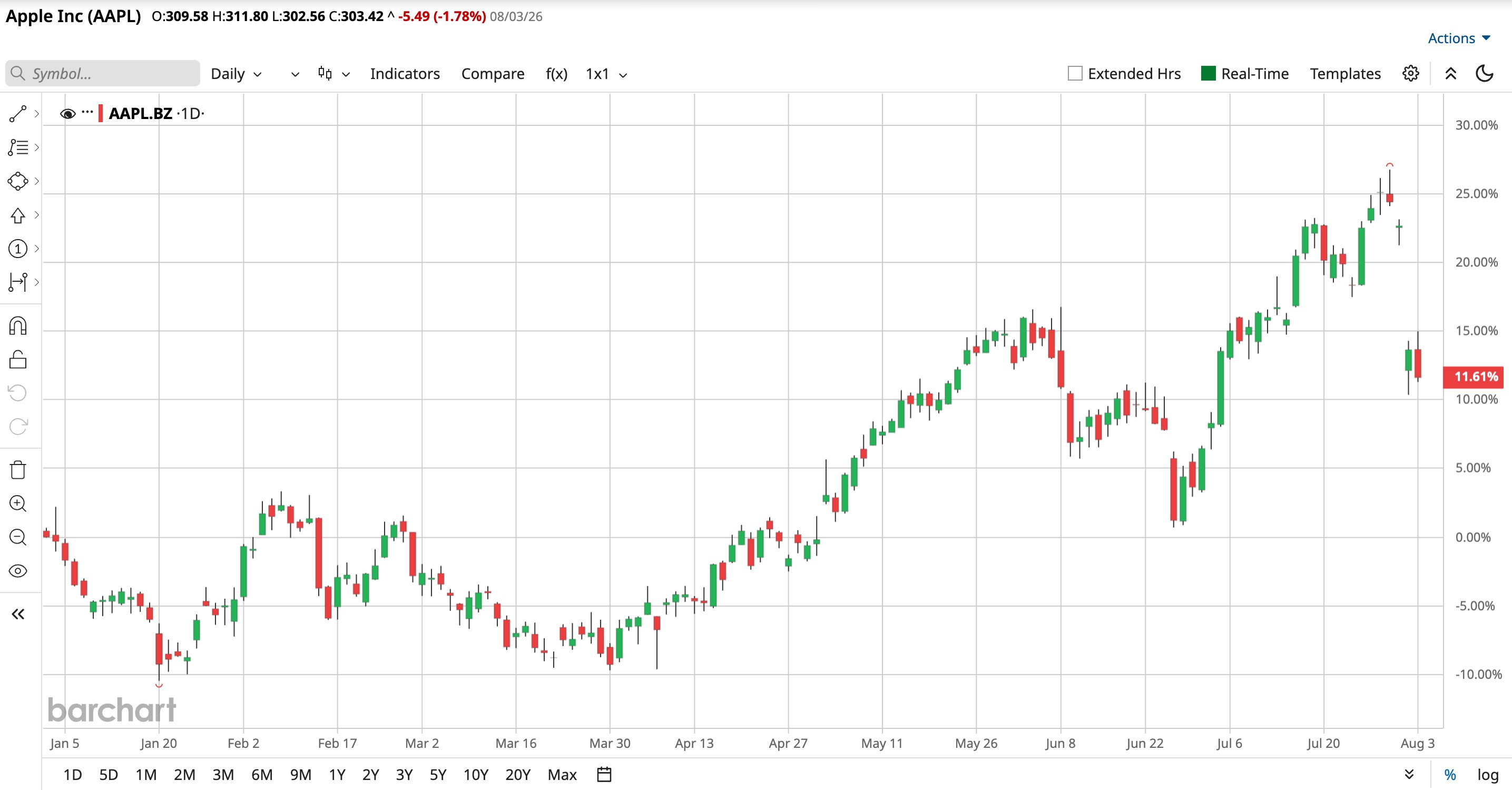
Apple stock has delivered strong long-term gains for shareholders despite recent volatility. The stock is up 50% over the past 52 weeks and has gained 11.6% year-to-date (YTD), significantly outperforming the broader market.
However, sentiment turned sharply negative after the company’s latest quarterly earnings report, with Apple shares tumbling 7.4% on July 31 after management issued weaker-than-expected September-quarter revenue guidance due to persistent supply chain constraints. The sell-off marked Apple’s worst single-day decline in months, as investors worried that shortages of advanced chipmaking capacity and memory components could limit near-term growth even as underlying demand for iPhones and Macs remains robust.
Investors were also concerned about Services growth, which missed expectations as App Store revenue faced headwinds from weaker mobile gaming and regulatory changes. Despite the solid quarter, cautious guidance and pressured Services segment overshadowed the results, raising concerns about Apple’s near-term growth trajectory.
 www.barchart.com
 The stock trades at a premium at 38.07 times forward price-to-earnings, compared to the sector median and its historical average.
Apple Q3 2026 Earnings Beat Expectations, but Offered Weak Guidance
Apple reported fiscal third-quarter 2026 results on July 30, delivering another quarter that exceeded Wall Street’s expectations. Revenue climbed 16.4% year-over-year (YOY) to $109.4 billion, while earnings per share (EPS) increased 29% to $2.02 from $1.57 a year earlier. Net income rose 27.1% to $29.8 billion, and gross margin expanded to 50.1%, benefiting partly from U.S. tariff refunds.
The iPhone remained the primary growth engine, with revenue surging 21.7% YOY to $54.3 billion, marking Apple’s strongest-ever June-quarter iPhone sales. Mac revenue jumped 28.7% to $10.35 billion, fueled by strong demand for the MacBook Neo and MacBook Pro, while iPad revenue declined 5.9% to $6.2 billion.
Apple’s Services business remained a bright spot in fiscal Q3 2026, with revenue rising 12.1% YOY to $30.74 billion, but it still fell short of expectations, disappointing investors. Management attributed the miss primarily to weaker mobile gaming spending, which pressured App Store revenue, as well as changes to the App Store business model in certain countries.
CFO Kevan Parekh also highlighted the ongoing impact of the U.S. court ruling in the Epic Games case, which allows developers to direct users to external payment options, reducing Apple’s App Store commissions. In Europe, regulatory changes requiring Apple to support alternative app stores created additional headwinds. While the Services segment continued to grow, its slower pace raised concerns that Apple’s highest-margin business could face increasing regulatory and competitive pressure.
Additionally, revenue from Greater China rose 22.4% YOY to $18.8 billion, reflecting continued strength in the region despite narrowly missing consensus estimates.
Despite the stable quarterly performance, investors focused on management’s cautious outlook. Apple forecast September-quarter revenue growth of 9% to 11%, below Wall Street’s expectation, while management also projected mid-teens iPhone revenue growth, compared with analysts’ 17.6% estimate.
CEO Tim Cook attributed the softer guidance to persistent shortages of advanced chipmaking capacity and memory components rather than weakening consumer demand, emphasizing that Apple is struggling to meet demand during an unexpectedly strong product cycle.
In addition, the consensus estimate of $8.80 for fiscal 2026 indicates an increase of 18% YOY, before improving by around 9.1% annually to $9.60 in fiscal 2027.
What Do Analysts Expect for Apple Stock?
Following Apple’s fiscal Q3 earnings report and weaker-than-expected Q4 guidance, Wall Street analysts have adjusted their stances.
On July 31, JPMorgan analyst Samik Chatterjee maintained an “Overweight” rating on Apple while lowering the price target to $340 from $345 following the company’s weaker-than-expected September-quarter guidance.
Also, GF Securities analyst Jeff Pu downgraded Apple to “Hold” from “Buy” while maintaining a $369 price target. Pu cited increasing demand risks stemming from higher memory costs, supply constraints, and the potential impact of higher iPhone prices on consumer demand following the company’s weaker-than-expected September-quarter guidance.
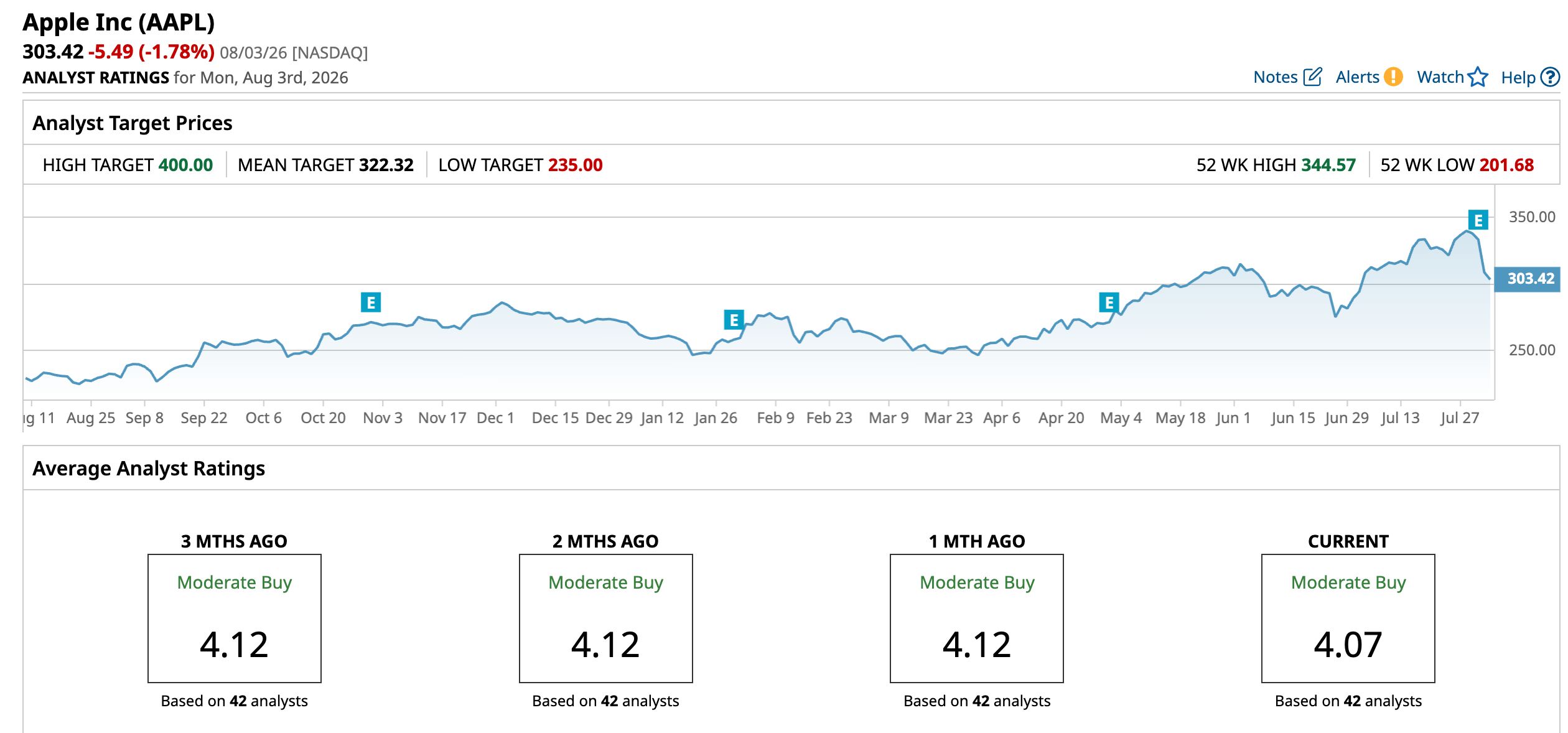
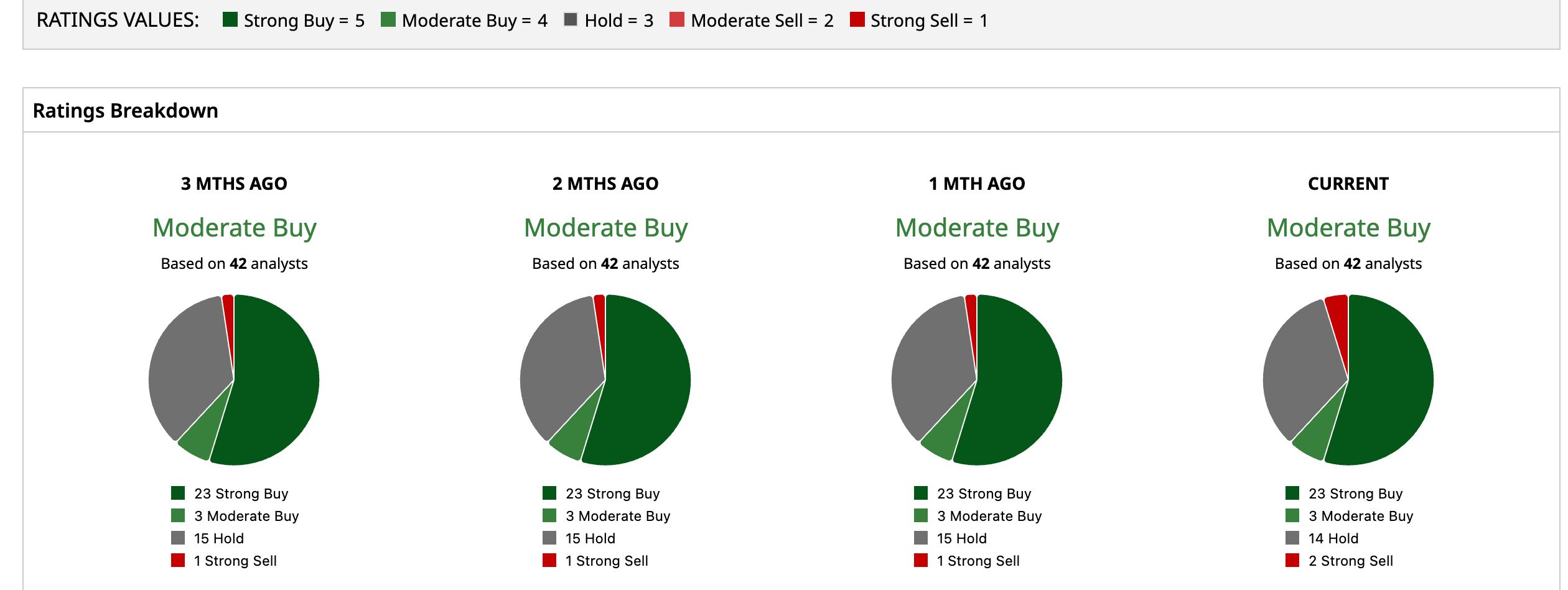
Overall, Apple stock has a consensus “Moderate Buy” rating. Out of 42 analysts covering the tech giant, 23 recommend a “Strong Buy,” three give a “Moderate Buy,” 14 analysts stay cautious with a “Hold” rating, and two advise a “Strong Sell.”
While the average analyst price target of $322.32 indicates an upside of 6.2%, the Street-high target price of $400 suggests the stock can still surge by 31.8%.
 www.barchart.com
  www.barchart.com
 On the date of publication, Subhasree Kar did not have (either directly or indirectly) positions in any of the securities mentioned in this article. All information and data in this article is solely for informational purposes. For more information please view the Barchart Disclosure Policy here.
More news from Barchart
Why Wall Street Is Panicking About Apple’s Services Business Reddit's Tumble Has Been Overdone After It Produced Strong FCF - RDDT Could be 40% Too Cheap A Palantir Deal May Boost Mercury System’s Efficiency, But Don’t Rush to Buy MRCY Stock SoFi Stock Sinks 50%, But Most Analysts Still Aren’t Bullish