

Intel Corporation (INTC) is a legacy American semiconductor powerhouse headquartered in Santa Clara, California, renowned for designing and manufacturing central processing units, AI accelerators, and cutting-edge chip packaging technologies that power everything from data centers to personal computers. Under CEO Lip-Bu Tan, Intel is executing an ambitious turnaround strategy anchored by its 18A and upcoming 14A process nodes, an expanding third-party foundry business, and a growing footprint in the booming artificial intelligence infrastructure buildout.
The U.S. government's 10% equity stake, secured to strengthen domestic semiconductor manufacturing, has further reshaped Intel's capital structure as the chipmaker competes head-to-head with Nvidia Corporation (NVDA), Advanced Micro Devices (AMD), and Taiwan Semiconductor ADR (TSM) for AI-era dominance and long-term technology leadership.
More Top Stocks Daily: Go behind Wall Street’s hottest headlines with Barchart’s Active Investor newsletter.
Intel’s $20 billion Offer
Intel has locked in pricing on a supersized $20 billion stock sale, offloading more than 210 million shares at $95 each after boosting the deal from its initial $15 billion target. Underwriters also received a 30-day window to snap up an extra 31.6 million shares if demand warrants it. Once the offering wraps up on Aug. 12, Intel expects to pocket roughly $19.7 billion in net proceeds, cash it says will go toward everyday corporate needs like capital spending and working capital as it accelerates its foundry expansion and AI chip manufacturing push.
Wall Street heavyweights J.P. Morgan (JPM), Goldman Sachs (GS), Morgan Stanley (MS), and Citigroup (C) steered the deal as lead underwriters, backed by a large syndicate of global banks. The mega-raise arrives as Intel leans into its turnaround playbook, pouring fresh capital into next-generation node development and factory capacity just as its revenue growth shows renewed momentum.
Intel Stock Surges in 2026
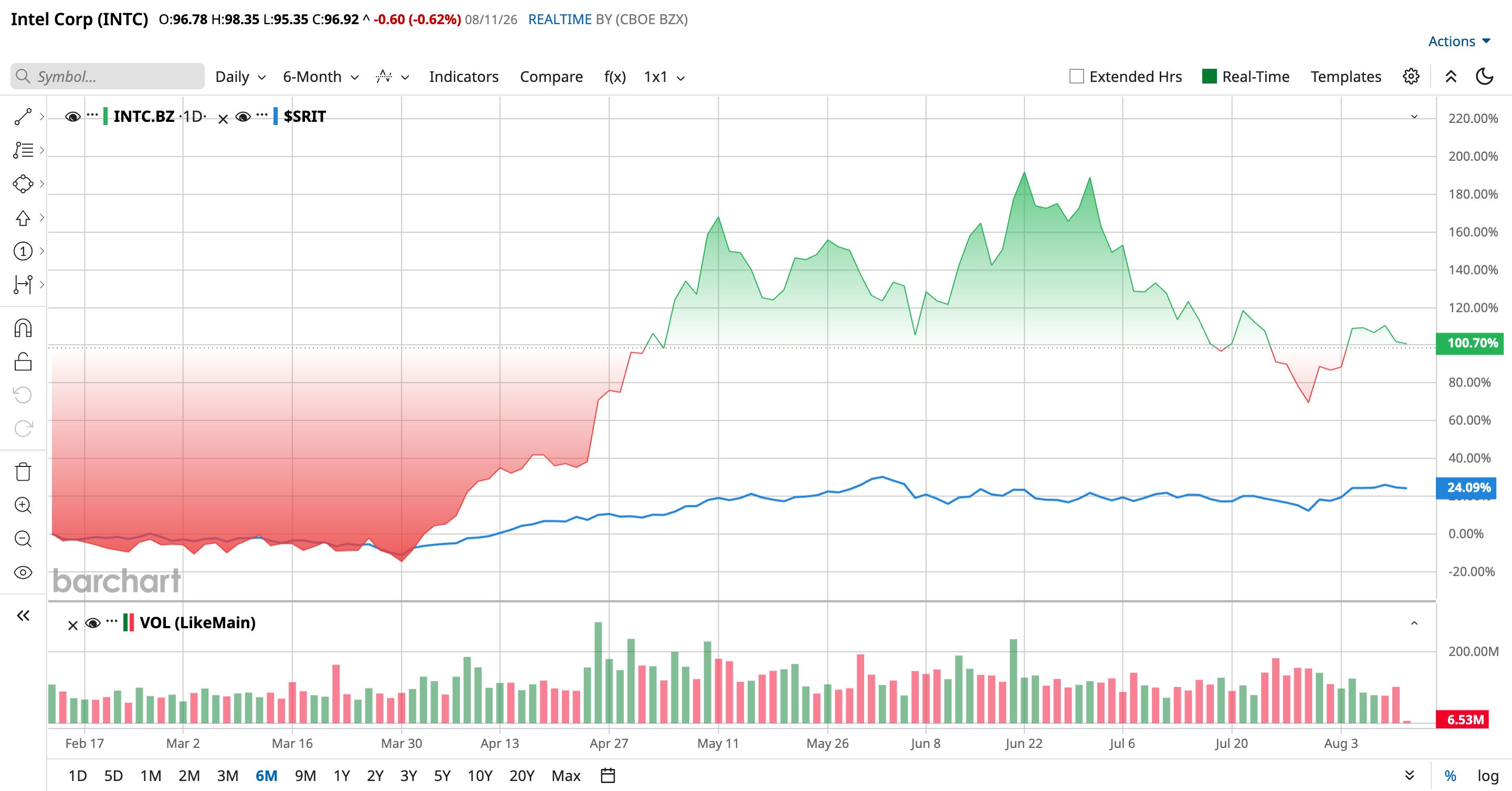
Intel stock has staged one of 2026's most remarkable comebacks, surging 373.85% over the past year and recently trading between $97.52 and $99, rebounding toward the psychologically important $100 level after a volatile stretch. Shares remain below their 52-week high of $142.35 set in June, and briefly dipped to $81.79 in July before recovering.
By comparison, the S&P 500 Information Technology Sector Index ($SRIT) has gained 21.67% year-to-date (YTD), a robust showing fueled by the broader AI rally. Intel's stock has dramatically outpaced its own sector, underscoring extraordinary investor enthusiasm around its turnaround narrative, government backing, and resurgent AI-driven chip demand.
 www.barchart.com
 Intel’s Remarkable Q2 Results
Intel's most recent second-quarter report, posted on July 23, showed revenue of $16.1 billion, up 25% year-over-year (YOY) and marking its strongest growth in more than 15 years, comfortably topping the $14.42 billion analyst consensus. Non-GAAP earnings per share came in at $0.42, doubling Wall Street's expectation of roughly $0.21. However, on a GAAP basis, Intel posted a net loss of $2.16 per share. This was driven largely by a $12.5 billion mark-to-market charge tied to escrowed shares under its CHIPS Act agreement with the U.S. government, highlighting the complex accounting behind Intel's federal partnership.
Growth was led by the Data Center and AI segment, where revenue jumped 59% YOY to $6.3 billion on surging demand for AI-optimized server chips. The Client Computing Group, Intel's largest unit, grew 13% to $8.9 billion despite looming memory-supply constraints. CFO Dave Zinsner credited the outperformance to higher factory yields and faster production cycle times, with 18A node yields climbing from roughly 65% to 85%, a key milestone supporting improved manufacturing efficiency and profitability across Intel's expanding foundry operations.
Looking ahead, Intel guided for third-quarter revenue of $15.8 billion to $16.8 billion, alongside non-GAAP EPS of $0.38, both comfortably above consensus estimates of $15.1 billion and $0.27. Management pointed to a strong and sustainable AI-driven spending environment, new customer wins including a Tesla foundry partnership and expanded Google Cloud collaboration, and plans to meaningfully increase investment in equipment, clean-room capacity, and advanced substrates. Executives expressed confidence that Intel's CPU franchise, foundry network, and AI silicon roadmap position the company for durable, long-term growth.
Is Intel Stock a “Buy” After the $20 Billion Raise?
Intel's supersized $20 billion capital raise highlights just how much cash the chipmaker needs to fund its ambitious foundry buildout, but the move comes with a trade-off: shareholders now face meaningful dilution as they weigh the long-term turnaround potential. Analyst sentiment on INTC stock reflects that tension.
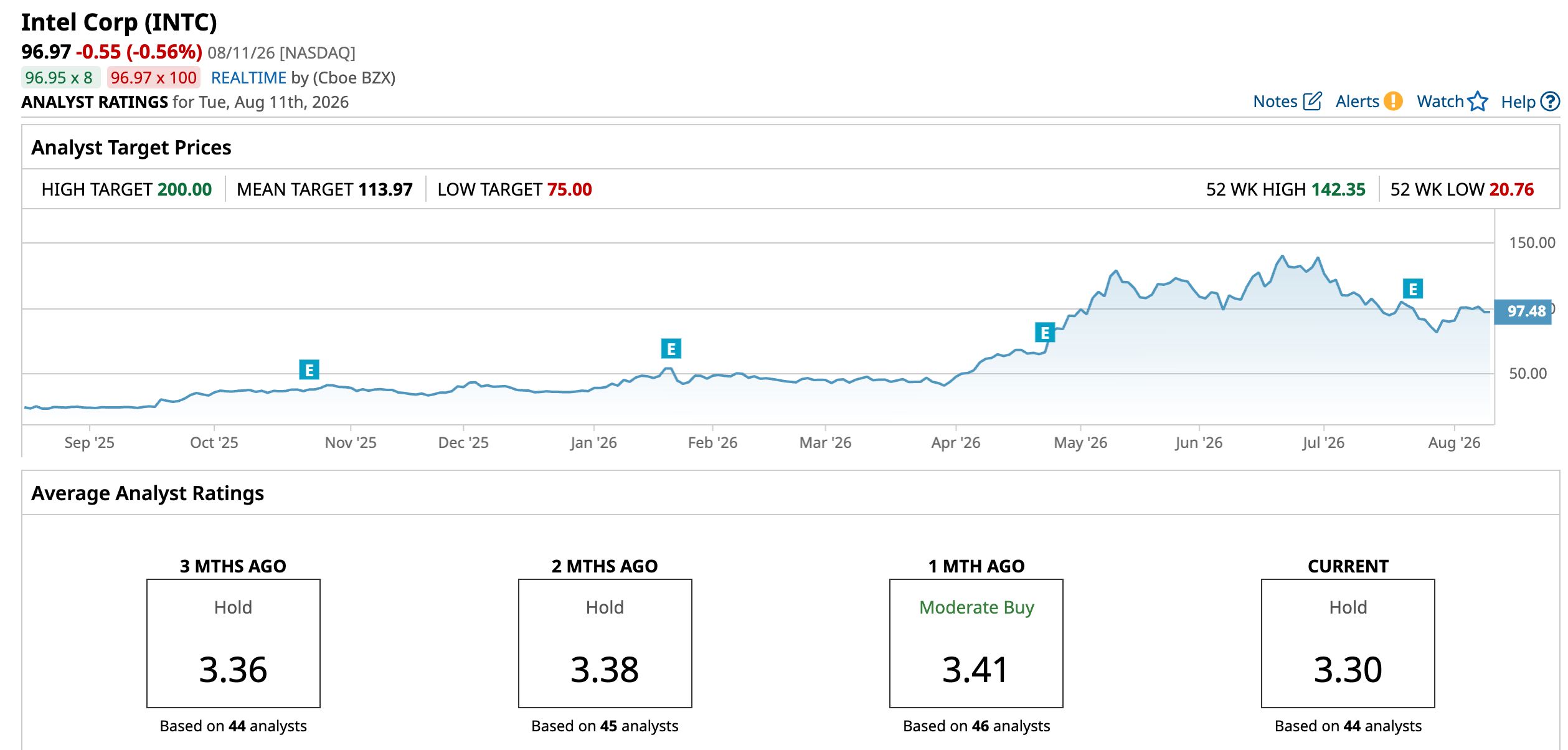
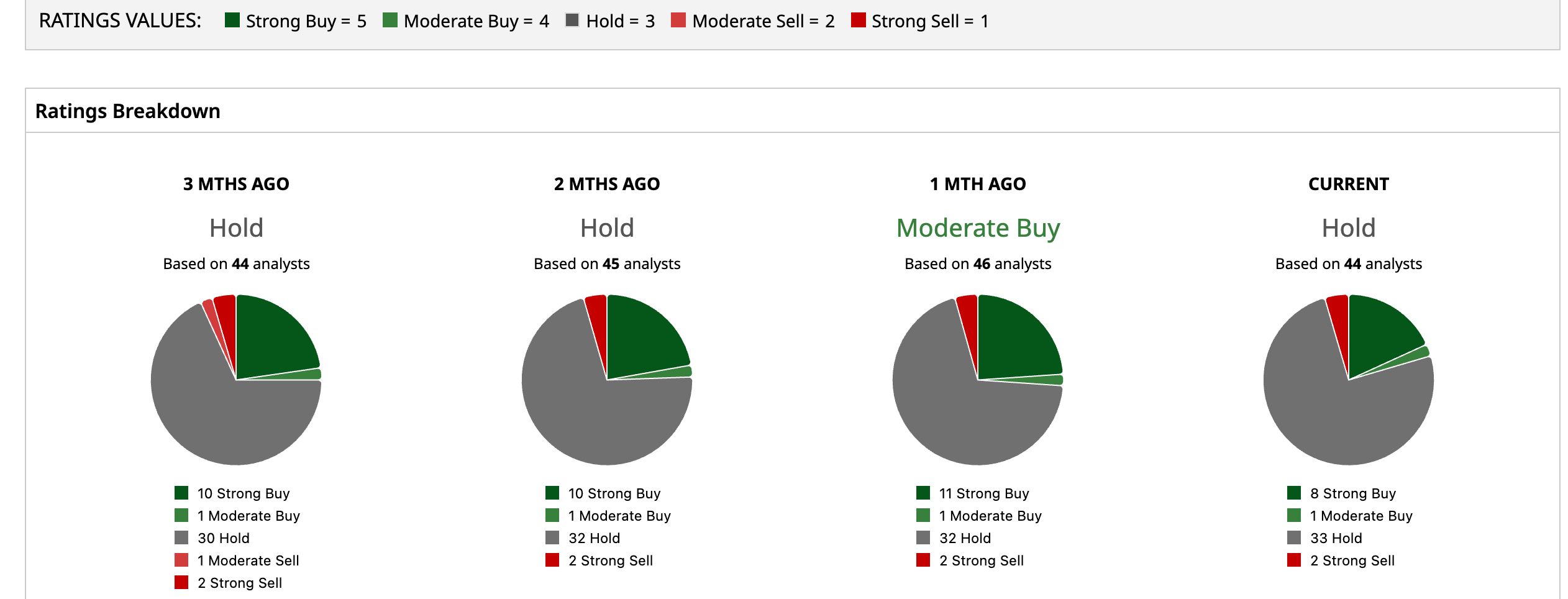
Wall Street's consensus lands on a "Hold" rating across 44 analysts, with just eight "Strong Buy" and one "Moderate Buy" calls offset by a heavier 33 "Hold" ratings and two "Strong Sell" calls. Still, the mean price target of $113.97 implies 17.5% upside from Intel's current price, hinting at real recovery potential.
The takeaway: Intel's story carries genuine upside, but it remains tangled in execution risk and ongoing questions about the way in which the company will fund its next chapter of growth.
 www.barchart.com
  www.barchart.com
 On the date of publication, Ruchi Gupta did not have (either directly or indirectly) positions in any of the securities mentioned in this article. All information and data in this article is solely for informational purposes. For more information please view the Barchart Disclosure Policy here.
More news from Barchart
Dear Intel Stock Fans, Mark Your Calendars for August 12 HP Inc. Has Unusual Put Option Activity - A 7.4% Short-Put Yield - But Is It a Trap? Airbnb Has Been on a Tear, But There’s 1 Key Reason to Wait to Buy ABNB Stock Apple’s Revenue Is Soaring, But Analyst Confidence in AAPL Stock Is Cooling. Here's Why.