

Billionaire Paul Tudor Jones recently liquidated his stake in the semiconductor manufacturing company Applied Materials (AMAT) during Q2. In Q1, Jones had 262,413 shares (worth almost $90 million), and his common stock holdings dropped to 0 in Q2.
He also has a growing put position in AMAT with 236,200 shares. But again, he also has a call position in AMAT to partially counterbalance that, and it's more of a hedge. Focusing on the common stock position is smarter, since it's tough to know the premium paid for the AMAT options.
More Top Stocks Daily: Go behind Wall Street’s hottest headlines with Barchart’s Active Investor newsletter.
He is known for his active market-timing strategies, so an exit like this from a major AI chip supplier raises questions about his view of the sector as a whole.
Applied Materials is a part of an oligopoly, along with KLA Corporation (KLAC), Lam Research (LRCX), and ASML (ASML), among others. Without the software and hardware developed by these companies, it would be impossible to make modern semiconductors and devices.
And as you may already know, most of the tailwinds here are coming from AI. Jones selling one of these stocks looks like a bearish bet on AI on the surface, but it's worth looking into this more deeply. The best way to do this is to look at AMAT stock first and consider why one would sell during a euphoric stretch.
 www.barchart.com
 AMAT May Have Gone Too Far
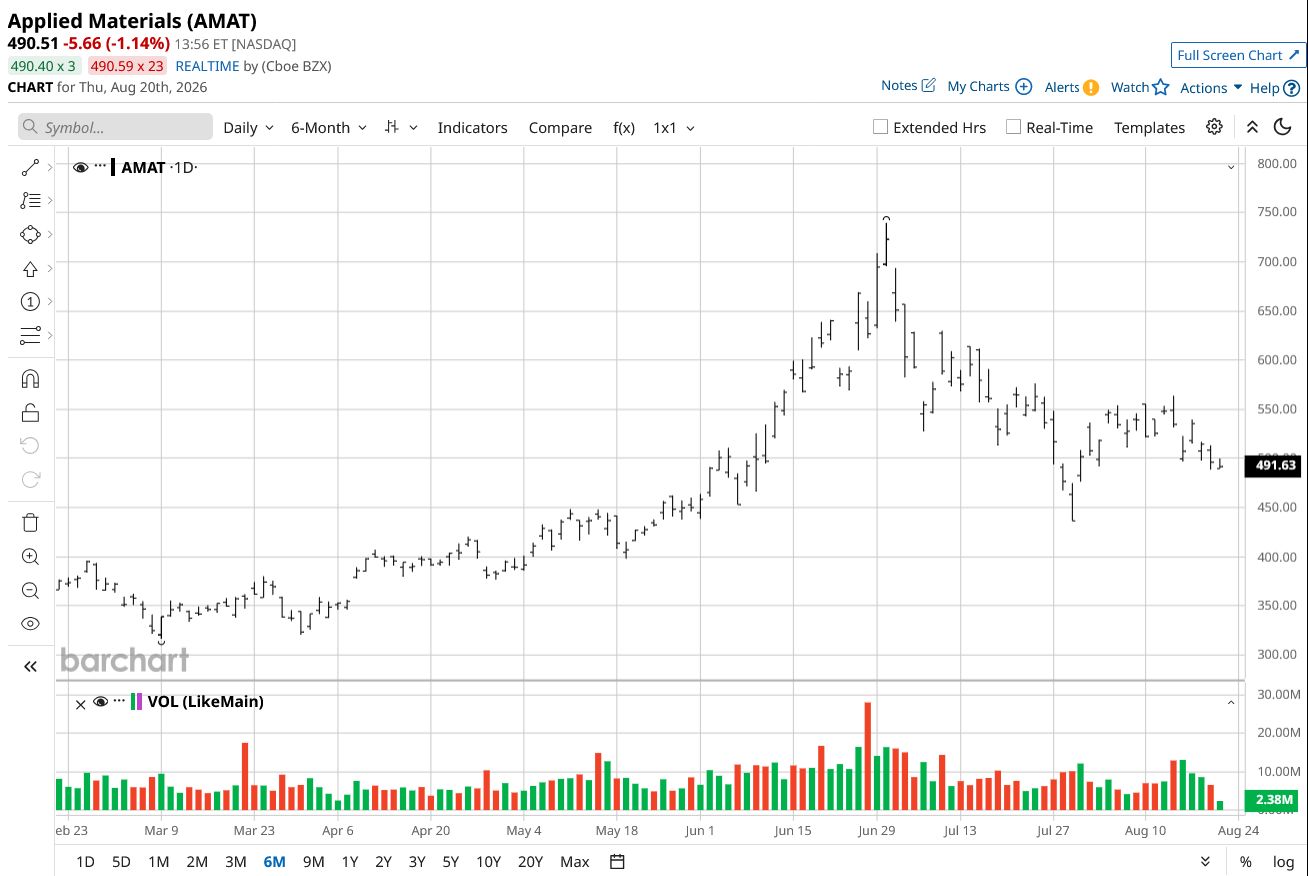
AMAT stock surged 181% from the start of this year to its peak, and if Jones sold near the end of Q2, he may have timed that peak. Since then, the stock has corrected by 33%.
Even after the correction, AMAT stock is trading at 40 times this fiscal year's earnings (ending in October 2026) and over 27 times next year's earnings. Even if growth holds at 30-40% annually, this sort of growth is readily available elsewhere in bigger AI names, where the market is pricing the stock near 20 times earnings.
In fact, for some of the more cyclical names like memory stocks, you can buy them at sub-10x forward earnings.
Paul Tudor Jones Is Not Bearish on AI—At Least Not Yet
If you look at all of his Q2 moves, you'll quickly realize that he's just rotating his gains from Applied Materials to other AI companies, many of which are undoubtedly the ones that offer higher growth at a lower cost.
For instance, he expanded his stake in Taiwan Semiconductor (TSM) by 340%. This is the ultimate AI bet because Taiwan Semiconductor is the company upstream of everyone else in the semiconductor sector. Nvidia (NVDA), AMD (AMD), and almost any fabless chip company you can think of rely on Taiwan Semiconductor's manufacturing.
And speaking of Nvidia, Jones increased his NVDA stake by 137%. He wouldn't be doing so if he were bearish on AI.
What Surprised Me
While Jones loaded up on TSM and NVDA, he ended up dumping Micron (MU). He sold 6.77% of his MU stake, which isn't much, but it is a stake I believed would've been added to instead, given how cheap MU stock is by conventional measures. MU stock trades at just 6x forward earnings, and the company's CEO believes the memory shortage will persist through next year. That's plenty of momentum to ride on.
That said, my conclusion is that Jones likely believes MU stock has outrun its near-term potential. He will likely accumulate more, and the Q3 filing might be when you are going to see heavy buying, because MU stock did indeed start correcting heavily in Q2 and is now deeply discounted.
Should You Also Sell AMAT Stock?
I would not make significant trading decisions based on what Jones did last quarter. Jones usually makes trades and reports well over a month later, by which time the thesis could've changed entirely. I believe that is the case here.
AMAT stock peaked right around the end of Q2, and the discount now puts it at an expensive-ish range, but somewhere you could still end up doubling from if the rally keeps going. Thus, I wouldn't follow what Tudor did in Q2 of this year.
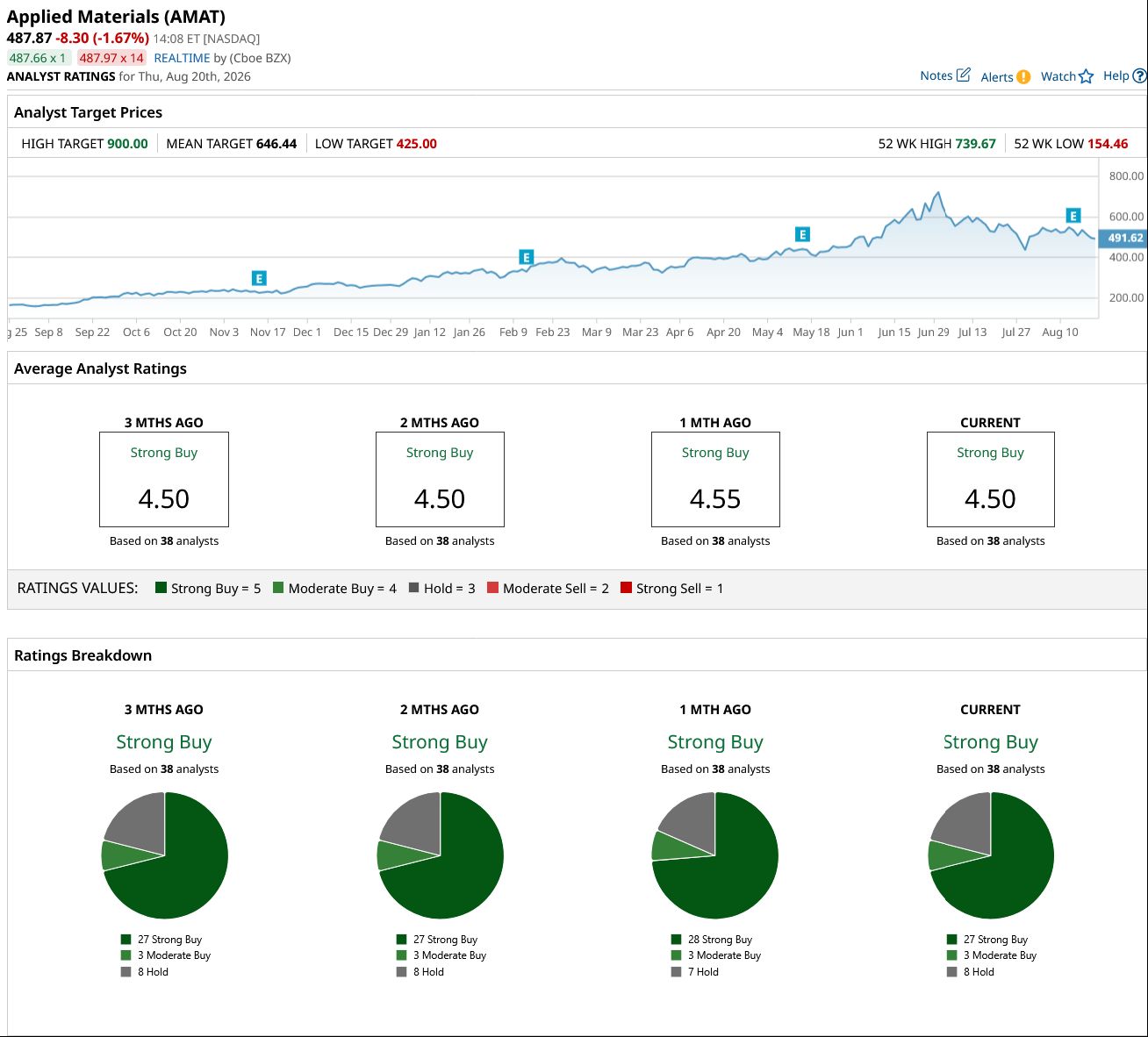
The average analyst price target has also shifted in AMAT's favor.
The peak price was well above most analysts' comfort levels, but now the mean price target implies a healthy 32% upside.
 www.barchart.com
 On the date of publication, Omor Ibne Ehsan did not have (either directly or indirectly) positions in any of the securities mentioned in this article. All information and data in this article is solely for informational purposes. For more information please view the Barchart Disclosure Policy here.
More news from Barchart
Duquesne Management Just Dumped Its Entire Stake in This Surging AI Stock The Biggest Players in a $500 Billion Market Are Exiting. Here’s Why Costco Just Entered. Paul Tudor Jones Just Liquidated His Entire Stake in Applied Materials Stock. I Don’t Think He’s 100% Bearish on AI Though… Yet Up almost 20%, Here’s Why Microsoft Stock Could Rise Even Further