


Penny stocks are generally very low-priced shares that can offer explosive upside if the underlying business becomes successful. However, they also come with higher risks than established companies. One such company is Werewolf Therapeutics (HOWL), a clinical-stage biotechnology firm that is developing therapies designed to activate the immune system against cancer and other immune-mediated disorders.
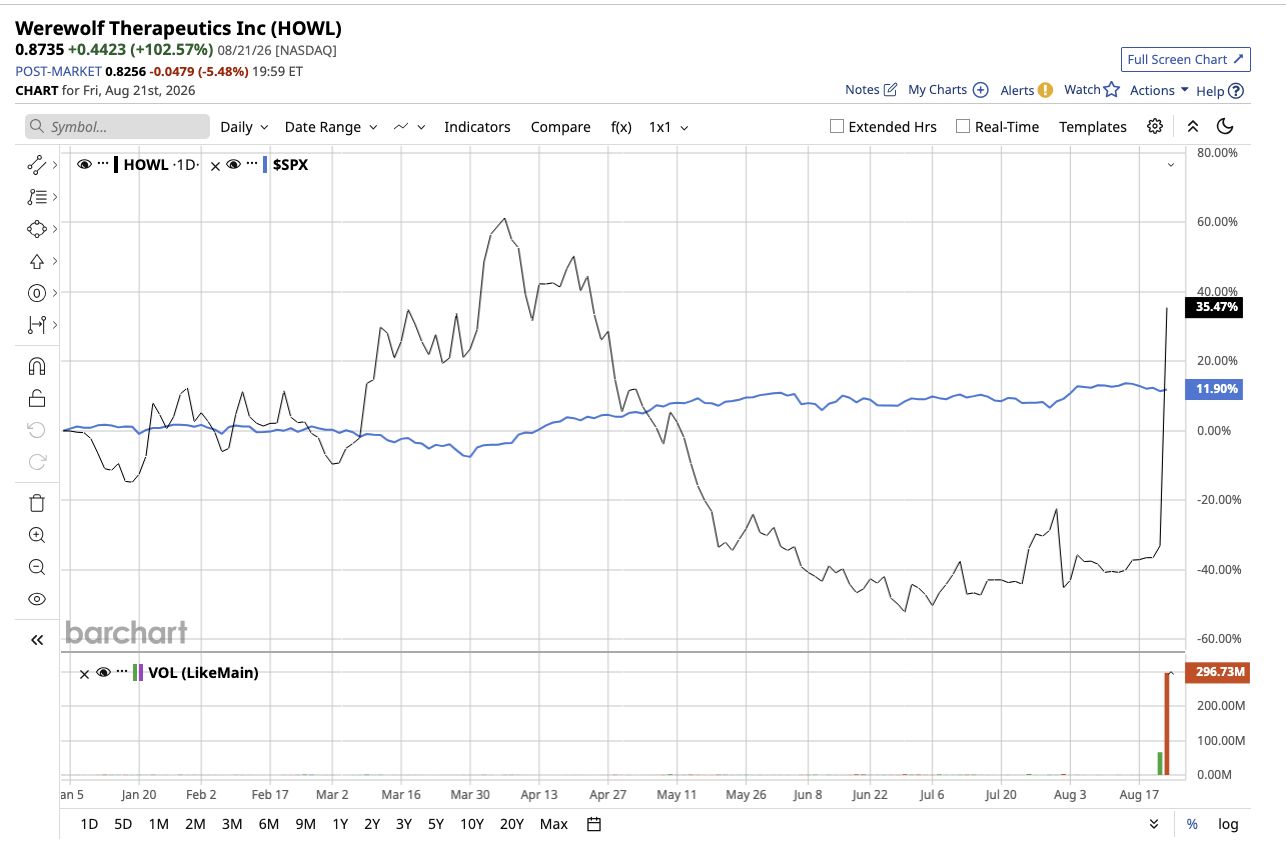
HOWL stock has surged 50% year-to-date (YTD), and has climbed more than 133% over the last five days. A proposed merger with Ambros Therapeutics, as well as a $150 million private placement, may have given the stock a chance to howl its way to the top.
More Top Stocks Daily: Go behind Wall Street’s hottest headlines with Barchart’s Active Investor newsletter.
Let’s take a look at what’s in store for HOWL stock investors.
 www.barchart.com
 The Merger Changes What Investors Are Actually Buying
On Aug. 21, Werewolf and Ambros Therapeutics agreed to combine in an all-stock transaction. If and when the deal closes, the combined company is expected to operate as Ambros Therapeutics and trade on the Nasdaq under the ticker “AMBX.” The transaction is currently expected to close by the first quarter of 2027, assuming shareholder approvals and other closing conditions are met.
This news also begs a question: If Werewolf will trade as Ambros, why are investors pouring money into HOWL stock now? Before the merger announcement, Werewolf was a struggling clinical-stage biotech with limited cash and strategic uncertainty. The merger has allowed Werewolf to own a stake in a much better-funded Phase 3 biotech story. Currently, Werewolf has two clinical-stage candidates, WTX-124 and WTX-330, in the advanced stage for multiple solid tumors. Werewolf is also developing INDUCER programs for potential use in ovarian and kidney cancers.
Now, Ambros is bringing neridronate to the table, which is being developed as a potential treatment for Complex Regional Pain Syndrome Type 1 (CRPS-1), a rare and debilitating condition that typically develops after an injury or trauma to a limb. There are currently no U.S. Food and Drug Administration (FDA) approved medicines specifically for CRPS-1, and neridronate is already in a pivotal Phase 3 trial for CRPS-1. According to Ambros, the drug has already received FDA Breakthrough Therapy, Fast Track, and Orphan Drug designations.
This means HOWL stock’s current rally is more about investors trying to get exposure to Ambros’ late-stage pipeline before the deal closes as well as Werewolf's existing oncology programs.
$150 Million Gives the New Company Breathing Room
The second piece of the announcement that caught investors’ attention was funding. Werewolf and Ambros also announced securing commitments for an oversubscribed $150 million private placement from healthcare-focused investors. At the end of its second quarter, Werewolf reported $22 million in cash and cash equivalents, down from $46.5 million at the end of March. Management expected this funding to last until Q2 2027.
However, with the additional $150 million, management now anticipates the proceeds to fund the combined company through top-line results from the Phase 3 CRPS-RISE trial and a potential FDA filing, with cash runway extending into the first half of 2029. As Werewolf is in the clinical stage with no FDA-approved products for commercial sale, its research and development expenses keep rising every quarter.
For a small biotech stock that has been trading under $1 per share, this is a huge deal, as clinical trials are expensive. This gives the combined company breathing room without the need to immediately obtain further funds.
The Risks Are Still Very Real
At the moment, the Ambros merger may now be the biggest catalyst for Werewolf Therapeutics. The combination of a Phase 3 asset, FDA designations, and a cash runway potentially extending into 2029 gives HOWL a credible path toward a much bigger biotech story. However, penny stocks are volatile, and the risks associated with them are very real, too. There are also merger-related concerns, as the transaction still requires shareholder approval and other closing conditions.
Even if the merger goes through, the combined company’s future will depend on clinical trials, approvals, and commercial success. Therefore, investors must do their due diligence before considering HOWL stock now.
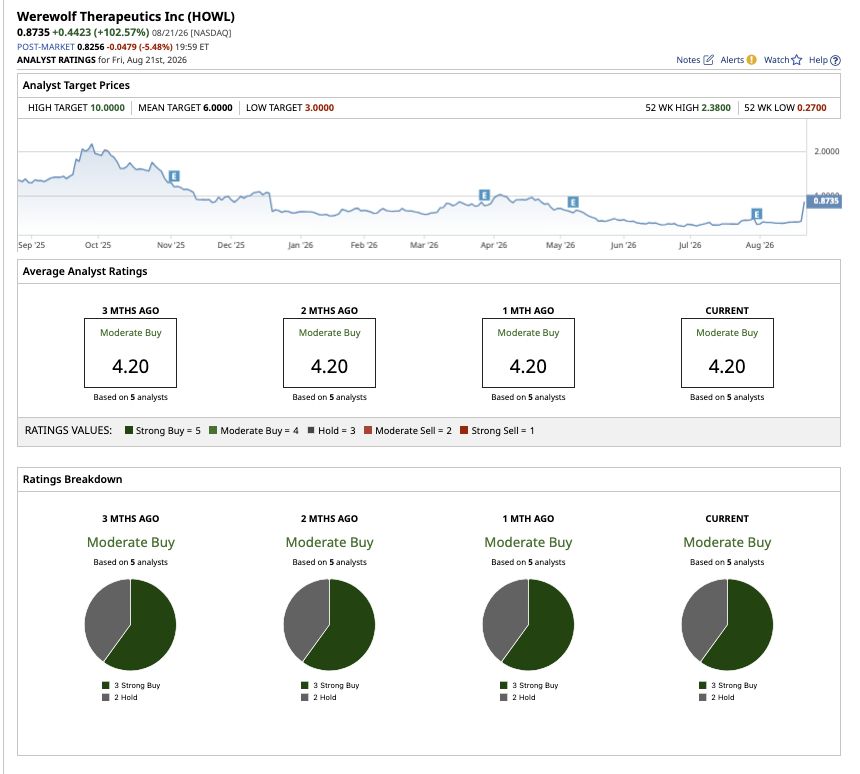
Overall, HOWL stock has a consensus “Moderate Buy” rating on Wall Street. Of the five analysts covering the stock, three have a “Strong Buy” rating while two offer a “Hold" rating.
 www.barchart.com
 On the date of publication, Sushree Mohanty did not have (either directly or indirectly) positions in any of the securities mentioned in this article. All information and data in this article is solely for informational purposes. For more information please view the Barchart Disclosure Policy here.
More news from Barchart
Personalis Stock Is Up 250% in the Past Year. It Needs to Turn a Profit Next. 1 Penny Stock That Could Howl Its Way to the Top After a $150 Million Funding Boost 3 ETFs to Buy Before Jackson Hole (and 1 Group of Stocks to Sell) Billionaire Figure AI Founder Brett Adcock Says Meta’s Glasses Are ‘Probably One of the Worst Products I've Ever Bought’