

Intel (INTC) stock has had a remarkable run. But Mizuho is telling investors to cool their expectations.
The firm recently cut its Intel price target to $92 from $109 while keeping a “Hold” rating. Analyst Vijay Rakesh cited multiple compression across agentic AI companies. In simple terms, investors may no longer be willing to pay as much for future growth.
More Top Stocks Daily: Go behind Wall Street’s hottest headlines with Barchart’s Active Investor newsletter.
That warning comes after Intel shares surged on stronger server demand, better execution, and hopes for a foundry comeback. The business is improving. INTC stock has moved faster.
That tension is now the big question for Intel investors. Strong earnings can support shares of Intel, but a falling multiple can offset those gains. Mizuho’s call is less a rejection of Intel’s turnaround than a warning that expectations are demanding.
Intel Stock Has Soared in 2026
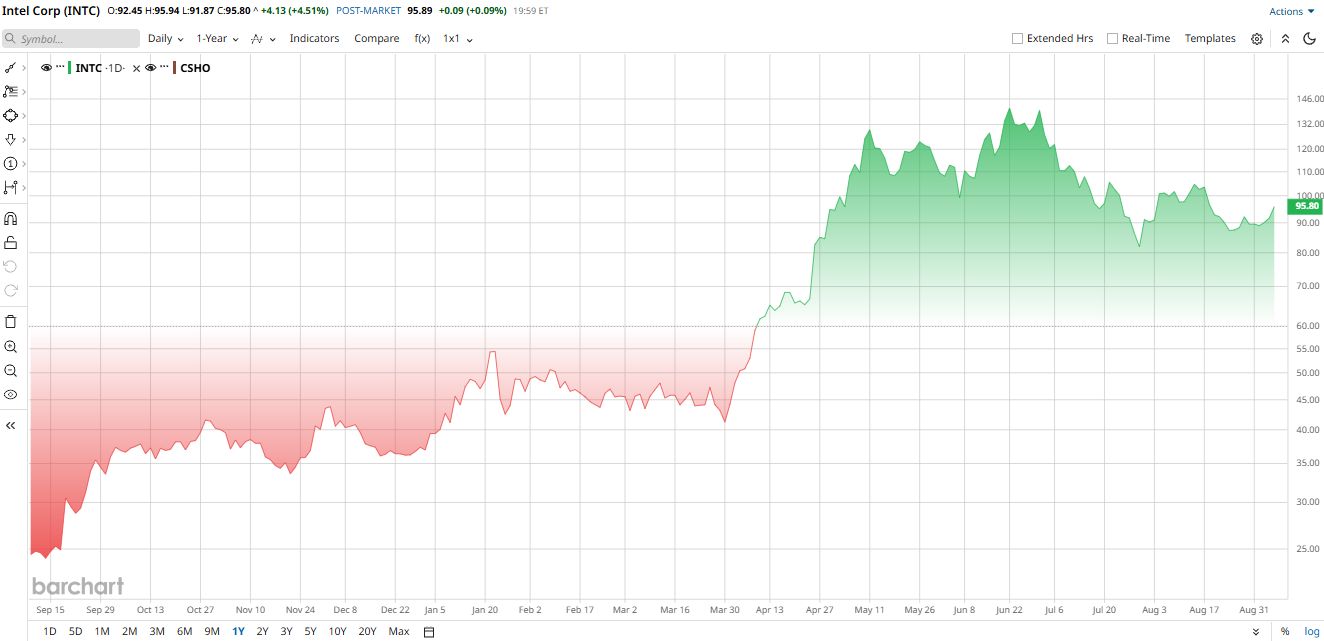
Over the past year, Intel stock has gained more than 310%. The rally has been fueled by AI-linked server demand, excitement around Intel 18A, and improving execution under CEO Lip-Bu Tan. Still, INTC stock reached a 52-week high of $142.35 in late June before retreating sharply. That swing shows how sensitive Intel has become to changing expectations.
After the bull run, the valuation leaves less room for mistakes. Intel stock trades at about 9.9 times sales and nearly 43 times cash flow. Those are demanding levels for a company still rebuilding profitability while funding an expensive manufacturing expansion.
The valuation is not necessarily excessive if earnings keep accelerating. But investors are paying for a much stronger Intel, which makes execution more important.
 www.barchart.com
 Mizuho’s Warning Goes to the Heart of Intel’s Story
The $92 target is below Intel’s latest close. Mizuho still sees support from agentic AI server CPU demand, but the firm is questioning the multiple to which investors should assign that growth.
That could become a catalyst in either direction. If Intel keeps expanding margins, growing server sales and proving that 18A works at scale, investors may eventually justify a higher multiple. If growth slows, however, multiple compression could make INTC stock fall even if revenue keeps rising.
Intel is strengthening the underlying story. In July, the company noted that 18A-P had entered risk production and that a subset of Panther Lake processors had reached high-volume manufacturing using High NA extreme ultraviolet (EUV) lithography. The company also launched Xeon 6+ this year, its first server product on 18A, while expanding AI infrastructure work with Alphabet's (GOOGL) Google Cloud and Fortinet (FTNT).
Q2 Results Give Bulls Something to Work With
Intel’s second-quarter revenue reached $16.1 billion, up 25% year-over-year (YOY). Product revenue climbed 28% YOY to $15.1 billion. Client Computing and Physical AI revenue rose 13% to $8.9 billion, while Data Center and AI (DCAI) jumped 59% to $6.3 billion. Intel Foundry revenue increased 31% YOY to $5.8 billion.
Net loss widened to $11 billion in Q2 2026 from a loss of $2.9 billion in Q2 2025. But adjusted earnings improved sharply to $0.42 per share from a $0.10 loss. Gross margin also jumped to 40.4% from 27.5%, while operating margin improved to 11.1% from -24.7%.
Intel generated $7 billion in operating cash flow, although adjusted free cash flow was -$8.4 billion after capital spending and partner contributions. The company ended the quarter with $12.9 billion of cash and equivalents and $16.9 billion of short-term investments.
CEO Lip-Bu Tan said that AI is driving “unprecedented demand for compute.” Intel expects Q3 revenue of $15.8 billion to $16.8 billion and adjusted EPS of $0.38. Meanwhile, Barchart currently projects EPS of $0.28 per share for Q3.
Wall Street Is Split on Intel Stock
Mizuho remains cautious, with Rakesh cutting his target to $92 and keeping a “Hold” rating. Goldman Sachs is more constructive, starting coverage with a “Neutral” rating and a $150 target as agentic AI boosts server demand. On the other side, Morgan Stanley raised its target to $84 from $75 but kept an “Equal-Weight” rating. UBS also recently kept a “Hold” rating while cutting its target to $112 from $121.
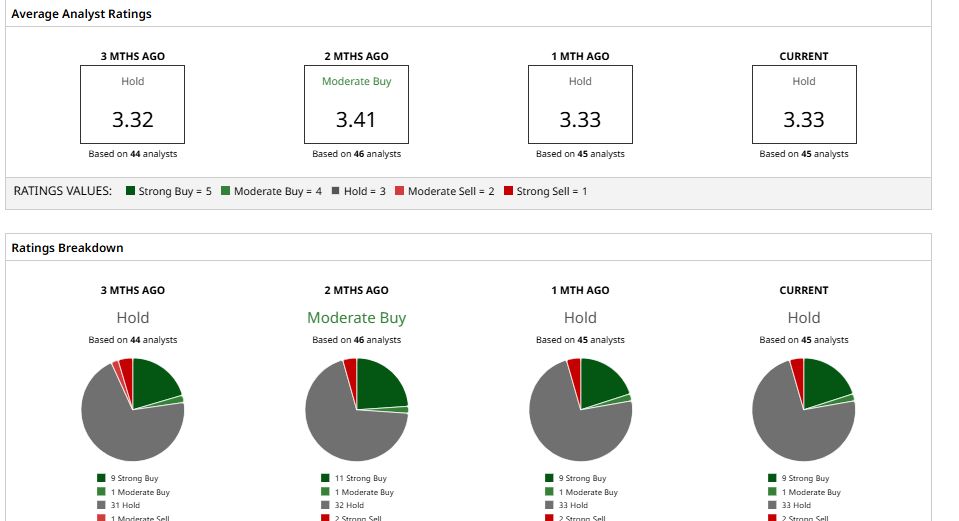
Overall, Intel stock has a consensus "Moderate Buy" rating based on 45 analysts with coverage. The mean price target of $113.54 shows that Wall Street still sees potential upside of around 13%, but not enough to ignore valuation risk. For Intel, the next leg higher may depend less on excitement and more on whether earnings can catch up with INTC stock.
 www.barchart.com
 On the date of publication, Nauman Khan did not have (either directly or indirectly) positions in any of the securities mentioned in this article. All information and data in this article is solely for informational purposes. For more information please view the Barchart Disclosure Policy here.
More news from Barchart
2 Reasons to Buy Super Micro Stock — And 1 Reason to Be Cautious Scott Bessent Thinks Norway May Trade Treasuries for Assets Like Fannie Mae. What That Actually Means for FNMA Stock. A Rare Quant Signal Just Flashed for Contrarian Options Traders in Home Depot Stock Why 1 Veteran Analyst Just Trimmed His Intel Stock Price Target