

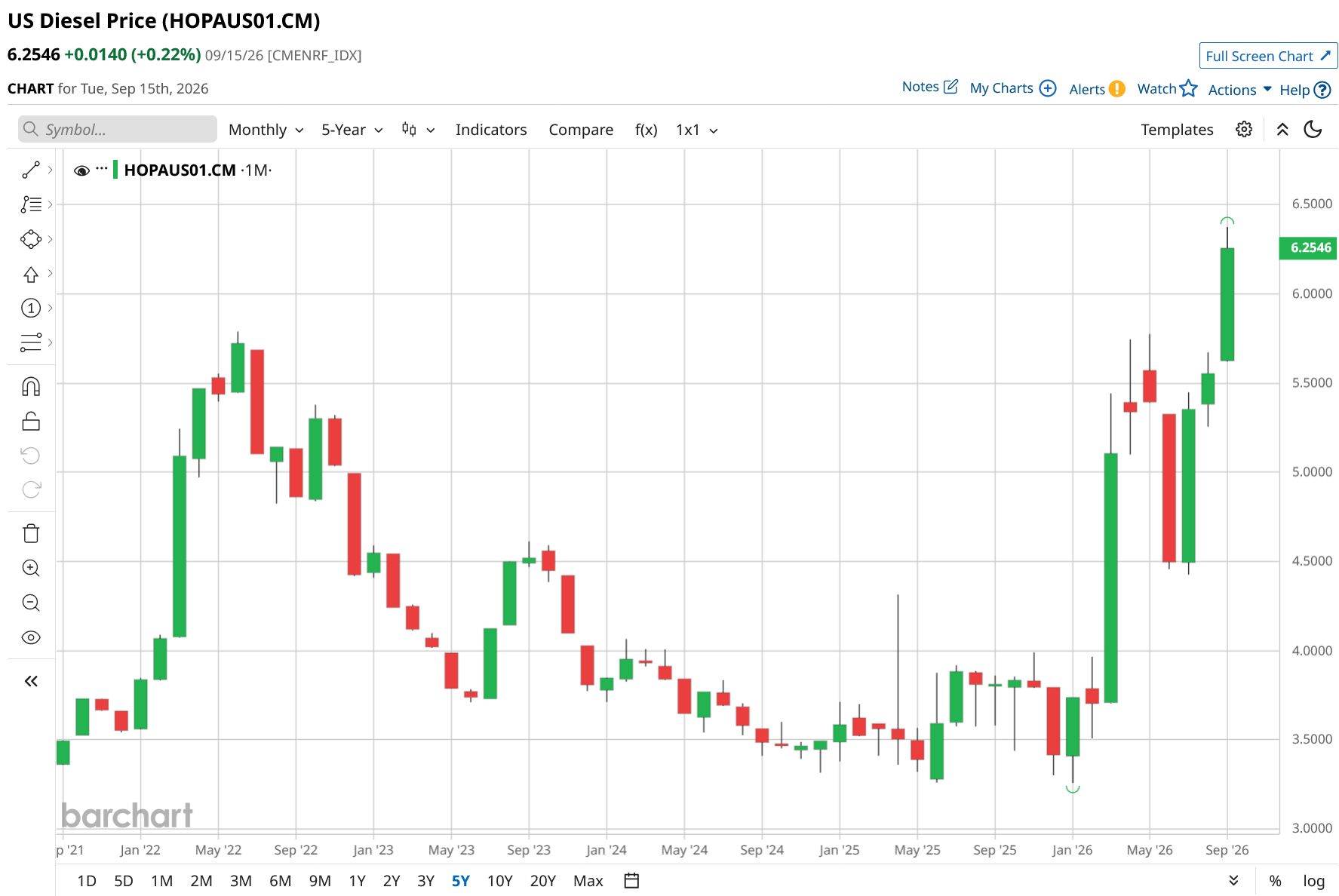
U.S. diesel prices have moved into record territory. The national average price of diesel climbed to a record $6.23 per gallon on Sept. 14, after first breaking above the $6 threshold last week. And diesel is hitting new highs again today at around $6.31. According to AAA data, the national average diesel price reached about $6.05 per gallon on Sept. 11, 2026, surpassing the previous record established in June 2022. The latest price is roughly 68% higher than the level of about $3.71 per gallon a year ago, highlighting the extraordinary speed of the rally.
The surge is being driven by a global shortage of refined petroleum products rather than crude oil alone. Disruptions to Middle Eastern energy infrastructure, sharply reduced traffic through the Strait of Hormuz, and attacks on Russian refineries have reduced the availability of diesel and other middle distillates. The situation has become serious enough that diesel prices are now adding to broader inflation concerns while simultaneously creating a potentially attractive environment for U.S. refiners.
Don’t Miss a Day: From crude oil to coffee, sign up free for Barchart’s best-in-class commodity analysis.
Now it remains to be seen whether diesel prices have already peaked or whether another leg higher is possible with inventories still extremely tight and refinery capacity disrupted around the world.
 www.barchart.com
 Why Did Diesel Prices Hit Over $6?
The diesel rally accelerated in September after a series of supply disruptions tightened an already constrained market.
While the U.S. national average diesel price had crossed $6 per gallon, U.S. inventories were about 13% below the five-year average, while the diesel crack spread, a key measure of refinery profitability, had reached a record level. The situation has worsened since then.
Middle Eastern oil and refined-product exports have been disrupted by the ongoing war involving Iran, while attacks on Russian refineries have reduced Russia’s refining capacity. Reports show Russia’s refining capacity had fallen sharply, and Moscow had banned diesel exports, while Gulf diesel exports have also been hit by disruptions around the Strait of Hormuz.
The latest developments in Saudi Arabia are adding another layer of risk. Oil prices jumped on Sept. 15 after attacks affected Saudi energy infrastructure, including the East-West pipeline, which has the capacity to move roughly 4 million barrels of oil per day toward the Red Sea, putting supply at risk. Brent crude climbed to about $107.55 per barrel, while WTI moved above $103.
That is important for diesel because refiners are operating in an environment where both crude stock and refined-product supply are under pressure.
Diesel Prices Could Remain Elevated Into 2027
In its Sept. 9, 2026, Short-Term Energy Outlook, the EIA raised its forecast for the average U.S. retail diesel price to $5.07 per gallon for 2026, up 4.4% from its previous forecast of $4.85. More importantly, it raised its 2027 forecast to $4.40 per gallon, up 8.2% from the previous estimate of $4.07.
At first glance, a $4.40 average for 2027 may appear inconsistent with today’s $6.23 price. However, the EIA forecast assumes that oil flows through the Middle East gradually improve and that global inventories eventually recover.
The EIA expects Brent crude to average around $90 per barrel during the second half of 2026 before declining toward approximately $74 per barrel in 2027 as production increases and inventories rebuild.
However, the EIA expects U.S. distillate inventories to fall below 100 million barrels in September and remain below the five-year low through much of 2027. It also expects global distillate production to remain below last year’s levels in the coming months. That means the current diesel-price shock may not disappear quickly.
On the other hand, speculation around diesel’s push toward $7 per gallon remains active among some analysts, given that the disruption to global oil and refining flows persists. The situation is turning even more extreme in California, where diesel prices have approached $8 per gallon.
Refiners Could Be the Biggest Stock Market Beneficiaries
For investors looking to capitalize on the diesel rally, refiners may offer more direct exposure. Valero Energy Corporation (VLO), Marathon Petroleum Corporation (MPC), and Phillips 66 (PSX) are among the most important U.S. refining names to watch. Their businesses are positioned to benefit when refined-product prices rise.
The setup has already been reflected in refinery stocks. Valero shares are up 135.2% year-to-date (YTD) and 12.1% this month, while MPC also surged 143.8% and 11.5%, respectively. Additionally, PSX gained almost 100% YTD and over 10% this month.
Furthermore, investors seeking a diversified approach might take a look at ETFs like the State Street Energy Select Sector SPDR ETF (XLE) and VanEck Oil Refiners ETF (CRAK), which provide broad exposure to the energy sector, including integrated oil companies, refiners, and other energy businesses.
On the date of publication, Subhasree Kar did not have (either directly or indirectly) positions in any of the securities mentioned in this article. All information and data in this article is solely for informational purposes. For more information please view the Barchart Disclosure Policy here.
More news from Barchart
Diesel Price Predictions: How Much Higher Prices Can Go as Diesel Prices Top Record $6 Per Gallon If You Missed the Nancy Pelosi Rally, Here’s the Case for Buying Bloom Energy Stock Now GLP-1s & Gas Prices Are Eating Restaurant Stocks. This Is the Indicator Investors Need to Watch. Fuel Crisis Hits Home — Even Costco Hikes Prices, Limits Purchases on Kirkland Motor Oil