


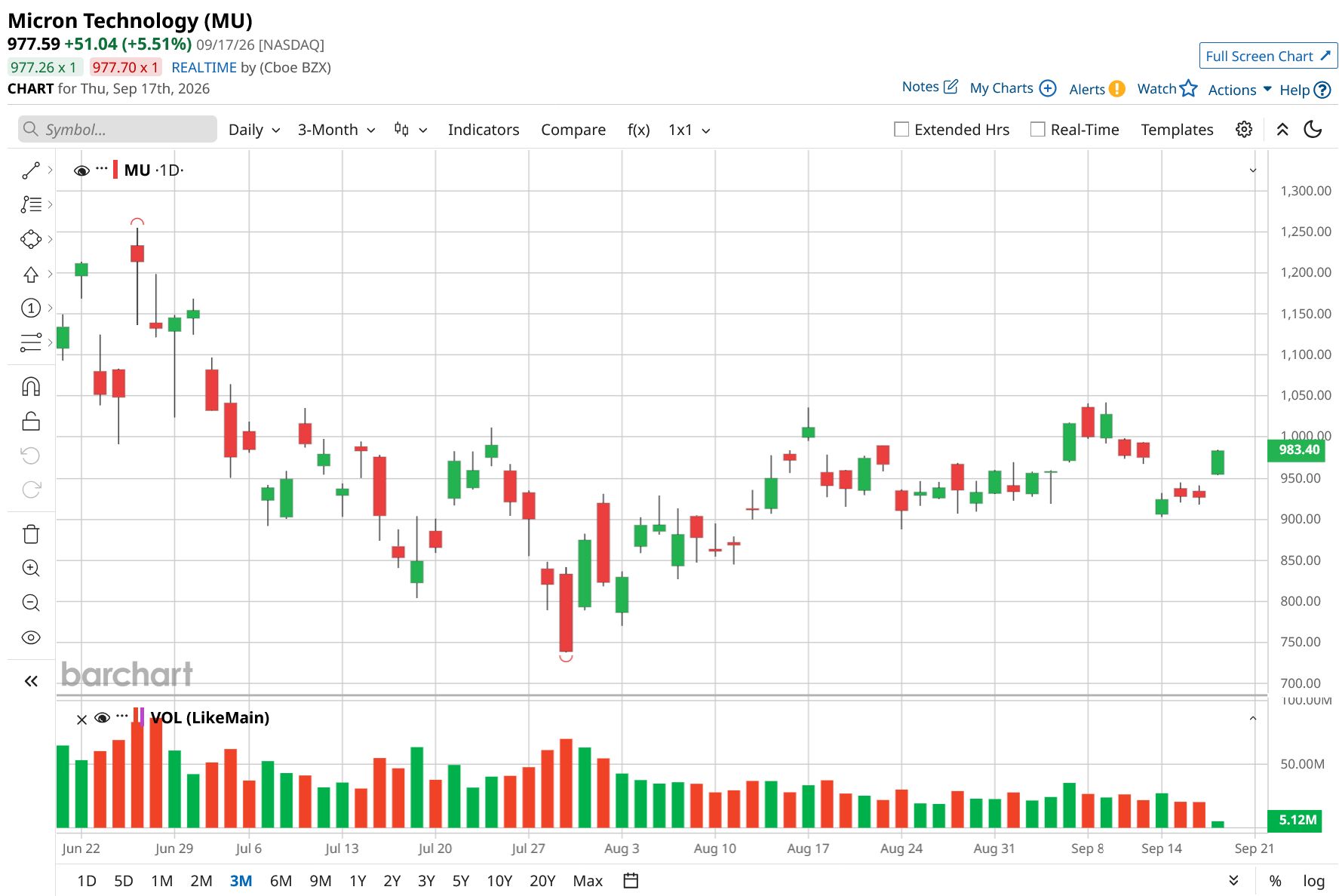
Before Micron’s (MU) last earnings, I argued it was a stock to sell. It was trading near its 52-week high, an AI-driven memory rally had priced in the good news, and there was more room to fall than to rise. That is close to how it played out. Micron beat expectations and briefly spiked, but the rally ended shortly after. MU stock has since fallen about 23% from that 52-week high to around $976. This wasn’t the first time the market punished it after earnings. Micron has repeatedly beaten estimates and then sold off anyway. After its fiscal Q2 report, it beat by a wide margin and still dropped roughly 20% the following week. So for this stock, guidance and sentiment drive the reaction far more than the beat itself.
Why MU Stock Has Fallen So Far
The recent drop isn’t really about Micron’s numbers. It’s a mix of factors that have hit the whole sector. A selloff followed calls from AI leaders to slow development, dragging down memory names like SK hynix (SKHY) and SanDisk (SNDK) too. Broader market pressure has added to it, as rising interest rates pushed investors away from expensive tech stocks. Some of it is simple profit-taking after a massive run.
More Top Stocks Daily: Go behind Wall Street’s hottest headlines with Barchart’s Active Investor newsletter.
There are longer-term worries as well. Nvidia’s (NVDA) own commentary showed its memory purchase commitments climbing through fiscal 2029, then dropping sharply after. As I covered earlier, Chinese maker CXMT is also inching into high-bandwidth memory, an area that has been Micron’s most profitable. Both are real concerns, but they won’t hurt the numbers for years.
That is why the story has flipped this time. Heading into the Sept. 30 report, the business itself is strong. Analysts expect fiscal Q4 revenue near $50 billion, close to five times last year. UBS sees memory undersupplied into 2027. Nearly every fresh analyst price target since the last report sits above the current price. Last time, an elevated stock left little room for reward. This time, a beaten-down stock still carries strong near-term upside potential. The risk-control logic that pointed to selling then leans the other way now. A lot, though, will depend on the 2027 outlook management gives, not just the numbers it reports for the quarter.
About Micron Stock
Micron Technology is one of the world’s largest manufacturers of memory and storage chips used in data centers, AI systems, PCs, smartphones, graphics cards, automobiles, and industrial devices. The company produces products such as DRAM memory, NAND flash storage, high-bandwidth memory (HBM), and solid-state drives (SSDs). These help devices store and process data. It markets its semiconductor memory and storage products under the Micron and Crucial brands. The company sells its products through its direct sales force, independent sales representatives, distributors, and retailers. Founded in 1978, the company is headquartered in Boise, Idaho.
Micron Technology has been one of the biggest winners of the AI infrastructure boom. Over the past 12 months, MU stock has climbed nearly 515%, driven by strong demand for HBM and DRAM memory, combined with supply constraints and higher pricing. The stock has also comfortably outperformed the iShares Semiconductor ETF (SOXX), which gained around 100% over the same period.
 www.barchart.com
 Micron’s valuation sends mixed signals, which is fairly common for a memory stock. The forward price-to-earnings (P/E) of just 12.70x looks cheap on its own, but it doesn’t have a multi-year average to compare against. This is because Micron’s earnings have swung wildly through the memory cycle and turned negative in earlier down cycles. The forward price-to-sales (P/S) ratio looks significantly different. At 8.04x, it sits about 96% above its 5-year average of 4.11x, so the stock looks expensive on that measure. The EPS trajectory reflects the cyclical nature of a memory stock. Analysts expect earnings to skyrocket 786% in fiscal 2026 and 113% in 2027 as the AI memory boom peaks. But growth then slows to 10% in 2028 and turns negative in 2029. That decline is what the market is worried about.
The balance sheet is solid. Micron holds $26 billion in cash against just $6.38 billion in debt, leaving it net cash positive by nearly $20 billion. That gives it room to invest through any downturn. For investors, it comes down to the time horizon. Long-term, the earnings are expected to peak and fade. But in the near term, growth is extraordinary, the P/E is low, and the balance sheet is strong. For that window, the stock looks worth owning.
AI Infrastructure Boom Pushes an Increase in Capacity Spending
Micron Technology reported its third-quarter fiscal 2026 earnings on June 24. It reported revenue of $41.46 billion, up from a forecast of $35.69 billion. Data center revenue was $25 billion, while the enterprise SSD revenue was $5 billion. The earnings per share came in at $25.11, comfortably beating the Wall Street consensus of $20.49. The company had a record free cash flow in Q3, with fourth-quarter free cash flow expected to exceed $30 billion. The company described the quarter as one of record cash generation, helped by strong pricing, tight inventory, and rapid growth in data center demand tied to artificial intelligence.
Micron is set to announce fourth-quarter fiscal 2026 earnings on Sept. 30. The company expects free cash flow to keep improving in the fourth quarter. The company also raised fiscal 2026 capital spending to about $27 billion. Management said the company will continue to prioritize share repurchases as the main form of capital return. On the product side, Micron said HBM3E and HBM4 are fully booked through calendar 2027, with demand stretching into 2028.
What Do Analysts Expect for MU Stock?
On Sept. 11, Goldman Sachs kept a “Neutral” rating on MU and assigned a price target of $1,100 ahead of the company’s fourth-quarter earnings. The firm expects Micron to deliver another strong quarter as supply remains tight in the memory market. Investors are optimistic about current demand for DRAM and NAND chips. However, some remain concerned that future capacity expansions by competitors, especially in China, could increase supply and pressure the market over the longer term. In contrast to Goldman Sachs, Bernstein analyst Mark Li reiterated a “Buy” rating on MU and set a price target of $1,300.
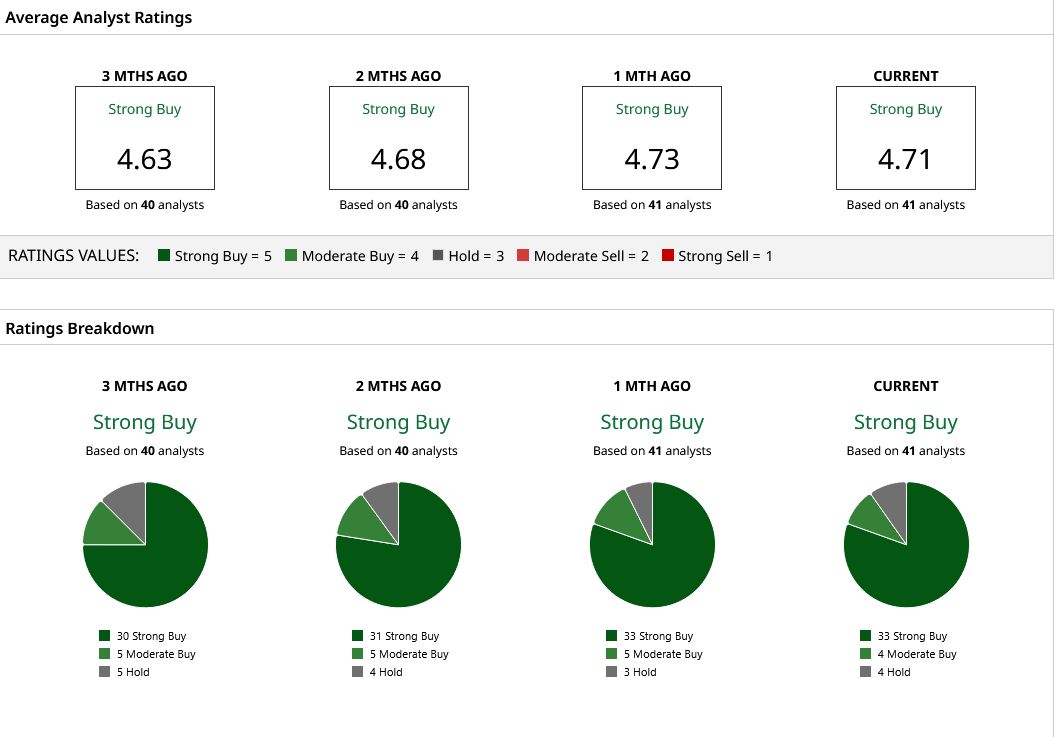
Overall, the stock carries a consensus “Strong Buy” rating from 41 Wall Street analysts covering it. Based on their estimates, it has a median price target of $1,476.64, implying a further 51% upside from current levels. Moreover, the highest price target of $2,000 suggests a compelling 104% upside from here.
 www.barchart.com
 On the date of publication, Jabran Kundi did not have (either directly or indirectly) positions in any of the securities mentioned in this article. All information and data in this article is solely for informational purposes. For more information please view the Barchart Disclosure Policy here.
More news from Barchart
Wall Street May Have Overpriced the Fed Rate Hike’s Impact on Citigroup Stock Spreads Broadcom CEO Hock Tan Says He Isn’t Worried – ‘No, Not in the Least’ – About AVGO as AI Extinction Fears Rattle Stocks I Sold Micron Before Q2 Earnings and It Fell 23%. Here’s Why I'm Buying Before the Next Report. Nvidia, OpenAI, and Oracle's $745B Financing Circle Just Hit Its First Stress Test: A Fed Rate Hike