

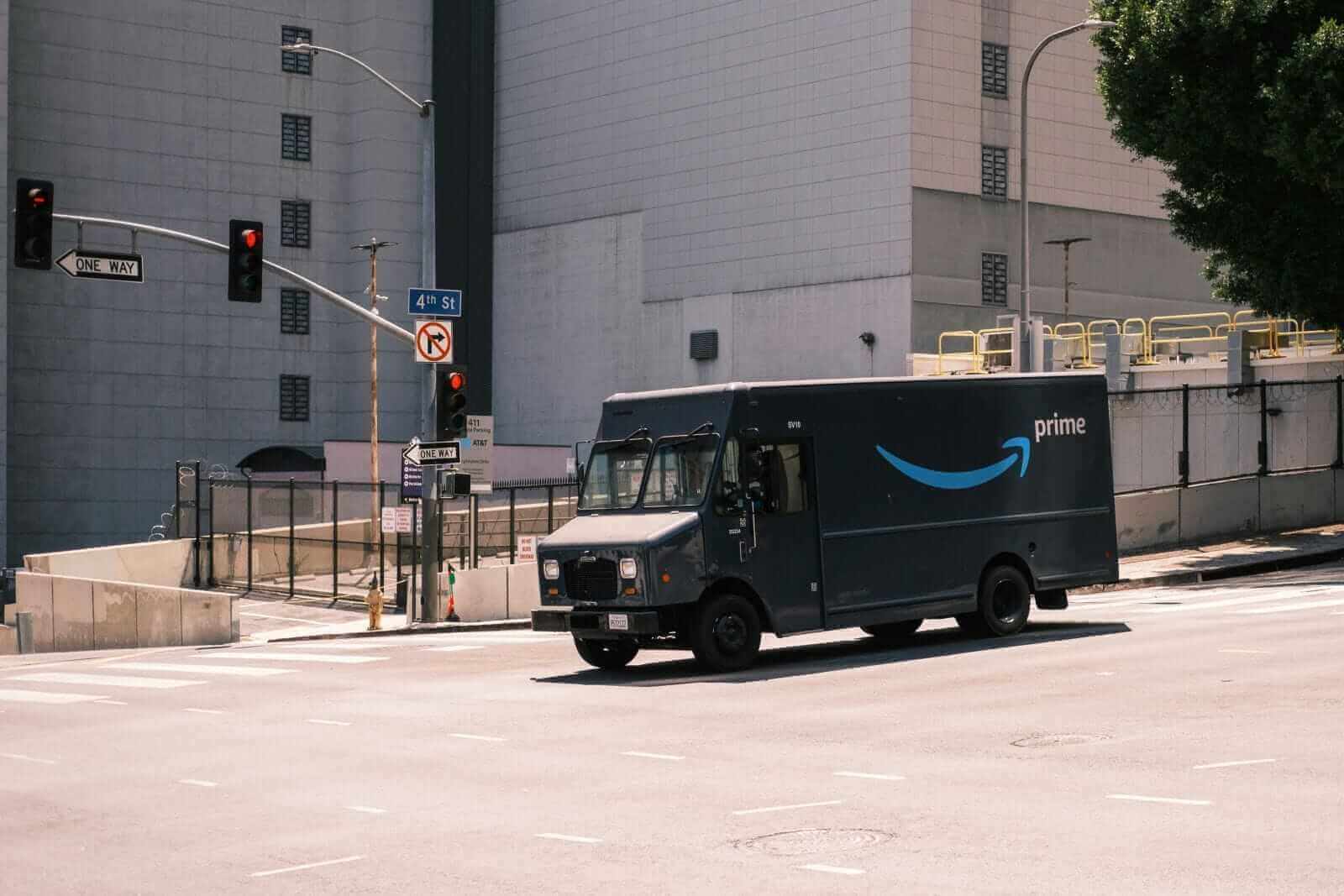
Amazon (AMZN) has spent years teaching customers to expect one thing—if you want it, it should probably be at your door sooner rather than later. That obsession with speed is now moving into another gear. Amazon is reportedly laying the groundwork for Project Mercury, an ambitious expansion of its same-day delivery network that could reshape how the company handles the final leg of its massive U.S. fulfillment operation.
Amazon is considering increasing its same-day delivery hubs from roughly 85 today to more than 1,000 by 2031. The idea is to put fulfillment facilities much closer to customers and make faster delivery less of a premium feature and more of the everyday Amazon experience. By 2031, the company reportedly wants 80% of U.S. Prime subscribers to live within a 10-mile straight-line radius of a same-day facility, compared with the roughly 90-minute driving distance used by many current locations.
More Top Stocks Daily: Go behind Wall Street’s hottest headlines with Barchart’s Active Investor newsletter.
But getting there will not come cheaply. Amazon’s three-year operating plan reportedly includes $6.8 billion for U.S. same-day delivery capacity in 2026 and 2027. An internal analysis estimates Project Mercury could generate $7.1 billion in economic value over a decade and reach positive cash flow by 2030. Amazon, however, has emphasized that these are preliminary projections and could change materially.
That leaves investors with an interesting balancing act. Faster delivery could strengthen Amazon’s competitive edge, but the upfront investment is substantial. And while AMZN stock has been grappling over the past few weeks but rising on the news project news, the question is where the Project Mercury fits into the investment story from here.
To that end, how should investors play AMZN stock after Amazon unveiled Project Mercury?
About Amazon Stock
Amazon has come a long way from its beginnings as an online bookstore. Today, it sits at the center of U.S. e-commerce and the broader digital economy, with a market capitalization of roughly $2.65 trillion. Its reach extends well beyond retail, spanning cloud computing, digital advertising, streaming, smart devices, healthcare, and artificial intelligence.
Amazon Web Services (AWS) remains a major pillar of the business, providing cloud infrastructure used by companies and organizations around the world. At the same time, Amazon is pushing deeper into the technology stack by developing its own chips for cloud and AI workloads, giving the company a larger role in the infrastructure behind the next wave of computing.
If we zoom out on Amazon’s chart, it is hard to miss just how much ground the stock has covered. Over the past 20 years, AMZN has delivered a staggering 15,215% return, turning a long-term investment into a very different story from the day-to-day swings investors often focus on. Even over the past decade, the stock has gained roughly 487.5%. More recently, AMZN shares have continued to build on that record, climbing 90.5% over three years as Amazon expanded across e-commerce, cloud computing, advertising, and artificial intelligence (AI).
The picture looks a little less comfortable when we zoom in. AMZN stock has been grappling over the past few weeks, with several developments giving investors reasons to take some money off the table. In September, the Federal Trade Commission and 22 states sued Amazon, alleging that the company’s advertising practices overcharged roughly 1.2 million advertising customers. Amazon has rejected the allegations, calling the FTC’s characterization of its business practices false. Still, the lawsuit has introduced another uncertainty around one of Amazon’s increasingly important profit engines: advertising.
Plus, more recent headlines have become harder to digest. AWS has been dealing with damage to data-center facilities in Bahrain and parts of the UAE, while Amazon has paused work with air carrier 21 Air following a fatal cargo-plane crash in Miami. Neither issue changes the broader investment story by itself, but together they add near-term pressure. And then there is AI spending. Amazon’s 2026 capex outlook has climbed to $220 billion, raising questions about how quickly those investments will translate into returns.
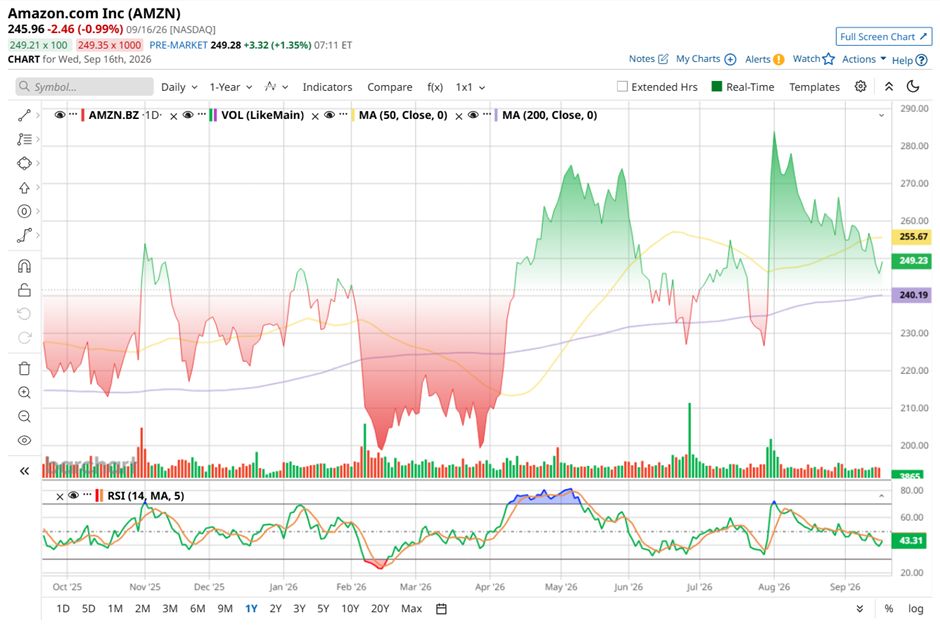
The stock is now down about 2% over the past month and roughly 12% below its record high of $287.20, reached on Aug. 3 after a strong second-quarter earnings report. That rally had been powered by strong AWS growth, encouraging AI commentary, and a string of higher analyst price targets. Yet, AMZN stock remains up 9.6% over the past year, 9.7% on a year-to-date (YTD) basis, and 21% over six months.
Technically, AMZN still looks relatively steady despite the pullback, with its 14-day RSI around 43, well below August’s near-overbought levels, suggesting momentum has cooled but has not completely broken down. The stock is also trading below its 50-day moving average but remains above the 200-day MA. That setup suggests near-term weakness, while the longer-term trend is still holding up.
 www.barchart.com
 Amazon's stock is not exactly being offered at a bargain. AMZN trades at about 19.1 times forward adjusted earnings and 3.2 times sales, both above sector averages. That premium suggests investors are already paying up for Amazon’s cloud, advertising, and AI growth story.
A Closer Look at Amazon’s Q2 Report
Amazon delivered a strong second quarter in July, with net sales reaching $200.6 billion, up 20% year-over-year (YoY) and comfortably ahead of Wall Street's expectations. The quarter showed that demand remains healthy across Amazon’s sprawling business, but once again, AWS was the part of the story that grabbed the most attention.
AWS brought in $42.2 billion in revenue, up 36.7% annually. That was its fastest growth rate in roughly 18 quarters, as companies continued spending on the cloud infrastructure needed to build and run generative AI applications. AWS remains the world’s largest cloud infrastructure provider, with an estimated 30% global market share. Amazon also said its AWS AI business and custom-chip portfolio had each surpassed a $25 billion annualized revenue run rate, with both growing at triple-digit rates.
Meanwhile, Amazon’s advertising operation continued to expand rapidly, with revenue rising 26% YoY to $19.8 billion as brands increasingly used Amazon’s retail ecosystem to reach shoppers. Subscription services, including Prime, grew 12% to $13.7 billion. Online store sales climbed 15% to $70.4 billion, while physical-store revenue edged up 4% to $5.8 billion.
EPS for the quarter came in at $5.75, more than three times the $1.68 recorded a year earlier and above analysts’ expectations.
Behind those numbers, Amazon is also pushing hard on delivery speed. During the first half of the year, it delivered more than 40% more items through same-day or overnight shipping than a year earlier. Its Amazon Now ultra-fast delivery service expanded into 80 additional U.S. cities and towns, as well as several cities in Egypt, and now operates in nine countries and more than 250 cities and towns.
Amazon ended the quarter with $78.2 billion in cash and equivalents and $128.9 billion in long-term debt. Trailing-12-month operating cash flow jumped 33% YoY to $161.4 billion, but free cash flow swung to a $7.6 billion outflow from an $18.2 billion inflow a year earlier. The main reason was a $66.1 billion increase in net purchases of property and equipment as Amazon ramped up AI infrastructure spending.
Looking ahead, Amazon expects Q3 sales between $197 billion and $202 billion, implying 9% to 12% YoY growth, with about an 80-basis-point foreign-exchange headwind and the timing shift of Prime Day into the second quarter. Without that timing effect, Q3 revenue growth would be nearly 400 basis points higher. Operating income is expected to be between $22.5 billion and $26.5 billion.
Wall Street analysts tracking Amazon project its revenue for Q3 to be around $202.2 billion, with EPS expected to rise 2.6% YoY to $2.00. For fiscal 2026, EPS is anticipated to be $8.01, indicating an 11.7% YoY surge, before rising by another 31.3% annually to $10.52 in fiscal 2027.
What Do Analysts Expect for AMZN Stock?
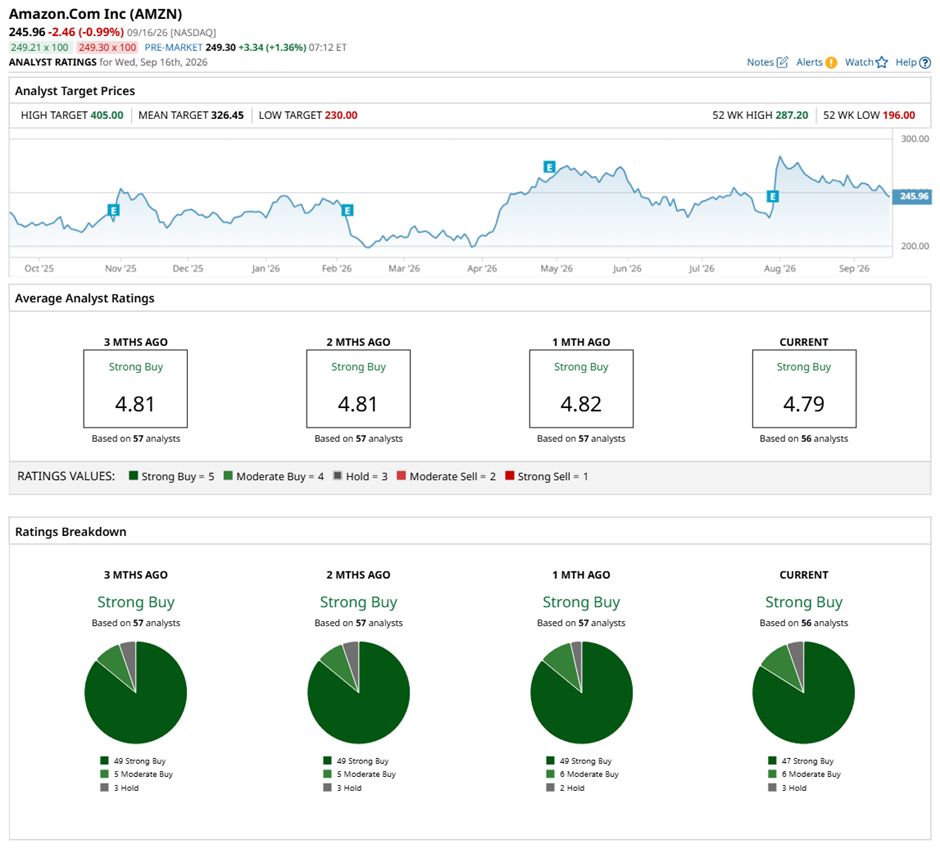
Wall Street remains highly optimistic about AMZN stock, with it earning an overall consensus rating of “Strong Buy.” Out of 56 analysts, 47 advise a “Strong Buy,” six recommend a “Moderate Buy,” and three are cautious with a “Hold” rating.
The average price target of $326.45 suggests a 33% upside potential from here. Meanwhile, the Street-high price target of $405 suggests AMZN could rise as much as 65%.
 www.barchart.com
 Final Thoughts
For AMZN investors, the story right now is less about chasing the next move and more about watching how the pieces come together. AWS growth remains strong, advertising is adding another profitable leg, and Project Mercury could further strengthen Amazon’s delivery advantage.
Plus, the $220 billion 2026 capex outlook and weaker free cash flow show that the AI push comes with a hefty price tag. With the stock still below its record high but above its 200-day moving average, the next few quarters could offer a clearer read on whether today’s spending is laying the groundwork for tomorrow’s returns.
On the date of publication, Sristi Suman Jayaswal did not have (either directly or indirectly) positions in any of the securities mentioned in this article. All information and data in this article is solely for informational purposes. For more information please view the Barchart Disclosure Policy here.
More news from Barchart
How to Play AMZN Stock as Amazon Unveils Project Mercury Why Barchart’s Top Technical Analysis Expert Isn’t Adding This Hot Stock (Up 220%) to His Portfolio Down 21% From All-Time Highs, JBHT Stock Warns of Earnings Decline Meta Stock Surges as It Unveils New Personal AI Agent