

Lisa Su had another feather added to her cap as CEO of Advanced Micro Devices (AMD). The chipmaker recently became the 14th company in the United States to enter the $1 trillion market-cap club. This is quite the journey for a company that has been public for more than five decades now. Notably, the company crossed the threshold of a $100 billion market cap just five years ago.
This follows shortly after the company debuted its rack-scale AI infrastructure platform: Helios. Helios exists in the market as a competitor to Nvidia's (NVDA) Vera Rubin platform.
More Top Stocks Daily: Go behind Wall Street’s hottest headlines with Barchart’s Active Investor newsletter.
About AMD
Founded in 1969, AMD began as a small Silicon Valley second-source chipmaker in 1969, spent decades battling Intel (INTC) in CPUs, expanded into graphics through ATI, and, under Lisa Su, has evolved into a broad high-performance computing company increasingly positioned as Nvidia’s principal challenger in AI accelerators.
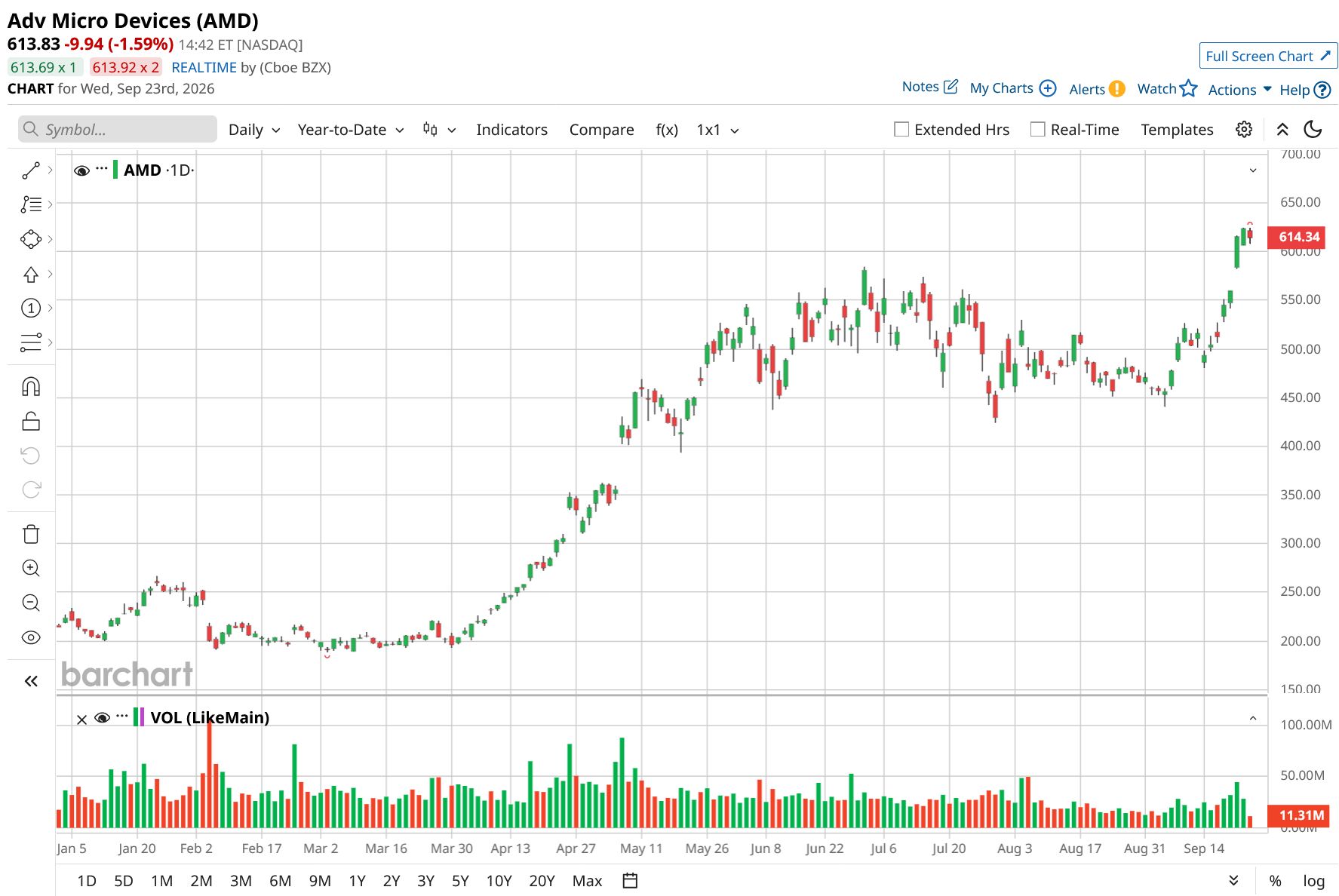
Valued at a market cap of a trillion dollars, AMD has had a rocking 2026 so far, rallying by 186% on a year-to-date (YTD) basis.
So, now that AMD is in such distinguished company, what does the future look like for it? Let's find out.
 www.barchart.com
 Road to the Next Trillion and Beyond
According to a recent report from Bank of America, the semiconductor market will show no signs of slowing down, with the market expected to reach a gargantuan $3.2 trillion in the next four years. And AMD, considering its market position, will be a natural beneficiary of the same.
However, as highlighted in my last analysis, AMD is being anything but passive about it. Helios was a company first, and it is already live. The purchase of Taalas adds the dimension of inference—a domain that is set to be the next battleground for AI companies and chipmakers.
Helios will have a massive role to play in this as AMD needs to turn an impressive rack design into repeat orders, profitable shipments, and a durable place in customers’ software workflows. Notably, Helios gives AMD a broader product to sell than a graphics processor alone. One rack combines 72 Instinct MI455X GPUs, 18 sixth-generation EPYC processors, Pensando networking, and ROCm software. Its specifications include 31 terabytes of HBM4 memory and 260 terabytes per second of bandwidth connecting the GPUs within the rack. That combination is aimed at large AI models, where moving data efficiently can matter as much as raw computing power. AMD estimates Helios can deliver up to 30% more inference tokens per dollar than Nvidia’s Vera Rubin NVL72.
However, the estimate uses a specified workload and projected pricing, so customers’ results will depend on their models, utilization, and operating expenses.
Finally, AMD is also building beyond the first Helios rack. Its 2026 launches include the MI430X for scientific computing, the MI350P for AI upgrades in existing infrastructure, and ROCm.ai, which is intended to make GPU software development easier. The announced roadmap calls for MI500 GPUs and a Helios 500 system in 2027, followed by MI600 GPUs in 2028.
Thus, the product roadmap looks solid. Now, deployment and execution will be key while making sure the margins are not compromised.
Solid Q2
AMD delivered strong second-quarter 2026 results that largely met high expectations. Despite a share price decline after the release, the company once again delivered a double beat on both revenue and earnings.
Revenue rose 50% year-over-year (YoY) to $11.5 billion. Data center revenue reached $6.7 billion, reflecting growth of 107% from the prior year. Gross margins expanded meaningfully to 54% from 40% in the year-earlier period. Looking ahead, the company guided for third-quarter net revenue between $12.7 billion and $13.3 billion, well above the consensus estimate of $12.5 billion.
Earnings per share surged 246% YoY to $1.66, exceeding the consensus forecast of $1.62. This marked the seventh consecutive quarter in which AMD outperformed profit expectations.
Cash generation remained solid, with net cash from operating activities climbing to $2.4 billion in the second quarter of 2026 from $1.5 billion in the year-ago period. Free cash flow advanced 32% to $1.6 billion. The company ended the quarter with $13.1 billion in cash, substantially higher than its short-term debt balance of $875 million.
During the quarter, AMD also introduced its next-generation graphics processing units under the Instinct MI400 Series, its sixth-generation EPYC server central processing units, and the Helios rack scale systems.
Yet, the significant run-up in the stock has left AMD shares trading at elevated valuation levels. The forward P/E, P/S, and P/CF of 81.25, 19.75, and 127.86 are all much higher than the sector medians of 23.05, 3.44, and 19.82, respectively.
Analyst Opinion of AMD Stock
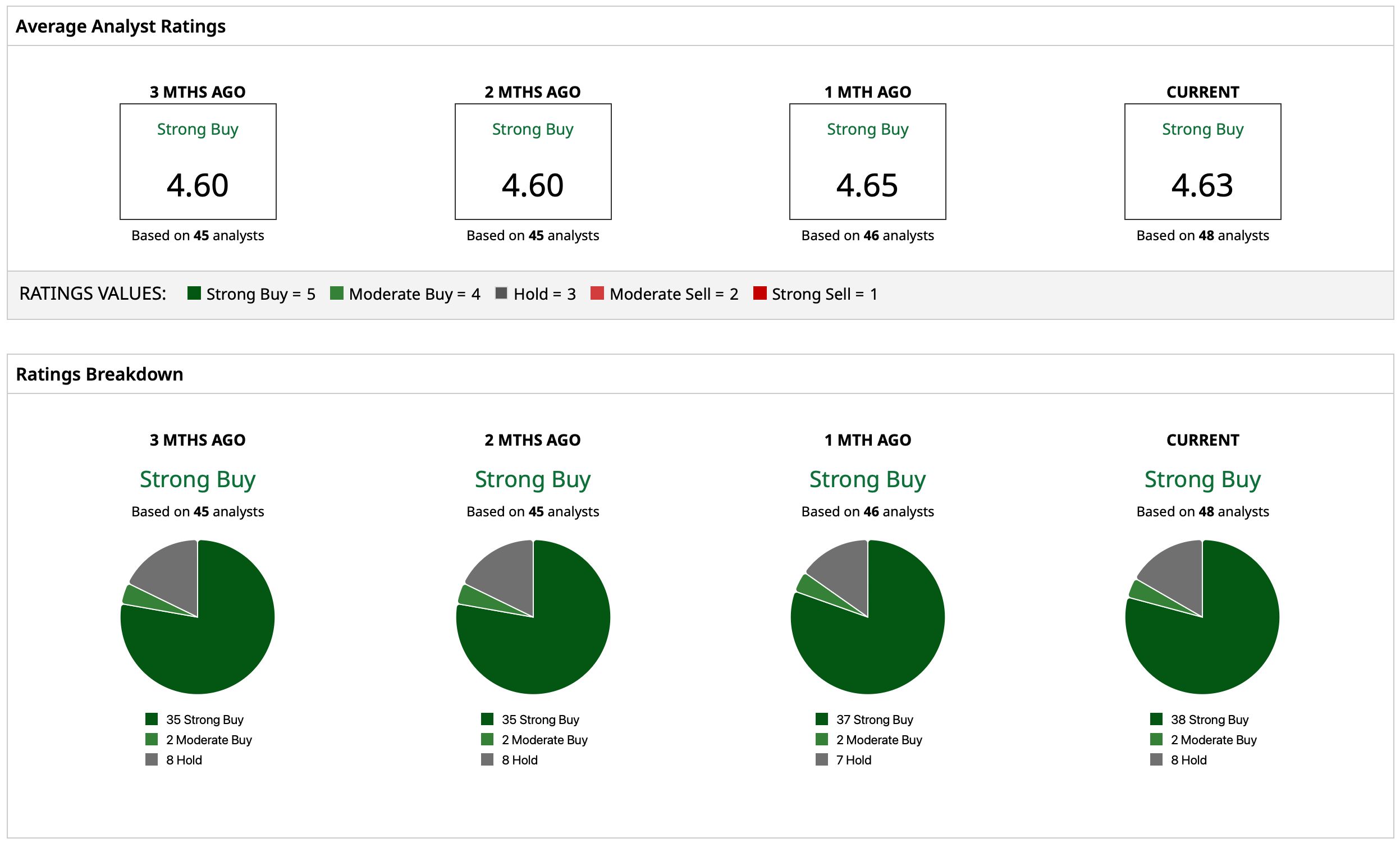
Thus, analysts are bullish on AMD stock. With an overall consensus rating of “Strong Buy,” the mean target price of $623.77 is just 2% above AMD's current price. The high target price of $1,250 indicates a potential upside of 104% from current levels. Out of 48 analysts covering the stock, 38 have a “Strong Buy” rating, two have a “Moderate Buy” rating, and eight have a “Hold” rating.
 www.barchart.com
 On the date of publication, Pathikrit Bose did not have (either directly or indirectly) positions in any of the securities mentioned in this article. All information and data in this article is solely for informational purposes. For more information please view the Barchart Disclosure Policy here.
More news from Barchart
AMD Becomes the 14th Company to Cross $1 Trillion In Market Cap. What This Means for AMD Stock. Surf Air Mobility Stock Jumps on a SkyDance Air Deal. How to Play SRFM Here. IonQ Just Nabbed a Quantum Computing Partnership with Nvidia. How to Play IONQ Stock Here. Lumentum Shares Are Up After an AI Optical Tech Partnership With Corning and Qualcomm. What This Means for LITE Stock.