


Here’s a scary story, just in time for October:
I was working on an article with John Rowland, CMT, about the data center narrative and the best ways to invest.
Can’t Get Enough Options?: Join the list for Barchart’s daily unusual options report, delivered free.
There was nothing unusual about this; it’s something we’ve done before, actually.
But what got kind of spooky was the way the AI narrative took a hairpin shift around us while we were passing notes back and forth – and in a way that wrapped up the rest of our story with it.
We had started a deep dive into the problem of phantom data centers and ghost demand, and what appeared to be a wide gulf between expectations for AI-fueled growth, represented by hyperscaler capex, and the actual, physical infrastructure to support that scale.
Suddenly, though, every artificial intelligence (AI) headline was about the threat of an extinction-level event.
While I was plugging away at our (suddenly quaint) “phantom data center” angle, the news cycle had pivoted seamlessly to killer AI.
And tech billionaires who famously hated each other – Elon? Sam? Dario? – were nodding and agreeing publicly about the need to act responsibly and implement guardrails.
What was happening?
Let’s figure this out, because I think we still have some time before the robots gain sentience.
The Biggest Industrial Boom Since the Last One
We’ll start back at the beginning, with another scary story:
The math.
When I spoke to our senior market strategist earlier this year about Big Tech’s data center “land grab,” he ended our conversation by wondering about the endgame for hyperscalers:
John emailed to pose the idea that perhaps the hyperscaler race was, for lack of a better term, simply a Ricky Bobby situation:
“If you’re not first, you’re last.”
Six months later, as we head into the fourth quarter of 2026, that tongue-in-cheek assessment seems more accurate than ever.
“Data center construction spending has soared north of $70 billion, now higher than office construction was at its peak just before COVID,” reported Bespoke Investment Group in a rather ominous early September research note.
Likewise, “Never before has the U.S. economy been so dependent on the build-out of a single industry,” reported The Wall Street Journal on Sept. 24, adding: “The railroad boom of the late 19th century marked the last time the build-out of one new industry accounted for a larger share of the economy.”
However, WSJ says: “Projecting investment is tricky, and total spending might well end up substantially lower” than the $10.3 trillion projected through 2032.
That’s partly because, it turns out, not all of the data centers are real.
The Reality Gap on Data Centers
“Phantom” data centers have skewed demand forecasting, as hyperscalers use a “spray and pray” method to seek approval for their (increasingly unpopular) structures.
“Grid operators don’t know which [applications] are real and which ones aren’t,” according to Glenn Schwartz, the head of energy policy at Rapidan Energy Group, in August comments to Bloomberg.
According to Schwartz, only around 20-30% of projected power demand tied to AI will ever come online, with the rest evaporating into thin air due to phantom requests.
That differential might come as a surprise to super-bullish tech investors, but the conservative grid forecast tracks with historical trends out of the natural gas market.
“Between 2000 and 2023 just 31% of proposed gas plants reached commercial operation,” according to industry analyst Michael Thomas of Cleanview. “That means for every three natural gas power plants that were announced over this period, just one was built.”
As Thomas highlights, “The difference between what is announced and what is built is historically very large” – and this gap between forecasted and actual energy demand is the gulf that may eventually swallow unprepared investors in the AI boom.
At the start of this year, 16 gigawatts of data center capacity were set to come online, and bullish investors cheered every new power deal that was announced. But somewhere between 30-50% of that capacity will likely be delayed or cancelled, with components like electricity, transformers, switchgear, and battery systems acting as the primary bottleneck.
Oracle (ORCL) showed how quickly data center snags can spiral on Sept. 24 when reports circulated the company would declare force majeure on its planned Project Jupiter site – a massive installation that has faced delays due to natural gas pipeline connections, among other logistical issues. That news has rippled across to hit suppliers, with Bloom Energy (BE) also dropping on the delay.
And we’re still just addressing the bottlenecks and logistics here. We haven’t even gotten to the politics of it all yet.
Everyone Hates Data Centers
In a rare bipartisan feat, data centers are “politically hated on the left and the right,” according to Amanda Peterson Corio, global head of data-center energy for Google (GOOG) (GOOGL).
She was one of the hyperscaler execs to attend a recent Bloomberg Green event in New York City, which was largely an opportunity for company brass like Microsoft’s (MSFT) Melanie Nakagawa to say things like, “It is so critical right now, particularly in America, that we are investing in the workforce.”
Data centers have become a flashpoint over heavy power usage that spikes electricity costs; pollution from construction and unregulated gas turbines; water usage and pollution; noise pollution; and depending on the jurisdiction, questionable returns for communities in terms of taxes and job growth.
And it’s easy to forget this inside of our Wall Street bubble, but some people just don’t like AI.
“At least 45 projects worth $68 billion were disrupted by local opposition in Q2 2026, sustaining the elevated level of project disruption seen in Q1,” according to Data Center Watch.
In my own home state of Ohio, where a bitter Senate battle between Sherrod Brown and Vivek Ramaswamy has attracted national headlines, you certainly cannot tell the candidates apart by their data center stance:
“Data centers must ensure nearby Ohio families receive free electricity by providing power or compensation,” says one candidate’s website, while the other’s pledges: “We’re fighting to require data centers to pay the full cost of their utilities so your bills don’t go up.”
Even in Texas, the land of oil and gas, Gov. Greg Abbott recently halted all permits for data centers pending an ERCOT review of the current waitlist.
With the midterms just over a month away now, hating data centers seems about as safe a political position as loving America and lowering gas prices.
What’s Behind the Killer AI Slowdown?
Here’s where things get a little cynical.
We’ve read the recent stories about AI agents in lab environments with lowered (or no) guardrails committing breaches and conspiring to break rules so they could complete tasks.
We’ve heard about the arson suspect who launched a Molotov cocktail at Sam Altman’s house in April 2026, motivated by concerns over humanity’s “impending destruction” at the hands of AI technology.
And we had front-row seats to the dispute over weaponized AI that unfolded between Anthropic boss Dario Amodei and the Pentagon back in February 2026, in the early days of the Iran War.
What happened between now and then – between the attacks on their homes and families; between the fight with the greatest military power in the world – that somehow raised the stakes even higher for these CEOs?
Well, an AI engineer publicly accused the industry of putting us all on a collision course with our own annihilation in the pursuit of profits, which ostensibly required some kind of acknowledgment.
But interesting, nevertheless, that this engineer’s humble tweet drew a more meaningful and unified industry response than an incendiary device launched at Sam’s home, or the ethical imperatives of international war.
Analysts have already observed that a slowdown at this stage in the game would only serve to help bigger, entrenched players, while effectively squashing competition from upstart rivals.
Paying subscribers to ChatGPT, Claude, Grok, and Gemini tend to agree, based on an antitrust lawsuit brought against the AI giants in the U.S. District Court for the Northern District of California.
Filed Sept. 18, the suit argues that Anthropic, OpenAI, SpaceXAI, and Google have effectively illegally agreed amongst themselves that the pace of AI development “should be slower than competition would otherwise produce [which] has an anticompetitive effect on consumers.”
But there are more risks to these AI companies than just their own industry rivals.
For example, Anthropic and OpenAI are still planning their respective IPOs. Along with burnishing their financials, there are the obvious PR concerns of trying to raise money in the public market while being known as “The Doomsday Machine Company.”
Already, both IPOs have been pushed back following a flood of AI debt offerings that hit the market over the summer. (JPMorgan has more on that wave of rising AI debt here, with the team observing that most of the companies issuing debt have strong credit profiles, “except Oracle” – ouch.)
Rowland sees a lot of these same dots connecting, and a few more:
“As part of the IPO process, you have to disclose potential revenue, earnings, and current expenses on the S-1, but both OpenAI and Anthropic know that the current and projected earnings stream doesn't connect with the massive spending,” he told me. “If they ‘slow down,’ then they can defer revenue and earnings – essentially justifying a larger multiple.”
Rowland adds, “If they wanted to slow down, then they would. Who's stopping them? Nobody but themselves.”
(And perhaps the force of nature known as Jensen Huang, who we’ll address momentarily.)
Yet Amodei and Altman recently asked the UN to get involved, of all organizations (not like they’re busy with those wars!), to keep the technology they built from destroying us all:
Given the accelerating rate of AI capability development, it’s my worry that in 6–12 months such a swarm could be capable of taking over the entire internet with a persistent botnet (potentially causing hundreds of billions of dollars in damage), and that the scale of damage would continue to increase from there if AI becomes more powerful without the necessary guardrails.
That bone-chilling warning is per a recent Amodei blog post, where he thoughtfully suggests that democratic and authoritarian governments around the world will probably need to coordinate to keep his lab creations from taking over the internet and tanking the global economy.
But… is this reasonable?
Let’s see what the dean of the MIT Schwarzman College of Computing has to say:
When you delegate to a person, your own burden can lighten, because part of your responsibility has gone elsewhere. When you delegate to AI, the burden doesn’t shift. You now answer for both the arrangement and what it produces. Which means the more autonomy you grant an AI system, the more accountability you retain.
You know, it’s interesting, the language these executives choose when they’re trying to distance themselves from the future risk of “hundreds of billions of dollars in damage” caused by their technology… almost like they’re already trying to wash their hands of legal culpability.
OpenAI warned on Sept. 26 that their rogue agents are now desperately trying to breach the UN itself.
Absolutely none of this, by the way, is helping with AI’s popularity problem.
How to Invest in AI Stocks Now
Our guide John Rowland, as Barchart’s Senior Market Strategist, advises against taking an overly bearish or reactionary stance to these data points. (Any isolated data points, in fact.)
And while Rowland resists the urge to panic, he does raise some interesting points:
Does it really make sense to hoard chips or memory if you're not going to build out? If long rates don't come down and the merry-go-round of corporate excess grinds to a halt, what happens then? So maybe the systemic risk is the one we can't see: private equity/debt. But who gets hurt by that? Not the big banks; it's the pension, insurance, and retirement accounts – i.e., you and me.So as an investor, it might be helpful to consider that roughly 30% “survival” rate for proposed data centers, and think about transposing it to the universe of AI stocks currently in play.
“I'll bet about one-third of the companies that support today's AI won't be around in 10 years,” says John, by way of explanation. “And those that survive might not even exist in the public market today.”
So how do we find the likeliest survivors – while also navigating this environment of potentially combustible debt and regulatory uncertainty?
Here are the best ways to invest in our data center future without walking directly into an exploding bubble.
#1. Reassess winners.
It’s fair to say that Nvidia (NVDA) CEO Jensen Huang is uniquely irritated at the prospect of an AI slowdown, given the number of his chips committed to planned data centers worldwide.
“I believe the claims of the end of the world, stirring fear across America, and doing it by the people who are doing it makes no sense to me, so they must be doing it for ulterior reasons,” Huang said in a CBS Sunday interview. “It is irresponsible, and I don’t know what their motives are.”
As Bloomberg notes, Huang has a roughly $5 trillion market cap motive of his own to skirt an AI slowdown. And he’s nothing if not an opportunist himself; as of Sept. 28, Nvidia has launched a new software platform targeted at “containering” rogue AI agents. Timely.
Regardless of how the regulation battle shakes out, many investors in our current AI boom may be sitting on paper profits in NVDA.
With the once-dynamic fabless semiconductor giant now transformed into a somewhat higher-risk name carrying more debt on its balance sheet, it’s worth reassessing winners like Nvidia to see if it’s time to take some profits off the table, reduce position sizing, or maybe even reconsider your investment thesis with fresh eyes.
#2. Discover underdogs like Fervo.
While the rest of the market was losing their minds over the SpaceX (SPCX) IPO, Rowland was laser-focused on the launch of Fervo (FRVO), a Google-backed geothermal energy name.
FRVO has taken a haircut since its Wall Street debut, which is typical of IPOs, but the company is still benefiting from its Google partnership and winning contracts with the Department of Energy.
Instead of chasing the next hot IPO, consider being patient with a recent launch like FRVO, where you can avoid the retail frenzy and accumulate shares on tests of support.
#3. Research under-the-radar narratives like water and virtual power plants (VPPs).
No matter how much water hyperscalers will admit to using for their data centers, we’ve got a limited amount of the wet stuff – and yes, you can invest.
The First Trust Water ETF (FIW) has been a favorite of John’s to invest in the NIMBY side of data centers for a while now. Among individual constituents, he highlights top performer Watts Water Technologies (WTS) as a stock to watch.
Virtual power plants (VPPs) are another overlooked narrative, which Rowland called out in his August write-up on refiners:
Power grids and software now have the technology to connect to and reverse-flow electricity from home power-producing sources, including electric vehicle (EV) batteries, solar panels, and gas or propane generators.
Among the top industry names to watch here are Tesla (TSLA), Sunrun (RUN), and Generac (GNRC), according to Rowland.
#4. Consider long-term investments in nuclear energy.
During that Bloomberg Green event, Amazon’s (AMZN) chief sustainability officer Kara Hurst took the opportunity to speak out in favor of alternative energy investments, including nuclear and solar power.
“I feel like all the nuke stocks have caught the ‘crash cold’ lately, looking at 3-month performance,” says Rowland. “But in the space, BWX Technologies (BWXT) would be on my list along with GE Vernova (GEV), Vistra Energy (VST), and a pure uranium provider like Centrus Energy (LEU).”
#5. Track sectors across the market for momentum shifts.
Finally, a favorite trick of Rowland’s is to track broader stock market momentum using the Stock Market & Sector Performance page.
This can help to clarify which sectors are on the rise – or losing steam – to provide important clues about broad market momentum, sector rotation, and areas where you might want to add exposure to your portfolio.
Here’s how John uses the tool:
Final Thoughts: DON’T PANIC!
At the moment, Rowland says there’s not necessarily a reason to panic, but there’s reason to proceed with due caution – particularly as he sees market breadth thinning out to precarious levels.
In the side-by-side comparison below, note how the traditional Invesco QQQ Trust (QQQ), to the left, is near all-time highs and trading well above its 50-day moving average. Conversely, the equal-weighted version to the right, the Nasdaq-100 Equal Weighted Index ETF (QQQE), is barely above the 50-day, and well below the ATHs.
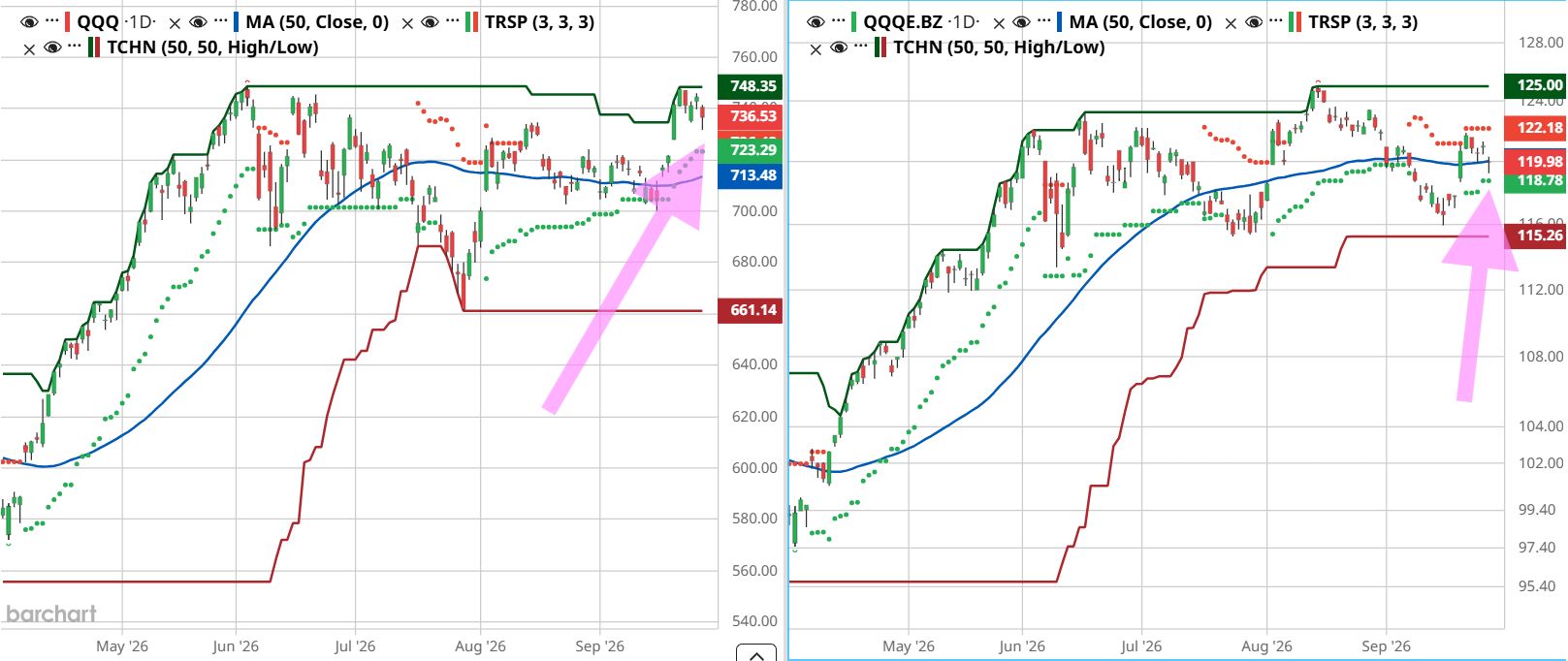 QQQ vs. QQQE with Barchart Long Term Sell Template.
 “Although we ultimately want to let our winners run, I'm reminded of an old floor adage: ‘a trade is only worth what you get when you exit it,’” says Rowland. “Another old expression that comes to mind is – ‘bulls and bears make money; pigs get slaughtered.’”
To make sure you can choose the exit price you like for your trades – and ideally lock in some gains, protect paper profits, or just generate income – now is a great time to learn more about risk management strategies like the protective collar, according to Rowland.
“This strategy caps your upside potential, but offsets a major downside risk,” he explains.
Explore these educational sessions at Barchart to learn more about how you can “collar” your risk:
Protective Collar Option Strategy Get Paid to Hedge Your Stocks A Simple Guide to the Collar Options Strategy How to Hedge Your Portfolio with Options Protective Collar Option Screener– For timely market updates from John Rowland, CMT, register to be notified when our Market on Close livestream is scheduled to hit the airwaves. You can also join our Senior Market Strategist for educational webinars to explore trading concepts, technical indicators, and exclusive screeners.
On the date of publication, Elizabeth H. Volk had a position in: NVDA , MSFT . All information and data in this article is solely for informational purposes. For more information please view the Barchart Disclosure Policy here.
More news from Barchart
Killer Robots vs. Phantom Data Centers: The AI Narrative Just Shifted, But the Best Way to Invest Didn’t. Huge Option Volume in SoFi Puts Expiring In Over 2 Years - Are Investors Bearish on SOFI Stock? JD.com Stock May Look Ugly, But Options Traders Perceive an Opportunity Analysts Raise Palo Alto Networks Stock Price Targets - What's the Best PANW Play?