

Meta Platforms (META) could be facing a multibillion-dollar bill in New Mexico, with the state asking a judge to impose between $35 billion and $40 billion in penalties. The request follows a jury’s finding that Meta misled consumers about Facebook users’ data privacy, putting a potentially significant liability back in focus.
The case traces back to the Cambridge Analytica scandal, when the British political consulting firm obtained personal information from as many as 87 million Facebook users through a third-party app without their consent. New Mexico filed its lawsuit in 2021, alleging Meta misrepresented data access, hate speech, and misinformation policies.
More Top Stocks Daily: Go behind Wall Street’s hottest headlines with Barchart’s Active Investor newsletter.
Jurors examined 29 statements made by Meta and its leadership and determined that 26 were misleading. Based on the number of Facebook users or New Mexico residents exposed to each statement, the state said Meta had committed over 43 million violations of New Mexico’s consumer protection laws.
State attorney Randi McGinn argued that the penalty needs to be large enough to matter to Meta. She said the company understands “money” and the value of its stock price. McGinn also believes the requested amount could withstand an appeal if Meta challenges the ruling.
Meta, however, is pushing for a much lower figure, asking the court to cap the penalties at $3.45 billion. The company argues New Mexico failed to prove that any of its residents were actually misled by the statements. With the judge expected to decide later this month, the final penalty amount would be a key factor for assessing what it means for META stock.
About Meta Stock
Meta Platforms has grown far beyond its social media roots. Based in Menlo Park, California, the company connects users through Facebook, Instagram, Messenger, WhatsApp, Threads, and Meta AI, while Reality Labs focuses on Quest headsets, artificial intelligence (AI) glasses, virtual and augmented reality, and related technologies.
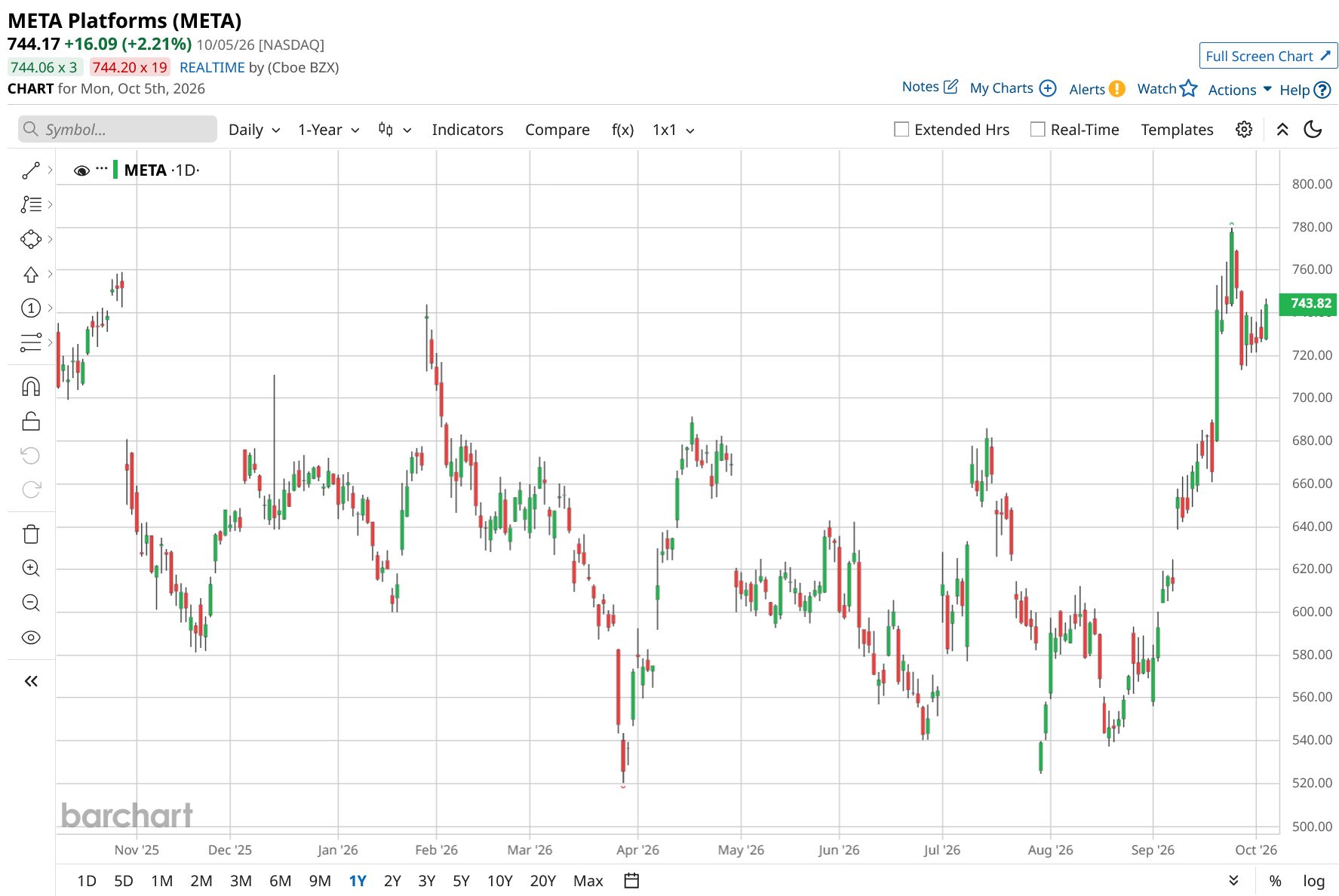
That broad portfolio has helped Meta become one of the technology sector’s largest companies, with a market cap of about $1.9 trillion. Investors have also rewarded the company strongly in 2026, with META stock gaining 13% this year and climbing 28% over the past three months.
 www.barchart.com
 But that momentum comes with a higher price tag. META stock currently trades at 23.65 times forward adjusted earnings and 7.30 times sales. Both multiples sit above industry averages as well as Meta’s own five-year average multiples, suggesting investors are already assigning a meaningful premium to the company.
Meta also returns some capital to shareholders through its dividend. The company pays $2.10 per share annually, translating into a yield of 0.29%. Its latest dividend payment was $0.53 per share, paid on Monday, Sept. 28, to shareholders of record as of Monday, Sept. 21.
A Closer Look at Q2 Earnings
Meta’s Q2 FY2026 results highlighted that while revenue is surging, so is the price of building its AI future. Reported on July 29, revenue reached $60.8 billion, up 28% year-over-year (YoY) and ahead of analysts’ $60.2 billion estimate. Yet earnings came under pressure as spending accelerated.
Advertising remained the company’s growth engine. Family of Apps advertising revenue rose 27% YoY to $59.4 billion, helped by a 14% increase in ad impressions and a 12% rise in the average price per ad. Meta, therefore, benefited from both higher advertising volume and stronger pricing across its platforms.
On the bottom line, EPS fell 13.4% to $6.18, missing analysts’ roughly $7.22 expectation. Meta also recorded $2.40 billion in legal-proceeding charges and $1.18 billion in severance expenses tied to its May 2026 headcount reduction. Total costs and expenses jumped 55.2% YoY to $42 billion.
The cost pressures extended beyond those charges. Total costs and expenses jumped 55.2% YoY to $42 billion. Meanwhile, capex climbed to $31.1 billion as the business accelerated spending on AI infrastructure. However, this spending surge sits at the heart of Meta’s growth.
AI spending was another major factor. Capex surged to $31.1 billion as Meta accelerated infrastructure investment, pushing full-year 2026 capital-spending guidance to $130-145 billion from $125-145 billion previously. The company also raised its full-year expense outlook to $165-169 billion due to the legal charge, while still expecting 2026 operating income to exceed 2025’s.
For Q3 FY2026, Meta expects revenue of $61 billion-$64 billion. Meanwhile, analysts project the quarter’s EPS to decline 11.9% YoY to $6.39, while FY2026 EPS is expected to fall 5.9% to $27.94. In FY2027, however, EPS is projected to rebound 23.1% YoY to $34.39, offering a potentially brighter earnings trajectory.
What Do Analysts Expect for META Stock?
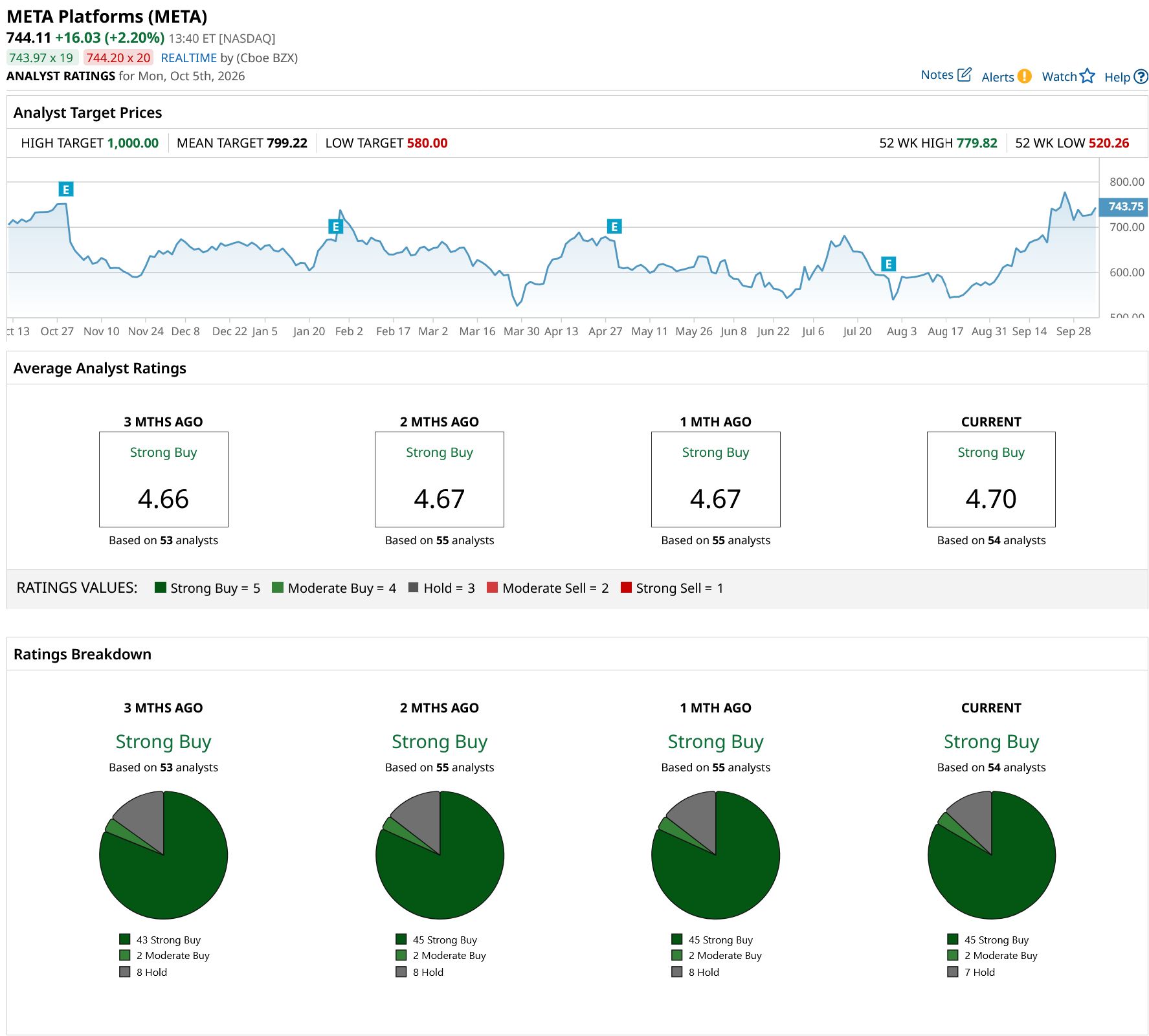
Meta still has plenty of fans on Wall Street. Across the 54 analysts covering the stock, the overall rating stands at “Strong Buy,” with 45 analysts giving META stock that rating. Another two rate it a “Moderate Buy,” while seven recommend “Hold,” leaving little doubt that sentiment remains heavily tilted toward the bullish side.
Price targets likewise reflect expectations for further appreciation. The average price target stands at $799.22, representing potential upside of 7%, while the Street-high target of $1,000 implies a 34% gain from current levels.
 www.barchart.com
 On the date of publication, Aanchal Sugandh did not have (either directly or indirectly) positions in any of the securities mentioned in this article. All information and data in this article is solely for informational purposes. For more information please view the Barchart Disclosure Policy here.