


Constellation Energy (CEG) shares jumped in early trading on Oct. 6 after the company announced a major power deal with Alphabet's (GOOG) (GOOGL) Google. Under a 20-year agreement, Google will support 890 megawatts of new nuclear capacity on the PJM grid. Constellation will unlock that power by upgrading equipment at 11 of its existing reactors in Illinois, Pennsylvania, and New Jersey. It plans to invest more than $4.3 billion, with the first upgrade expected by 2028. The companies also signed a separate 15-year agreement covering another 2,700 megawatts from Constellation’s existing PJM fleet. In total, Google has contracted for about 3,590 megawatts of power. The deal follows a similar 20-year agreement Constellation signed with Amazon (AMZN) on Sept. 30.
The power challenge facing AI is not only about how quickly new data centers can be built. Hyperscalers also need electricity that is carbon-free, reliable, and available at the scale their expanding AI infrastructure requires. Constellation Energy owns the largest fleet of nuclear power assets, directly addressing those energy needs. As reliable, carbon-free electricity becomes more difficult to obtain at scale, the limited supply of nuclear generation is becoming an increasingly important part of the company’s investment story.
Don’t Miss a Day: From crude oil to coffee, sign up free for Barchart’s best-in-class commodity analysis.
About Constellation Energy Stock
Constellation Energy operates as a producer and seller of energy products and services across the United States. It operates in the New York, Mid-Atlantic, ERCOT, Midwest, and Other Power Regions segments. The company provides energy-related products, electricity, natural gas, and sustainable solutions. It serves distribution utilities, municipalities, cooperatives, and commercial, industrial, and residential customers. Founded in 2021, the company is headquartered in Baltimore, Maryland.
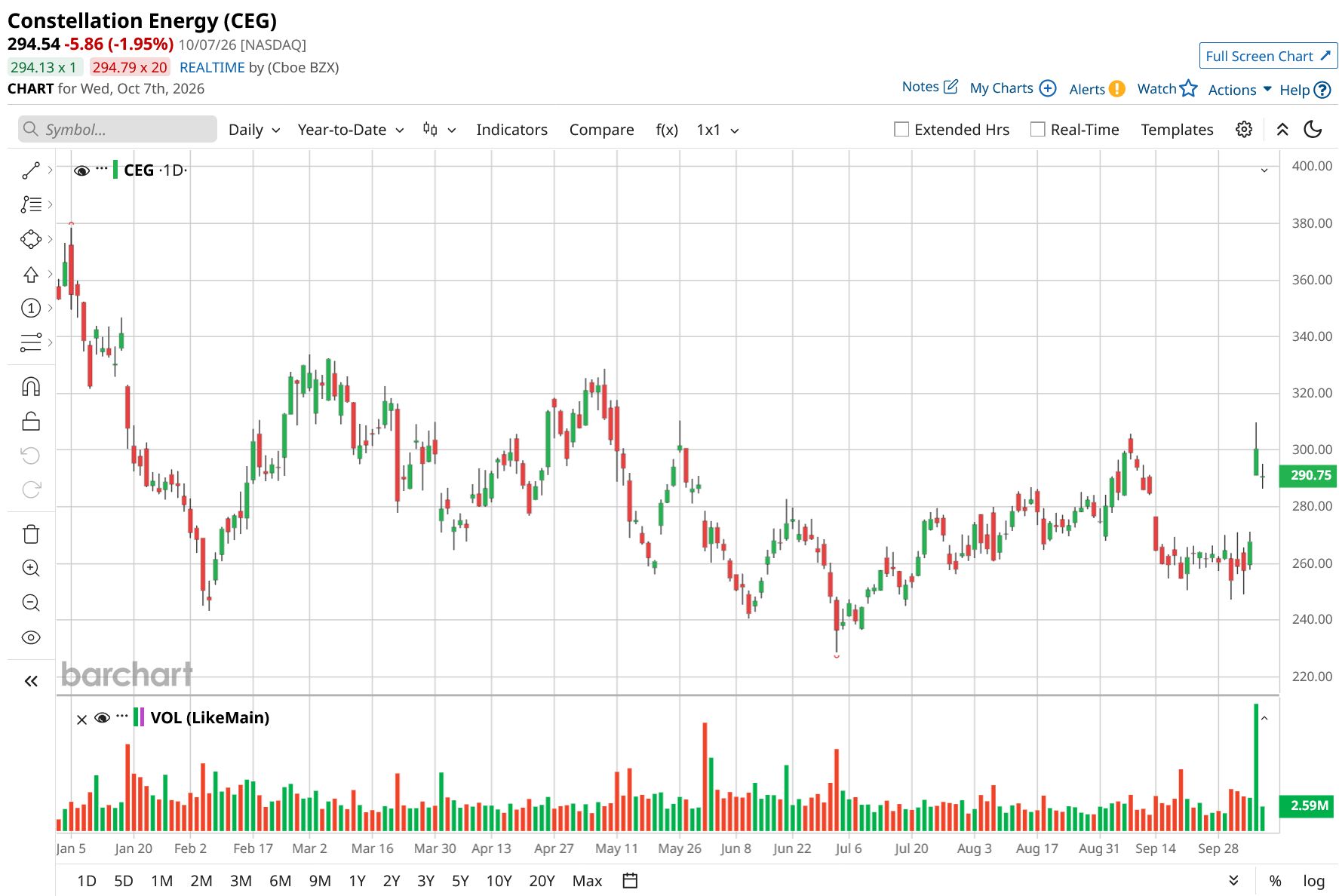
Constellation Energy's stock has struggled lately, though its new deals with Amazon and Google have lifted sentiment. Over the past year, the shares have fallen about 19%, underperforming the Utilities Select Sector ETF’s (XLU) 9% decline over the same period. CEG stock sits about 30% below its 52-week high of $412.58. The trend has continued this year as well, with the stock down 18% year-to-date (YTD) while the XLU has declined 4%. CEG’s decline appears to be driven by a cooling of the AI and nuclear-power trade, rising interest rates, and concerns surrounding AI infrastructure spending.
 www.barchart.com
 The Asset AI Can’t Build Its Way Around
Constellation’s nuclear fleet gives it a unique position in the race to meet hyperscaler demand. As the largest nuclear operator in the United States, the company offers investors a direct way to participate in the growing need for reliable electricity. The challenge is that nuclear capacity cannot easily be added when demand rises. New projects can take years to develop, which makes Constellation’s existing fleet a scarce asset that would be difficult for competitors to replicate. That scarcity could become increasingly valuable if electricity demand continues rising faster than new supply can come online.
The company is already locking in that value through long-term contracts. Even before the Amazon and Google deals, management said about 30% of its expected clean baseload output would be under long-term contracts by 2032, providing revenue visibility for years to come. It has also signed new agreements covering an additional 920 megawatts of nuclear generation with a diverse group of investment-grade customers. Those contracts run for 15 to 20 years, with supply scheduled to begin between 2029 and 2032. Meanwhile, Constellation has applied to the Nuclear Regulatory Commission to extend the operating licenses of the Ginna Clean Energy Center and Nine Mile Point Unit 1 reactor through 2049. Those investments suggest management expects demand for its nuclear generation to remain strong well beyond the current AI buildout.
The operational performance of that fleet further strengthens the case. Constellation generated 44,160 gigawatt-hours of nuclear power in the second quarter, achieving a 93% capacity factor. That performance ranks among the best in the industry and highlights the reliability of the company’s generation assets. That reliability is becoming increasingly valuable as hyperscalers secure electricity for power-intensive AI infrastructure.
At the same time, Constellation is simplifying its portfolio. The company agreed to sell the Brazos Valley Energy Center gas plant in Texas to LS Power for $860 million. The sale completes the final required divestiture associated with the company’s $16.4 billion acquisition of Calpine. Once the deal closes, it will enter the next phase with a cleaner and more streamlined generation portfolio.
Constellation's Higher Guidance Highlights Growing Earnings Power
Constellation Energy reported its second-quarter fiscal 2026 earnings on Aug. 6. It reported revenue of $7.5 billion, below the $7.94 billion forecast. The earnings per share came in at $2.55, beating the Wall Street consensus of $2.41. The company signed about 920 megawatts of long-term nuclear contracts during the quarter. However, the quarter was not without offsets. Planned nuclear refueling outages increased, and the timing of revenue recognition from Illinois zero-emission credits reduced the amount recognized in the period compared with a year earlier.
Looking forward, the company raised its full-year adjusted operating earnings guidance to $11.50 to $12.50. Management said the stronger outlook reflects commercial execution and disciplined capital allocation, including share repurchases. Moreover, the company plans to increase the number of long-term nuclear power purchase agreements. In addition, progress is expected on the Crane nuclear restart, which is expected to return to service in the second half of 2027.
What Do Analysts Expect for CEG Stock?
Bernstein reiterated a “Buy” rating on CEG stock and set a price target of $296. Morgan Stanley also kept a “Buy” rating and raised its price target from $364 to $369.
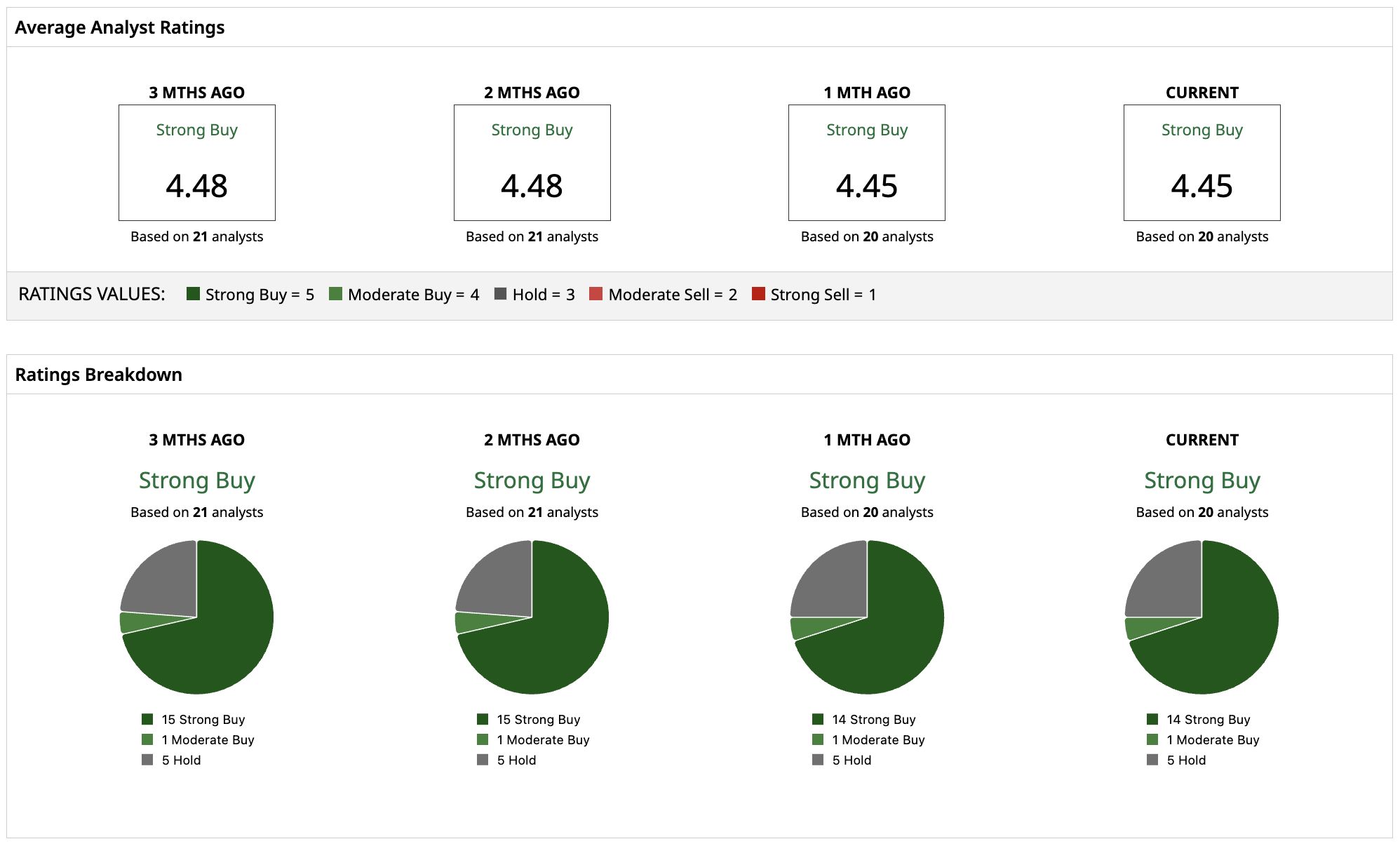
Based on 20 Wall Street analysts covering the stock, CEG holds a consensus “Strong Buy” rating. Out of those, 14 have a “Strong Buy” rating, one has a “Moderate Buy” rating, and five have a “Hold” rating. The stock has a mean price target of $337.85, which reflects 15% upside from the current share price.
 www.barchart.com
 On the date of publication, Jabran Kundi did not have (either directly or indirectly) positions in any of the securities mentioned in this article. All information and data in this article is solely for informational purposes. For more information please view the Barchart Disclosure Policy here.
More news from Barchart
Constellation Lands a 3,590 MW Power Deal With Google. AI’s Quietest Winner May Not Stay Quiet for Long. Corn, Soybeans, and Wheat: What Is Really Driving Grain Volatility? What Record Diesel and Heating Oil Prices May Be Telling Other Markets What Should We Read Into Monday Morning's Markets?