

Leveraging debt financing to fund high-performance artificial intelligence infrastructure allows cash-rich technology companies to rapidly expand computing capacity while preserving balance sheet liquidity. By tapping bond markets, industry leaders accelerate next-generation hardware deployment to meet compounding data center demand and unlock transformative revenue opportunities across ecosystem applications.
Underlining this aggressive capital strategy, SpaceX (SPCX) is reportedly seeking $40 billion in debt to acquire cutting-edge Nvidia (NVDA) chips.
More Top Stocks Daily: Go behind Wall Street’s hottest headlines with Barchart’s Active Investor newsletter.
About Space Exploration Technologies
Space Exploration Technologies, known as SpaceX, is Elon Musk's space, satellite internet, and artificial intelligence company. It builds Falcon rockets and the Starship launch vehicle, runs the Starlink satellite network, and owns xAI and its Grok models. Headquartered in Starbase, Texas, SpaceX trades on the Nasdaq under the ticker SPCX and is a Nasdaq-100 ($IUXX) component.
SpaceX Stock Since the IPO
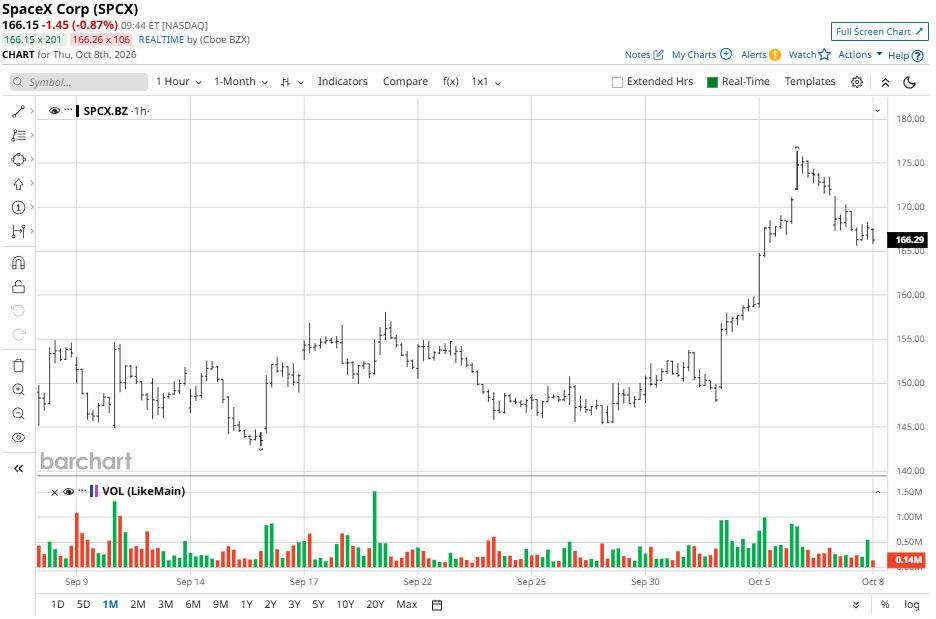
SpaceX priced its IPO at $135 per share, raising a record $75 billion, and closed its first trading day at $160.95. The stock peaked at $225.64 on June 16, then slid to a closing low of $108.27 in early August amid concerns over AI spending and lockup expirations. Shares have since recovered, closing at $167.60 on Oct. 7, about 24% above the IPO price but still roughly 26% below the record high.
SpaceX remains valued above $2 trillion, though additional lockup expirations are scheduled through June 2027, which could keep volatility elevated.
 www.barchart.com
 Second-Quarter Results
SpaceX reported second-quarter 2026 revenue of $7.8 billion, up 92% from $4.1 billion a year earlier, well above the $6.93 billion analysts expected in its first report since the IPO. The net loss narrowed to $541 million from $1.0 billion a year ago, and the loss of $0.09 per share beat the $0.23 loss analysts had forecast. Shares fell as much as 8% after hours on spending worries.
Adjusted EBITDA surged 191% to $3.5 billion. Connectivity, led by Starlink, grew revenue 66% to $4.3 billion, AI revenue jumped 247% to $2.6 billion, and Space revenue rose 29% to $962 million. The AI segment turned adjusted-EBITDA positive at $1.1 billion. Capital expenditures reached $18.4 billion, including $15.8 billion for AI compute, far above the roughly $13 billion analysts expected. SpaceX ended the quarter with $100 billion in cash and securities and a $47.5 billion backlog, plus 12 million Starlink subscribers.
Management said SpaceX is on pace to reach $100 billion in annualized recurring revenue by the end of the year and moved its $1 trillion annual revenue target up to 2030, one year earlier than previously projected. CEO Elon Musk expects AI revenue to surpass every other line of business, probably in September, and said the first orbital AI data center platform, Starmind AI-1, should begin launching next year.
SpaceX Eyes $40 Billion Debt Raise to Buy Nvidia AI Chips
SpaceX is reportedly seeking to raise $40 billion in debt to buy Nvidia (NVDA) AI chips, and Wall Street is paying attention. The financing, led by Apollo Global Management (APO), would include about $10 billion in bank loans and $30 billion in investment-grade debt. Pimco is among the lenders in talks, and the deal is expected to close in 2027.
Yorkville Ives analyst Dan Ives, who rates SpaceX “Outperform” with a $225 price target, calls the plan a smart strategic move. He argues it strengthens the flywheel linking SpaceX's launch business, Starlink, and its growing AI segment, where each unit lowers costs or boosts demand for the others.
Why it makes sense: Ives says AI cloud capacity is limited by chip supply, not customer demand. Debt lets SpaceX lock in Nvidia chips quickly without going back to equity markets just months after its June IPO, which avoids diluting shareholders. The capacity is also being contracted ahead of delivery, so it can generate revenue as soon as it is energized.
The move shows that SpaceX is positioning itself as a serious AI infrastructure player, not just a rocket and satellite company.
SPCX Price Target and Analyst Ratings
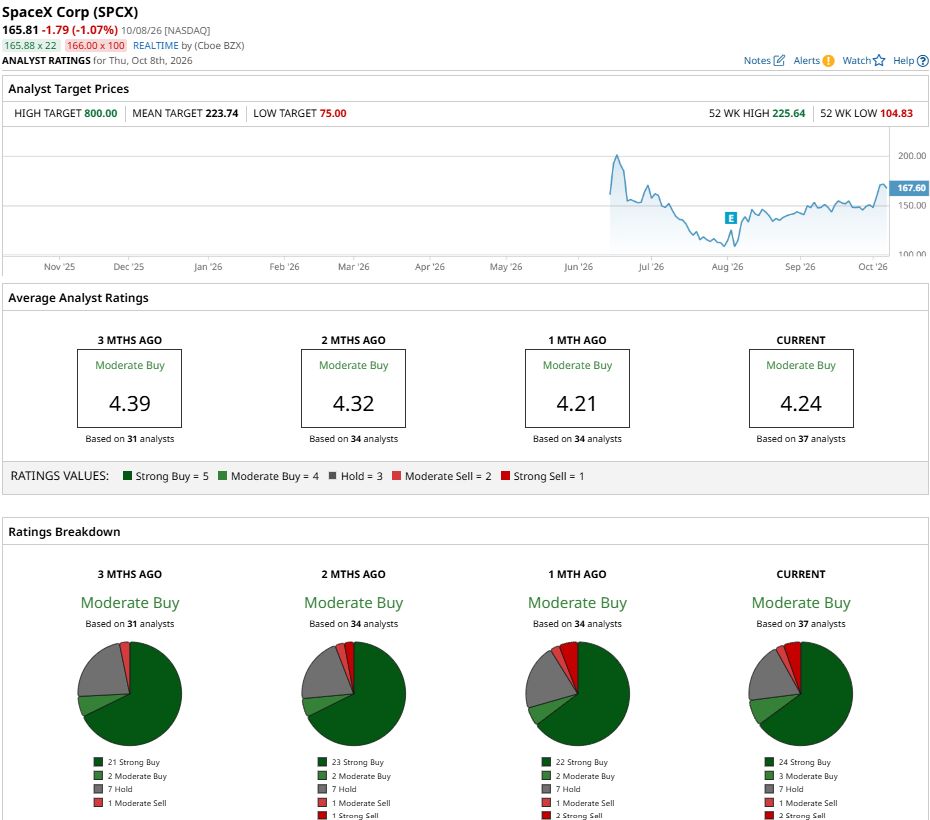
Wall Street leans bullish on SPCX. The stock carries a consensus "Moderate Buy" rating, and the mean price target of $223.74 implies about 33.5% upside from the current market price. Of 37 analyst ratings, 24 are “Strong Buy,” three “Moderate Buy,” seven “Hold,” one “Moderate Sell,” and two “Strong Sell.” The $40 billion debt plan adds leverage, so weigh the AI and Starlink growth story against financing risk.
 www.barchart.com
 On the date of publication, Ruchi Gupta did not have (either directly or indirectly) positions in any of the securities mentioned in this article. All information and data in this article is solely for informational purposes. For more information please view the Barchart Disclosure Policy here.
More news from Barchart
Dan Ives Calls SpaceX’s $40B Nvidia Chip Debt Plan a ‘Smart Move’ Domino's Pizza Releases Earnings Pre-Market on Tuesday, Oct. 13 - What's the Best DPZ Play? How Broadcom’s $42 Billion ‘Loan’ to Anthropic Is a Bet on a $2 Trillion IPO Dear Johnson & Johnson Stock Fans, Mark Your Calendars for October 13