

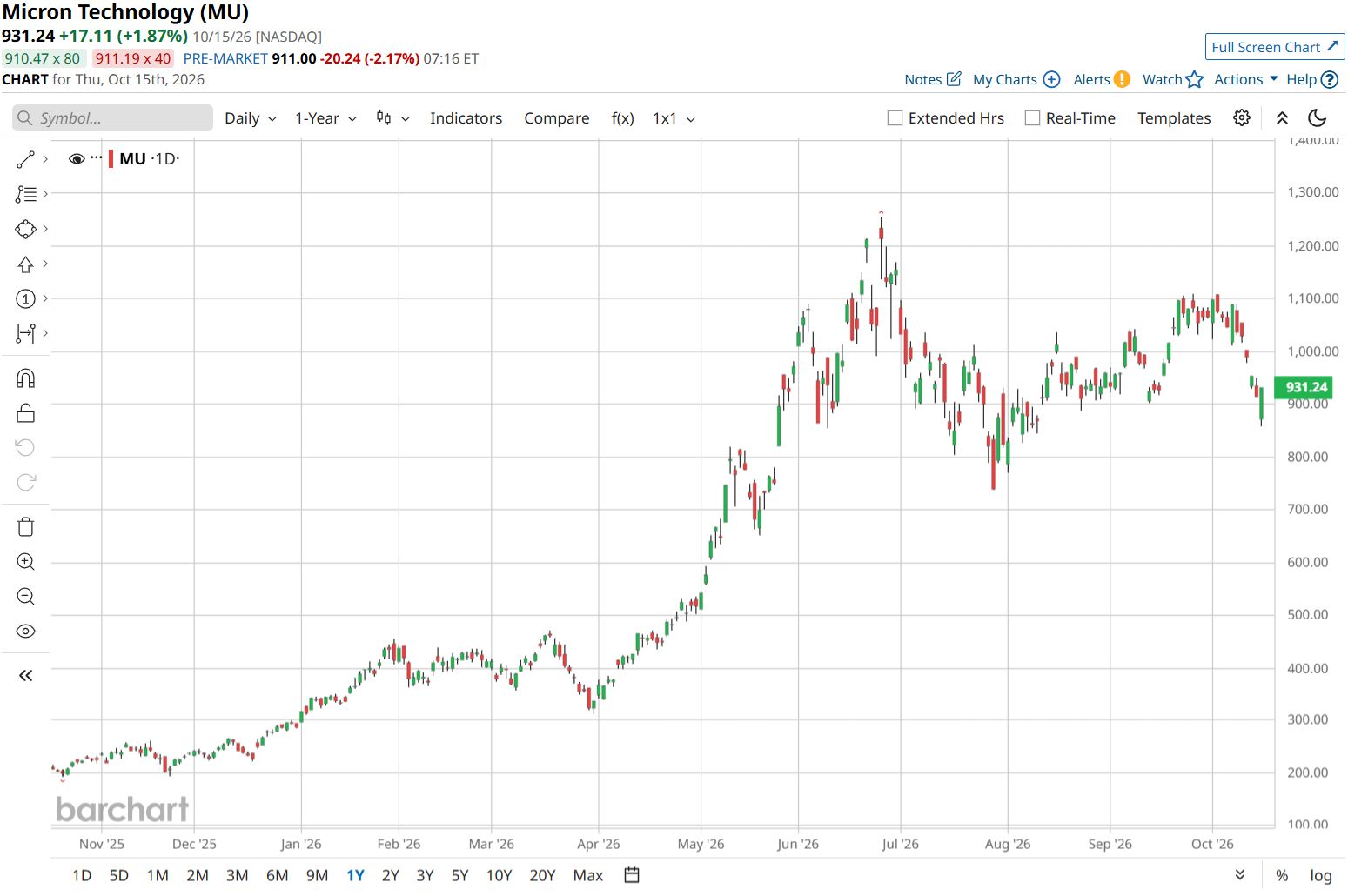
Memory chips have been one of the market’s biggest stories in 2026, and Micron Technology (MU) has been a major part of that run. MU stock has more than tripled this year, and its rally picked up after Micron posted record fiscal fourth-quarter results on Sept. 30, lifting shares 3% in the following session.
The stock has been under pressure lately, though. Shares fell in back-to-back sessions last week after Chinese rival ChangXin Memory Technologies (CXMT) reported progress in server memory. That pushed MU stock down into $900 territory, although it was still up more than 200% year-to-date (YTD).
More Top Stocks Daily: Go behind Wall Street’s hottest headlines with Barchart’s Active Investor newsletter.
Now, Micron faces another concern closer to home. On Oct. 7, workers at its Taoyuan site in Taiwan voted to authorize a strike. The union wants a one-time fiscal 2026 bonus worth about 83 months of pay, along with quarterly bonuses equal to 15% of operating profit starting in fiscal 2027.
That matters because Micron employs about 15,000 people in Taiwan, where it makes DRAM and high-bandwidth memory (HBM) chips used in artificial intelligence (AI) systems. No strike date has been set, but Taiwan's president has reportedly called on Micron and its workers to negotiate.
What does this dispute mean for Micron shareholders? Let’s take a closer look.
Taiwan’s President Urges Talks Before Possible Micron Strike
Taiwan President Lai Ching-te spoke up on Oct. 15 at the opening of Micron’s new advanced assembly and test plant in Taichung. He urged Micron and its workers to negotiate seriously and reach an agreement.
President Lai Ching-te compared the relationship between workers and employers to fish and water, saying each side needs the other. Micron has invested about $49.4 billion in Taiwan, while the new Taichung site is reportedly sold out through 2027.
The dispute came to a head with the Taoyuan union’s Oct. 7 strike vote. Of the 2,012 ballots cast, 1,994 — or about 99% — supported strike action, representing 88.3% of eligible members. Union chairman Jerry Lin has not announced a strike date, but he said a surprise walkout remains possible if talks fail.
Workers are asking for a one-time fiscal 2026 bonus worth about 83 months of pay and a permanent quarterly profit-sharing plan that would set aside 15% of operating profit from fiscal 2027. The Taoyuan talks broke down in September while the bigger Taichung union, with about 11,000 members, is due back in mediation on Oct. 22. Workers are also planning a rally in Taipei on Oct. 19, though they say it will not be a strike.
Micron says it respects workers’ rights and wants to keep talking. Still, the dispute matters because its Taiwan plants make DRAM and HBM chips used in AI systems, putting a local pay fight on the radar of investors and Taiwan’s government.
Micron’s Fundamentals Beyond the Labor Dispute
Micron posted its best quarter yet with its Q4 fiscal 2026 results released on Sept. 30. Revenue came in at $54.23 billion, nearly four times higher than a year earlier and above Wall Street’s roughly $51 billion estimate. Adjusted EPS reached $33.42, up from $3.03 a year ago.
DRAM revenue rose to a record $39.8 billion and made up about 73% of sales, while data-center SSD revenue neared $10 billion. For fiscal 2026, Micron Technology reported $133.19 billion in revenue, up 256% year-over-year (YOY), and adjusted EPS of $75.52. MU stock reflects that progress, with shares up 334% over the past 52 weeks and 208% so far this year.
 www.barchart.com
Micron is also trying to secure future demand. In July, the company signed strategic customer agreements with seven Tier 1 automotive suppliers, including Qualcomm (QCOM), Visteon (VC), and Hyundai Mobis. The company now has 26 such agreements. Micron also opened its second advanced assembly and test plant in Taichung on Oct. 15, with the site reportedly sold out through 2027.
What Does Wall Street Expect for Micron Stock?
Micron is set to report Q1 fiscal 2027 results on Dec. 16. Analysts expect earnings of $37.93 per share for the November quarter, up 723% from $4.61 a year ago. For fiscal 2027, the consensus calls for $177.03 per share, up 137% YOY. Those estimates show that Wall Street expects demand for Micron’s memory chips to remain strong, even with the labor issue in Taiwan still unresolved.
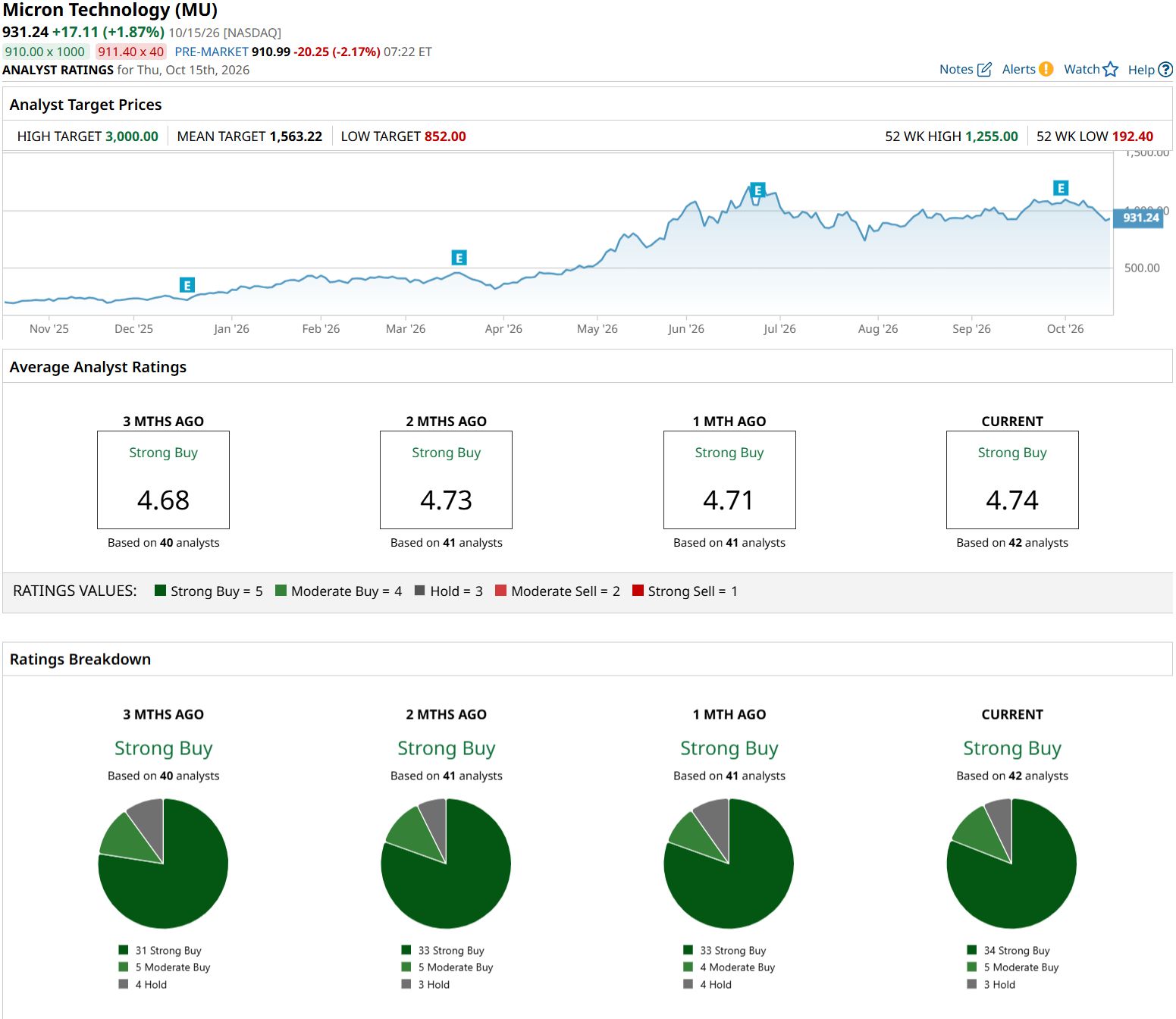
That view is clear in recent analyst calls. On Oct. 7, D.A. Davidson analyst Gil Luria kept a “Buy” rating on MU stock and raised his price target to a Street-high $3,000 from $2,100. Luria expects major cloud companies to keep securing memory supply as demand outpaces capacity through 2028. Baird analyst Tristan Gerra also recently kept an “Outperform” rating and lifted his target to $1,520 from $1,280.
Based on 42 analysts with coverage, MU stock has a consensus “Strong Buy” rating on Wall Street. The average price target of $1,563.22 suggests potential upside of 78% from current levels.
 www.barchart.com
Conclusion
Micron’s Taiwan labor dispute is a real risk worth watching, especially because the company’s local operations are important to its memory-chip supply chain. Still, a strike has not been scheduled, negotiations remain possible, and Micron’s fundamentals continue to point to powerful demand for DRAM and high-bandwidth memory. On balance, MU stock is likely to remain volatile in the near term as investors weigh labor developments and competitive concerns. But if Micron reaches a workable agreement in Taiwan and AI-driven memory demand remains strong, the stock’s longer-term direction still appears tilted higher.
On the date of publication, Ebube Jones did not have (either directly or indirectly) positions in any of the securities mentioned in this article. All information and data in this article is solely for informational purposes. For more information please view the Barchart Disclosure Policy here.
More news from Barchart
Taiwan’s President Called on Micron and Workers to Negotiate Ahead of a Possible Strike. Here’s What to Know. Rocket Lab's Biggest Technological Advantage Is Fast Becoming Its Biggest Problem Venture Global Stock Just Secured a Data Center Win. How to Play It Here. SanDisk Stock Is Caught in the China Chip Selloff. Here’s What Investors Are Missing.