

I asked if lumber prices and seasonality were pushing lumber prices lower in a September 18, 2026, Barchart article, where I concluded with the following:
I favor a scale-down accumulation approach to lumber-related assets over the coming weeks and months, leaving plenty of room to add on further declines. I would avoid lumber futures, as they remain highly illiquid with low open interest and daily volume. I would accumulate WY, WOOD, and/or CUT shares on a scale-down basis to position for higher lumber demand over the coming years.
Join 200K+ Subscribers: Find out why the midday Barchart Brief newsletter is a must-read for thousands daily.
Interest rates and seasonality are pushing lumber and lumber-related assets lower in September 2026, which could be an opportunity for 2027 and beyond.
Nearby CME lumber futures for November delivery traded at $542.50 per 1,000 board feet on September 18, and were lower in October. Lumber futures appear headed for a test of the $500 level as seasonality and interest rates continue to push wood prices lower.
Lumber futures continue to decline
The continuous physical lumber futures contract fell 12.56% in Q3 2026 and 6.34% over the first nine months of 2026. Lumber futures for November 2026 delivery settled at $539.50 per 1,000 board feet on September 30, 2026.
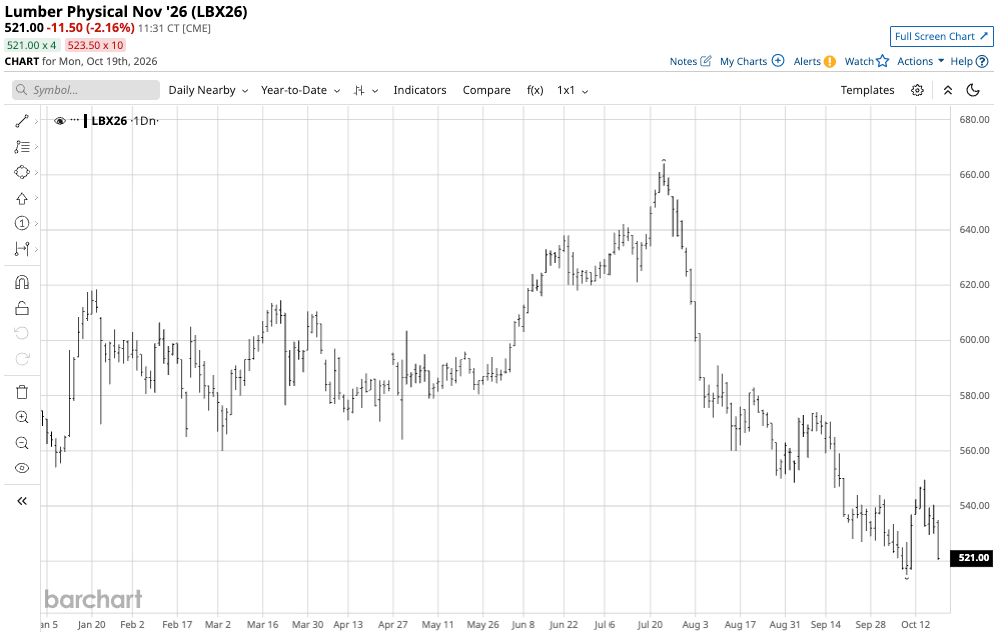
The daily year-to-date physical lumber chart shows prices moved lower in early Q4.
Seasonality is bearish, and policy can impact prices
While many factors affect lumber prices, it is a seasonal commodity: demand tends to rise in spring and summer, when conditions support construction, and decline in fall and winter, when weather curtails construction projects.
Meanwhile, policy decisions can impact lumber prices.
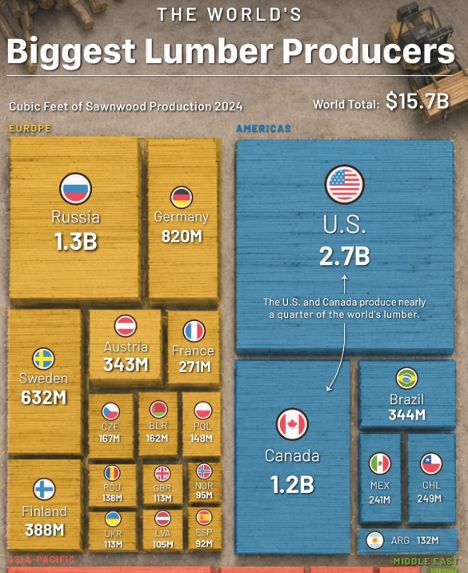 Source: visualcapitalist.com
The chart shows that in 2024, the U.S., China, Russia, and Canada were the leading lumber-producing countries.
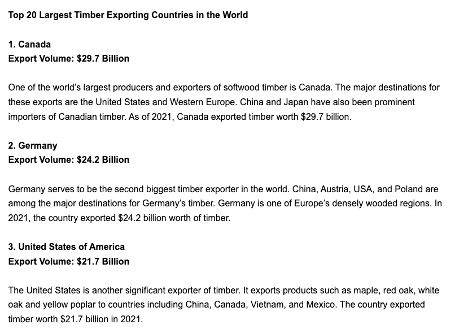 Source: globalwood.org
Meanwhile, Canada is the leading lumber exporter, with the U.S. as a leading destination for Canadian timber. Trade issues between the U.S. and Canada have affected the lumber market in recent months.
Interest rates are very bearish
While seasonality and trade issues are significant factors for the path of least resistance of lumber prices, interest rates drive prices. Lower interest rates that push mortgage rates down increase lumber demand, as it is a critical component of new home building. Conversely, rising interest rates curtail lumber demand as new home construction suffers.
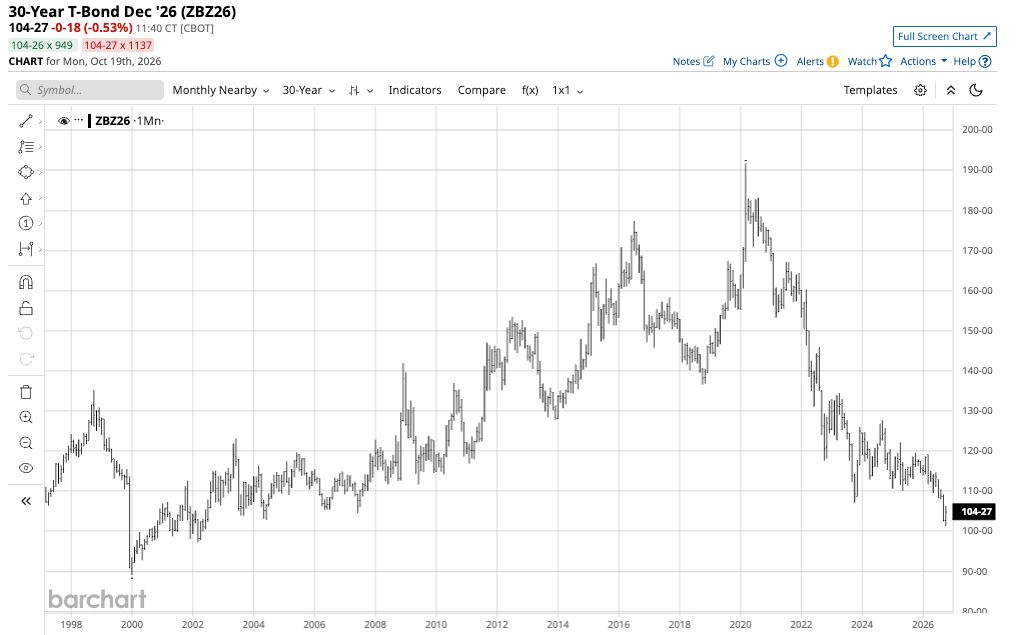
The chart of the 30-year U.S. Government Treasury Bond futures shows that they broke through critical technical support at the October 2023 low of 107-04 in September 2026. Long bond futures fell to a recent low of 101-05 on October 7, the lowest level and highest yield since June 2002. The next technical support is at the March 2002 low of 97-06.
The highest long-term interest rates in over two decades are bearish for lumber, as rising mortgage rates weigh on demand for new home construction. While this factor is bearish in the short term, pent-up demand for housing and new home ownership will eventually lead to the next housing boom when rates decline.
Update on WOOD, CUT, and WY
Lumber prices have declined 4% from $542.50 per 1,000 board feet on September 18, 2026, to $521.00 on October 19, 2026. Over the same period:
WOOD shares moved 6% lower from $70.55 to $66.34 CUT shares moved 4.6% lower from $29.32 to $27.96 WY shares have declined 9.5% from $21.39 to $19.36Lumber-related shares have underperformed lumber futures in recent weeks, likely due to the rising interest-rate environment and a break below technical support in long-term bond futures.
Levels to watch in lumber futures and lumber-related stocks over the coming weeks and months
Technically, lumber futures have broken below their first support level.
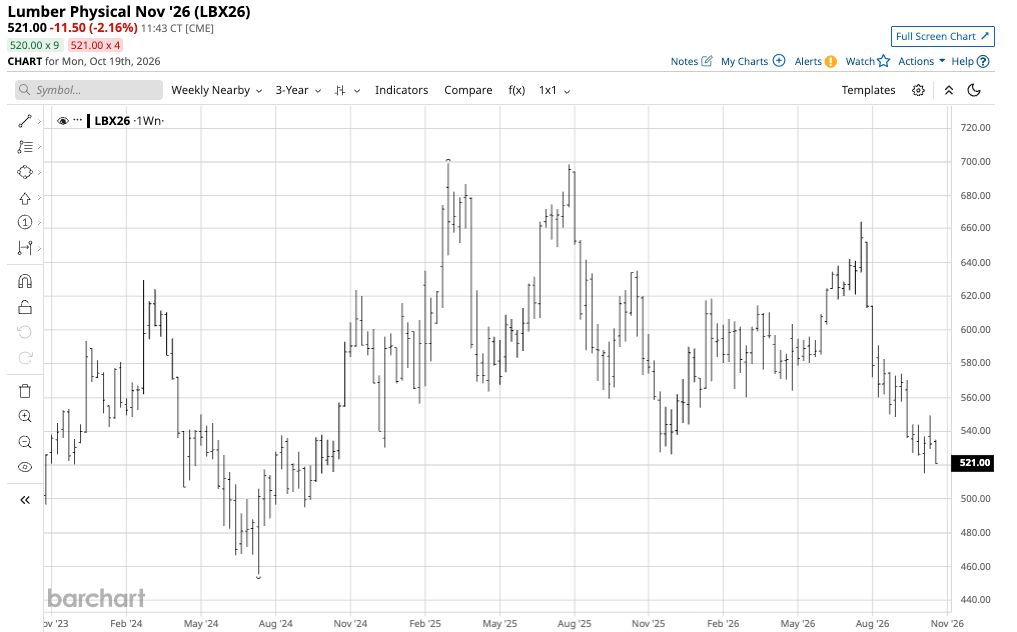
The weekly continuous contract chart shows that technical support was at the early December 2025 low of $526.50 per 1,000 board feet. Lumber futures traded down to $515 on October 5, 2026, with the next downside support levels at the September 2024 low of $495 and the July 2024 low of $455.50 per 1,000 board feet.
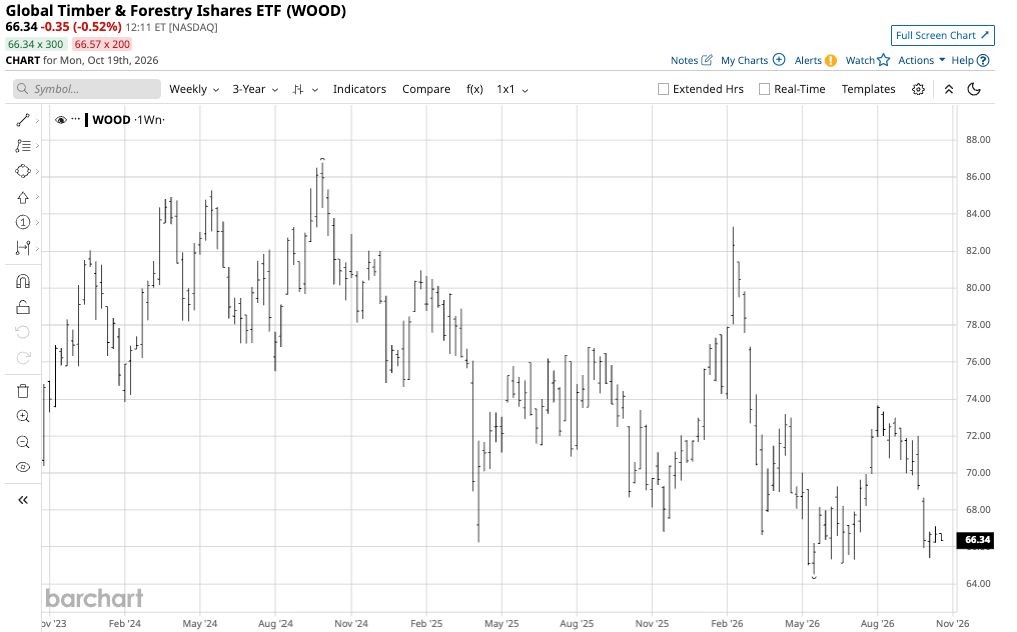
The weekly chart shows WOOD’s technical support is nearby at the May 2026 low of $64.53 per share.
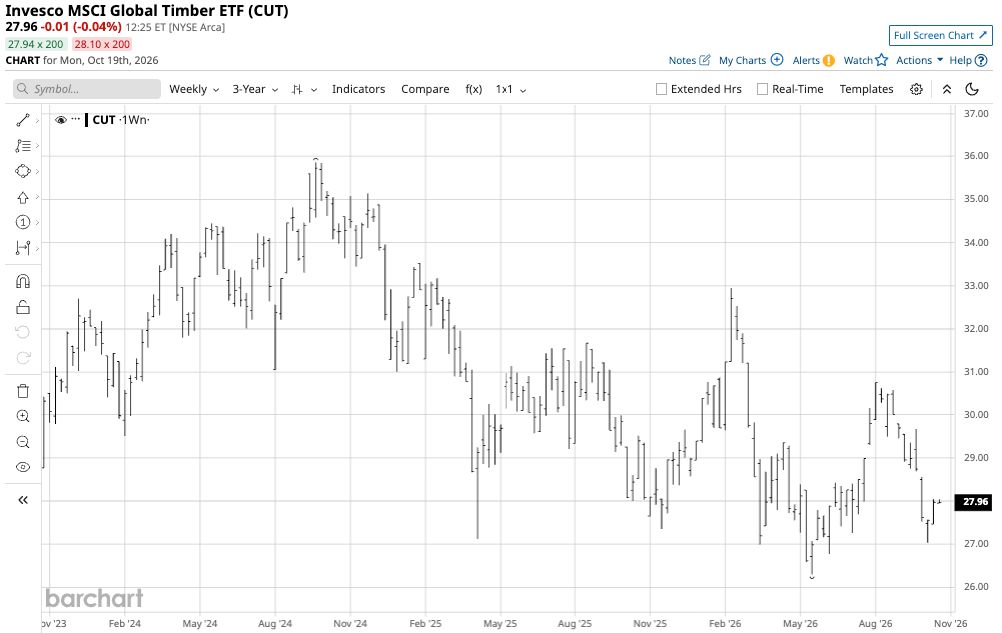
The weekly chart shows that CUT’s technical support is nearby at the May 2026 low of $26.30 per share.
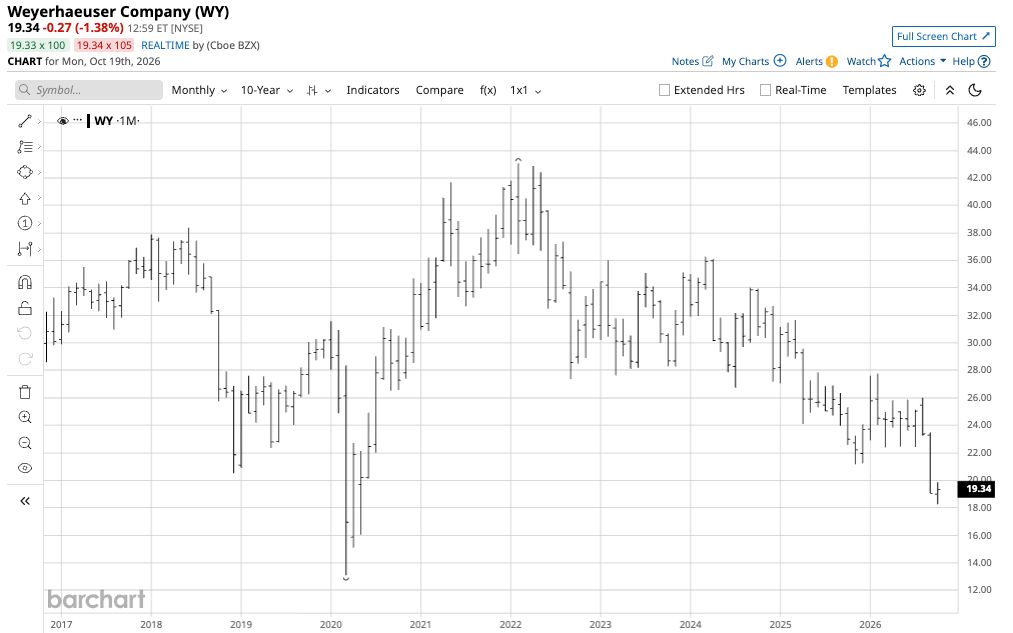
The monthly chart shows that WY’s technical support is at the March 2020 pandemic-inspired low of $13.10 per share.
From a value perspective, WY could be the most attractive investment candidate. At $19.34 per share, Weyerhaeuser Company (WY) had a market cap of over $14 billion. In its most recent earnings report, WY beat consensus forecasts for EPS and revenues. WY pays shareholders a $0.84 per share annual dividend, yielding 4.34%. WY operates as a real estate investment trust in the lumber sector, making it unique. The over 4% dividend lets investors earn an attractive yield while waiting for volatile lumber prices to recover. I recommend a scale-down approach to accumulating WY starting at the current price level.
Lumber can be a highly volatile commodity. While the price is approaching $500 per 1,000 board feet, the old random-length futures contract reached $1,711.20 in May 2021, and a lower high of $1,477.40 in March 2022. Futures fell to a low of $352.50 per 1,000 board feet in January 2023. Lumber is seasonal, and WY, WOOD, and CUT are lumber proxies, with far more liquidity. Seasonality and rising interest rates favor lower prices over the coming weeks and months. However, lower lows could be an accumulation opportunity for WY shares. Stay tuned!
On the date of publication, Andrew Hecht did not have (either directly or indirectly) positions in any of the securities mentioned in this article. All information and data in this article is solely for informational purposes. For more information please view the Barchart Disclosure Policy here.
More news from Barchart
How Low Can Lumber Prices Fall This Winter? Are Interest Rates and Seasonality Pushing Lumber Futures Prices Lower? What are the Prospects for Lumber Prices? West Fraser Timber Stock Charges Ahead as Lumber’s Technical Breakout Gains Steam