


Artificial intelligence (AI) has fueled one of the largest infrastructure spending booms in history, but Wall Street is beginning to question how the bill gets paid. Billions of dollars in borrowing have financed data centers, advanced semiconductors, and the electricity infrastructure needed to power them. Now, stubborn inflation and rising interest rates threaten to make those investments more expensive. Investors who once rewarded companies for spending aggressively are increasingly demanding evidence that their investments will pay off.
The change has been especially punishing for neocloud companies whose business models depend on borrowing heavily today against the promise of future AI revenue. CoreWeave (CRWV) has become the poster child for those fears. Yet one top tech investor believes Wall Street may be misunderstanding the company's debt.
More Top Stocks Daily: Go behind Wall Street’s hottest headlines with Barchart’s Active Investor newsletter.
 www.barchart.com
CoreWeave's $50 Billion Debt Contagion
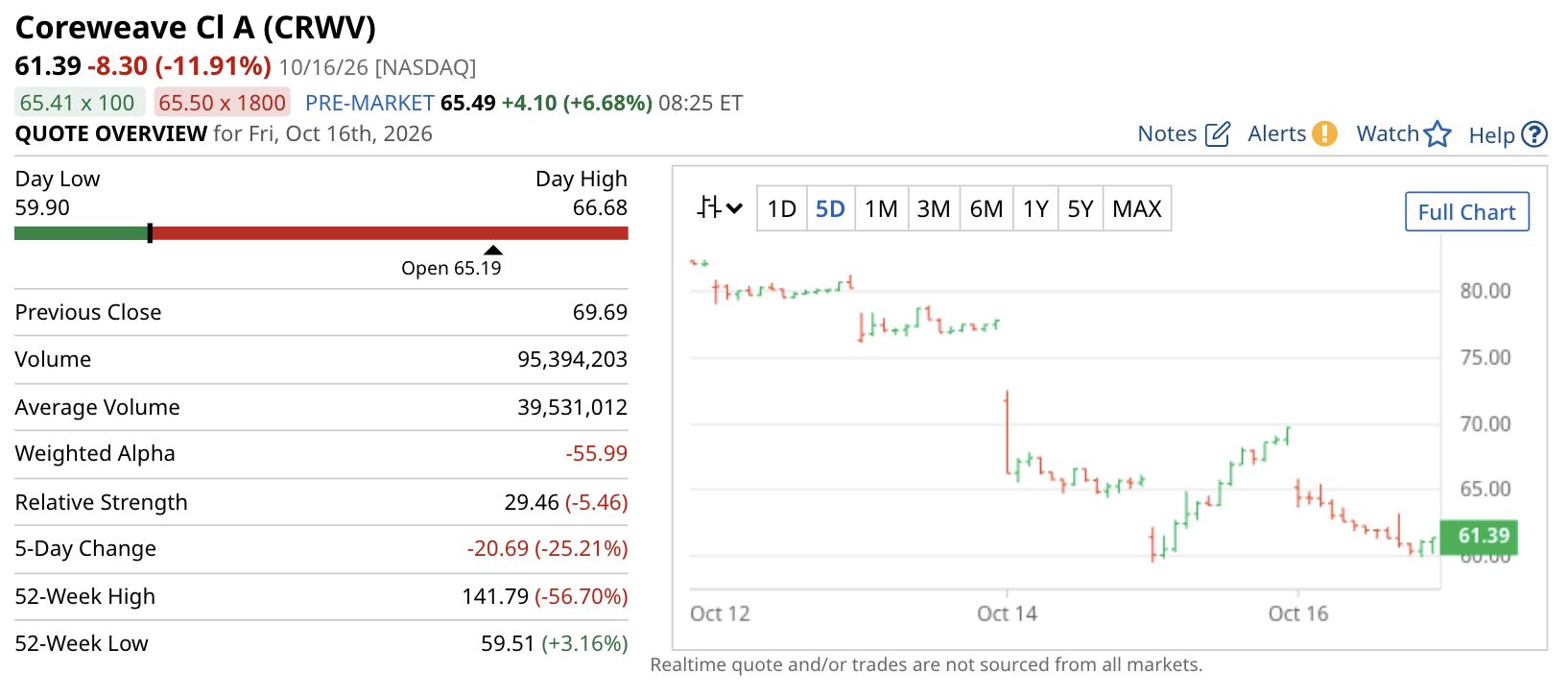
CoreWeave shares plunged approximately 25% last week as investors questioned whether its debt-financed expansion could survive higher borrowing costs. The selloff followed September's hotter-than-expected inflation report, which revived expectations of another Federal Reserve interest rate hike.
As debt-laden neocloud stocks tumbled, the selling spread beyond CoreWeave shares. On Oct. 14 alone, Nebius Group (NBIS) fell 10%, Applied Digital (APLD) declined 9%, and IREN (IREN) lost 12%.
The bigger warning came from the bond market. CoreWeave's bonds, originally issued at yields around 9.7%, saw their yields climb to approximately 15% as prices collapsed. The cost of insuring its debt against default also approached 1,200 basis points.
According to Reuters, CoreWeave carries approximately $50 billion in debt and has accumulated more than $104 billion in contracted revenue backlog. That's an enormous amount of business waiting to be delivered. Unfortunately, contractual revenue commitments aren't the same as cash sitting in the bank. CoreWeave must still build the infrastructure, deliver computing capacity, and generate enough cash to service its obligations.
The market fears problems at CoreWeave could spread throughout the AI financing ecosystem, making lenders reluctant to finance competitors with similarly aggressive expansion plans.
AI Investor Says Wall Street Has the Debt Math Wrong
Altimeter Capital founder Brad Gerstner — an early CoreWeave investor — offered a different interpretation during an Oct. 15 appearance on CNBC's “Halftime Report.” He argued that much of the commentary surrounding CoreWeave's financial condition misunderstands how its borrowing works. Specifically, Gerstner explained that the widely reported 15% bond yield applies to the market pricing of approximately 20% of CoreWeave's debt.
The company continues paying approximately 9% on that existing borrowing. The remaining 80%, according to Gerstner, consists of relatively inexpensive GPU-backed financing. That debt is secured by the graphics processing units CoreWeave purchases to fulfill customer contracts.
The distinction is important financially. A bond trading at a 15% yield doesn't automatically mean the company must begin paying 15% interest on its entire debt portfolio. Its financing costs rise when it refinances existing obligations or takes on new borrowing.
Gerstner also praised CoreWeave's management and the firm's partnerships with Nvidia (NVDA), suggesting the company could emerge as one of the industry's long-term winners.
Surprisingly, Gerstner acknowledged he no longer owns CRWV stock. He exited while reducing his broader AI exposure, reallocating capital into Meta Platforms (META) and Tesla (TSLA). Nevertheless, he sees potential opportunities in CoreWeave's equity and debt at current valuations.
Strong AI Demand Doesn't Eliminate Financing Risk
CoreWeave's enormous backlog provides a powerful argument against predictions of an imminent collapse.
Its growing commercial relationships also reinforce the demand picture. Meta, for example, expanded its commitments to CoreWeave by another $21 billion earlier this year, demonstrating how Big Tech's AI infrastructure spending continues expanding.
Yet the company's profitability remains problematic. According to Reuters, CoreWeave generated $5.1 billion in revenue during 2025 while reporting a $1.2 billion net loss. Despite its operating momentum, CoreWeave's earnings have repeatedly failed to ease investor concerns about borrowing, profitability, and shareholder dilution.
Granted, GPU-backed financing gives lenders collateral, while multiyear customer contracts improve revenue visibility. Neither eliminates refinancing risk, equipment depreciation, or the possibility that future returns disappoint.
Gerstner's argument helps explain why existing financing arrangements may be healthier than recent bond prices suggest. It doesn't guarantee the company's next financing round will be equally attractive.
Bottom Line
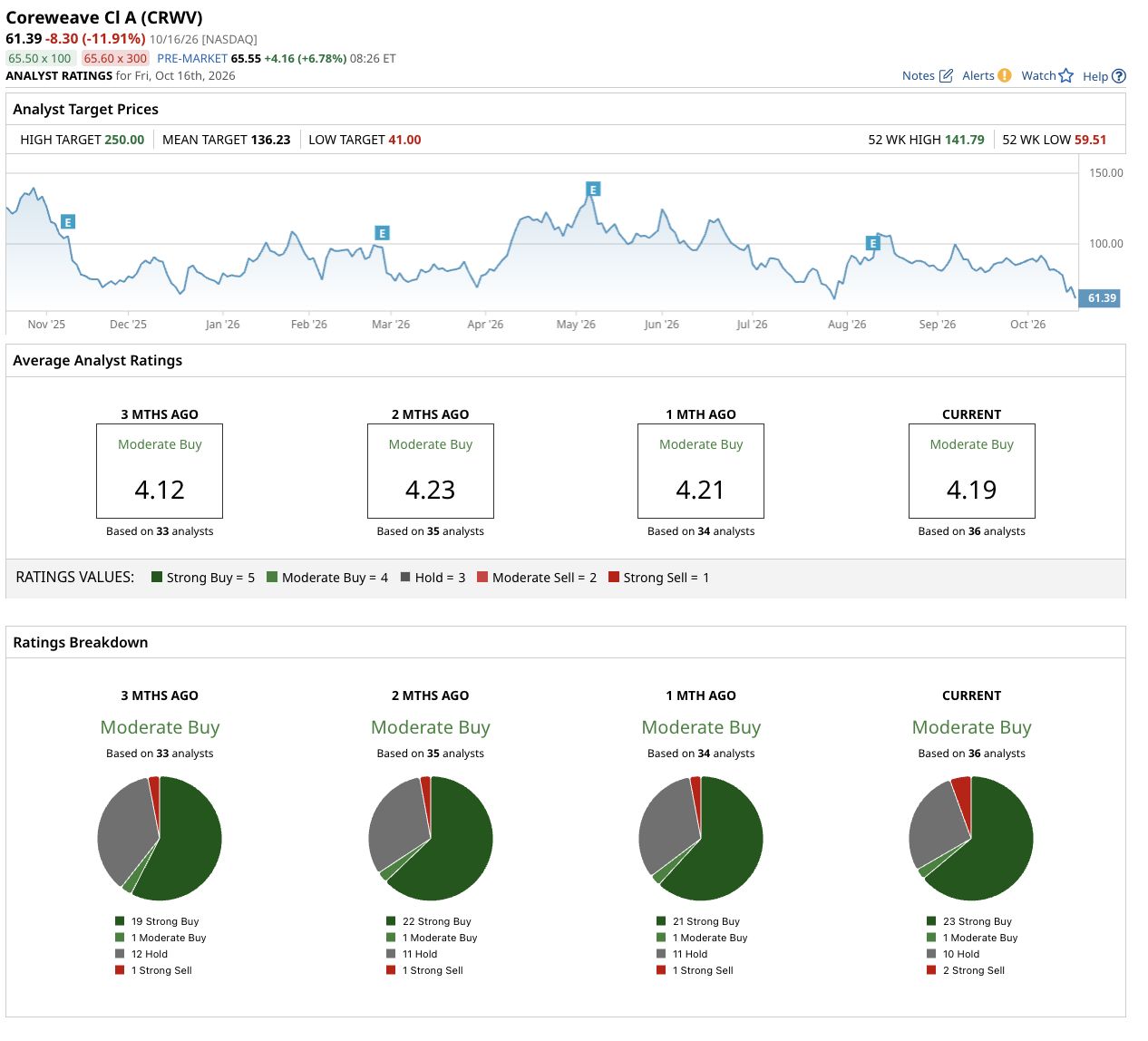
In short, CoreWeave's financial position may be stronger than its collapsing bond prices imply, and Gerstner makes a persuasive argument that investors are overlooking the structure of its debt. Still, investors shouldn't confuse a potentially mispriced bond with a bargain stock.
CoreWeave's $104 billion backlog gives it a path toward growing revenue, but its roughly $50 billion debt burden leaves little room for execution problems.
For investors comfortable with volatility, the selloff deserves attention. More cautious investors should wait for improving cash flow and evidence that CoreWeave can continue funding expansion without materially increasing its borrowing costs. A Big Tech investor who sold all his shares but tells you to buy them isn't exactly a comfortable trade.
The AI boom isn't necessarily ending. Wall Street is becoming more selective about who gets to finance it.
 www.barchart.com
On the date of publication, Rich Duprey did not have (either directly or indirectly) positions in any of the securities mentioned in this article. All information and data in this article is solely for informational purposes. For more information please view the Barchart Disclosure Policy here.
More news from Barchart
CoreWeave’s Debt Sparks AI Contagion Fears, But This Top Tech Investor Says Investors Are Missing Something Oracle Stock Is Falling as AI Spending Worries Mount. Most Analysts Think ORCL Could Rebound. What to Expect from SoFi’s Q3 Earnings Tesla’s Flying Car Isn’t the Game Changer Investors May Believe It Is